Navigating a Texas child support case without expert legal counsel is a significant risk. The system is governed by a detailed set of rules within the Texas Family Code, and a minor error can lead to long-term financial consequences. This is why retaining an experienced Texas child support lawyer is not just advisable; it's essential for a fair outcome.
An attorney does more than fill out forms; they construct a legal strategy designed to ensure the final order is equitable and serves your child's best interest.
Your Strategic Guide Through Texas Child Support
Consider your lawyer your personal navigator through the complex legal landscape, armed with a map of the system and knowledge of its potential pitfalls. Their primary role is to translate the dense legal language of the Texas Family Code into a clear, actionable plan.
The foundation of Texas child support is a formulaic approach. Under Texas Family Code § 154.125, the guidelines apply a percentage to the paying parent's (the "obligor's") net monthly resources, but only up to a statutory cap. For any case filed after September 1, 2025, that cap is $11,700 per month.
Texas Guideline Child Support Percentages (Effective Sept. 1, 2025)
The table below outlines the standard percentages a court uses to establish a baseline child support obligation. This is the starting point for nearly every child support order.
| Number of Children Before the Court | Percentage of Net Resources | Maximum Guideline Monthly Support |
|---|---|---|
| 1 | 20% | $2,340 |
| 2 | 25% | $2,925 |
| 3 | 30% | $3,510 |
| 4 | 35% | $4,095 |
| 5 or more | At least 40% | $4,680+ |
However, the calculation is not merely about applying a percentage. An attorney's true value lies in ensuring the guidelines are applied correctly and justly. They will meticulously verify the other parent's income, uncover any hidden financial resources, and argue for a deviation from the guidelines when the facts and law support it.
The court's primary duty, as mandated by Texas Family Code §154.123, is to render an order that is in the "best interest of the child." Your attorney’s mission is to gather and present compelling evidence demonstrating how the support amount you seek aligns with this critical standard.
Whether you are establishing an initial order, seeking a modification due to a change in circumstances, or enforcing overdue payments, your lawyer serves as your advocate. They manage deadlines, court appearances, and difficult communications, allowing you to focus on your family. To see how we manage these matters with care, you can explore our comprehensive approach to family law. Ultimately, a proficient lawyer ensures every action taken is legally sound and focused on securing your child’s well-being.
How Texas Calculates Child Support
To achieve a fair child support outcome, you must understand how a Texas court calculates the obligation. The process follows a specific formula detailed in the Texas Family Code. Achieving an accurate result requires careful attention to detail, which is why a skilled child support lawyer is invaluable. They ensure your financial reality is presented accurately from the outset.
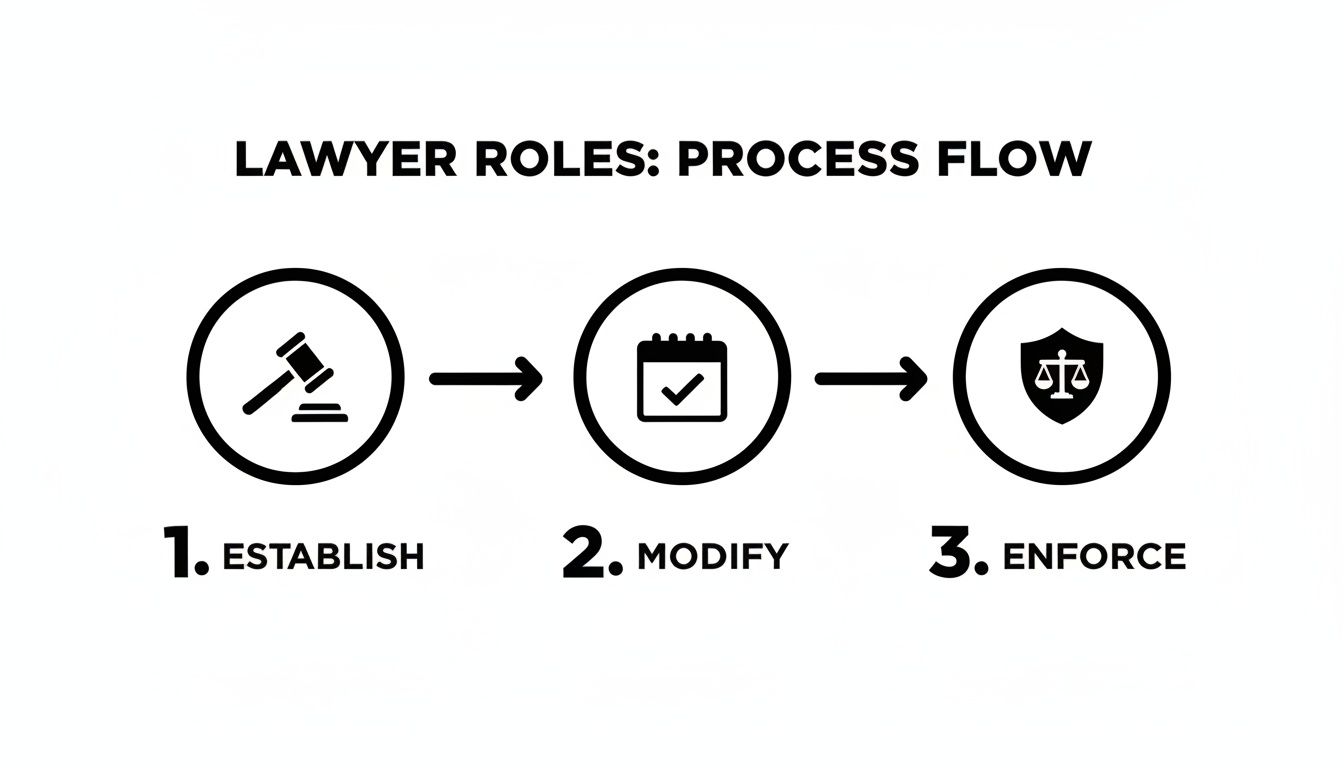
Think of your attorney as a strategic guide. They are there to establish the initial order, help you modify it when life circumstances change, and step in to enforce it if payments stop.
Defining Net Monthly Resources
The entire child support calculation hinges on a single figure: net monthly resources. This is not merely take-home pay. As defined in Texas Family Code § 154.062, it encompasses all financial resources available.
This includes:
- All wage and salary income, covering commissions, overtime, tips, and bonuses.
- Self-employment income, which is gross revenue minus ordinary and necessary business expenses.
- Investment income from sources like interest, dividends, and royalties.
- Other income, such as rental income, retirement benefits, trust distributions, and social security benefits.
From this gross figure, the court deducts only a few specific items: federal income taxes (for a single person claiming one exemption), Social Security and Medicare taxes, union dues, and the amount paid for the child’s health insurance. The remaining amount is the net monthly resource figure that dictates the support calculation.
Applying the Guideline Percentages
Once net monthly resources are determined, the court applies a set percentage based on the number of children. This is the core of the guideline formula.
However, there is a statutory cap. Under Texas Family Code §154.125, these percentages apply only up to a certain income level. To account for inflation, this cap is re-evaluated every six years. The update effective September 1, 2025, raised the cap from $9,200 to $11,700 in net monthly resources.
This adjustment reflects the rising cost of living across Texas. As a direct result, the maximum guideline payments have increased. For one child, the new maximum guideline amount is $2,340 per month—a $500 increase.
Practical Calculation Examples
Let's illustrate with two real-world scenarios.
Scenario 1: Income Below the Cap
An obligor in Fort Worth has two children and $8,000 in net monthly resources. Since this is below the $11,700 cap, the calculation is direct:
- Guideline Percentage: For two children, the guideline is 25%.
- Calculation: $8,000 x 0.25 = $2,000.
- Result: The guideline child support obligation is $2,000 per month.
Scenario 2: Income Above the Cap
A Dallas-based obligor has three children and $15,000 in net monthly resources. Their income exceeds the cap, so the calculation changes:
- Guideline Percentage: For three children, the guideline is 30%.
- Calculation on the Cap: $11,700 x 0.30 = $3,510.
- Result: The baseline guideline support is $3,510 per month.
A judge can order support above this baseline amount if the child has proven needs that justify it, but this serves as the starting point. This is why the initial net resources calculation is so critical. An experienced lawyer will scrutinize every financial document to ensure all income is counted and only legally permissible deductions are taken.
For a complete breakdown of the initial steps, you can dive into our guide on how to file for child support in Texas.
Child Support for High-Income Parents
Texas child support is not always a simple formula, particularly when a parent's income is substantial. The standard guidelines have a ceiling, but a child’s needs and accustomed lifestyle do not.
As of September 1, 2025, the net monthly resources cap increases to $11,700. This was a significant 27% jump that immediately impacted high-income families. The familiar percentages—20% for one child, 25% for two—are now applied to this higher amount. For one child, this means the maximum guideline support rose from $1,840 to $2,340 per month. You can learn more about how these new 2026 child support laws work and what it means for your payments.
Many parents earn far more than $11,700 a month. In these cases, Texas Family Code §154.123 empowers judges to order child support above the guideline maximum, but only if the requesting parent demonstrates the child has proven needs that justify a higher amount.
What Are "Proven Needs"?
This is the pivotal question. A "proven need" is not a luxury; it is a specific, quantifiable expense that is part of the child's established lifestyle and necessary for their well-being. The court will not order more support simply because a parent can afford to pay it. The focus is on meeting the child's best interests.
A "proven need" must be documented and tied to the child's established standard of living. The burden of proof rests entirely on the parent requesting the additional support.
Common examples of proven needs in high-income cases include:
- Private school tuition and related expenses like uniforms, books, and educational trips.
- Competitive sports leagues that involve travel, specialized coaching, and expensive equipment.
- Specialized tutoring or therapy for medical conditions or learning differences.
- Extracurricular activities like advanced music lessons, art classes, or immersive summer camps.
- High-cost medical and dental care, such as orthodontics not fully covered by insurance.
A skilled attorney will not just present a list of expenses. They will build a compelling case backed by evidence for each need.
Building a Case for Above-Guideline Support
To persuade a judge to exceed the guidelines, your lawyer must present a meticulously prepared case. This requires documentation, strategy, and a clear understanding of judicial requirements.
A Common Scenario:
Imagine a Houston-based surgeon with two children and net monthly resources of $25,000. The maximum guideline support is $2,925 (25% of the $11,700 cap). However, the children have always attended a private school costing $2,000 per month, and one child requires ongoing therapy for a learning disability at a cost of $800 per month.
An experienced child support attorney would immediately begin assembling proof:
- Detailed Expense Report: We create a spreadsheet documenting every child-related expense, supported by school invoices, receipts for activities, and statements from therapy providers.
- Expert Testimony: We might retain an educational psychologist to testify why the specific school or therapy is essential for the child’s development and well-being.
- Financial Documentation: We use discovery to obtain pay stubs, tax returns, and bank statements from both parents to paint a clear picture of the family's lifestyle and the paying parent's ability to continue funding it.
The objective is to weave this evidence into a coherent narrative that demonstrates to the judge why the standard guideline amount is insufficient to serve the child's best interests, as required by Texas Family Code §154.123. This proactive, evidence-based approach is what secures a fair child support order.
A Step-by-Step Look at the Child Support Legal Process

The child support legal process can seem daunting, but it becomes manageable when you understand the procedural steps. The system follows a specific path designed to gather all necessary facts. Knowing what to expect allows you to prepare effectively with your attorney.
Let's review the procedural steps, from filing the initial pleading to obtaining a final order.
Step 1: Filing the Petition and Service of Process
Every case begins with a Petition. This is the formal legal document that initiates the case with the court. In a divorce, child support is addressed within the Original Petition for Divorce. For unmarried parents, a Suit Affecting the Parent-Child Relationship (SAPCR) is filed.
After the petition is filed, the other parent must be formally notified. This is a constitutional requirement known as service of process. A neutral third party, such as a sheriff's deputy or a private process server, must personally deliver the lawsuit documents to the other parent. This action confers jurisdiction on the court and officially starts the legal timeline.
Step 2: The Discovery Phase: Uncovering Financial Facts
Once service is complete, the case enters the discovery phase. This is where cases are often won or lost. It is the formal legal process for exchanging information and evidence needed to prove income and financial resources.
As your attorney, I utilize several legal tools to obtain a complete and honest financial picture:
- Requests for Production: We serve formal demands for specific documents, including tax returns, pay stubs, complete bank statements, and business records.
- Interrogatories: These are written questions that the other parent must answer under oath.
- Depositions: This is out-of-court testimony where I question the other parent directly, under oath, while a court reporter transcribes every word.
An experienced lawyer knows how to analyze financial documents to identify hidden income, verify earnings, and build the factual foundation necessary for negotiations or trial.
Step 3: Negotiation and Court: Mediation and Hearings
Before a final trial, most Texas family courts require parties to attend mediation. This is a confidential meeting where a neutral third-party mediator facilitates settlement negotiations. If an agreement is reached, it is documented in a Mediated Settlement Agreement, which, once signed by a judge, becomes a final, binding court order.
If mediation is unsuccessful, the case is set for a hearing or trial. At this stage, your attorney presents all gathered evidence, makes legal arguments, and examines witnesses. The judge then makes a final ruling and signs the child support order.
Step 4: When Life Changes: Modifying a Child Support Order
Child support orders are not permanent. However, to change an order, you must meet a specific legal standard. Under Texas Family Code §156.401, you must prove that a "material and substantial change" in circumstances has occurred since the date the last order was signed.
A "material and substantial change" is the legal threshold for a modification. It must be a significant, provable event that renders the current support amount unfair or improper.
Common examples that meet this standard include:
- The involuntary loss of a job or a significant promotion with a pay increase.
- A change in the child's needs, such as a new medical diagnosis requiring expensive care.
- A change in the possession schedule where the child's primary residence changes.
The modification process mirrors that of an initial case. Your lawyer files a Petition to Modify, serves the other parent, and proceeds through discovery to prove that a material and substantial change has occurred.
Enforcing Child Support When Payments Don't Arrive

A Texas child support order is a direct, legally binding command from a judge. When a parent fails to pay, they are violating a court order. As a Texas child support attorney, my role is to use the powerful enforcement tools within the Texas Family Code to collect the financial support your child is owed.
Non-payment is a common problem. While a high percentage of custodial parents obtain a child support order, compliance is often inconsistent. This gap leaves children without essential resources, making effective legal enforcement critical.
The Most Powerful Enforcement Tools
When payments cease, you are not powerless. Texas law provides several potent legal methods to compel payment. We initiate this process by filing a Petition for Enforcement, a specific lawsuit asking the court to hold the non-paying parent accountable.
These are the most effective remedies we can pursue:
- Wage Withholding Order: This is our primary and most reliable tool. We obtain an order sent directly to the obligor’s employer, legally requiring them to deduct child support from each paycheck.
- Property Liens: We can place a legal claim, or lien, on the obligor's non-exempt property, such as a second home, land, or other valuable assets. This lien prevents the sale or refinancing of the asset until the child support debt is paid.
- Bank Account Levies: In certain situations, a judge can authorize the seizure of funds directly from the non-paying parent's bank accounts to satisfy the overdue support.
Holding a Non-Paying Parent Accountable
Beyond seizing assets, courts have other methods to increase pressure on a delinquent parent.
A primary goal in an enforcement case is to obtain a judgment for all unpaid child support, known as arrearages, plus statutory interest. This ensures you can collect not just what was originally owed, but also compensation for the delay.
For continued non-payment, we can ask the judge to take actions with serious personal and professional consequences, such as suspending various licenses.
License Suspensions a Judge Can Order:
- Driver’s License: A suspension makes it illegal for the parent to operate a motor vehicle.
- Professional Licenses: This can impact licenses for doctors, lawyers, electricians, or real estate agents, preventing them from working in their profession.
- Recreational Licenses: The court can even suspend hunting and fishing licenses.
Finally, for willful and repeated violations, a judge can find the non-paying parent in contempt of court. This is the most severe consequence, potentially resulting in fines and jail time for each violation. A proficient lawyer knows how to present the evidence of non-payment to build a powerful case for enforcement. For an even deeper dive into this process, check out our guide on how to collect back child support.
FAQ: Common Texas Child Support Questions
When navigating child support in Texas, questions are inevitable. The system is complex, and every family's situation is unique. Here are authoritative answers to some of the most common questions we encounter.
How does a 50/50 possession schedule affect child support?
A common misconception is that a 50/50 possession schedule eliminates the need for child support. In Texas, this is incorrect. The court's primary focus remains the child's best interest and ensuring their needs are met consistently in both homes.
Even with equal possession time, a judge will calculate the guideline child support obligation for each parent. Typically, the higher-earning parent will be ordered to pay an "offset" amount to the lower-earning parent. This payment represents the difference between their respective obligations and helps equalize the financial resources available to the child in each household. An attorney can argue for adjustments based on which parent covers major expenses like health insurance, further ensuring a fair outcome.
Can I get retroactive child support?
Yes. If a formal child support order was never in place, Texas law permits the court to order retroactive support. A judge can order the non-custodial parent to pay support dating back to the time of the parents' separation.
Under Texas Family Code § 154.009, there is a statutory presumption that ordering support for the preceding four years is reasonable and in the child’s best interest. The primary challenge is proving the other parent's income during that period. A skilled attorney uses formal discovery tools—such as subpoenas for tax returns, pay stubs, and bank records—to reconstruct the financial history and build a strong case for recovering the back support your child is owed.
What if the other parent is self-employed or hides income?
This is one of the most challenging scenarios in child support litigation. When a parent is self-employed, works for cash, or is intentionally underemployed, retaining an experienced lawyer is essential. We are familiar with the tactics used to hide or minimize income.
Through the discovery process, we issue subpoenas for business and personal bank records, credit card statements, and loan applications to demonstrate the parent's true financial lifestyle to the court. If we can prove a parent is intentionally underemployed or unemployed, Texas Family Code § 154.067 authorizes a judge to calculate child support based on their proven earning potential, not their reported income.
What exactly does "net resources" include?
"Net resources," as defined in Texas Family Code § 154.062, is the starting point for every child support calculation. The definition is intentionally broad and includes virtually all money received from any source.
- Earned Income: Wages, tips, overtime, commissions, and bonuses.
- Self-Employment Income: Gross revenue from a business minus ordinary and necessary business expenses.
- Passive/Investment Income: Interest, dividends, and royalty income.
- Other Sources: Rental income, retirement benefits, trust distributions, Social Security benefits, and unemployment benefits.
From this gross total, the court permits only a few specific deductions: Social Security taxes, federal income tax (calculated for a single person with one exemption), union dues, and the amount paid for the child's health insurance. An attorney’s meticulous review of this calculation is critical, as a small error can result in a significant financial impact over the life of the order.
Answering these questions on your own can be daunting. You need a strategic partner who lives and breathes Texas family law. At the Law Office of Bryan Fagan, PLLC, our entire focus is on helping parents secure fair and enforceable child support orders. If you're dealing with a child support matter in Texas, contact us today for a consultation and learn how we can help protect your child’s financial future.