When parents separate, one of the biggest questions is always about money: How will the kids be supported financially? In Texas, the answer comes in the form of a court-ordered child support payment, which is money one parent pays to the other to help cover a child's living expenses.
The law sees this differently than many parents do. In Texas, child support isn't a reward or a punishment. It’s considered a fundamental right of the child, and the entire system is built to make sure they receive consistent financial support.
Understanding Your Child Support Payment in Texas
Figuring out child support can seem complicated, but Texas law actually lays out a straightforward path. The system is designed for predictability, using a standard formula to determine who pays and how much. It's also completely gender-neutral—either parent can be ordered to pay support, depending on the custody arrangement and their income.
At the heart of it all is what we call "guideline child support." Think of it as the state's standard playbook. The court uses a formula based on a percentage of the paying parent's income, which brings a welcome dose of consistency to cases across Texas.
Key Concepts to Know
Before you ever step into a courtroom, you need to get comfortable with a few key terms. These concepts are the building blocks of every child support case in Texas.
- Guideline Calculations: This is the basic formula. The court takes the paying parent’s net monthly income and applies a specific percentage to it, as outlined in the Texas Family Code. That percentage goes up depending on how many children the parent is responsible for supporting.
- Net Resources Income Cap: The law doesn't apply the guideline percentages to an unlimited amount of income. There’s a ceiling, and as of September 1, 2025, that cap is $11,700 in net monthly resources. This is a critical number for anyone with a higher income, as it directly shapes the final support amount.
- State Disbursement Unit (SDU): This is the central hub for all child support payments in Texas. To ensure everything is tracked accurately, nearly all payments are automatically withheld from the paying parent's wages and sent through the SDU before being passed on to the receiving parent.
The court's number one priority is making sure the child's needs are met, no matter what's going on between the parents. Every decision is guided by one central question: What is in the child's best interest?
Getting a handle on these core principles—the guideline formula, the income cap, and how payments are processed—is the first real step toward navigating your case. It removes a lot of the anxiety and guesswork, helping you understand what to expect and what financial information you'll need to gather for a fair outcome.
How Texas Calculates Guideline Child Support
When it comes to child support in Texas, courts don't just pick a number out of thin air. The process is surprisingly structured, thanks to a formula laid out in the Texas Family Code. This is designed to create consistency from one courtroom to another, and it all starts with the non-custodial parent's income.
The entire calculation hinges on one key figure: the paying parent's (known as the "obligor") monthly net resources. Think of this as their true take-home pay, but it's a bit more comprehensive than what you see on a typical pay stub.
Step 1: Determine Monthly Net Resources
First, the court has to get a full picture of all the money the obligor has coming in. As defined by Texas Family Code § 154.062, this isn't just their salary. It's a wide-ranging list that includes almost every source of income.
The court will add up everything, including:
- Wages, salaries, commissions, tips, and overtime
- Income from self-employment
- Bonuses
- Rental income
- Retirement benefits, pensions, and annuities
- Social Security and disability benefits (but not Supplemental Security Income or SSI)
- Income from investments, like dividends and interest
Once that gross total is established, the court subtracts a few specific, legally approved deductions. This typically includes federal income taxes (for a single person claiming one exemption), Social Security taxes, union dues, and the cost of health insurance for the child. What’s left over is the monthly net resources—the magic number used for the actual support calculation.
Step 2: Apply the Guideline Percentages
With the net resources figured out, the next step is simple math. The court applies a set percentage based on how many children are included in the support order, as detailed in Texas Family Code § 154.125.
This is where the Texas guidelines really provide predictability. Here is a quick breakdown of how those percentages work.
Texas Guideline Child Support Percentages
| Number of Children | Guideline Support Percentage |
|---|---|
| 1 | 20% |
| 2 | 25% |
| 3 | 30% |
| 4 | 35% |
| 5 | 40% |
| 6+ | At least 40% |
So, for one child, the guideline is 20% of net resources. For two children, it's 25%, and so on. The system is built to be straightforward, ensuring the child's needs are met in a structured way.
This chart helps visualize how the whole system is designed—it's centered on the child's rights and uses a clear framework to make sure payments happen as they should.
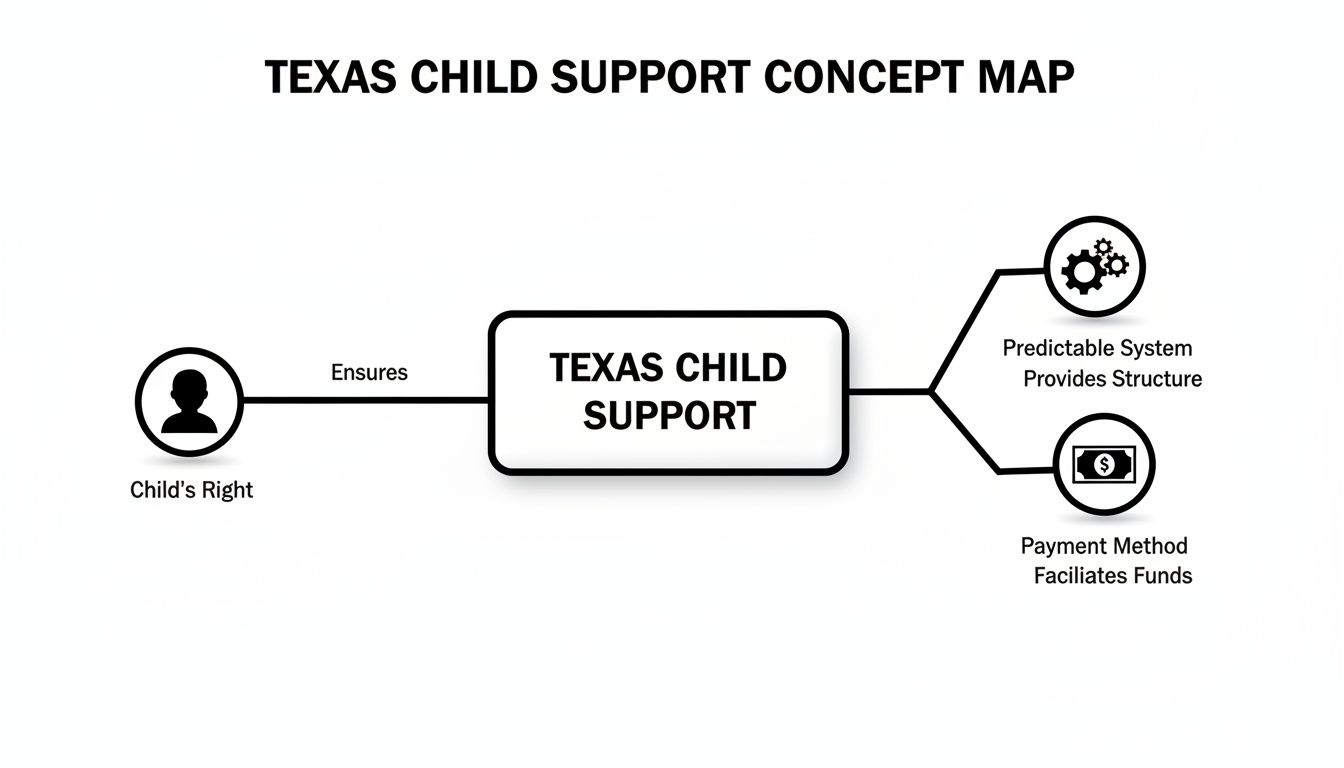
As you can see, the goal is to provide a reliable structure that supports the child first and foremost.
The Role of the Statutory Cap
Now, there’s one major factor that complicates this simple formula: the statutory cap. The guideline percentages we just discussed don't apply to a parent's entire income if they are a high-earner. Instead, the law sets a ceiling.
Effective September 1, 2025, the statutory cap on net monthly resources subject to guideline child support will increase to $11,700. This is a substantial update from the previous $9,200 cap and will significantly affect calculations for higher-income parents.
Think of this cap as the maximum income level the standard formula looks at. If the paying parent’s net resources are below the cap, the percentages apply to their actual income. But if their net resources are above the cap, the calculation is only performed on the $11,700 amount.
Let’s look at a couple of real-world examples to see how this plays out in court.
Example 1: Below the Cap
An obligor has $6,000 in monthly net resources and two children.
- Calculation: $6,000 x 25% (the guideline for two children)
- Guideline Child Support: $1,500 per month
Example 2: Above the Cap
An obligor has $15,000 in monthly net resources and one child.
- Calculation: $11,700 (the cap) x 20% (the guideline for one child)
- Guideline Child Support: $2,340 per month
In that second scenario, the guideline calculation stops at the $11,700 cap, even though the parent earns more. A judge can order additional support above and beyond this amount, but only if there’s proof that the child has needs that justify it—a different and more complex legal argument.
This is why documenting every bit of income and every valid deduction is so important. Understanding how a judge will likely apply these rules helps you know what to expect. If your financial situation is complex, you may want to learn more about how a dedicated Texas child support lawyer can provide strategic guidance.
Support Calculations for High-Income Parents
What happens when a parent earns a significant income? You might assume the standard child support percentages just apply to their entire paycheck, but that’s not quite how it works in Texas. The law actually sets a ceiling on the income used for the basic calculation, but it also gives judges a way to go above that ceiling.
This is all about fairness. The goal is to make sure a child's lifestyle isn't drastically altered just because their parents are no longer together. The court essentially follows a two-step thought process: first, calculate the standard support amount up to the legal cap, and second, decide if the child’s proven needs require more.
The Presumptive Maximum and the New Cap
Texas law establishes a "presumptive maximum" level of child support. Think of this as the baseline amount the court starts with in a high-income case. It’s calculated using the standard percentage on a capped amount of the parent’s income.
Effective September 1, 2025, that income cap is set to increase to $11,700 in net monthly resources. For any new or modified orders after this date, the court will apply the guideline percentages to this new, higher number, even if the paying parent brings home far more.
For example, with one child, the presumptive support payment would be $2,340 per month (20% of $11,700). But for many families, this is just a starting point. The law recognizes that the true cost of raising a child in a high-earning household often goes well beyond this baseline.
Ordering Support Above the Guideline Cap
A Texas judge has the authority to order child support payments that exceed the presumptive maximum. Under Texas Family Code § 154.126, this is possible when the parent asking for more support can show that the "proven needs of the child" justify a higher amount.
This is where the real work begins for your case. You can't just walk into court and say the child needs more money because their other parent is wealthy. You have to back it up with concrete, documented evidence of the child's actual expenses. The burden of proof is on you to demonstrate these needs, and judges will scrutinize the details.
The court doesn't make this decision in a vacuum. It weighs a list of factors found in Texas Family Code § 154.123 to see if deviating from the guideline is truly in the child's best interest.
Key factors include:
- The child’s age and specific needs, like tutoring or medical care.
- The financial ability of both parents to contribute.
- All financial resources available for the child’s support.
- How much time the child lives with each parent.
- The lifestyle and standard of living the child is used to.
- Any extraordinary costs, like private school or competitive sports.
Building Your Case for Above-Guideline Support
In a high-income case, proving a child's "needs" isn't just about food and housing. It’s about documenting the established lifestyle that the child has grown accustomed to, which is a direct result of the parents' financial success.
Real-World Example:
Let’s say the paying parent has $25,000 in net monthly resources for one child. The presumptive, guideline support is capped at $2,340 (20% of the $11,700 cap). The receiving parent believes this isn't enough to cover the child's actual costs and decides to ask for more.
To build a successful argument, they need to present a detailed budget backed by proof. Their evidence might show the child's real monthly expenses look more like this:
- Private School Tuition: $2,000
- Competitive Sports: $800 (for travel, coaching, and gear)
- Specialized Tutoring: $500
- Extracurricular Activities: $300 (music lessons, art classes)
Here, the documented "needs" add up to $3,600 a month. By presenting receipts, invoices, and bank statements, the parent shows the judge that the baseline $2,340 falls short. The judge could then agree that the child's proven needs require an additional $1,260, bringing the total child support in Texas for this family to $3,600 per month. This ensures the final order reflects both the child's best interests and the parents' actual financial capacity.
How Child Support Payments Actually Work in Texas

Once a judge signs the final child support order, the big question is: how does the money actually get from one parent to the other? Texas doesn't leave this to chance. Forget about mailing personal checks or awkward handoffs. The system is built around a default, automated process designed for consistency and reliability.
The go-to method for collecting a child support payment in Texas is the Order/Notice to Withhold Income for Child Support. This is a powerful legal document the court sends straight to the paying parent's (the obligor's) employer. It's not a request—it’s a legal mandate for the employer to deduct the court-ordered child support amount directly from the employee's paycheck. The money comes out before the parent even sees it.
The State Disbursement Unit: Your Official Record Keeper
So, does the employer just send a check to the other parent? Absolutely not. Instead, the employer sends the withheld funds to a central clearinghouse called the Texas State Disbursement Unit (SDU). Think of the SDU as a neutral third party that meticulously tracks every payment. It records the exact date and amount received, then disburses the money to the receiving parent (the obligee).
This setup is brilliant for two reasons:
- Proof and Accountability: It creates an official, undeniable payment history. If a dispute ever arises about whether a payment was made, the SDU's record is the definitive proof.
- Reliability: Automating payments through payroll takes human error out of the equation. There are no forgotten checks or late payments because the paying parent never has to actively send the money themselves.
The results speak for themselves. Texas is a national leader in child support collection, largely because of this wage withholding system. Preliminary data for the 2023 fiscal year shows that wage withholding brought in $3.47 billion of the $4.85 billion in total child support collected. You can explore more data on Texas's successful collection strategies to see just how effective this is.
What About Self-Employed Parents?
Of course, a wage withholding order is useless if the paying parent doesn't have a traditional employer. This is a common scenario for business owners, freelancers, and independent contractors. In these cases, the court order will direct the parent to make the payments themselves.
While necessary for non-traditional earners, this approach puts all the responsibility on the paying parent's shoulders. The court still demands the same on-time consistency, and every single payment must still go through the SDU to count.
The Texas Attorney General's office offers a few ways to make these payments:
- Online: Use a credit card or bank draft through the AG’s Smart e-Pay system.
- Mail: Send a check or money order directly to the SDU.
- In-Person: Use a payment kiosk at a local child support office.
I can't stress this enough: no matter how you pay, it must be processed through the SDU. Any "informal" payments—cash, Venmo, Zelle, or even buying things for the child directly—are considered legal gifts. They will not be credited against your official child support obligation. This is a common and costly mistake that can cause you to fall into arrears, even if you’ve been spending money on your child.
Enforcing Unpaid Child Support in Texas

A Texas child support order isn't just a suggestion—it's a court mandate with real teeth. When a parent starts missing payments, the law provides some very powerful tools to collect the money your child is owed.
Missed payments don't simply vanish. They pile up as arrears, which is the legal term for a past-due child support balance. This isn't just an informal IOU; it becomes a formal judgment against the non-paying parent. To make matters worse for them, statutory interest starts tacking on, causing the total debt to grow over time.
Taking Action: The Enforcement Process
So, how do you get the court to step in? The first procedural step is to file a Petition for Enforcement with the same court that issued the original child support order. This legal document is your official request for help, and it needs to spell out every single missed payment, including the date and the amount.
Once the petition is filed, the other parent must be formally "served" with the paperwork. This is a crucial step that provides them legal notice of the court date and the specific claims against them. At the hearing, you’ll present your evidence—usually, the official payment records from the State Disbursement Unit are all you need to prove the violations.
If the judge agrees that the parent has violated the order, they can bring down some serious consequences to force payment.
The Consequences of Not Paying
Judges in Texas have a wide variety of remedies at their disposal. These aren't just slaps on the wrist; they are designed to have a major impact on the non-paying parent's finances and daily life.
A common myth is that trying to enforce child support is a slow, toothless process. The reality is that Texas courts can act surprisingly fast, and the penalties for being found in contempt can be severe—including jail time.
Here are some of the most common tools a judge can use:
- Wage Garnishment: The court can order the parent's employer to withhold money directly from their paycheck. This can cover both the current monthly support and an extra amount to start chipping away at the arrears.
- Property Liens: A lien can be placed on the parent’s assets, like their house, land, bank accounts, or even retirement funds. This means the child support debt has to be paid off before they can sell or refinance the property.
- License Suspension: This one gets people's attention. A judge can order the suspension of a driver's license, professional licenses (for doctors, lawyers, plumbers, etc.), and even recreational licenses for hunting and fishing.
- Jail Time: For someone who willfully refuses to pay, a judge can find them in contempt of court and sentence them to jail for up to six months for each violation.
These enforcement actions show just how seriously the legal system takes a child's right to financial support. If you're dealing with a parent who refuses to pay, you have strong legal options. You can learn more about what happens if child support is not paid in our in-depth guide.
How to Modify Your Child Support Order
Life is always changing. A child support order that seemed fair and reasonable a couple of years ago might not make sense for your family's situation today. Thankfully, Texas law gets this. It provides a clear path for updating—or "modifying"—an existing child support order to match major life changes.
But you can't just ask a judge to change the order on a whim. The law has specific standards you have to meet. The whole process kicks off when you file a Petition to Modify the Parent-Child Relationship with the same court that handled your original order.
The Material and Substantial Change Standard
To get a modification, you must prove there's been a material and substantial change in circumstances for either one of the parents or the child since the last order was signed. This is the legal cornerstone for any modification case, and it comes directly from the Texas Family Code.
So, what does "material and substantial" actually mean? It’s more than a small dip in pay or a new, minor expense. The change has to be significant, and often, it needs to be something that isn't just temporary.
Common real-world examples that usually meet this standard include:
- Involuntary Job Loss: A parent gets laid off and has no choice but to take a job that pays significantly less.
- Significant Promotion or Raise: The parent paying support gets a major salary bump, which could easily justify a higher support payment.
- Change in Custody: The child now lives primarily with the parent who was originally paying support, completely flipping the script on who pays and who receives.
- New Needs for the Child: A child develops a medical condition that requires expensive, ongoing care, or needs special tutoring that wasn't a factor before.
Keep in mind, a voluntary change usually won't cut it. For example, quitting a great-paying job to start a risky new business probably won't convince a judge to lower your support payments. In those cases, courts often look at a parent's earning potential, not just what they're actually making at the moment.
The Three-Year Review Rule
Besides proving a major life event, Texas law gives you another way to ask for a review. Under Texas Family Code § 156.401, you can request a modification if it's been at least three years since your order was last put in place or changed.
The rule is simple: if it's been three years, and the current child support guidelines would result in a monthly payment that's different from your current order by either 20% or $100, the court can adjust the order.
This is a big deal right now. With the state's net resource cap set to increase to $11,700 on September 1, 2025, many parents whose orders are based on the old cap may find they automatically qualify for a review.
Example: The Three-Year Rule in Action
- Let's say a support order for one child was finalized in 2022. The paying parent's income was capped at the old $9,200 limit, making the monthly payment $1,840 (20% of $9,200).
- Fast forward to 2026. That parent's income is still above the new $11,700 cap. A new calculation would set support at $2,340 (20% of $11,700).
- The difference between the old order ($1,840) and the new guideline amount ($2,340) is $500. That's way over both the $100 and 20% thresholds, giving the receiving parent clear grounds to file for an upward modification.
Understanding these two paths is the key to successfully navigating a child support modification in Texas. If you want to dive deeper into the legal specifics, you can check out our guide on the Texas Family Code for child support. Just remember, knowing the rules is only half the battle—the actual steps of filing the petition, serving the other parent, and presenting your case are just as crucial.
Frequently Asked Questions About Texas Child Support
When you're dealing with child support, a lot of specific, real-world questions come up. These are some of the most common issues we see in our practice, and understanding the answers is the first step to handling your case with confidence.
Does a 50/50 Possession Schedule Eliminate Child Support?
This is probably the single most common question we get, and the answer surprises many parents: no, it does not automatically cancel out child support.
Even with a true 50/50 possession schedule, a Texas court still runs the numbers based on the standard child support guidelines. If there's a significant gap in what you and the other parent earn, the higher earner will almost certainly be ordered to pay support. The court's goal is to ensure the child has a consistent standard of living in both homes. It’s less about equal time and more about equalizing the financial support available to the child, no matter whose roof they're under that night.
Can I Stop Paying Child Support if I Am Denied Visitation?
Absolutely not. This is a critical point: in Texas, your duty to pay child support and your right to see your child are two completely separate legal issues. You cannot legally withhold payment, even if the other parent is unfairly and illegally denying you court-ordered time with your child.
Think of them as two different lanes on a highway—what happens in one doesn't give you the right to stop traffic in the other. Withholding support will only land you in hot water, facing an enforcement action for back pay, interest, and potentially even jail time for contempt. The correct move is to keep paying while you file a separate enforcement action to restore your possession and access rights.
What Happens if the Paying Parent Moves Out of State?
A Texas child support order has long arms. It doesn't just disappear because a parent moves to Oklahoma or California. A powerful federal law called the Uniform Interstate Family Support Act (UIFSA) ensures that a valid Texas order is fully enforceable in all 50 states.
To make it happen, the order simply gets registered in the new state where the paying parent lives. From there, that state’s own child support agencies and courts can enforce the Texas order just as if it were their own. This includes hitting the parent's new employer with an Order to Withhold Income to make sure payments continue seamlessly.
How Do You Prove Income for a Self-Employed Parent?
This is where things can get complicated. Unlike a W-2 employee with a clear-cut paycheck, proving the true income of a self-employed parent requires some serious digging to determine their actual "net resources" under the Texas Family Code.
It's a process of financial investigation, not just a quick look at last year's tax return. To build a strong case, you'll need to gather a lot of documentation, including things like:
- At least two years of personal and business tax returns
- Detailed profit and loss statements for the business
- Complete bank statements for all business and personal accounts
- Records of any loans, draws, or payments the parent took from the business
In tough cases where income seems to be hidden or intentionally minimized, it’s often necessary to bring in a forensic accountant. They can analyze the paper trail and provide expert testimony on what the parent is really earning.
Navigating the complexities of a Texas child support case can feel overwhelming, but you don’t have to do it alone. If you're facing challenges with setting up, changing, or enforcing a child support order, the experienced team at the Law Office of Bryan Fagan is here to give you the strategic guidance you need. Contact our office today to schedule a consultation and learn how we can help protect your rights and your child’s future.