Losing your job is a gut-wrenching experience, but if you're a parent paying child support in Texas, the financial panic is immediate. The first thing you need to understand is this: your child support obligation does not disappear with your job. Your current court order stays in effect, and you are obligated to pay the full amount until a judge signs a new one.
The only way to legally reduce your child support payment is by filing a Petition to Modify the order, proving there has been a "material and substantial change" in circumstances, as required by Texas Family Code §156.401. Your involuntary job loss is that change.
The First Steps After Losing Your Job
That moment your job ends is critical. Parents often wait too long, thinking the system will automatically adjust. It will not. The Texas legal system keeps the clock running on your support obligation, and every missed or partial payment digs a deeper financial hole of arrears, interest, and potential enforcement actions. Acting swiftly is your only defense.
The financial fallout from a job loss can be staggering. Studies show that when a parent becomes unemployed, their earnings can plummet by over 70% in the first year. Even five years down the road, many are still earning 10% to 35% less than before. You can read more about these long-term financial impacts of job loss to see why this isn't just a temporary problem. This reality is exactly why the law allows for modifications, but you must initiate the process.
To help you get organized immediately, here is a quick checklist of what you need to do in the first few days.
Immediate Action Checklist After Job Loss
This table is your quick-reference guide. Following these initial steps is crucial for protecting your legal and financial standing right from the start.
| Action Item | Why It's Critical | Relevant Texas Family Code Concept |
|---|---|---|
| Notify the Other Parent in Writing | Creates a dated record of your transparency and good faith. An email or text message is sufficient. | Demonstrates you are not trying to hide income changes or evade your obligation. |
| Gather All Termination Paperwork | This is the core evidence for your modification case. It proves the job loss was involuntary. | Supports your claim of a "material and substantial change in circumstances" under §156.401. |
| Apply for Unemployment Benefits | Shows the court you are actively seeking to mitigate your income loss and are not voluntarily unemployed. | Evidence against a claim of intentional unemployment under §154.066. |
| Create a Detailed Budget | Documents your new financial reality and demonstrates the need for a reduced support payment. | Helps the court understand the direct impact of the income loss on your ability to pay. |
Taking these steps provides the court with a clear, documented timeline of events and proves you've acted responsibly from day one.
Notify and Document Everything
Your first move, even before you file anything with the court, is to inform the other parent about your job loss. A simple, professional email or text is perfect—it creates a timestamped record that you were upfront about the situation.
Next, become a document-hoarding machine. You need to gather every piece of paper related to your job ending.
This includes things like:
- The official termination letter or email.
- Details about any severance package, including the total amount and how it will be paid out.
- Your very last pay stub, which shows your year-to-date earnings.
- All communications and filings related to your application for unemployment benefits.
This isn't just busywork. This paperwork is the foundation of your legal argument to get your child support modified.
A Texas family court judge will not just take your word for it. Without concrete proof of an involuntary job loss, the court might assume the worst—that you quit or are trying to dodge your financial responsibilities.
Understanding the Legal Standard for Modification
To successfully lower your child support, you must prove a "material and substantial change in circumstances" has happened since your last order was put in place. This is the legal bar set by Texas Family Code §156.401. An involuntary job loss is the textbook definition of this kind of change.
Here’s the part that trips up so many parents: the change isn't legally official until you file a lawsuit. The court can only adjust your support obligation back to the date the other parent was served with your Petition to Modify—not back to the date you lost your job.
This is a critical distinction. Every single day you delay filing is another day you legally owe the old, higher child support amount. Those arrears pile up fast, making a bad situation much, much worse. Filing immediately isn't just a good idea; it's a financial necessity.
How to Legally Modify Your Child Support Order
First things first: a handshake deal or a text message agreement with your ex to pay less child support is not legally binding. To truly protect yourself, you absolutely must get a new court order.
The legal process kicks off when you file a Petition to Modify the Parent-Child Relationship. This document is filed in the same court that handled your original child support case.
In the petition, you formally tell the court that your financial world has been turned upside down. The legal term for this is a “material and substantial change” in circumstances, which is the standard required by Texas Family Code §156.401. An involuntary job loss is precisely the kind of situation this law was written for.
The Procedural Steps: Filing, Service, and Hearings
Filing the petition is just the starting line. The clock for a potential child support reduction does not start ticking until the other parent is formally notified of the lawsuit. This official notification is called service of process, and there are no shortcuts.
Once you file, the other parent must be personally "served" with the lawsuit papers by a sheriff, constable, or private process server. This is a point many people miss, and it's a costly one: a judge can only modify your child support obligation back to the date the other parent was served—not the date you lost your job.
Every day you delay getting them served is another day you’re on the hook for the full, original child support amount. The arrears can pile up frighteningly fast.
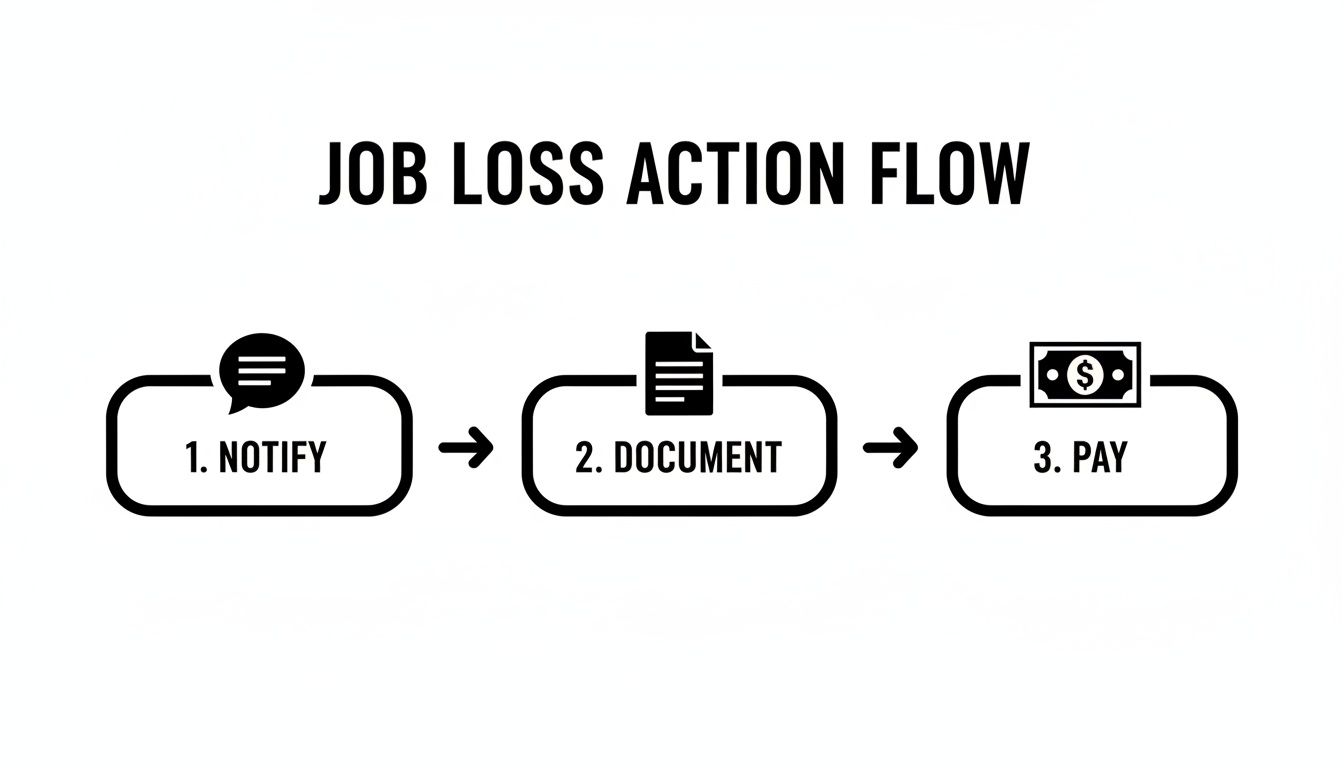
As this shows, the moment you lose your job, you need to be thinking about notifying the other parent (through formal service), documenting everything, and continuing to pay what you can. These actions set the foundation for a successful modification.
After service is complete, your lawyer will likely push for a temporary orders hearing. Think of it as a mini-trial where you ask the judge for immediate relief. The goal is to get a temporary reduction in your payments while the full case moves forward. You must show up ready to prove your case with hard evidence.
For a comprehensive breakdown of the entire legal process, you can get more information on how to modify child support in Texas from our in-depth guide.
Gathering the Right Evidence for Court
When you walk into that temporary orders hearing, the judge will expect you to prove your case. You need to come prepared with clear, organized proof that paints a vivid picture of your new financial reality.
Here is the essential evidence you’ll need to have ready:
- Termination Letter: The official notice from your employer is non-negotiable. It proves the job loss was involuntary.
- Final Pay Stub: This document establishes your previous income and what you had earned year-to-date.
- Severance Agreement: If you received severance, you must disclose it. The court will view it as a financial resource.
- Unemployment Benefit Statements: This shows your current, much lower income from the Texas Workforce Commission.
- Job Search Log: This is your proof that you're actively trying to fix the problem. Keep a detailed log of every application, interview, and networking call. It’s your best defense against a claim of intentional unemployment.
Let's walk through a real-world scenario. A client's salary required him to pay $2,000 per month in child support for one child. He gets laid off, and his only income is now $2,200 a month from unemployment benefits. The original order is simply impossible to meet.
In court, we'd immediately present his termination letter and unemployment statements to establish the "material and substantial change." Under Texas Family Code §154.125, his new guideline support for one child would be 20% of his net resources. A judge could issue temporary orders slashing the support payment to roughly $440 per month. This provides immediate, critical relief. Without that hearing and evidence, he'd still legally owe the full $2,000 and fall thousands of dollars behind in just a few months.
Calculating Support on a Reduced Income

When you walk into a courtroom to modify child support after losing your job, the judge is going to cut right to the chase: What is your income right now? Your previous salary is history. The new calculation hinges entirely on your current financial reality, which means we have to look at every single dollar coming in the door.
In Texas, child support is not based on your take-home pay alone. The court uses a specific legal formula to determine your "net monthly resources," as defined in Texas Family Code §154.062. This is a broad term that covers much more than just a simple paycheck.
What Counts as Income After a Job Loss
After a layoff, your income stream can get complicated fast. A judge will want to see everything to get a clear picture.
- Unemployment Benefits: This is the big one. Yes, those weekly benefits from the Texas Workforce Commission absolutely count as income for child support.
- Severance Pay: Whether you received it as a lump sum or it's being paid out over time, severance is a financial resource. A judge will look at how this money should be applied—often by prorating a lump sum over a few months to figure out its impact on your monthly income.
- Part-Time or "Gig" Work: Earning a little on the side? Every dollar you make from a part-time retail job, freelance project, or a gig app like Uber or DoorDash counts. It is crucial to track this income meticulously because it must be disclosed.
- Other Sources: Think broader. This could be rental income, withdrawals from a retirement account, investment dividends, or any other money flowing your way.
From that total, the court then subtracts a few specific things—Social Security taxes, federal income tax (calculated for a single person with one exemption), union dues, and the amount you pay for the child's health insurance. What's left is your net monthly resources. If you want to dive deeper into the math, our guide on how to calculate child support in Texas breaks it all down.
Applying the Texas Child Support Guidelines
Once your net monthly resources are determined, the court applies a simple percentage based on how many children you support, as outlined in Texas Family Code §154.125. This calculation is also subject to an income "cap."
As of September 1, 2025, that statutory cap on net resources is set to increase to $11,700 per month. If your net resources fall below this cap, the standard percentages apply directly. For one child, support is 20% of your net resources; for two children, it's 25%, and the percentages continue up from there.
Here's a Real-World Example: We represented an engineer who was laid off from a high-paying job. His net monthly resources plummeted from over $10,000 to just $2,200 a month, cobbled together from unemployment and a part-time consulting gig. His original order for two children was $2,500—more than his entire current income. After we filed for a modification, the judge recalculated his support at 25% of his new net resources, resulting in a new, manageable order of $550 per month.
The Danger of Intentional Unemployment
Now, here’s the critical exception. If a judge suspects you are unemployed or underemployed on purpose to dodge your child support obligation, they can invoke a powerful tool: Texas Family Code §154.066. This is what we call the "intentional unemployment" rule.
Under this rule, the judge can completely ignore what you're actually making. Instead, they will calculate child support based on your earning potential—what you should be earning based on your skills, education, and the local job market.
Your best defense against this claim is to prove you are making a good-faith effort to find a new job. You must keep a detailed, organized log of your search.
- Every job application, including the company, position, and date you applied.
- All interviews, networking events, and conversations with recruiters.
- Any classes, certifications, or training you're pursuing to improve your prospects.
This log isn't just busywork; it's your shield. It demonstrates to the court that you're acting responsibly and trying to meet your obligations, not run from them.
Falling behind on child support creates a crushing debt that can paradoxically make it even harder to get back on your feet. Federal research has shown that large arrears can discourage parents from finding work in the formal economy. Taking proactive legal action isn't about avoiding responsibility—it's about aligning your court order with your current reality.
The Real Consequences of Falling Behind

It’s a common and dangerous assumption: you lose your job, so your child support obligation must automatically stop, right? Many parents think a judge will just forgive the payments missed during unemployment. That couldn't be further from the truth.
Your court order is the law. It stays in full effect until a judge signs a new one. A modification to your child support is almost never retroactive to the date you lost your job. It only goes back to the date the other parent was formally served with your lawsuit. This gap creates a high-risk window where unpaid support—called arrears—can pile up with shocking speed.
The Unforgiving Math of Child Support Arrears
Every single day you wait to file for a modification is another day you are legally racking up debt.
If your current support order is $1,500 per month and you wait three months to file and serve the other parent, you are already $4,500 in the hole. That’s before you even get a court date.
This isn't like credit card debt. In Texas, child support arrears are "super-judgments." They grow with interest, cannot be discharged in bankruptcy, and give the state a massive toolbox to collect what you owe. They will use it.
Waiting is not a strategy; it’s a financial trap. The stress of losing your job is bad enough. Adding thousands in unavoidable arrears on top of it creates a downward spiral that is incredibly difficult to escape.
Texas Attorney General Enforcement Powers
Once you fall behind, the Office of the Attorney General (OAG) can—and will—start enforcement actions under Texas Family Code Chapter 157. These are not just threats in letters. They are aggressive, highly effective collection methods designed to get that money for your child.
The OAG’s enforcement toolkit includes:
- Wage Garnishment: An order goes directly to your new employer to take support right out of your paycheck.
- Bank Account Levies: They can freeze your bank accounts and seize the funds to cover the arrears.
- Property Liens: A lien can be placed on your house, car, or other property, making it impossible to sell until the debt is paid.
- License Suspension: The OAG can suspend your driver's license, professional licenses (nursing, plumbing, law, etc.), and even your hunting and fishing licenses.
- Passport Denial: Owe significant arrears? You will not be able to get or renew a U.S. passport.
The point here is not to scare you, but to provide a clear-eyed look at what happens when you don't handle a job loss the right way. These enforcement actions can cripple your ability to find a new job and get back on your feet. For a deeper dive, check out our guide on what happens if child support is not paid in Texas.
Preventing a Financial Crisis
The entire system is built to react when you don't pay. The only way to stop this avalanche of penalties is to get ahead of it.
Filing a Petition to Modify your child support immediately is the only way to protect yourself. By getting a new, temporary court order that reflects your current lack of income, you stop the arrears from building. It also shows the judge you’re acting in good faith. This one proactive step can be the difference between a temporary setback and a decade-long financial nightmare.
Navigating the Financial Storm: Smart Moves After a Job Loss
When you’ve just lost your job, the last thing you want to hear is that the court system moves slowly. But it’s the truth. While filing a formal Petition to Modify is the critical first step, just filing and waiting isn't a strategy—it's a recipe for financial disaster.
You need to be proactive. Fortunately, you have options beyond just sitting tight until your court date. Let's talk about the practical, strategic moves you can make right now to manage this crisis and protect your financial future.
Can You Negotiate a Temporary Deal?
First things first: an informal agreement with your ex to lower child support isn't legally binding. I need to be very clear about that. However, that doesn't mean you shouldn't try. The goal is to get a temporary, written understanding in place while your modification case is making its way through the courts.
You could, for example, propose paying guideline support based on your unemployment benefits. If the other parent agrees, get it in writing. An email or even a text message can work. Just make sure it clearly states:
- This is a temporary arrangement only.
- It does not permanently change the official, court-ordered amount.
- You are still moving forward with a formal modification in court.
Even though arrears will technically keep adding up based on the old order, this written proof is gold in the courtroom. It shows the judge you were transparent, responsible, and tried to find a solution. That goes a long way.
When to Ask for an Emergency Hearing
Sometimes, waiting a few weeks or months for a standard hearing just isn't an option. If paying your current child support order would make it impossible to cover basic necessities like your rent or power bill, you might need to seek Emergency Temporary Orders.
This is a more aggressive legal move, and it's not one to take lightly. You are essentially telling the judge that your situation is so dire that you need to jump to the front of the line. To be successful, you have to prove that you will suffer immediate and irreparable harm if the court doesn't step in right away.
It's not enough to just say you lost your job. You have to connect the dots for the judge, showing exactly how being forced to pay the old support amount will lead to severe consequences, like an eviction or utility shut-off.
Making a Strategic Choice
Losing your income puts you in a tough spot, and you'll have to decide on the best path forward. Each approach has its own risks and rewards.
Strategic Approaches to Child Support Modification
| Strategy | Best For… | Key Consideration |
|---|---|---|
| Negotiate & File | Parents on relatively good terms who can communicate effectively. | The informal agreement isn't legally binding. Arrears will still accrue until a judge signs a new order. |
| File & Wait | Low-conflict situations where you can afford the original support amount for a few months using savings or severance. | This is a passive approach. You risk falling far behind if the case gets delayed or you can't afford the payments. |
| Emergency Orders | Cases of extreme financial hardship where you cannot afford basic necessities while paying the current support amount. | This is a high-stakes move. You must prove immediate, irreparable harm, and judges have a very high standard for granting it. |
| Hire an Attorney | High-income earners, complex compensation (severance, stock), or high-conflict cases where the other parent is uncooperative. | This is an upfront cost, but it's an investment to prevent much larger financial losses from a poorly handled case. |
Choosing the right strategy depends entirely on your specific circumstances—your relationship with the other parent, the severity of your financial situation, and the complexity of your case.
Should You Hire an Attorney or Go It Alone?
After a job loss, the idea of representing yourself (pro se) to save money is incredibly tempting. This is almost always a costly mistake. Family law is filled with procedural landmines, and one wrong move can get your case thrown out or leave you on the hook for thousands in arrears.
An experienced family law attorney does so much more than fill out forms. They ensure your case is filed and served correctly, which is a common and fatal mistake for pro se filers. They know how to present your job search evidence effectively and defend you against accusations of being intentionally unemployed or underemployed under Texas Family Code §154.066.
An attorney’s value becomes crystal clear in complex situations. If you're a high-income earner with a complicated severance package or dealing with a hostile ex who is determined to fight you at every turn, legal counsel isn't a luxury—it's essential. The cost of an attorney is often just a fraction of the money you'll save by getting a fair modification quickly and avoiding months of inflated support payments.
Ultimately, hiring a professional is an investment in your own financial recovery. It ensures your case is built correctly from the ground up, giving you the best possible shot at a fair outcome that reflects your new financial reality.
Frequently Asked Questions: Texas Child Support After Job Loss
Losing your job is stressful enough. When you have a child support order hanging over your head, that stress can feel completely overwhelming. Based on our years of experience in Texas family courts, here are clear, practical answers to the questions we hear most often.
Can I just stop paying child support now that I have no income?
No. This is the single biggest mistake you can make. Your current court order is a binding legal obligation until a judge officially signs a new one. Deciding on your own to stop payments—even with zero income—is a fast track to financial disaster. This is how parents find themselves buried under arrears (past-due support), snowballing interest, and facing aggressive enforcement actions. The only legal way to lower your payment is to get a new court order.
How soon after losing my job can I ask for a modification?
Immediately. There is no waiting period. Texas Family Code §156.401 requires a "material and substantial change in circumstances" to modify an order, and an involuntary job loss is the textbook definition of that change. You can—and should—file your modification lawsuit the moment you lose your job. Every day you wait is another day the old, higher child support amount is locking in, digging you deeper into a financial hole.
Can the judge lower my support back to the day I got fired?
This is a very common and costly misunderstanding. A Texas judge can only make your new, lower child support payment retroactive to the date the other parent was officially served with your lawsuit paperwork. The court almost never backdates the reduction to the day you actually lost your job. This is why it is so critical to not only file the petition but also pay a constable or private process server to get it served immediately. Procrastination here will cost you, literally.
What if my company gave me a severance package?
A severance package is definitely a financial resource the court will consider. It does not get you out of paying support, but it will be part of the new calculation under Texas Family Code §154.062. How it’s treated depends on how you receive it. If it’s a lump-sum payment, a court might prorate it over several months to create a temporary "income" figure while you're job hunting. For example, a $30,000 severance might be treated as $5,000 per month for six months for the purposes of setting a temporary support amount.
How is child support calculated if I am only receiving unemployment benefits?
Unemployment benefits are absolutely considered income for child support calculations. Under Texas Family Code §154.062, a judge will look at all your income sources to figure out your "net monthly resources." They will take your gross unemployment benefit and subtract costs like Social Security taxes you would have paid on that income and the amount you pay for the child's health insurance. What's left is your net resources, which is then used to calculate the new support amount based on the standard guideline percentages.
Trying to modify child support on your own after a job loss is incredibly risky. One wrong move can cost you thousands. At the Texas Child Support Law Office of Bryan Fagan, we protect parents from financial crises by taking immediate, smart legal action. If you're out of work and need to change your support order, contact us today for a consultation and let us help you get this under control.