You have a Texas child support order, but circumstances have changed. Perhaps you’ve experienced an involuntary job loss, or your child has new, expensive medical needs. The critical question is, "Can we change the child support amount?" The answer is yes, but you cannot unilaterally decide to pay a different amount. In Texas, you must return to court and formally ask a judge to modify the order.
To succeed, you must meet one of two legal standards. The first is proving a material and substantial change in circumstances, as defined in Texas Family Code § 156.401. The second is a more straightforward option often called the three-year review rule. Let’s break down what each of these means for you in court.
When You Can Legally Modify Child Support in Texas

Life does not stand still after a divorce or custody case, and an order that made sense years ago may be completely unrealistic today. The Texas Family Code acknowledges this by providing a legal path for parents to update their orders to reflect their current reality.
However, a judge will not entertain a modification request simply because you feel the amount is unfair or because you've had a minor financial hiccup. You must meet a specific legal threshold, which means proving a “material and substantial change in circumstances” has occurred since your last order was signed. This isn't just a legal phrase; it's the core of your case under Texas Family Code § 156.401. A minor, temporary dip in income will not suffice. The change must be significant and expected to be long-term.
Proving a Material and Substantial Change
What does a "material and substantial change" actually look like in court? The determination is always based on the specific facts of your case. From our experience, however, some situations almost always command a judge's attention.
These common scenarios provide a solid foundation for a modification request:
- A major shift in either parent's income. This could be an involuntary job loss, a disability that prevents you from working, or a significant promotion for the other parent. Be warned: a judge will not look kindly on a parent who voluntarily quits a high-paying job for a much lower one right before attempting to lower their support obligation.
- The child's needs have fundamentally changed. A new diagnosis of a chronic illness, a need for specialized therapy, or other new, recurring expenses can all be grounds for a modification.
- The person the child lives with has changed. If the non-primary parent becomes the one providing the day-to-day home for the child (i.e., becomes the primary conservator), the support order must be revisited.
- The cost of care has significantly increased. A substantial and ongoing increase in the cost of the child's health insurance premiums is a very common and valid reason to adjust support.
The parent asking for the change bears the burden of proof. You cannot just tell the judge you lost your job; you must show them the termination letter, your final pay stubs, and evidence of your job search. The more concrete proof you have, the stronger your position.
For an even more detailed look at what courts consider, you can find a lot of information in this article on what a substantial change in circumstances explained.
Key Takeaway: The parent requesting the modification bears the burden of proof. You must come to court prepared with documents—pay stubs, medical records, termination letters—to show the judge why the change is needed and how it serves the child’s best interest.
To make this clearer, here are some real-world examples that typically meet the legal standard outlined in Texas Family Code § 156.401.
Common Events That Can Justify a Modification
| Type of Change | Example Scenario | Key Legal Standard (Tex. Fam. Code § 156.401) |
|---|---|---|
| Parent's Income | The paying parent is laid off from a long-term job and is now on unemployment. | An involuntary, significant, and long-term decrease in the parent's income. |
| Child's Needs | The child is diagnosed with Type 1 diabetes, requiring ongoing insulin, monitoring supplies, and specialist visits. | A new and ongoing medical or educational need that significantly increases the cost of raising the child. |
| Custody/Possession | The child, who previously lived with Parent A, now lives full-time with Parent B. | A change in the designation of the primary conservator who has the exclusive right to determine the child's residence. |
| Cost of Living | The cost to keep the child on a parent's health insurance plan increases from $150 to $450 per month. | A substantial and permanent increase in the costs directly associated with caring for the child, such as health insurance. |
These are just a few examples, but they illustrate the type of significant, lasting event a court is looking for when you file for a modification.
The Three-Year Review Rule
What if there hasn't been one big, dramatic event? What if income has just slowly crept up over the years, and the old order is simply outdated?
Texas law provides a second, much simpler path under Texas Family Code § 156.401(a-1). If it has been at least three years since your child support order was signed by the judge or last modified, you can request a review.
Under this "three-year rule," if the support amount calculated using the current Texas guidelines would be different from your current payment by either 20% or $100, the court can modify the order. You do not have to prove a job loss or any other major event.
Let's say your order was finalized four years ago and has you paying $800 a month. Based on your current income, the guideline calculation would now be $1,000. That $200 difference is more than $100, and it's also a 25% increase ($200 ÷ $800 = 0.25), which is more than 20%. That is all you need to demonstrate. This rule is a practical tool to ensure support orders don't become completely disconnected from the parents' financial realities over time.
How Courts Recalculate Support with the New Income Cap
Once a judge agrees that a modification is justified, the focus shifts to the numbers. A Texas court does not guess; it is required to follow a specific formula laid out in the Texas Family Code, and everything revolves around a single, crucial figure: monthly net resources.
This is where many people get tripped up. "Net resources" is not the same as your take-home pay. It's a legal term for a very specific calculation that starts with your total gross income and only allows for a handful of deductions.
Determining Monthly Net Resources
First, the court will tally up all your income from every source—wages, salary, bonuses, commissions, self-employment income, rental properties, and even returns from investments. From that gross total, the law allows you to subtract only a few specific items:
- Federal income taxes (calculated as if you're a single person with one exemption)
- State income taxes (if applicable)
- Social Security and Medicare taxes (FICA)
- Union dues
- The actual amount paid for the child's health and dental insurance premiums
The number you're left with is your "monthly net resources." This is the figure the court plugs into the child support guidelines outlined in Texas Family Code § 154.125.
The court's job is to apply these guidelines consistently so that children receive support based on their parents' true financial capacity. Miscalculating your net resources is one of the most common—and expensive—mistakes you can make in a modification case.
The Impact of the New Income Cap
A major change driving many modification requests is the adjustment to the "guideline cap." For years, the maximum amount of a parent's income subject to the guidelines was capped.
Effective September 1, 2025, the Texas child support cap increases from $9,200 to $11,700 in monthly net resources. This is a game-changer for how courts calculate support for higher-earning parents. For a deeper dive, see our detailed breakdown of how the $11,700 cap affects calculations right here.
Let's look at what this means in a real-world scenario.
Example Calculation:
A non-primary parent with two children (and no other children outside the case) has monthly net resources of $15,000.
- Under the old $9,200 cap: The court would take 25% (the guideline percentage for two children) of the cap, making the support obligation $2,300 per month ($9,200 x 0.25).
- Under the new $11,700 cap: That same 25% is now applied to the higher cap. The new guideline obligation jumps to $2,925 per month ($11,700 x 0.25).
That's a $625 increase every single month. If it's been more than three years since your last order, this change in the law is often enough on its own to warrant a modification.
When Can a Judge Deviate from the Guidelines?
While the formula provides the starting point, the guidelines aren't set in stone. Texas Family Code § 154.123 gives a judge the power to order a support amount that’s different from the guideline calculation if applying the formula would be "unjust or inappropriate" in a specific case.
To do this, the judge must find it is in the best interest of the child and must weigh all the relevant factors, such as:
- The age and proven needs of the child
- The parents' ability to support the child
- Other financial resources available to the child
- The amount of time the child spends with each parent (possession schedule)
- Extraordinary expenses, like for special education, healthcare, or other unique needs
- The cost of travel for one parent to exercise possession and access
For instance, a judge may order support above the guideline amount for a child with special needs who requires costly therapy not covered by insurance. Conversely, if the paying parent must spend a significant amount on flights to see their child because the other parent moved out of state, a judge might order an amount slightly below the guideline to account for that burden. If a judge does deviate, they must state in the final court order the specific reasons why the guideline amount was unjust or inappropriate.
How the Child Support Modification Process Actually Works
Going to court can be intimidating, but knowing the procedural steps makes the process manageable. When you need to change your child support order in Texas, you are following a specific legal road map that ensures both parents' rights are protected.
It all starts with one crucial document: the Petition to Modify the Parent-Child Relationship. This formal legal pleading officially kicks off your case. It tells the court who you are, who the other parent is, what your current order says, and—most importantly—the legal grounds for the change.
Getting the Case Started: Filing and Service
Once your Petition is drafted, it gets filed with the district clerk in the county that has continuing, exclusive jurisdiction (usually where your last order was made). But here’s a step you absolutely cannot skip: Service of Process.
You cannot simply email or text the other parent a copy of the lawsuit. Texas law requires them to be formally "served" by a constable, sheriff, or private process server. This official hand-delivery is your proof to the court that the other parent has been legally notified about the case.
A word of warning from experience: One of the biggest mistakes we see is waiting too long to file. A judge can only modify child support back to the date the other parent was officially served—not the date your income dropped or your expenses went up. Every single day you delay filing and serving is a day of potential financial relief you can never get back.
After the other parent is served, they have a legal deadline to file a formal "Answer." Their response sets the tone for the rest of the case, indicating whether it will be a straightforward agreement or a contested legal battle.
Handling Immediate Needs and Gathering Facts
What if you've lost your job and simply can't make the current child support payment? You don't have to wait months for a final decision. You can file a motion for Temporary Orders. This triggers a hearing where a judge can set a temporary, more manageable child support amount that you'll pay while the case moves forward. It can be a financial lifesaver.
Next, the case moves into the discovery phase. This is the formal, under-oath information exchange where both sides get the financial facts on the table. This is typically done through:
- Requests for Production: A formal demand for documents like recent pay stubs, tax returns, and bank statements.
- Interrogatories: Written questions the other parent must answer truthfully and under oath.
- Requests for Disclosure: A set of standard, required questions about the case, including potential witnesses and legal arguments.
Once all that financial information is gathered, the court can begin to run the numbers. This flowchart gives you a bird's-eye view of how that core calculation is done.
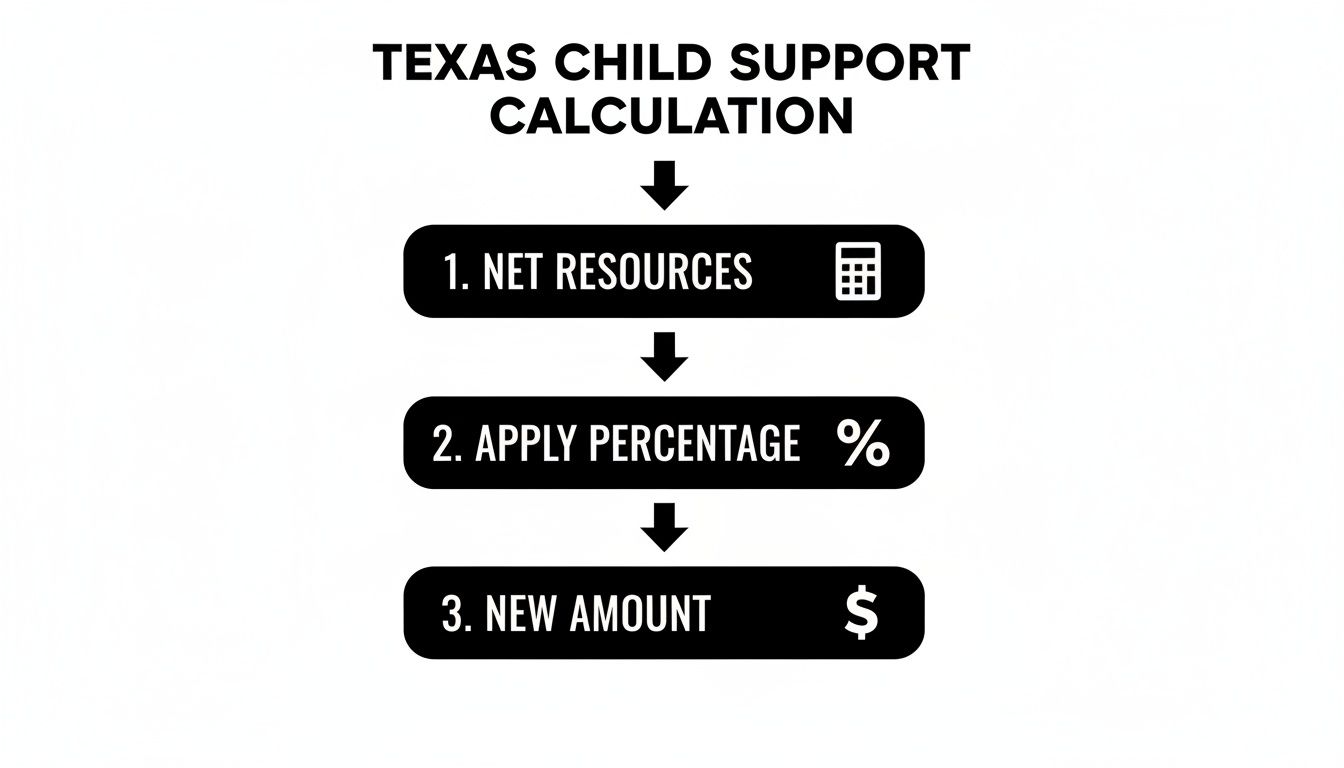
It always starts by figuring out a parent's net resources before applying the guideline percentages to find the new support amount.
Reaching a Resolution: Mediation vs. a Final Hearing
Before a judge will grant you a trial date, nearly every court in Texas will require you to attempt mediation. This is a confidential meeting where you, the other parent, and your attorneys sit down with a neutral third-party mediator whose sole job is to help you find common ground and reach a settlement.
If you can reach an agreement in mediation, your lawyers will draft a Mediated Settlement Agreement. This binding document is then used to create the new, final court order.
If you cannot reach a deal, the next and final step is a trial. Your case will be set for a final hearing where both you and the other parent will present evidence and testify before the judge. After hearing all evidence, the judge will make the final ruling on whether to modify child support and what that new amount will be.
Proving Your Case: What Evidence Actually Works

To win a child support modification, your argument must be built on a rock-solid foundation of proof. You cannot walk into court and simply tell a judge your income dropped or that the other parent got a huge raise. You must prove it with credible, well-organized evidence.
When you ask a Texas court to change a previous order, the burden of proof is on you. Your story is only as strong as the paper trail that backs it up.
Documenting Your Own Income Change
Let's say you are asking for a reduction in your child support payments because you lost income. The judge will immediately want to know two things: was the income loss significant, and was it involuntary? Your job is to paint a crystal-clear picture of your new financial reality.
To accomplish this, you need to gather specific documents that tell the story for you. The most powerful pieces of evidence include:
- Termination Letter or Severance Agreement: This is your primary proof that you did not just quit. It shows the job loss was not your choice.
- Final Pay Stubs: These are crucial for establishing a baseline, showing the court exactly what your income was before the change.
- Job Search Logs: This is critical. A detailed log of your applications, interviews, and networking efforts proves you're actively trying to remedy the situation. Judges absolutely look for this.
- Unemployment Benefit Statements: If you're receiving unemployment, these statements are official proof of your current (and much lower) income.
In court, an unproven claim is just noise. A judge needs to see that you're doing everything in your power to become re-employed. A well-documented job search is often the most persuasive evidence you can present to show your income loss is legitimate.
Uncovering the Other Parent's True Income
What if the situation is reversed? You have a strong suspicion the other parent is earning more than they claim, perhaps after a promotion or by hiding cash income. You cannot rely on rumors or social media posts. Thankfully, the legal process gives you powerful tools to get to the truth.
This is where the discovery process becomes your best friend. Through a formal Request for Production, your attorney can legally require the other parent to turn over their financial records. For a complete look at what counts as income, check out our guide on how Texas courts calculate net resources.
These legal requests are not optional. We typically demand:
- Recent Pay Stubs and W-2s: The most direct evidence of what an employer is paying them.
- Personal and Business Tax Returns: These are goldmines for uncovering other income sources, like investments, bonuses, or self-employment profits.
- Bank Statements: By reviewing deposits, we can often spot income that never made it onto a pay stub.
- Profit-and-Loss Statements: This is absolutely essential if the other parent is self-employed. It gives a real look at the financial health of their business.
When a parent is trying to hide income, these discovery tools are not polite suggestions—they are legal demands backed by the court. Ignoring them can lead to serious penalties, making this an incredibly effective way to get the real numbers.
Proving a Change in Your Child's Needs
Sometimes, a modification isn't about parental income at all; it's about the child's needs evolving significantly. Just like with income, proving this requires careful documentation.
For instance, if your child develops a new medical condition that requires expensive care, your word alone will not be enough. You’ll need to present the medical invoices, reports from therapists, and official statements from doctors that detail the condition and its ongoing costs.
The same logic applies to educational needs. If you’re trying to cover new costs for private school, specialized tutoring, or therapy, you’ll want to gather the tuition statements, invoices, and any psychological evaluations that recommend that specific support. Each document you provide adds another layer of strength to your case, showing that the current support order is no longer in the child’s best interest.
The Money Matters: What's Really at Stake in a Modification Case
When you head into a child support modification, it’s easy to focus only on the new monthly payment amount. But several other financial issues will invariably arise, and they can have a huge impact on your case for years to come. Understanding these concepts is essential before you set foot in a courtroom.
One of the biggest, and most costly, misunderstandings involves retroactive modification. Many parents assume that if they lose their job in January, a judge can go back and adjust their child support obligation to that date. That is not how it works in Texas.
A judge’s authority is limited. They can only modify support payments back to the date the other parent was officially served with the lawsuit. So, if you wait until April to file and serve the other parent, you are still on the hook for the full, original child support amount for January, February, and March. You cannot get that money back.
Medical and Dental Support Are Part of the Equation
When you modify child support, the court will almost always re-evaluate medical and dental support. Think of these as separate, additional forms of child support. The new order will specify which parent must provide the child's health insurance.
Typically, the decision comes down to who has better and more affordable access to coverage, usually through an employer. The actual monthly premium for the child's portion of the insurance is credited to the paying parent, which can lower their net resources and, in turn, their cash support payment. Be prepared to show proof of what you're paying for insurance and what is available to you.
What About Past-Due Child Support?
This is a critical point: filing for a modification does not stop, change, or erase any past-due child support, which is called arrears. If you owed $5,000 in back child support before you filed your case, you will still owe that $5,000 after the judge signs a new order.
A modification looks forward, not backward. It’s a tool to adjust future payments based on new circumstances, not a get-out-of-jail-free card for old debts. That money is still owed, it will still collect interest, and it is still fully enforceable.
The new order will set your new monthly obligation moving forward, but the Attorney General can and will continue any enforcement actions—like wage garnishment or license suspension—to collect on those old arrears.
The Realistic Costs of a Modification Lawsuit
Finally, you need a clear-eyed view of what this process can cost. A modification is a formal lawsuit, and lawsuits come with unavoidable expenses. They generally fall into three buckets:
- Court Filing Fees: Every Texas county charges a fee just to open a case. This usually runs a few hundred dollars.
- Service Fees: You have to pay to have a constable, sheriff, or private process server formally deliver the lawsuit papers to the other parent. Expect this to cost anywhere from $75 to $150 or more.
- Attorney's Fees: This will be your most significant expense. The final cost depends entirely on the complexity of your case. A simple, agreed-upon modification will cost far less than one that goes to a contested hearing.
While a judge can order one parent to pay the other's attorney's fees, you can never count on it. It is wise to budget for the entire process, from filing the first document to getting that final signature from the judge.
FAQ: Common Questions About Texas Child Support Modification
When a major life change hits, navigating the legal system is the last thing on your mind. But when it comes to child support, you cannot afford to wait. As family law attorneys, we receive calls every day from parents trying to figure out what to do next. Here are the straightforward answers to the most common questions we hear.
How long does it take to modify a child support order in Texas?
The timeline depends entirely on cooperation. If you and the other parent agree on the new support amount and are willing to sign the necessary paperwork, an uncontested modification can be resolved in as little as 4-6 weeks. This is the fastest and most cost-effective scenario.
If you cannot agree, a contested case will take much longer. The process will involve formal discovery, mandatory mediation, and ultimately a final hearing before a judge. A realistic timeline for a contested modification is anywhere from 6 to 12 months, depending on the court's docket and the complexity of your financial situation.
Can I just stop paying child support if I lose my job?
No. Absolutely not. Your current child support order is legally binding until a judge signs a new one. You cannot unilaterally decide to stop paying or pay less, no matter how valid your reason is.
Your first step should be to file a Petition to Modify immediately. You must continue paying what you can under the old order, but the court can only make a new, lower payment retroactive to the date the other parent was officially served with your lawsuit. Every day you wait to file and serve is a day you are on the hook for the full, prior amount.
Expert Insight: I have seen countless parents wait months after a job loss to take action. They end up thousands of dollars in arrears—debt that could have been completely avoided. Time is your enemy here. Act immediately to protect your financial future.
What if the other parent is hiding income?
This is a very common concern, especially when a parent is self-employed, works for cash, or runs their own business. The law provides powerful tools to uncover the truth. Through formal discovery, an attorney can legally demand financial records that tell the real story.
We routinely subpoena and analyze records such as:
- Bank Statements: We look for consistent cash deposits or transfers that do not match their claimed income.
- Business Records: For business owners, we dig into profit-and-loss statements, expense reports, and company bank accounts.
- Loan Applications: It is remarkable how often someone claims a low income for child support purposes but a very high income on a recent car loan or mortgage application.
If we can prove a parent is "intentionally underemployed or unemployed," Texas Family Code § 154.066 empowers the judge to calculate child support based on their proven earning potential, not the low income they are claiming.
Is it possible to modify child support without a lawyer?
Legally, yes, you can represent yourself (this is called appearing "pro se"). However, it is an incredibly risky gamble. Modifying a court order is a formal legal process with strict procedural rules, evidence standards, and complex financial calculations based on the Texas Family Code.
A single mistake—missing a deadline, failing to properly serve the other party, or miscalculating "net resources"—can get your case thrown out or cost you (or your child) tens of thousands of dollars over the years. Hiring an experienced attorney is an investment in ensuring your case is built correctly and your rights are protected.
Navigating the complexities of a child support modification requires strategic legal guidance. The attorneys at the Law Office of Bryan Fagan have the experience to build a strong case, whether you are seeking to increase or decrease payments. If your circumstances have changed, don't wait. Contact us today to understand your options and protect your financial stability. Learn more about how we can help at https://txchildsupport.net.