The single biggest misconception Texas parents have is assuming a 50/50 custody schedule automatically means no one pays child support. In my practice, I have seen this myth cause significant legal and financial problems. The reality is that even with perfectly equal possession time, a child support obligation is almost always part of the final court order.
The Myth of Zero Child Support in 50/50 Custody

The Texas Family Code is designed to ensure a child’s needs are met consistently, regardless of which parent’s home they are in. A 50/50 possession schedule does not change this core responsibility. You should view child support not as a payment to the other parent, but as an investment in your child's stability across both households.
Even when you have agreed to split time equally, a judge must perform a child support calculation. Texas Family Code §154.125 requires a formal finding of guideline child support to be included in your court order. This is a non-negotiable procedural step designed to protect the child's financial well-being, which is always the court's paramount consideration.
Why Is One Parent Still Ordered to Pay?
The primary objective of the child support system is to provide the child with a reasonably consistent standard of living. If one parent earns significantly more money, the law ensures the child benefits from that income in both households. Without a support payment, a child could experience a "feast-or-famine" lifestyle, moving between a home with every advantage and one where finances are a constant concern.
To achieve this balance, Texas courts will typically:
- Designate a Custodial Parent: For legal purposes, even in a 50/50 arrangement, one parent is usually named the "custodial" parent with the exclusive right to designate the child's primary residence. This parent is often the one designated to receive support.
- Calculate Guideline Support: The court will determine each parent's monthly net resources and apply the standard child support percentages as outlined in the Texas Family Code. This calculation is mandatory.
Under Texas law, a child support order is required unless a judge finds there is a compelling reason, consistent with the child's best interest, not to order support. Every judicial decision is guided by the "best interest of the child," and financial stability is a critical component of that standard.
Income Disparity Drives the Obligation
The most common reason one parent pays support in a 50/50 case is a disparity in income. The court's analysis begins with a simple mathematical comparison.
For example, if Parent A has net monthly resources of $8,000 and Parent B has $4,000, the court will calculate what each parent would owe under the guidelines. In almost every scenario, the higher-earning parent (Parent A) will be ordered to pay an "offset" amount to Parent B. This payment helps balance the financial resources available to the child in each home.
Understanding this from the outset is crucial. It allows you to shift your focus from pursuing an unrealistic "zero support" outcome to ensuring the net resource calculations are accurate and arguing for a support amount that is fair and appropriate for your specific circumstances.
How Texas Courts Calculate Your Net Resources
Every Texas child support case begins with one number: your monthly net resources. This is not mere financial jargon; it is the foundation for the entire child support calculation. Accurately determining this figure is the most critical step in the process.
The court establishes this number by first identifying your gross income and then applying a specific set of statutory deductions. This process is far more detailed than a simple review of your pay stub, as the Texas Family Code employs a broad definition of what constitutes financial resources.
What Counts as Income
First, the court aggregates all your income from every conceivable source. This comprehensive approach often surprises parents.
A judge will consider:
- Wages and Salary: Your regular pay, as well as any commissions, overtime, tips, and bonuses.
- Self-Employment Income: The net income from your business after deducting all ordinary and necessary business expenses.
- Investment Income: All income derived from interest, dividends, and royalties.
- Other Sources: Rental income (net of operating expenses), retirement benefits, pensions, trust distributions, and annuities.
The court's objective is to obtain a complete and accurate picture of the cash flow available to you each month. If a judge determines you are intentionally unemployed or underemployed to avoid or reduce your child support obligation, the court can impute an income value to you based on your proven earning potential.
The Only Deductions That Matter
Once your total gross monthly income is established, the court subtracts a very specific, state-approved list of deductions to arrive at your net resources. This is where many parents make errors. You cannot deduct personal expenses like car payments, rent, or credit card bills.
Pursuant to the Texas Family Code, the only permissible deductions are:
- Federal income taxes (calculated for a single person claiming one exemption)
- State income taxes (if applicable)
- Social Security and Medicare taxes (FICA)
- Union dues
- The amount paid for the child's health and dental insurance
The amount remaining after these deductions is your official monthly net resources. This figure is the basis for the entire child support formula.
Key Takeaway: The Texas formula for net resources is standardized to ensure uniformity and predictability. It deliberately ignores your personal spending and lifestyle choices. A judge focuses only on your gross income minus a handful of legally permitted deductions to arrive at the final number.
The Net Resource Cap and What It Means
Texas law imposes a ceiling, or "cap," on the amount of net resources subject to the standard child support calculation. This ensures that support covers a child's reasonable needs without creating a financial windfall for the recipient.
Effective September 1, 2025, that cap is set at $11,700 per month.
In practice, if your actual monthly net resources are $15,000, the court will generally apply the guideline support percentages only to the first $11,700 of that income. A judge can order additional support based on the income above the cap, but only if the requesting parent proves the child has specific needs that justify that extra amount. You can see more on these finer points in our guide explaining how Texas courts calculate net resources.
Understanding how to properly calculate and present your financial information—from all income sources to the few allowable deductions—is fundamental to achieving a fair outcome in your 50/50 custody and child support case.
Guideline vs. Offset: The Math Behind 50/50 Support
In 50/50 custody cases, the central financial question is how child support is calculated when both parents share time equally. A Texas judge’s primary objective is to ensure the child has a consistent standard of living in both homes. To achieve this, courts generally use one of two methods: the Standard Guideline Method or the Offset Method. The Offset Method is far more common in a true 50/50 possession arrangement.
Regardless of the method used, the first step is always calculating each parent's net monthly resources.
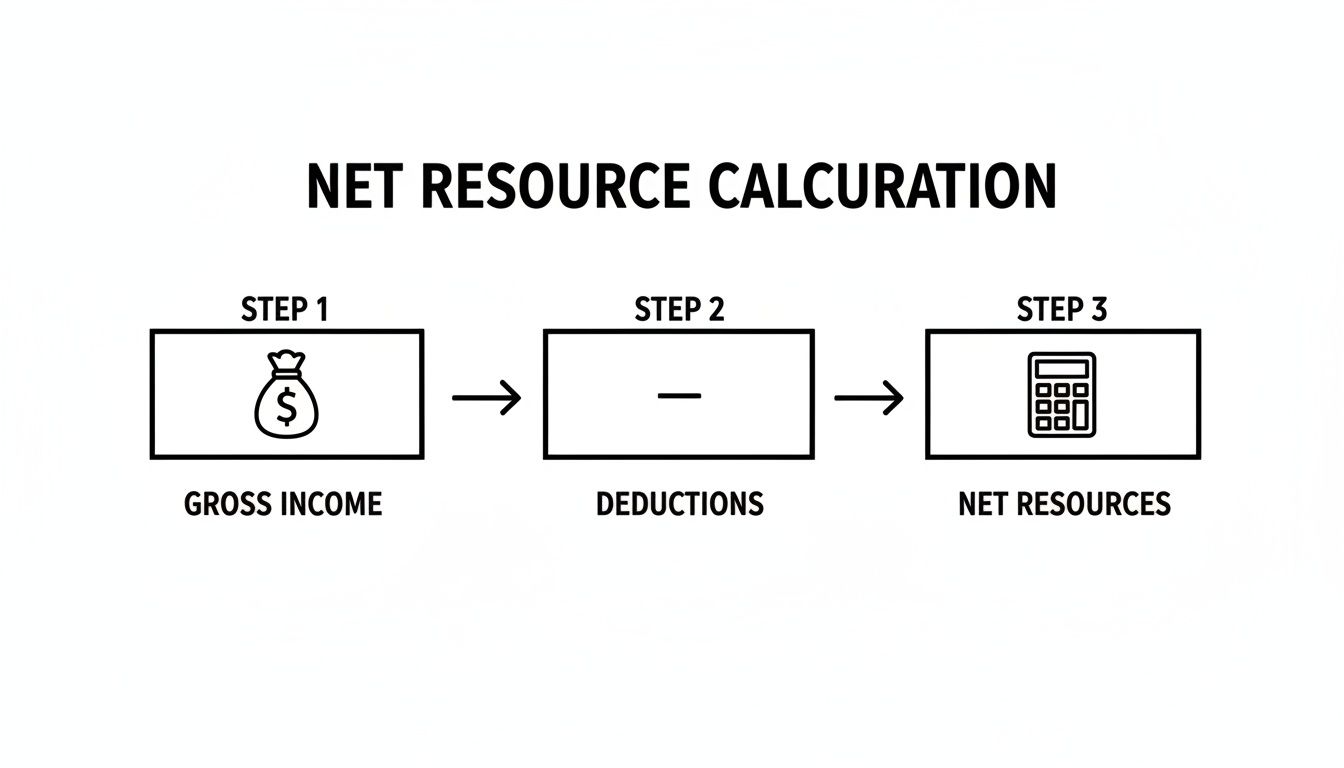
The formula is direct: take all sources of gross income, subtract the specific list of statutory deductions (like taxes and the child's health insurance premium), and the remaining amount is the net resource figure that drives the support calculation.
The Standard Guideline Calculation
The Texas Family Code technically defaults to the standard guideline calculation. This approach was designed for traditional custody arrangements where one parent is the primary custodian and the other parent (the obligor) pays support.
Even with a 50/50 split, the court must designate one parent as "primary" for legal purposes, such as establishing the child's residence for school enrollment. The calculation then proceeds as if it were a standard case: the non-primary parent pays a percentage of their net resources. For one child, this is 20% of the obligor's net resources, up to the statutory cap.
However, most judges recognize that this method is inequitable in a true 50/50 scenario because it fails to account for the fact that both parents are incurring daily expenses for the child an equal amount of time. This is where the Offset Method provides a more just solution.
The Offset Method: A More Common Approach for 50/50
The Offset Method is the approach most Texas judges use for 50/50 custody cases. It is considered a fair deviation from the standard guidelines under Texas Family Code §154.123, which grants judges the discretion to alter the support amount if applying the standard formula would be "unjust or inappropriate." An equal possession schedule is a classic example of such a circumstance.
This method calculates what each parent would owe the other and then nets the difference.
Here is a breakdown of the calculation:
- Calculate Parent A’s theoretical guideline support payment.
- Calculate Parent B’s theoretical guideline support payment.
- Subtract the smaller amount from the larger amount.
- The parent with the higher income pays the difference to the parent with the lower income.
This approach credits both parents for their time and direct expenses while still ensuring the child is supported by the combined parental incomes. For a deeper dive into the numbers, check out our complete guide on how to calculate child support in Texas.
Practical Example: Standard Guideline vs. Offset Method
Let's walk through a real-world example to illustrate the different outcomes. This scenario involves one child and hypothetical incomes.
Remember, the guideline cap on net monthly resources, effective September 1, 2025, is $11,700. The guideline percentage for one child is 20%.
- Parent A's Net Monthly Resources: $8,000
- Parent B's Net Monthly Resources: $5,000
The table below demonstrates the math for both methods.
| Calculation Step | Standard Guideline Method (Parent A Pays) | Offset Method (Difference is Paid) |
|---|---|---|
| Parent A's Obligation | $8,000 x 20% = $1,600 | $8,000 x 20% = $1,600 |
| Parent B's Obligation | (Not calculated in this method) | $5,000 x 20% = $1,000 |
| Final Calculation | Parent A pays the full amount. | $1,600 – $1,000 = $600 |
| Final Support Order | $1,600 per month | $600 per month |
As this example shows, the difference is substantial. While a judge could order the standard guideline amount, they are far more likely to order the offset amount of $600 per month to be paid by Parent A.
This offset is designed to help equalize the child's standard of living between the two homes. It acknowledges that Parent A has greater financial capacity and ensures those resources benefit the child, no matter which parent's home they are in.
Understanding this calculation is fundamental to developing your financial strategy in a 50/50 custody and child support case. It removes guesswork from negotiations and allows you to enter mediation or court with a realistic, data-driven position.
Arguing for a Fair Child Support Order
While the "offset method" is a common starting point for 50/50 custody cases, it is not the final word. A Texas judge has the authority to order a child support amount that deviates from any formula—whether standard guideline or offset—if applying the formula would produce an unjust or inappropriate result for the family.
This is where a strong, evidence-based legal argument becomes critical. Your objective is to demonstrate to the judge why your proposed child support amount is truly in your child's best interest.
The legal basis for this argument is found in Texas Family Code §154.123. This statute provides a list of factors that empower a judge to look beyond the basic math and consider the real-life financial circumstances of your 50/50 arrangement.
Making Your Case with the Best Interest Factors
Under §154.123, a judge can conduct a more granular analysis than just comparing paychecks. This is your opportunity to present concrete evidence about your unique situation.
Key factors a judge can consider include:
- The age and needs of the child: Does your child have special medical needs, require tutoring, or participate in costly extracurricular activities? You must document these expenses with receipts, invoices, and bank statements.
- The financial ability of the parents: This encompasses more than just net income; it includes all financial resources available to support the child.
- The amount of possession and access: A true 50/50 schedule is the foundation of any request for a non-standard order. You must prove that you have the child half the time and are directly paying for their needs during that time.
- The cost of travel for visitation: If one parent's relocation forces the other to incur significant travel expenses to maintain the 50/50 schedule, the court can factor that cost into the support calculation.
Your success depends not on what you say in court, but on what you can prove with clear documentation.
Practical Example: When a Fair Offset is Unfair
Let’s examine a scenario where the standard offset calculation might be unjust.
- Parent A has $6,000 in net monthly resources.
- Parent B has $4,500 in net monthly resources.
- They share one child on a true 50/50 schedule.
Using the offset method, the calculation would be:
- Parent A's Guideline Obligation: $6,000 x 20% = $1,200
- Parent B's Guideline Obligation: $4,500 x 20% = $900
- Offset Payment: $1,200 – $900 = $300 per month from Parent A to Parent B.
However, let's assume Parent A also pays $250 per month for the child's health insurance premium. Although this cost is deducted when calculating net resources, it remains a real, out-of-pocket expense directly benefiting the child.
Parent A can argue that paying an additional $300 in cash on top of the $250 insurance premium is unjust. This would result in Parent A covering a disproportionately larger share of the child's monthly costs, which contravenes the principle of a shared parenting plan.
In this situation, you would present evidence of the insurance payments and argue for a downward deviation from the $300 offset amount, citing the factors in §154.123.
Your argument must always be framed in terms of the child’s best interest. This is not about achieving "fairness" for you; it is about proving that your proposed support order ensures the child’s needs are met in both homes without imposing an inequitable financial burden on one parent.
This focus on the child's well-being is supported by a growing body of research. A 2023 analysis confirmed that children in shared parenting schedules thrive, often doing just as well as children in intact families across key academic, emotional, and health benchmarks. This data supports a more balanced financial approach, which is exactly what a deviation from the guidelines can achieve. You can explore the full findings on the benefits of 50/50 timesharing to see the trends for yourself.
Ultimately, a judge has broad discretion. A well-reasoned, evidence-backed argument is your most powerful tool for achieving a just result.
Navigating the Texas Court Process Step by Step

The prospect of court can be daunting, but the process becomes manageable once you understand the procedural roadmap. Knowing the key steps—from initial filing to final hearing—empowers you to maintain control and make strategic decisions for your family.
Let's outline the typical procedural path for establishing or modifying a child support order in Texas.
Step 1: The Initial Filing and Service of Process
The first legal action is filing a lawsuit. To establish a new court order, you file an Original Petition in Suit Affecting the Parent-Child Relationship. To change an existing order, you file a Petition to Modify the Parent-Child Relationship.
Once filed with the district clerk, the other parent must be formally notified. This critical step is known as service of process. A sheriff's deputy or private process server will personally deliver a copy of the lawsuit and a "citation"—a legal summons compelling the other parent to file a formal response, called an Answer.
Step 2: Discovery and Mediation
After the other parent files their Answer, the case enters the discovery phase. This is the formal process for exchanging evidence. Both sides will request and exchange key financial documents, such as tax returns, pay stubs, and bank statements, to accurately establish each parent’s monthly net resources.
Before a final trial, Texas courts require parents to attend mediation. This is a confidential settlement conference guided by a neutral third-party mediator. The goal is to reach a mutually acceptable agreement on all issues, including the possession schedule and child support. A successful mediation keeps the final decision-making power in your hands, not a judge's.
The Standard for Modifying Child Support
You cannot modify a child support order simply because you want a different outcome. The law requires you to prove that a material and substantial change in circumstances has occurred since the date the last order was signed.
Common examples of a material and substantial change include:
- A significant, involuntary change in either parent's income (e.g., job loss).
- A change in the parent responsible for providing the child's health insurance.
- A change in the possession schedule, especially a transition to a true 50/50 plan.
Shared parenting is a growing national trend, strengthening arguments for modification. For instance, in states like Virginia and Florida, fathers now have their kids for an average of 50% of the time. While Texas fathers average closer to 33%—ranking us 22nd in the nation—this national shift gives weight to arguments for modification based on increased possession, which directly affects 50/50 custody and child support. You can learn more about the demographic trends in shared parenting and how they might apply to your case.
Procedural Note: If you can prove a material and substantial change, a court can modify the support amount. It is critical to file your Petition to Modify immediately when that change occurs. A judge's authority to modify support is typically retroactive only to the date of filing, not the date your circumstances actually changed.
If you cannot reach an agreement in mediation, the final step is a trial, where both sides present evidence and a judge makes a binding ruling. Understanding this entire roadmap prepares you for the legal journey ahead. Our team of Texas child support lawyers is here to help you navigate every step with a strategy tailored to your family’s unique situation.
FAQ: Common Texas 50/50 Custody & Child Support Questions
When navigating 50/50 custody and child support, clients often have similar pressing questions. Here are clear, authoritative answers to the most common issues parents face in Texas.
Who provides health insurance in a 50/50 custody case?
A Texas judge must order one parent to provide the child's health insurance. The court will determine which parent can obtain better-quality, more affordable coverage, which is often through an employer's group plan. This decision directly impacts the child support calculation. The monthly premium cost for the child's portion of the insurance is a mandatory deduction used to calculate the paying parent's "net resources" under the Texas Family Code. Therefore, if you provide the insurance, your net resources are reduced, which in turn lowers your guideline child support obligation.
Can parents with a 50/50 schedule agree to $0 child support?
While parents can agree to waive child support, a judge must approve that agreement. The Texas Family Code prioritizes the child's best interest above any parental agreement. Before signing a zero-dollar order, a judge will scrutinize the agreement to ensure it does not compromise the child's financial well-being. If a significant income disparity exists between the parents, a judge will almost certainly reject a zero-support agreement and order support consistent with the child's needs.
What happens if one parent’s income changes dramatically?
A significant, involuntary change in income is a classic example of a "material and substantial change in circumstances," which is the legal standard required to modify a child support order. A job loss, a new disability, or a major promotion can all meet this standard. If you are using an offset calculation for your 50/50 case, any major shift in either parent's income will alter the final support amount. To update the order, you must file a Petition to Modify the Parent-Child Relationship. It is critical to file this petition immediately, as a court can typically only make the new support amount effective retroactive to the date of filing, not the date your income actually changed.
How is child support handled if my child's other parent dies?
If the parent ordered to pay child support (the obligor) passes away, the obligation does not simply vanish. The remaining parent can file a claim against the deceased parent's estate to recover future child support payments. Texas Family Code §154.013 allows a court to order the full amount of future support to be paid from the estate in a lump sum. This ensures the child's financial needs are met. This claim is treated like any other debt of the estate and must be properly presented to the estate's executor or administrator.
Navigating Texas child support, especially in a 50/50 custody situation, requires more than just a calculator—it demands strategic insight. The Law Office of Bryan Fagan is dedicated exclusively to these complex family law matters. We provide parents across Texas with the expert guidance they need to secure fair and lasting court orders. If you're facing a child support dispute, contact us to start building a legal strategy that protects your rights and your child’s future. Find out more at https://txchildsupport.net.