When you encounter a Texas child support calculator online, it is simply an estimator applying a basic formula from the Texas Family Code. It takes the non-custodial parent's Net Monthly Resources and multiplies that figure by a specific percentage dictated by the number of children requiring support.
For one child, the guideline outlined in Texas Family Code §154.125 begins at 20% of those net resources. For two children, it is 25%, and so on, but only up to a statutory income cap.
How Texas Courts Actually Calculate Child Support
To secure a fair child support order, you must first understand the precise methodology Texas courts use to arrive at the final obligation. This is not a discretionary figure; it is a specific formula laid out in the Texas Family Code. This guide provides a step-by-step breakdown of that process so you can prepare for court with confidence.
The entire calculation hinges on one critical figure: the paying parent's (obligor's) Net Monthly Resources.
A crucial detail often overlooked is that this is not equivalent to take-home pay. "Net Monthly Resources" is a legal term with a very specific definition. The court begins with the obligor’s gross income and subtracts only a handful of statutorily approved deductions.
The Guideline Formula
The foundation for nearly every child support order is a straightforward, percentage-based formula. Once a judge has determined the paying parent’s Net Monthly Resources, they apply a standard percentage found in the Texas Family Code §154.125.
These percentages are the default starting point for any child support case. The table below illustrates how the calculation works.
Texas Guideline Child Support Percentages at a Glance
This table shows the standard percentage of Net Monthly Resources applied based on the number of children, as defined by the Texas Family Code. This is the starting point for all standard calculations.
| Number of Children | Percentage of Net Monthly Resources |
|---|---|
| One Child | 20% |
| Two Children | 25% |
| Three Children | 30% |
| Four Children | 35% |
| Five or More Children | 40% |
Real-World Example: If an obligor's net monthly resources are determined to be $6,000 and they have two children, the guideline child support amount is $1,500 per month (25% of $6,000).
Client Advisory: A Texas court will presume that any child support amount calculated using these guidelines is in the child's best interest. This is the baseline figure that all negotiations and court arguments will revolve around.
The Income Cap and Its Impact
What happens when the paying parent is a high-income earner? Texas law imposes a "cap" on the amount of income to which the standard guidelines apply.
Effective September 1, 2025, this cap increases to $11,700 in Net Monthly Resources. This is a substantial increase from the previous $9,200 cap, a change mandated by law to account for inflation.
This means that if a parent nets more than $11,700 a month, the guideline percentages are typically applied only to that capped amount. For example, if a parent with one child nets $20,000 per month, the minimum guideline support is calculated based on the cap: $2,340 (which is 20% of $11,700).
However, this is not the end of the inquiry. Under Texas Family Code §154.123, a judge can order support above this guideline amount. To achieve this, the receiving parent must prove that the child's specific, documented needs require additional funds. We will discuss the strategy for proving such needs later in this guide.
How to Calculate Net Monthly Resources Accurately
In Texas child support litigation, everything hinges on one number: Net Monthly Resources. Calculating this figure correctly is the single most important part of the process, as any error will affect the final support obligation for years to come.
This is not about your take-home pay. The Texas Family Code sets forth a specific formula for courts to follow. The process begins by identifying all of the paying parent's gross income and then subtracting a very specific list of statutory deductions.
What Counts as Gross Income
The court takes a comprehensive view of all money coming in. "Gross income" is far more than just a salary. A judge will evaluate the total financial picture, which includes:
- Wages, salaries, commissions, tips, and bonuses.
- Income from self-employment, a partnership, or a privately owned business.
- Rental income from any properties owned.
- Interest, dividends, and royalty income.
- Other sources like retirement benefits, pensions, trust income, and annuities.
If a parent intentionally quits their job or takes a lower-paying one before a child support hearing to reduce their obligation (a practice known as intentional underemployment or unemployment), a judge can assign an imputed income. This means the court calculates support based on what that parent should be earning, considering their experience, qualifications, and local market earning potential.
The flowchart below shows how this starting number—Net Resources—is used to arrive at the guideline child support amount.
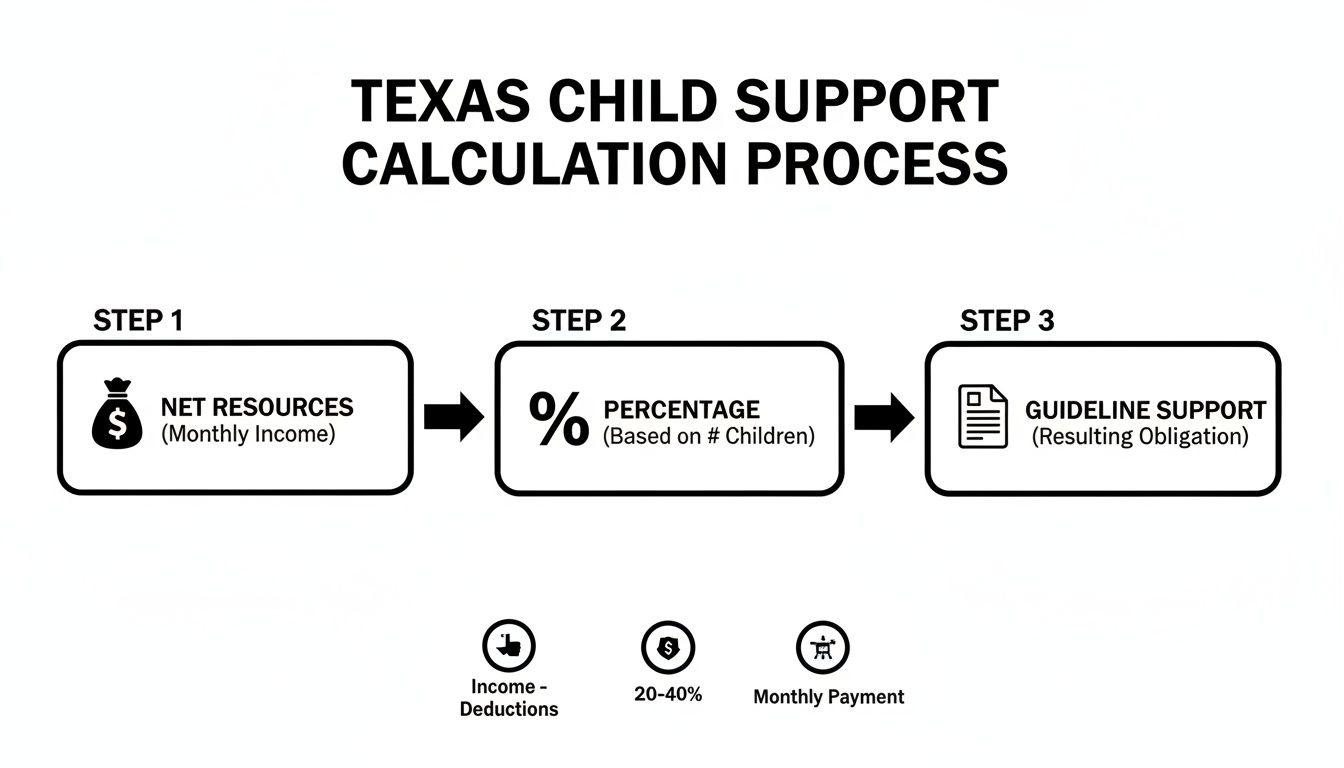
As you can see, once the net resource figure is set, the rest of the standard calculation is a straight path based on state-mandated percentages.
Permitted Deductions Under Texas Law
This is where many miscalculations occur. After tallying gross income, the law permits only a handful of specific deductions under Texas Family Code §154.062 to arrive at the "net" resource figure. These are the only deductions allowed.
Allowed Deductions Include:
- Federal income tax (based on a single person claiming one exemption).
- State income tax (not applicable in Texas).
- Social Security (FICA) taxes.
- Mandatory union dues.
- The actual amount paid for the children's health insurance premium.
Just as crucial is knowing what you cannot deduct. This is a common source of confusion.
Client Advisory: The court will not subtract personal living expenses. Items like car payments, 401(k) contributions, credit card bills, or mortgage payments are considered personal financial choices, not mandatory deductions for child support purposes.
For a deeper dive into this critical step, you can learn more about how Texas courts calculate net resources in our detailed guide. Understanding what counts—and what doesn't—is the first step toward ensuring the final child support order is both fair and accurate.
Understanding the New $11,700 Monthly Income Cap
If you are involved in a Texas child support case, you must be aware of the significant legislative change effective September 1, 2025. This update reshapes how maximum guideline child support is calculated by increasing the monthly net resource cap—the maximum income a court considers when applying standard guidelines.

This adjustment reflects the legislature's acknowledgment that the old cap was not keeping pace with the real-world cost of raising children. This was not a random change; it was a required update based on inflation.
The New Cap Versus the Old Cap
As of September 1, 2025, the maximum net monthly resources used for guideline child support calculation is $11,700. This is a 27% increase from the previous cap of $9,200.
Under Texas Family Code §154.125(a-1), the Attorney General's office must adjust this cap every six years based on the Consumer Price Index. This update directly reflects the increased cost of living for families in Texas.
For parents in major Texas cities like Houston, Dallas, Austin, San Antonio, and Fort Worth, the impact is immediate. Let's break down the new maximum guideline amounts:
- 1 Child: $2,340 per month (20% of $11,700), an increase of $500.
- 2 Children: $2,925 per month (25%), an increase of $625.
- 3 Children: $3,510 per month (30%), an increase of $750.
- 4 Children: $4,095 per month (35%).
- 5+ Children: $4,680 per month (40%).
This means higher-earning parents face a potentially larger child support obligation, as the law presumes more of their income should go toward their children's needs. For a deeper dive into these changes, you can explore our comprehensive guide on the $11,700 cap.
Case Study: Before vs. After the New Cap
Imagine an obligor who earns $12,000 in net monthly resources and has two children.
- Before the Update: A court could only apply the guidelines to the first $9,200 of income. Guideline child support would have been $2,300 (25% of the $9,200 cap).
- After the Update: Now, a court considers income up to the new $11,700 cap. Guideline child support becomes $2,925 (25% of $11,700).
That is a difference of $625 every month, totaling $7,500 annually. This example demonstrates why understanding this new cap is critical for anyone involved in a child support case.
Does the New Cap Apply to My Existing Order?
This is a critical point: The new cap is not retroactive and does not automatically change an existing order. If your child support was ordered before September 1, 2025, it remains in effect unless a party takes formal legal action.
To have the new $11,700 cap applied to an older case, a parent must file a formal Petition to Modify with the court. A court is likely to approve a modification if it has been at least three years since the order was made and the new calculation changes the amount by 20% or $100 per month. For high-earners whose support was previously limited by the old $9,200 cap, the law change itself often serves as the "material and substantial change in circumstances" needed to justify a modification.
Arguing for Support Beyond the Guideline Amount
It is a common misconception that the Texas child support calculator is the final word. The law recognizes that a rigid calculation is not always fair or appropriate.
Texas Family Code §154.123 gives a judge the power to order child support that deviates from the guidelines if applying them would be “unjust or inappropriate under the circumstances.” To succeed, you cannot simply ask; you must build a case with clear, convincing evidence demonstrating why a different amount is in your child's best interest.
Factors a Court Considers for Deviation
A judge will evaluate the entire family's circumstances when deciding whether to deviate. Texas Family Code §154.123 outlines several key factors, including:
- The age and specific needs of the child, especially medical, educational, or psychological needs.
- The parents' respective abilities to support the child.
- The amount of time the child spends with each parent (the possession schedule).
- The financial resources available to the child.
- Travel costs associated with visitation, a significant factor in long-distance cases.
Your task is to connect these factors to your child's needs or your ability to provide for them, presenting a clear argument to the judge.
Support Above the Cap for High-Income Earners
A frequent reason for seeking a deviation is when the paying parent is a high-income earner. As of September 1, 2025, the guideline percentages only apply up to $11,700 in net monthly resources. But what if the paying parent earns far more?
A judge can order additional support above the capped amount. To win this argument, the receiving parent must prove the child has needs that justify the higher payment. This is about ensuring the child maintains the standard of living they were accustomed to, not funding a life of luxury.
Example of Proven Needs: A judge might order support above the guideline cap to cover documented expenses for a child's private school tuition, specialized medical treatments not covered by insurance, therapy for a special needs child, or costs associated with elite-level extracurricular activities like competitive sports or arts programs.
Deviations for 50/50 Possession and Travel Costs
Deviations are not limited to high-income cases. The possession schedule itself can trigger a deviation. While Texas lacks a specific formula for 50/50 custody, courts often land on a non-guideline amount using an "offset" calculation: the court calculates what each parent would owe, and the higher earner pays the difference.
Conversely, a paying parent can argue for a downward deviation. For instance, if you live out of state and incur significant expenses for airfare and lodging to exercise possession of your child, the court has discretion under §154.123 to lower your guideline support to offset those necessary costs.
Successfully arguing for any deviation requires meticulous documentation and a compelling presentation to the court.
Navigating the Texas Child Support Legal Process
Understanding the calculation is only the first step. To obtain an enforceable order, you must navigate the Texas legal system. The procedural steps are formal and have strict rules. Knowing what to expect provides a significant strategic advantage.
Initiating a Child Support Case: Filing and Service
A child support case officially begins when one parent files an Original Petition with the court. In a divorce, this is part of the Petition for Divorce. For unmarried parents, it is a Suit Affecting the Parent-Child Relationship (SAPCR).
After filing, the other parent must be formally notified through a process called service of process. This is a non-negotiable step. A sheriff, constable, or private process server will personally deliver a copy of the lawsuit to the other parent, ensuring they have a legal opportunity to participate.
Upon being served, the responding parent has a strict deadline—typically around 20 days—to file a formal Answer with the court. Failure to file an Answer can result in a default judgment, where the judge may grant the filing parent's requests without hearing the other side. For a complete breakdown, see our guide on how to file for child support in Texas.
The Discovery and Hearing Phase
Once both parents are part of the case, it enters the discovery phase. This is the formal process for exchanging the financial information required for an accurate child support calculation. Both parties must provide documents such as:
- Pay stubs and tax returns from the last two years
- Bank statements
- Proof of health insurance premium costs for the child
This evidence is what a judge uses to determine net monthly resources and decide whether a deviation from the guidelines is warranted. Following discovery, the case typically proceeds to mediation and, if unresolved, a final hearing where a judge issues a binding order.
Modifying an Existing Child Support Order
Child support orders can be modified, but it is not an automatic process. You must file a Petition to Modify and go back to court.
To succeed, you must prove a "material and substantial change" in the circumstances of either a parent or the child has occurred since the last order was signed. The recent increase in the statutory cap to $11,700 effective September 1, 2025, is a prime example. If the paying parent's income exceeds the old $9,200 cap, this legislative change itself constitutes a material and substantial change, providing strong grounds to request a modification.
Real-World Texas Child Support Calculation Scenarios

Theory is one thing; practical application is another. Let's analyze how courts apply these principles in common scenarios. These examples illustrate how the Texas Family Code works in practice.
Scenario 1: The W-2 Employee
This is the most straightforward calculation. Consider a non-custodial parent, Alex, with a W-2 job and one child.
- Gross Monthly Income: $7,500
- Deductions: $1,650 (for federal income tax, Social Security, and Medicare)
- Child's Health Insurance Premium: $250 per month (paid by Alex)
- Number of Children: 1
The Calculation:
- Determine Net Monthly Resources: The court subtracts statutory deductions from gross income.
- $7,500 (Gross) – $1,650 (Taxes) – $250 (Insurance) = $5,600 in Net Monthly Resources
- Apply Guideline Percentage: The guideline for one child, per §154.125, is 20%.
- $5,600 x 0.20 = $1,120 per month
Alex’s guideline child support obligation is $1,120 per month.
Scenario 2: The High-Income Earner
When an obligor's income exceeds the statutory cap, the calculation becomes more complex. This example uses the $11,700 cap effective September 1, 2025.
- Net Monthly Resources: $15,000
- Number of Children: 2
The Calculation:
- Apply the Cap: Though net resources are $15,000, the court's starting point is the $11,700 cap.
- Apply Guideline Percentage: For two children, the guideline is 25%.
- $11,700 x 0.25 = $2,925 per month
This $2,925 is the "presumptive" minimum guideline support. The custodial parent can argue for support above this amount by presenting evidence that the children's proven needs exceed what this baseline payment covers, as permitted under §154.123.
Scenario 3: The 50/50 Possession Schedule Offset
With a 50/50 possession schedule, courts often deviate from the standard formula using an "offset" calculation.
- Parent A's Net Monthly Resources: $8,000
- Parent B's Net Monthly Resources: $5,000
- Number of Children: 1
- Possession: A true 50/50 schedule
The Calculation:
- Calculate Each Parent's Theoretical Obligation: The court determines what each parent would owe.
- Parent A's Guideline (20%): $8,000 x 0.20 = $1,600
- Parent B's Guideline (20%): $5,000 x 0.20 = $1,000
- Determine the Offset: The court subtracts the smaller obligation from the larger one.
- $1,600 – $1,000 = $600
In this 50/50 scenario, Parent A, the higher earner, would pay Parent B $600 per month. This non-guideline award recognizes both parents cover the child's daily costs and balances the income disparity.
While 50/50 custody frequently results in deviations under §154.123, other factors can also lead to non-guideline awards. For more analysis, you can discover more insights about Texas child support caps and deviations.
FAQ: Answering Your Texas Child Support Questions
Navigating child support can be overwhelming. Here are authoritative answers to common questions we encounter from our clients.
Does a 50/50 Schedule Mean No One Pays Child Support?
No. This is a very common misconception. In Texas, even with a 50/50 possession schedule, one parent is almost always ordered to pay child support. Instead of a special formula, judges typically use an "offset" approach. They calculate what each parent would pay as the obligor, and the higher-earning parent pays the difference. This amount can be further adjusted based on factors in Texas Family Code §154.123 to ensure the final order is just and appropriate.
Can a Judge Order Back-Pay for Child Support?
Yes. This is called retroactive child support. A judge can order a parent to pay for support that should have been provided in the past, typically dating back to the parents' separation. However, there is a rebuttable presumption that ordering more than four years of retroactive support is not in the child’s best interest. Overcoming this presumption requires compelling evidence.
What Happens if My Income Changes After the Order Is Final?
A child support order is not static. If you experience a major financial shift, you can petition the court to modify the order. You must prove a “material and substantial change” in the circumstances of a parent or the child has occurred. A significant promotion, a layoff, or a change in the child's needs can all qualify.
The increase of the guideline income cap to $11,700 per month on September 1, 2025, is a legislative change that can serve as the basis for a modification, allowing a parent to update an order based on the old, lower cap.
Remember, providing health and dental insurance is an additional obligation. The court will order one parent to maintain coverage and will divide the premium costs equitably in addition to base child support.
Navigating the complexities of the Texas Family Code requires an experienced hand. The Law Office of Bryan Fagan, PLLC offers strategic guidance on everything from net resource calculations to guideline caps and modifications. If you're dealing with a child support matter in Houston, Dallas, Austin, San Antonio, or Fort Worth, reach out to us for a consultation to protect your rights. Find the clarity and confidence you need by visiting https://txchildsupport.net.