When you’re staring down a child support case in Dallas, it's easy to feel lost. You’re worried about your kids, your finances, and what the future holds. This is where a child support lawyer in Dallas becomes your most crucial ally. They do more than just navigate the legal system; they protect your child's financial stability and defend your rights as a parent under the Texas Family Code.
Whether you're establishing child support for the first time, modifying an existing payment, or enforcing an order to collect what’s owed, a skilled lawyer is your dedicated advocate from start to finish. We are not here to provide generic disclaimers; we are here to advise you on how to prepare for court and secure a fair outcome.
Why You Need a Dallas Child Support Lawyer
Trying to handle a child support case in Dallas County on your own is a significant risk. The Texas Family Code is a maze of statutes, deadlines, and procedural requirements, and one wrong move can create financial problems that stick with you for years. It's not just about filling out the right forms; it's about building a compelling case.
An experienced child support lawyer is your strategist. They’ve seen countless cases and understand the nuances of how Dallas judges interpret the law. They work to make sure the final outcome is fair, based on the real facts of your situation, not just what’s on paper.
Your Advocate in All Child Support Matters
A skilled attorney anticipates problems and handles every aspect of your case with authority. Their expertise is vital when:
- Establishing the First Order: They dig deep to ensure the initial child support calculation is based on an honest, complete financial picture from both parents. This sets the foundation for a fair payment going forward.
- Modifying an Existing Order: Life happens. A job loss, a big promotion, or a change in custody arrangements can all trigger a need to adjust support. Your lawyer guides you through the official modification process to ensure the change is legal and enforceable.
- Enforcing Unpaid Support: If the other parent isn't paying, you can't just wait and hope. Your lawyer can take immediate action by filing an enforcement lawsuit to collect missed payments and hold the other parent accountable.
Going to court alone often means walking away with a deal you'll regret. A seasoned child support lawyer knows the specific procedures in Dallas County courts. They can spot red flags and address potential issues before they spiral. This isn't just about convenience—it's about protecting your family's future.
Without professional guidance, you're vulnerable to simple procedural mistakes, inaccurate income calculations, and agreements that don't truly serve your child’s best interests. A dedicated lawyer ensures all the financial cards are on the table and that the final order is both fair and enforceable. If you're at the beginning of this journey, you can learn more about how our legal team serves the Dallas area and can help protect your rights.
How Texas Calculates Guideline Child Support
When clients first come to us, one of their biggest questions is always the same: "How much is child support going to be?" It's a source of a lot of anxiety, but in Texas, the process isn't just a judge picking a number out of thin air. It’s a very specific, formula-based system defined by the Texas Family Code.
The entire calculation hinges on one critical figure: the paying parent's net monthly resources. This isn't just take-home pay from a W-2. It's a legal term for what's left after the court subtracts a handful of very specific, state-allowed deductions from your total income. Getting this number right is everything.
Figuring Out "Net Monthly Resources"
First, we have to establish the parent's total, or gross, income. The Texas Family Code casts a very wide net here. "Resources" includes just about everything you can think of:
- Salary, wages, overtime, and bonuses
- Tips and commission
- Self-employment and business income
- Rental income from properties
- Retirement benefits, social security, and disability payments
- Even investment income like dividends and capital gains
Once we have that total, the law only allows a few specific deductions to get to the "net" amount. Forget your car payment or rent—the court won't consider those. The only things that come off the top are Social Security taxes, federal income taxes (calculated for a single person with one exemption), union dues, and the cost of the child's health insurance.
This flowchart shows how an attorney helps you navigate these key stages, from the initial calculations to handling life changes and enforcement down the road.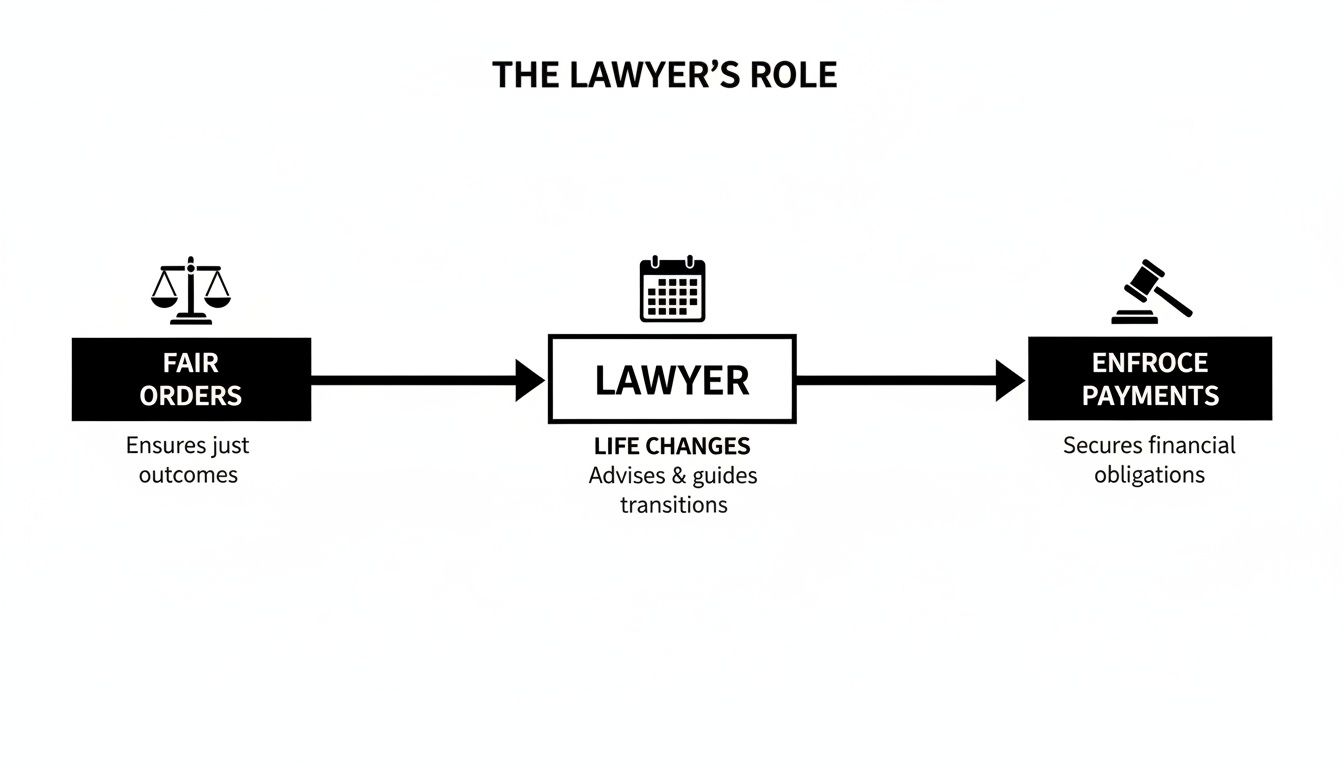
Each step, from that first financial disclosure to any future modifications, needs a solid legal strategy to protect your child's well-being and ensure the order is fair.
Applying the Guideline Percentages
With the net monthly resources figured out, the court then applies a simple set of percentages based on how many children the support order is for. These guidelines are laid out in Texas Family Code § 154.125.
The percentages of net resources are:
- 20% for 1 child
- 25% for 2 children
- 30% for 3 children
- 35% for 4 children
- 40% for 5+ children
Real-World Example: A Dallas parent has one child and their net monthly resources are calculated at $8,000. According to the guidelines (Texas Family Code § 154.125), their child support would start at 20% of that, which is $1,600 per month. After this baseline is set, the court will also issue orders for who provides health insurance.
While a judge can deviate from these percentages, they need a very good reason, and it must be clearly documented and in the child's best interest. You can learn more about how to calculate child support in Texas in our detailed guide.
The "Cap" on Income
Now, there's a major catch for high-income earners. Texas law puts a ceiling—or a "cap"—on the amount of income that the standard percentages apply to. As of September 1, 2025, that cap is $11,700 in net monthly resources.
This means if you make more than $11,700 a month, the guideline calculation only applies to that first $11,700. For any income above the cap, the court won't automatically order more support.
To get support based on income above that ceiling, the receiving parent must prove the child has needs that justify a higher amount. This is where having an experienced lawyer becomes absolutely crucial, as these high-income cases require a much more detailed and persuasive argument under Texas Family Code § 154.126, which governs support for high-net-worth families.
Understanding the New High-Income Child Support Cap
If you’re a high-earner in the Dallas area, the rules for child support have changed in a big way. A recent move by the Texas legislature, effective September 1, 2025, has significantly raised the stakes for anyone involved in a high-asset child support case. It’s a change you absolutely need to be aware of as we head into 2026.
Think of the child support guidelines as having a "ceiling." Previously, the standard support formula only applied to the first $9,200 of a parent’s net monthly income. Anything earned above that was irrelevant for the baseline calculation. As of last year, that ceiling has been raised to $11,700 per month.
This isn't just a minor tweak. It's a direct response to the rising cost of raising children in Texas and an effort to make sure support orders reflect what high-income parents can actually provide. Whether you're setting up a new support order or looking to modify an old one, this new cap will be a central part of the conversation.
The New Cap in Action
So, what does this look like in practice? The percentages used to calculate support haven't changed—they’re still laid out in Texas Family Code § 154.125—but the income they apply to has grown considerably. This automatically increases the maximum guideline support for parents whose income hits that new cap.
Here is a straightforward comparison to show you the real-dollar impact.
Child Support Guideline Cap Comparison (Old vs. New)
This table clearly illustrates the difference in maximum monthly guideline support before and after the cap was raised from $9,200 to $11,700.
| Number of Children | Guideline % | Max Support (Old $9,200 Cap) | Max Support (New $11,700 Cap) | Monthly Increase |
|---|---|---|---|---|
| 1 Child | 20% | $1,840 | $2,340 | +$500 |
| 2 Children | 25% | $2,300 | $2,925 | +$625 |
| 3 Children | 30% | $2,760 | $3,510 | +$750 |
| 4 Children | 35% | $3,220 | $4,095 | +$875 |
As you can see, the increase is substantial across the board. The $2,500 jump in the cap means courts now have a more realistic basis for their initial calculations, accounting for years of inflation. For a family with one child, that’s a potential increase of $500 every single month.
It’s crucial to remember that any new child support orders will be calculated using this new $11,700 cap. If you have an existing order based on the old cap, it won't update automatically; you’ll need to file a formal modification to have the court apply the new standard. Learn more about how the new child support landscape may affect you from experts at The Overstreet Law Firm.
Can the Court Order Support Above the Cap?
Yes, absolutely. A Dallas judge can order child support that goes beyond the amount calculated using the $11,700 cap. But—and this is a big but—it doesn't happen just because one parent asks for it.
The parent requesting the additional support has the burden of proof. You must show the court that the child has proven needs that justify an amount above the standard guideline.
This is where having an experienced child support lawyer in your corner becomes critical. Under Texas Family Code § 154.126, a judge weighs the parents' income against the child's demonstrated lifestyle and needs. Simply wanting more for the child isn't enough; you must come to court with compelling, concrete evidence.
So what counts as a "proven need"? A judge will want to see specific, documented expenses that are in the child’s best interest. Common examples include:
- Private School Tuition: Especially if the child has a history of attending private school and it’s a stable part of their life.
- Specialized Medical or Educational Needs: This covers everything from ongoing therapy and tutoring to specialized care for a child with unique health challenges.
- High-Cost Extracurricular Activities: Think competitive sports teams, intensive arts programs, or other developmental activities that have become part of the child's routine.
Proving these needs is a meticulous process. It requires gathering receipts, bank statements, school records, and sometimes even expert testimony. An attorney can help you build a persuasive case that shows why the child’s best interest is served by support that goes beyond the standard cap. For a deeper dive into these complex situations, you might be interested in our guide to understanding high-income child support.
The Legal Roadmap for Your Child Support Case
Facing a child support case in Dallas County can feel overwhelming, but there’s a clear legal path to follow. Understanding the process takes away much of the mystery and helps you work more effectively with your lawyer. Every case, whether you're starting from scratch or changing an old order, moves through a predictable set of procedural stages.

The entire journey starts by officially opening a case with the court. This first move is what sets all the legal wheels in motion.
Step 1: Filing the Petition and Service
The process formally begins when one parent, the "Petitioner," files an Original Petition in a Suit Affecting the Parent-Child Relationship. This document identifies the parents and children and tells the court what the Petitioner is asking for—to establish, modify, or enforce a child support order.
After filing, the other parent, the "Respondent," must be formally notified. This critical step is called service of process. A constable or private process server will physically hand-deliver a copy of the lawsuit papers (the "citation" and the petition) to the Respondent. This ensures they know a case has been filed and have a legal deadline to respond.
Step 2: Discovery and Financial Disclosure
Once served, the case enters the "discovery" phase. This is the information-gathering stage where both sides exchange financial records. Your attorney will send formal requests for documents like:
- Recent pay stubs and W-2s
- Tax returns from the last few years
- Bank statements
- Profit-and-loss statements if a business is involved
- Evidence of health insurance costs
This evidence is the foundation for everything. It's how we accurately calculate each parent's net monthly resources and make sure the final child support amount is fair and based on facts, not guesswork.
Step 3: Hearings, Mediation, and Final Orders
Before a final trial, your case will likely pass through a few other checkpoints. A temporary orders hearing often happens early on. Its purpose is to put a temporary child support order in place while the rest of the case unfolds, ensuring the child’s needs are met without a months-long wait.
Most Dallas County courts will require you and the other parent to attend mediation before you can get a final trial date. Here, a neutral third-party mediator helps both sides and their lawyers hammer out an agreement. A good child support lawyer is your champion in these negotiations, fighting to get a deal that protects your rights and follows Texas law.
A huge number of child support cases are settled in mediation. It’s a private, less formal setting where you have more control to create a custom agreement, rather than letting a judge decide for you.
If you can't reach an agreement, the last resort is a final hearing or trial. This is where both sides present their evidence and make arguments to a judge. The judge then makes a final, legally binding decision and signs the final child support order.
Changing an Existing Child Support Order
Life doesn't stand still, and a child support order that was fair years ago might not make sense today. Texas law allows parents to ask for a modification, but you must meet a specific legal standard.
To successfully change a court order, you must prove there has been a material and substantial change in the circumstances of the child or one of the parents since the last order was signed (Texas Family Code § 156.401).
What counts as a "material and substantial change"? Common examples include:
- Major Income Shifts: A parent is laid off, gets a huge promotion, or sees their business income drop significantly.
- New Needs for the Child: A child is diagnosed with a medical condition that requires expensive care or needs special tutoring.
- Changes in Custody: The primary parent who has the children most of the time changes.
- Applying the New Cap: If an order was based on the old $9,200 cap, the increase to the $11,700 cap can itself constitute a material and substantial change.
Your attorney’s job is to gather the hard evidence needed to prove this change to the court, paving the way for a new, modified order that reflects your family’s current reality.
How to Enforce a Child Support Order in Dallas
A Dallas child support order is supposed to provide consistency for your child. It's not a suggestion—it’s a court-ordered mandate. So, what happens when the payments stop coming? You have powerful legal options to make things right.
When a parent falls behind, your focus must shift to enforcement. The first move is to file a Petition for Enforcement. This document is a formal legal action that tells a judge the other parent is violating a court order and asks them to step in and force payment.

The Power of a Child Support Enforcement Action
An enforcement lawsuit gives a Texas judge serious leverage to compel a delinquent parent to pay. The court has a whole toolbox of remedies designed to collect what's owed and make it clear that ignoring the order has consequences.
A judge has the authority to impose a wide range of penalties, including:
- Wage Garnishment: The court issues a Writ of Withholding directly to the non-paying parent's employer, who is then legally required to deduct child support from their paycheck.
- Property Liens: A lien can be placed on the parent's non-exempt property—like a second home, land, or valuable assets. They can't sell or transfer that property until the child support debt is cleared.
- License Suspension: A judge can order the suspension of a driver's license, professional licenses (like for doctors or realtors), and even recreational licenses.
- Jail Time and Fines: For willful violations, a judge can find the parent in "criminal contempt" and sentence them to up to six months in jail for each missed payment. In cases of "civil contempt," the parent is jailed but holds the "keys to the jail cell"—they're released as soon as they pay a specific lump sum to catch up.
Calculating Arrearages and Interest
When we file an enforcement action, we meticulously calculate every single missed payment. This total past-due amount is legally known as arrearages. A judge will then sign a judgment for the full amount, plus interest.
In Texas, a judgment for child support arrearages accrues interest at a rate of 6% per year. That interest compounds, so the debt can grow substantially larger than the original missed payments over time.
This judgment doesn't just disappear when your child turns 18. It stays on the books until it's paid in full, ensuring the non-paying parent is held accountable no matter how much time passes. A good lawyer makes sure this calculation is rock-solid and presented clearly to the court.
Private Attorney vs. The Attorney General
The Texas Attorney General's Office (OAG) handles child support enforcement, but the reality is they are managing a staggering number of cases. The U.S. child support program handled a massive $29.5 billion in FY 2024, and with only about 65% of people rating government programs positively, it's clear many families feel lost in the shuffle. You can find more data on trends in family law on Clio's blog.
This is where a private child support lawyer in Dallas can make a huge difference. Instead of being one case in a pile of thousands, you get a dedicated advocate. We can often move faster, demand immediate hearings, and build a more aggressive case for contempt because your family is our sole focus. While the OAG’s primary goal is collection, our goal is to achieve your specific objectives and get your child the financial support they are owed—as quickly and effectively as possible.
FAQ: Common Texas Child Support Questions
When you're facing a child support issue, the questions can feel overwhelming. As family lawyers in Dallas, we've helped countless parents navigate these exact same concerns. Here are straightforward answers to the questions we get asked most often, based on our real-world experience with the Texas Family Code.
Does 50/50 Custody Mean No One Pays Child Support?
This is easily the biggest misconception in Texas family law. A 50/50 possession schedule does not automatically eliminate child support. A judge’s top priority is always the child’s best interest, which includes ensuring a consistent standard of living in both homes. Since parents rarely have identical incomes, the court still needs to balance things out financially.
The most common method for this is an "offset" calculation:
- First, we calculate what the higher-earning parent would normally pay based on Texas guidelines.
- Then, we calculate what the lower-earning parent would pay.
- The smaller amount is subtracted from the larger amount, and the parent with the higher income pays the difference.
Practical Example: Parent A has net resources of $10,000, and Parent B has net resources of $5,000. For one child, Parent A's guideline support is $2,000 (20% of $10k), and Parent B's is $1,000 (20% of $5k). A court would likely order Parent A to pay Parent B the "offset" amount of $1,000 per month ($2,000 – $1,000).
Can I Get Support for the Time Before We Went to Court?
Yes, you can. This is called retroactive child support. Under Texas Family Code § 154.009, a judge can order a parent to pay for the support they should have been providing all along, typically going back up to four years from the date the lawsuit is filed. When deciding whether to award it, a judge will consider if the other parent knew about the child and if they made any prior efforts to provide support. Calculating this requires proving the paying parent's income during that past period, making legal assistance crucial.
What Really Counts as "Income" for Child Support?
When the Texas Family Code talks about income, it uses the term "resources," and the definition is incredibly broad. It's far more than just what's on your W-2. A court will look at nearly every dollar coming in the door, including salary, wages, bonuses, self-employment income, rental payments you receive, and even investment income. To get to the final net monthly resources figure, the court only subtracts a few specific things: federal income taxes (for a single person with one exemption), Social Security/Medicare taxes, union dues, and what you pay for the child's health insurance. Things like your rent, car payment, or credit card bills are not deducted.
What Does a Child Support Lawyer in Dallas Cost?
There's no single price tag for a child support lawyer, as the cost is tied directly to how complex your situation is. Most dedicated family law attorneys in Dallas charge by the hour and ask for an upfront payment, known as a retainer, to get started on your case.
- Simple Agreement: An agreed-upon modification, where both parents are already on the same page, will always be the most affordable.
- Contested Case: A contested enforcement action to collect thousands in unpaid support will naturally be more involved and cost more.
- High-Asset & Complex Cases: The most significant investment comes in high-income cases. These often involve fighting over the new $11,700 net resource cap, valuing a business, or arguing for support above the standard guidelines, which increases the legal work involved.
During a consultation, a lawyer can review the specifics, spot potential challenges, and give you a clear and honest estimate of what it will take to protect your family and achieve your goals.
Navigating a Dallas child support case requires more than just knowing the law; it demands a clear strategy built for your family's unique needs. At the Law Office of Bryan Fagan, we provide the expert guidance and strong advocacy you deserve. If you're ready to move forward, contact us today to schedule a consultation and find out how we can safeguard your rights and your child’s future.