When a Texas judge signs a child support order, that document carries the full weight of the law. It’s not a guideline or a friendly suggestion—it’s a direct command. If a parent doesn't pay, the court has a powerful enforcement tool at its disposal: contempt of court for nonpayment. This legal action allows a judge to impose significant penalties, including fines and even jail time, to make a parent comply.
Understanding Contempt Actions in Texas

It's easy to feel overwhelmed when you're served with a Motion for Enforcement, but understanding what's happening is the first step toward regaining control. In Texas, failing to pay court-ordered child support isn't like falling behind on a credit card bill. It's viewed as a direct defiance of a judge's order, which is why the potential consequences are so serious.
The process kicks off when the other party files a Motion to Enforce. This is a formal legal document that asks the court to step in and force the non-paying parent to follow the order. It officially starts the contempt proceedings under the Texas Family Code, and the entire case will hinge on one critical question: was the failure to pay willful?
Civil vs. Criminal Contempt
When you face a contempt action, it can take one of two forms: civil or criminal. While they sound similar, they have very different goals. Knowing the difference is key to building an effective defense.
To put it simply, civil contempt is meant to coerce future compliance, while criminal contempt is designed to punish past violations.
Here’s a breakdown of the key differences you need to know:
Civil vs. Criminal Contempt Key Differences
| Feature | Civil Contempt | Criminal Contempt |
|---|---|---|
| Purpose | Coercive: To compel you to pay what is owed. | Punitive: To punish you for past, willful disobedience. |
| Penalty Focus | Ongoing; you hold the "keys to the jailhouse." | Fixed sentence or fine for a past offense. |
| How to End It | You can "purge" the contempt by making a specified payment. | You must serve the sentence; payment doesn't undo the punishment. |
| Example | The judge orders you to jail until you pay $5,000 in arrears. | The judge sentences you to 30 days in jail for failing to pay last year. |
As you can see, the court has two distinct ways to address nonpayment. Civil contempt is all about getting the child the support they are owed, while criminal contempt is about penalizing a parent for intentionally ignoring their legal duty.
The court's ability to enforce its own orders through contempt is a cornerstone of the American legal system. Civil contempt gives the non-compliant person a chance to fix the problem—essentially a 'pay or stay' ultimatum. Criminal contempt, on the other hand, is a penalty for defiant behavior. Under Texas Family Code § 157, judges can use these powers to enforce child support, including jailing a parent if they find the nonpayment was willful. For those interested in the legal history, you can explore a historical analysis of the contempt power as understood by the founders.
The Focus on Willful Nonpayment
A judge can’t find you in contempt just for being behind on child support. The party who filed the motion has the burden of proving that you willfully violated the order. This is a very important distinction.
"Willful" means showing the court you had the ability to pay something toward your obligation but consciously decided not to.
This is the heart of the matter. If you lost your job and had no income, savings, or assets to draw from, you likely have a strong defense. But if you had an income and chose to spend it on vacations, new cars, or other non-essential items instead of child support, a judge will almost certainly find your nonpayment was willful. That finding is what opens the door to the most serious penalties.
The Legal Rules for Child Support Enforcement
Filing a Motion for Enforcement isn't as simple as telling a judge someone owes you money. It’s a formal legal process, and if you don't follow the specific rules laid out in the Texas Family Code, your case can be dead on arrival. Whether you're trying to collect support or defending against a motion, understanding these rules is your first step.
The authority for this kind of legal action comes directly from Texas Family Code § 157.001. This law gives a parent the right to ask a court to enforce a child support order. But it's not enough to just file the motion. The "movant" (the person filing) has to prove three specific things to the judge.
The Three Pillars of an Enforcement Case
Think of your case as a three-legged stool. If any one of these legs is missing, the whole thing falls apart. You have to provide clear evidence for each point:
- A Valid Court Order Exists: First, you need a signed, final court order that spells out the child support obligation. It has to be crystal clear on the amount and when payments are due.
- The Obligor Knew About It: You must be able to show that the person ordered to pay (the "obligor") was aware of this order.
- The Specifics of Nonpayment: This is where the details matter. Your motion has to be an itemized list of every single missed or partial payment, including the date it was due and the exact amount that wasn't paid.
A judge can't take action on a vague claim like, "He's months behind on child support." You must provide a precise accounting of the debt you're trying to collect.
At the heart of any contempt hearing is the question of willful nonpayment. The court needs to see that the obligor had the financial ability to make the payments but consciously chose not to. This is the critical difference between being unable to pay and being unwilling to pay—a distinction that has enormous legal consequences.
Understanding How Your Original Support Was Calculated
To get a handle on an enforcement action, it helps to look back at how the original child support amount was calculated. Texas courts don't just pick a number; they follow a specific formula laid out in the Texas Family Code.
The calculation begins with the paying parent's "net monthly resources." This is all their income—from wages and salaries to self-employment income and rental properties—minus a few key deductions: social security taxes, federal income tax (using the single, one exemption rate), and the amount they pay for the child's health insurance.
From there, the court applies percentage guidelines found in Texas Family Code § 154.125. For one child, the guideline is 20% of the obligor's net resources. For two children, it’s 25%, and so on.
Example: An obligor has a gross monthly income of $8,000. After taxes and paying for the child's health insurance, their net monthly resources are $6,200. For one child, the guideline child support would be $1,240 per month (20% of $6,200).
Important Update: For any orders signed after September 1, 2025, the cap on net monthly resources used for this calculation will increase to $11,700. If the paying parent earns more than that, the guideline percentages will presumptively apply only to that capped amount. For parents already dealing with missed payments, our guide on how to collect back child support in Texas has more practical information.
Of course, a judge can deviate from these guidelines, but they must have a good reason and state on the record that doing so is in the child's best interest. Texas Family Code § 154.123 lists factors that might justify a change, like a child's special needs or extraordinary educational costs.
Navigating the Enforcement and Contempt Hearing
The idea of going to court for a contempt action is enough to make anyone nervous. But understanding what happens step-by-step can take a lot of the mystery out of it and put you on much firmer ground. The path from a missed child support payment to a judge's final ruling is a very specific legal process that starts long before you ever step into the courtroom.
The First Steps: Filing and Service
It all kicks off with one crucial document: the Motion for Enforcement. This is the formal legal paperwork you file to ask the court to step in and force the other parent to follow the child support order. Filing the motion is just the beginning; the other parent must be officially notified.
This official notification is called “Service of Process,” and it's non-negotiable. The parent accused of not paying (the "Respondent") must be personally handed a copy of the motion and a citation ordering them to appear in court. This is a fundamental right, ensuring they have a fair opportunity to prepare a defense. If you don't serve the other parent correctly, the judge will dismiss the case.
Once properly served, the Respondent is legally required to appear. Ignoring a court date is a huge mistake. It can lead to a default judgment against them and can even result in a warrant being issued for their arrest.
This flowchart breaks down the basic sequence: a valid court order exists, the parent is on notice about their obligation, and then they fail to pay.
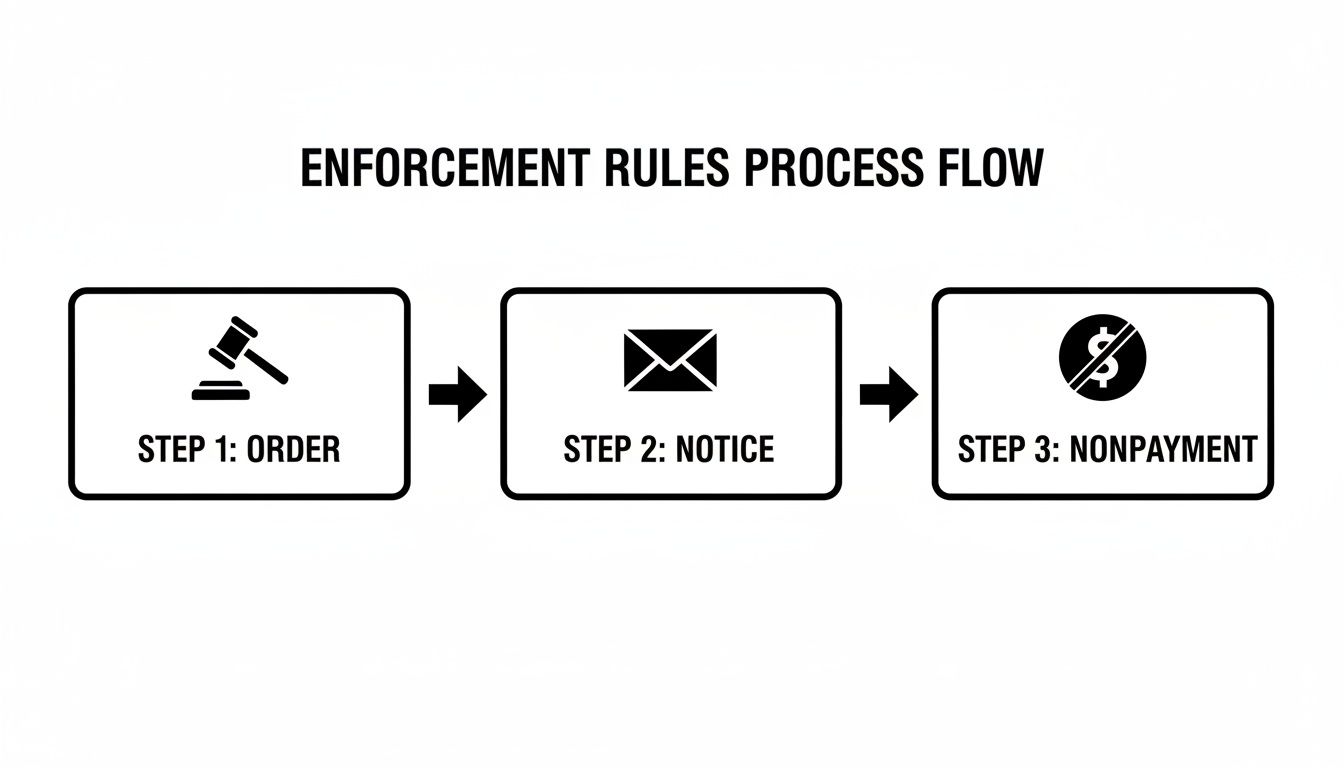
This simple progression—Order, Notice, and Nonpayment—is the core of every contempt case. It establishes both the legal duty and the alleged violation that the court will examine.
Inside the Courtroom: What to Expect at the Hearing
The hearing is a formal proceeding where both parents present their case to the judge. The person who filed the motion (the "Movant") goes first. Their job is to prove two things: that a valid child support order is in place and that the other parent failed to make specific payments.
Evidence is everything. You can't just walk in and say, "He didn't pay." You need to back it up with solid proof. Typically, a Movant will present documents like:
- The official payment history from the Texas Child Support Disbursement Unit.
- Bank statements showing the payments were never deposited.
- A certified copy of the original child support order.
After the Movant makes their case, the Respondent gets their turn. This is their chance to fight back. They can challenge the Movant's evidence or present their own, like receipts for direct cash payments or proof that they were financially unable to pay (which is a specific legal defense). For a more detailed guide on the initial paperwork, you can review our article on filing a motion for contempt of court.
The judge acts as a neutral referee. Their job is to weigh the evidence from both sides against the rules in the Texas Family Code. The final decision isn't based on emotion—it's based strictly on the facts and testimony presented in that courtroom. Once the judge has heard from everyone, they will issue a ruling. If they agree that the Respondent deliberately violated the court order, they will find them in contempt and decide on the punishment.
Potential Penalties and How to Resolve Them

When a judge finds you in contempt of court for nonpayment, the situation gets serious, fast. The consequences aren't just a slap on the wrist; they can genuinely disrupt your entire life. Courts have a wide range of powerful tools to enforce a child support order, and understanding what you're up against is the first step in figuring out a solution.
Let's be blunt: the most severe penalty is jail time. A judge has the authority to sentence you to jail for up to six months and hit you with a fine of up to $500 for each time you violated the order. If you've missed ten payments, you're theoretically on the hook for ten separate violations. It adds up quickly.
The Purge Amount and Civil Contempt
With civil contempt, a judge's primary goal isn't to punish you for past mistakes. It's to compel you to follow the order now. This is where a crucial concept called the "purge amount" comes into play.
Think of the purge amount as the key to your own jail cell. The judge will set a specific dollar figure you must pay to "purge" the contempt. For instance, the judge might say, "You are committed to jail, but you can secure your immediate release by paying $5,000 toward your child support arrears." Paying it gets you out and gets much-needed funds to your child.
Beyond jail, a judge can also place you on community supervision—basically, probation—for as long as 10 years. This comes with strict rules, like making every single payment on time and regularly checking in with a supervision officer. If you slip up, you could find yourself right back in that courtroom, facing a revoked probation and the jail sentence you initially avoided.
Additional Enforcement Tools
A judge’s power doesn't end with fines and jail. The court can authorize a whole host of other measures to collect past-due child support (arrears). These aren't just minor inconveniences; they are designed to impact your financial life until the debt is handled.
Some of the most common enforcement tools include:
- License Suspension: The court can order the suspension of your driver's license, professional licenses (like for nursing or contracting), and even recreational licenses for hunting and fishing.
- Wage Garnishment: This is a big one. An "income withholding order" is sent directly to your employer, who is then legally obligated to deduct support payments straight from your paycheck.
- Property Liens: A lien can be slapped on your non-exempt property, which could include real estate, bank accounts, or even retirement funds. This means you can't sell or cash out that asset without settling the child support debt first.
- Tax Refund Intercept: If you're expecting a federal tax refund, the court can have it seized and applied directly to what you owe.
For any Texas parent facing a contempt hearing, this is why it is absolutely critical to be able to prove an inability to pay, if that’s your defense. Don't underestimate a motion for contempt of court for nonpayment. The potential outcomes show why you must take it seriously from the moment you're served. For a deeper dive into the consequences, you can learn more about what happens if child support is not paid in Texas in our detailed guide.
How to Build a Defense Against a Contempt Motion
Facing a Motion for Enforcement can feel like the deck is stacked against you. But an accusation of nonpayment isn’t an automatic conviction. A judge can't find you in contempt just because you’re behind on payments. They have to find that you willfully disobeyed the court order.
This is a critical distinction, and it opens the door for you to present evidence and argue your side of the story.
Your strongest line of defense is what the law calls the affirmative defense of inability to pay. This specific defense is laid out in the Texas Family Code § 157.008. When you claim this, the legal burden shifts. It's now your job to prove to the court that you genuinely could not pay your child support as ordered.
The Affirmative Defense of Inability to Pay
This isn't as simple as telling the judge you were short on cash. The Texas Family Code sets a very high bar. To successfully use this defense, you must prove all of the following things were true for the period you didn't pay:
- You lacked the financial ability to provide support in the amount ordered.
- You had no property or assets that could be sold, mortgaged, or otherwise tapped into to get the funds.
- You tried, and failed, to borrow the money.
- You had no other source from which you could have legally obtained the money.
Essentially, you have to paint a clear picture for the judge showing that you were completely out of options and that your failure to pay was not a choice.
Proving inability to pay is all about documentation. It's your word against a court order, and without concrete evidence, your defense is on shaky ground. You have to build a case that shows your financial hardship was real, involuntary, and left you with no way to comply.
Example: Imagine a parent was unexpectedly laid off from a long-term job. They can't just show up and say, "I was unemployed." To build a solid defense under § 157.008, they would need to bring a folder full of proof to court, including:
- The termination letter from their old job.
- A detailed log of their job search, with copies of applications sent and emails about interviews.
- Bank statements showing a lack of income and depleted savings.
- Records showing they applied for personal loans but were denied.
This mountain of evidence demonstrates a good-faith effort to fix the problem and a genuine lack of resources. It makes it much harder for a judge to conclude the nonpayment was willful.
Other Potential Defenses
While the inability to pay is the most common and powerful defense, it’s not the only one. It's crucial to look at every detail of the enforcement action to find other potential weaknesses in the other parent's claim.
Other possible defenses include:
- Vague or Unclear Order: If the original child support order was fuzzy on the exact amount, due date, or how you were supposed to pay, you can argue it was impossible to follow. You can't willfully violate an order that you can't understand.
- Improper Payment Credit: Mistakes happen. If you have proof of payments—like canceled checks, bank transfers, or Zelle receipts—that aren't being counted, you can present this to correct the record.
- The Child's Residence: Did the child actually live with you (the paying parent) for some or all of the time you're accused of not paying? If so, this can be a valid reason to contest the arrears that piled up during that period.
Successfully defending against a contempt of court for nonpayment charge requires a proactive, evidence-based strategy. You have to be ready to open up your financial life to the court and provide undeniable proof that you didn't deliberately ignore your obligation.
Proactive Strategies and When to Hire an Attorney
When it comes to a contempt of court for nonpayment action, getting ahead of the problem is always smarter, easier, and less stressful than defending yourself in front of a judge. Whether you’re the parent owed money or the one struggling to pay, the steps you take before things spiral out of control are what really matter.
For the Parent Owed Child Support
It is infuriating when child support payments stop. While you can file a Motion for Enforcement after the first missed payment, it's often more strategic to let two or three months of missed payments accumulate. This demonstrates a clear pattern of non-compliance to the judge. However, don't wait too long. The longer you wait, the harder it can be to collect the full amount.
The Most Important Move for Paying Parents
If you are the parent ordered to pay support and your income has dropped for any reason—a layoff, a pay cut, a health issue—you have one critical move to make: file a Petition to Modify your child support order immediately.
This is the only way the law recognizes to lower your monthly obligation. A verbal agreement with your ex means nothing in court and offers you zero protection from an enforcement action. A judge cannot go back in time and reduce what you owed in previous months. Any change to your support amount only applies from the day you formally file the Petition to Modify and serve the other parent. This is the single biggest mistake parents make, and it’s how manageable problems snowball into massive arrears and a contempt charge with potential jail time. The standard for modification is showing a "material and substantial change" in the circumstances of a parent or the child.
When to Call an Attorney Immediately
Some fights are too risky to handle alone. In a contempt case, your freedom can be on the line, and knowing when to get professional help is not optional—it’s essential for protecting your rights.
You should hire an attorney if:
- You’ve been served with a Motion for Enforcement or a Show Cause Order. This isn't a friendly letter; it’s a legal summons that requires a formal, strategic response.
- Your income has changed, and you need to file a Petition to Modify. An attorney ensures the paperwork is done right and that the new support amount is calculated fairly based on Texas law.
- The other parent has a lawyer. Walking into court alone against a trained attorney puts you at a severe disadvantage from the start.
- Your case involves tricky financial situations, like income from self-employment, inconsistent commissions, or suspicions that the other parent is hiding assets.
Taking proactive steps, like filing a timely Petition to Modify, isn’t just good advice—it’s your primary defense against a future contempt charge. It demonstrates to the court that you are acting in good faith and respecting your legal obligations, even when facing financial hardship.
Don’t wait until you’re backed into a corner and facing jail time. Whether you need to enforce an order or defend against a contempt of court for nonpayment charge, the best outcomes come from making smart, informed decisions early on.
Your Top Questions About Texas Child Support Contempt
When you're staring down a potential contempt of court for nonpayment action, the questions can feel overwhelming. You need clear answers, not legal jargon. Based on my experience helping Texans through these situations, let's break down some of the most common concerns.
Can I Go to Jail for Being Unemployed and Unable to Pay Child Support?
This is the number one fear I hear, and the short answer is no—you can't be jailed just for being unemployed. The key word here is willfully. A Texas court has to believe you had the money to pay but deliberately chose not to.
Under Texas Family Code § 157.008, proving you were unable to pay is what we call an "affirmative defense." The responsibility falls on you to show the judge you had no income, couldn't borrow the money, and didn't have property you could sell to cover the debt. Things like a termination letter and a detailed log of your job search become critical pieces of evidence. Be warned, though: if the judge suspects you're just avoiding work or taking a lower-paying job on purpose, you can still be found in contempt.
How Far Back Can Unpaid Child Support Be Collected in Texas?
For all practical purposes, there’s no expiration date on collecting a child support judgment in Texas. Once the court confirms the total amount of your arrears (the past-due support) and turns it into a formal judgment, that judgment is good for ten years.
But here’s the crucial part: that judgment can be renewed over and over again, each time for another ten-year period. This means the other parent can pursue enforcement actions—like garnishing your wages or putting a lien on your property—long after your child is an adult. Old child support debt doesn't just vanish over time.
What if I Pay the Other Parent Directly Instead of Through the State Registry?
I can't stress this enough: paying the other parent directly with cash or through an app like Venmo is incredibly risky. The Texas Family Code operates under the assumption that any payment made outside the official State Disbursement Unit (SDU) was a gift, not a child support payment.
The burden of proof will be entirely on you to convince the judge that those direct payments were for child support and should be counted. You would need a flawless paper trail, like signed receipts for every single payment or bank statements with crystal-clear memo lines. To avoid any "he said, she said" battles in court, always pay exactly how your court order tells you to.
My Income Decreased. Can I Just Pay Less Child Support?
Absolutely not. You are legally required to pay the full amount listed in your current court order until a judge officially signs a new one. It doesn't matter if you and the other parent have a verbal agreement to lower the payments; that agreement won't hold up in court.
If your financial situation has had a "material and substantial change," you must file a Petition to Modify your child support order with the court immediately. A modification can only reduce your payments from the date you file the petition forward—it can't go back and erase what you already owe. Acting fast is the only way to protect yourself from a future enforcement action for contempt of court for nonpayment.
Whether you need to enforce a child support order or you're the one being served with a motion, navigating a contempt action demands a solid legal strategy. At the Law Office of Bryan Fagan, our attorneys live and breathe Texas child support law, and we bring that focused experience to every case. If you need to understand your options, contact us for a consultation at https://txchildsupport.net.