When a court order for child support is just a piece of paper the other parent ignores, it can leave you feeling powerless and create incredible financial stress. This is precisely when you need to turn that ignored order into an enforceable command. Filing a motion for contempt of court is the most powerful tool in your Texas family law toolkit to make that happen.
This isn't about revenge. It’s about using the court's authority to force compliance and get the support your child is legally owed.
When It's Time to Force Compliance

You have a child support order, which means you have a legal right to receive timely payments. When those payments become sporadic or stop altogether, you don't have to just wait and hope. The law provides a clear path forward.
That path is a Motion for Enforcement, which almost always includes a request to hold the non-paying parent in contempt of court. Taking this step sends a clear message to both the other parent and the judge: you're serious, and the games are over. The entire process is grounded in the Texas Family Code, Title 5, Chapter 157, which lays out exactly how enforcement actions work.
Understanding the Two Types of Contempt
When you file for enforcement, you’re asking the court to find the other parent in contempt. But it's important to know that there are two different kinds of contempt in Texas family law, each with a very different purpose.
Understanding this distinction is key, as your motion will likely ask the judge to use both civil and criminal contempt to get the other parent to comply.
| Aspect | Civil Contempt (Coercive) | Criminal Contempt (Punitive) |
|---|---|---|
| Purpose | To coerce future compliance. It's forward-looking. | To punish past, willful violations of the court order. |
| Key Phrase | "You hold the keys to your own jail cell." | "You broke the rules, and this is the consequence." |
| Potential Outcome | Jail time that can be "purged" or avoided by complying (e.g., paying a lump sum). | A fixed sentence of jail time (up to 180 days per violation) and/or a fine that cannot be avoided by later compliance. |
| Example | "You're sentenced to 90 days, but the sentence is suspended if you pay $5,000 by Friday." | "For willfully failing to pay support in June, you are sentenced to 30 days in jail." |
Essentially, civil contempt is the carrot-and-stick approach to get the money flowing again, while criminal contempt serves as a penalty for thumbing their nose at the court's authority. A skilled attorney will use the threat of both to maximize pressure.
The Real-World Impact of an Enforcement Action
Filing for contempt is a serious move. Under Texas Family Code §157.001, judges have broad authority to enforce child support orders, and they take this duty seriously. The stakes are incredibly high for the non-compliant parent.
The law gives judges the power to order:
- Jail time of up to 180 days per violation.
- Fines and court costs.
- Payment of your attorney's fees.
I’ve seen it happen time and time again: the mere act of being served with a contempt motion is often enough to get a delinquent parent’s attention. Suddenly, a private dispute becomes a very public matter of defying a judge's direct order—something no judge takes lightly.
This legal pressure is often the catalyst that resolves years of non-payment. Sometimes, the issue is part of a larger pattern of difficult behavior. If you're dealing with a high-conflict co-parent, you may find our guide on navigating parent alienation in Texas to be a helpful resource.
By filing, you’re doing more than just collecting past-due support. You’re taking a proactive step to secure your child’s financial stability and send a message that the court's orders will be followed.
Gathering the Proof You Need to Win
When you decide to file a motion for contempt, you aren't just telling the judge the other parent isn't paying—you're preparing to prove it. A successful enforcement action is built on a foundation of clear, undeniable evidence. Your job is to transform a frustrating story of missed payments into a factual record the court simply cannot ignore.
Think of yourself as the lead investigator on your own case. We'll walk through exactly what you need to gather to build a rock-solid argument, leaving no room for excuses or doubt. This process will demystify what feels like a daunting task and turn your frustration into focused, effective action.
Creating an Ironclad Payment Ledger
The single most important document you will create is your payment ledger. This isn't a mental tally or a rough guess; it’s a formal, detailed log of every single payment that was ordered, what was actually received, and what was missed. A vague claim of "he's behind on payments" just won't cut it in court. You need precision.
Your ledger should be organized neatly, like a spreadsheet. Make sure it includes columns for:
- Date Payment Was Due: Match this to the date in your court order (e.g., the 1st of every month).
- Amount Due: The exact dollar amount specified in your order.
- Date Payment Was Received: The actual date the money arrived.
- Amount Received: Log the exact amount paid, especially if it was only a partial payment.
- Amount Overdue: Keep a running total of the arrears (the total amount owed).
This detailed log becomes the backbone of your Motion for Enforcement. From a judge's perspective, each missed or partial payment is a separate violation of their order. When they see a clean, month-by-month breakdown, they can instantly grasp the history and scale of the non-compliance.
Essential Documents to Back It Up
Beyond your personal ledger, you need official records to prove your claims. The goal here is to paint a complete financial picture that shows the other parent had the ability to pay but simply chose not to.
Start by gathering these critical documents:
- Texas Child Support Disbursement Unit Records: If your payments are supposed to go through the state, this is your gold standard. Print the complete payment history directly from their online portal. Judges often see this as the most credible, unbiased record available.
- Bank Statements: Your own bank statements showing deposits—or the lack thereof—are incredibly powerful. Highlight the relevant lines to make it easy for the judge to see what you're talking about.
- Written Communications: Never underestimate the power of a text message or email. Any communication where the other parent acknowledges the debt, promises to pay, or offers excuses can be invaluable. A message saying, "I know I owe you for last month, I'll get it to you soon," is a direct admission that they knew they were behind.
Imagine this scenario: The other parent claims in court that they're unemployed and broke. But a quick look at their public social media profile shows photos from a recent expensive vacation or a brand-new truck. This kind of evidence directly contradicts their claim of an inability to pay and shows the judge they have access to money they aren't using for child support.
The Power of Simply Filing the Motion
Here's something many people don't realize: gathering all this evidence isn't just for a trial. The mere act of filing a well-documented motion often scares the other parent into compliance. The very real prospect of facing a judge with a mountain of proof is a powerful motivator. In my experience, many contempt cases get resolved before the final hearing even takes place.
Research supports this. For instance, findings on court actions and their outcomes show that a significant percentage of enforcement actions result in payment compliance without proceeding to a full-blown punitive hearing. Simply initiating the legal process demonstrates that you will not let the violations slide.
Especially with high-income earners who might try to hide money, filing a motion for contempt forces them to open their books. It puts an end to the games and compels them to provide a full financial disclosure, ensuring the judge’s decision is based on facts, not fiction.
From Proof to Paperwork: The Legal Roadmap
You’ve done the hard work of gathering your proof. Now, it's time to turn that evidence into a formal legal action. This is where precision and procedure take over. Filing a motion for contempt isn't just about submitting a form; it's about kicking off a legal process designed to get you the support you're owed. Let's walk through what that looks like.
Drafting a Powerful Motion for Enforcement
The first move is to draft the Petition for Enforcement of Child Support Order. Think of this document as the backbone of your case. Under Texas Family Code §157.002, it must be incredibly specific, laying out every single violation of the court's order.
A weak motion might just say, "He's behind on child support." That won't fly. A strong, effective petition lists each and every failure to pay as a separate count. For each one, you must state:
- The exact part of the court order that was ignored.
- The date the payment was missed.
- The precise amount of money that was due on that date.
- The running total of arrears (the total past-due amount).
This level of detail shows the judge a clear, undeniable pattern of non-compliance. It’s not just a complaint; it's a documented history of the other parent ignoring a direct court order.
Why Personal Service is Non-Negotiable
Once your motion is filed with the district clerk, the next step is an absolute must: personal service. This isn't optional. It means a neutral third party—like a sheriff, constable, or a private process server—has to physically hand a copy of the motion and a "show cause" order to the other parent.
Why so strict? Because contempt actions can lead to jail time, Texas law demands that the accused person's due process rights are protected. They have to be formally notified of the charges and ordered to appear in court to "show cause"—meaning, to give a reason why they shouldn't be held in contempt.
A common and costly mistake is thinking you can just mail, text, or email the documents. You can't. If you don't get proper personal service, your case will be dead in the water. The judge has no authority to move forward without it.
If you have no idea where the other parent is, our firm has access to professional process servers and investigators who specialize in locating people for this very purpose.
Getting Ready for the Show Cause Hearing
The show cause hearing is the main event. This is where you and your attorney present your case directly to the judge. These hearings are usually quick and to the point, focused on one thing: determining if the order was violated and if the other parent had the ability to pay.
Your attorney will present the evidence you’ve collected—the payment log, bank statements, and any relevant texts or emails—in a simple, organized way. The other parent will then get their chance to offer a defense. The most common one you'll hear is, "I couldn't afford to pay."
This is where your detailed preparation pays off. By using their own financial records against their claims, a skilled attorney can often demonstrate that they did have the money but simply chose to spend it elsewhere.
To build an airtight case, you need to have your evidence in order. Here’s a simple visual of the core proof you’ll need to assemble.
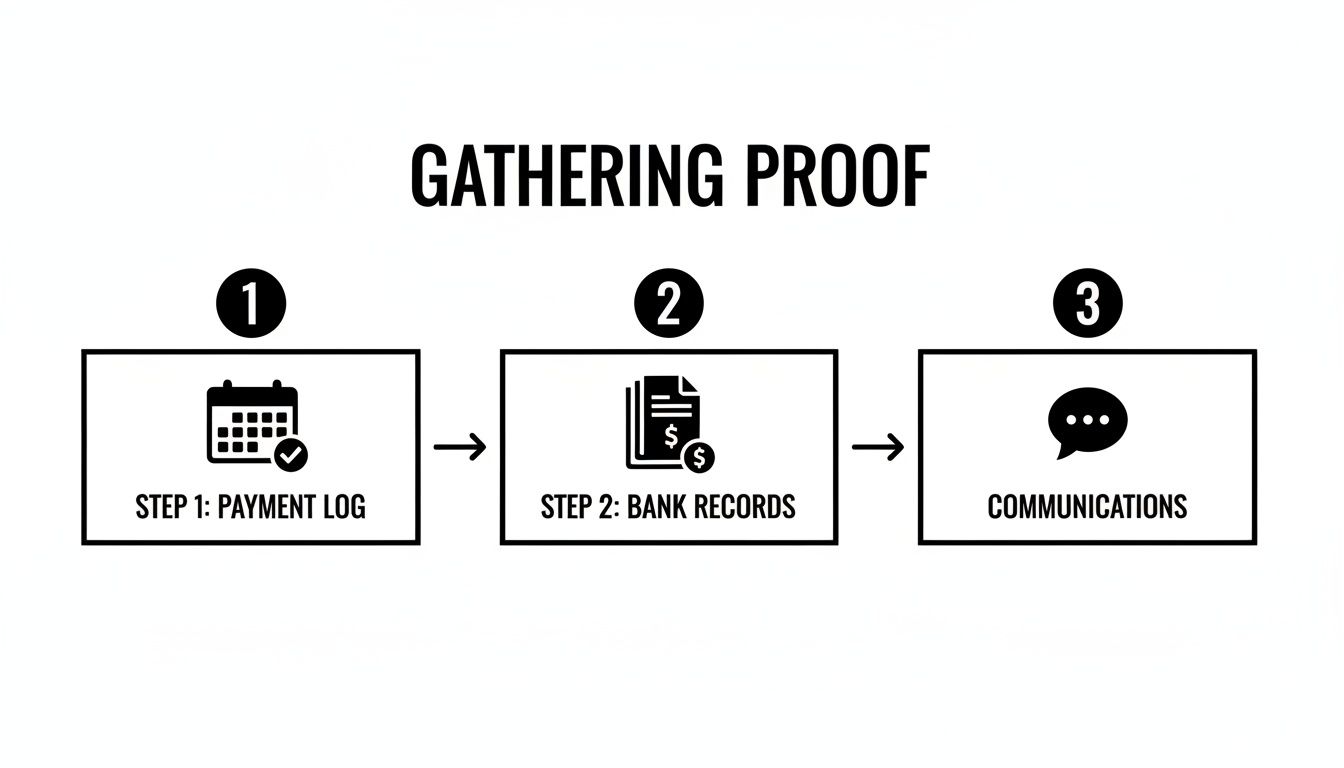
When your argument is built on a solid foundation of facts, it's tough for the other parent to argue. The judge will have questions, and having this documentation ready allows you to provide clear, confident answers that get straight to the point.
Possible Outcomes, Sanctions, and Defenses
Once your motion is filed and you've laid out your evidence, the ball is in the judge's court. It’s important to understand what can happen next, from the penalties the other parent might face to the defenses they might try to use. Texas judges have a lot of power to enforce their orders, and frankly, they don't appreciate being ignored.
Sanctions a Judge Can Impose
Under Texas Family Code §157.167, a judge has several ways to hold a non-compliant parent accountable. The goal here isn't just punishment—it's about getting the parent to pay what they owe and making sure they keep paying in the future.
Here are some of the most common remedies a judge can order:
- A judgment for the total amount of unpaid child support, plus 6% annual interest on those arrears.
- An order forcing the other parent to pay your attorney's fees and all court costs.
- Community supervision (probation) that can last for up to ten years, which always includes a strict schedule for paying back what's owed on top of current support.
Perhaps the most powerful tool in a judge’s arsenal is a suspended jail sentence. This is a very effective way to get someone's attention and give them one last chance to follow the court's order.
Here's a real-world example: A judge might sentence the parent to 180 days in county jail but then "suspend" that sentence. This means the parent stays out of jail as long as they follow specific conditions, like paying a lump sum toward the arrears immediately and then making consistent monthly payments (say, an extra $500/month) until they're caught up. If they miss even one of those court-ordered payments, the suspension is lifted, and they go directly to jail. This creates an incredibly powerful incentive to pay.
Common Defenses and How We Counter Them
The most common excuse you’ll hear in a contempt hearing is, "I can't afford it." A claimed "inability to pay" is an affirmative defense under Texas Family Code §157.008, but the burden is on the other parent to prove it. Our job is to show the judge that's simply not the whole story.
We dismantle this defense by bringing their real financial life into the courtroom. This means showing the judge evidence that tells a different story:
- Bank statements that reveal spending on non-essentials like vacations, dinners out, and hobbies.
- Social media posts that show off a new car, expensive trips, or a lifestyle that doesn't match their claims of poverty.
- Pay stubs, employment records, or business documents that contradict what they're telling the court about their income.
Sometimes, a parent will purposely take a lower-paying job to try and reduce their obligation. When we see this, we can ask the judge to find them "intentionally underemployed or unemployed" under §154.066. This allows the court to calculate child support based on what they should be earning, not their current depressed income. When making this argument, we reference the state's guideline income caps—like the $11,700 net monthly resource cap effective September 1, 2025—to show the judge the kind of income someone with their skills and experience could realistically earn.
These enforcement actions have a high success rate when they're prepared correctly. When you present clear, undeniable evidence, judges will act. For a deeper dive into the consequences of non-payment, check out our guide on what happens when child support is not paid in Texas. A well-documented case makes it nearly impossible for a non-compliant parent to hide behind flimsy excuses.
Other Powerful Enforcement Tools in Texas

While hauling the other parent into court for contempt is a direct and often necessary step, it's not the only tool we have. Texas law gives us several powerful ways to enforce a child support order, which can be used either with a contempt action or as a standalone strategy.
Sometimes, the smartest move isn't another court date. It's about strategically targeting the other parent's finances and privileges to make non-payment a major problem for them. By using a combination of tactics, we can apply pressure from multiple angles to get the support your child deserves.
Placing a Lien on Property and Assets
One of the most effective methods, particularly when dealing with a parent who is self-employed or owns significant property, is a child support lien. Once we file a lien under Texas Family Code Chapter 157, Subchapter G, it becomes a financial deadbolt.
This means they can't sell, refinance, or even get a loan against that asset without paying the child support debt first. Picture this: the other parent is all set to sell their house, but the title company runs a search, finds our lien, and stops the closing cold until you are paid in full.
A lien can lock down a surprising range of assets:
- Real estate, like homes and land
- Bank and other financial accounts
- Retirement funds, including 401(k)s and IRAs
- Potential lawsuit settlements or personal injury claim payouts
This is a potent tool because it works quietly behind the scenes. It can completely block major financial transactions until they settle up with you.
License Suspension and Other Administrative Actions
The state can also put serious pressure on a non-paying parent by going after the licenses they depend on for daily life and work. Through the Texas Attorney General's Office, we can trigger the suspension of various state-issued licenses for delinquent child support under Texas Family Code Chapter 232.
This isn't an empty threat. It’s a real process that can lead to the suspension of their:
- Driver's License: This is often the most persuasive. Suddenly, they can't legally drive to work or run errands, making non-payment an immediate, personal crisis.
- Professional Licenses: This is a career-killer for doctors, lawyers, contractors, real estate agents, and others. If they lose their license, they can't work legally.
- Recreational Licenses: Even their hunting and fishing licenses are on the table, adding one more consequence for failing to meet their obligations.
The real power here is the immediate inconvenience. A contempt hearing might be weeks away, but the prospect of not being able to drive to work tomorrow can motivate someone to pay up very, very quickly.
Intercepting Funds and Seizing Accounts
Beyond liens and license suspensions, we can take direct action to seize money owed to the non-compliant parent. This is another highly effective route for collecting past-due support, often without the need for a drawn-out court fight.
A common tactic is intercepting their federal income tax refund. If they're expecting money back from the IRS, we can make sure that refund is redirected to you to pay down the child support debt before they ever see a penny of it.
Another powerful move is a bank account levy. Armed with a court order, we can legally instruct a bank to freeze the other parent’s account and turn over the funds to satisfy the arrears. It's a direct, surprising action that delivers immediate results, especially if you have an idea of where they bank. For those facing significant arrears, you can learn more about how to collect back child support and see which of these tools is the right fit for your case.
Texas Child Support FAQs
When you're dealing with unpaid child support, your head is probably swimming with questions. It's a stressful situation, and the legal process can feel intimidating. Let's walk through some of the most common questions our clients ask so you can get a clearer picture of what to expect.
How is child support calculated in Texas?
Texas courts use a clear formula outlined in the Texas Family Code. First, the court determines the paying parent's average "net monthly resources." As of September 1, 2025, the law presumes this income does not exceed $11,700 per month. For one child, support is 20% of that net income (§154.125). For two children, it's 25%; for three, it's 30%, and so on, up to 40% for five or more children (§154.129).
Example: If a parent's net monthly resources are $6,000, guideline child support for one child would be $1,200 per month ($6,000 x 0.20). For two children, it would be $1,500 ($6,000 x 0.25).
How much does it cost to file for contempt in Texas?
Thinking about legal costs is completely normal. The total expense really breaks down into a few parts: court filing fees (usually a few hundred dollars, depending on the county), and the cost to have a sheriff or private process server personally hand the paperwork to the other parent.
Then, of course, there are attorney's fees. But here’s where the law gives you a powerful advantage.
The Texas Family Code is very clear: under §157.167(c), if the judge finds the other parent violated the court order, the judge must order them to pay your reasonable attorney's fees and all court costs. This law exists to ensure that the cost of going to court doesn't stop you from getting the support your child is legally owed.
This provision makes it financially possible for parents to enforce their rights without bearing the entire burden themselves.
Can my ex actually go to jail for not paying child support?
Yes, absolutely. But it's important to understand how and why a judge uses jail time. In Texas, a judge has the authority to sentence a non-paying parent to up to 180 days in the county jail for each violation.
However, the goal isn't just punishment; it's to force compliance. What we often see is a judge using a "suspended sentence." For instance, the judge might sentence the parent to 90 days but then suspend that sentence, putting them on a form of probation. The conditions will be strict: pay a specific lump sum toward the back-support now and make every future payment on time.
If they miss a single payment, that suspension is revoked, and they go directly to jail. The threat of jail is an incredibly effective motivator for getting a non-compliant parent to finally take their obligation seriously.
Can I modify my child support order?
Yes, you can file a Petition to Modify the Parent-Child Relationship. However, to be successful, you must prove there has been a material and substantial change in the circumstances of the child or a parent since the last order was signed (§156.401). Common examples include a significant increase or decrease in the paying parent's income, a change in the child's living arrangements, or a change in the child's needs, such as new medical expenses.
How long does the contempt process take from start to finish?
Every case has its own timeline, but a realistic window is usually somewhere between 60 and 120 days from filing the motion to the final hearing in front of the judge. The speed of your case will depend on a few key things:
- The Court's Schedule: How backed up is the judge's calendar?
- Service of Process: How quickly can we locate and serve the other parent with the lawsuit?
- The Other Parent's Response: Do they hire a lawyer and try to drag things out with legal maneuvers?
Because court dockets can get crowded, time is of the essence. The sooner you start the contempt process, the sooner you can get a hearing on the books and start fighting to recover the financial support your child deserves.
Successfully navigating a child support enforcement action requires more than just filling out forms; it demands a strategic legal approach and a thorough understanding of the Texas Family Code. At the Law Office of Bryan Fagan, PLLC, our practice is dedicated to helping parents enforce their court orders and protect their child's financial stability. If you're ready to take action, contact us today. You can learn more about our experienced team and our approach at https://txchildsupport.net.