Calculating child support in Texas boils down to a formula defined by state law. At its core, the court takes the non-custodial parent's monthly net resources and applies a specific percentage. Your preparation for court begins with understanding precisely how these numbers are determined.
The percentage used depends directly on how many children are involved in the case.
The Foundation of Texas Child Support Calculations
Before you can figure out the final child support amount, you must nail down one key number: monthly net resources. The entire Texas system is built on this figure. For the parent paying support (the obligor), we first must calculate this number, and only then can we apply the right percentage.
This process is all laid out in the Texas Family Code, which aims to keep child support awards predictable and consistent across the state.
A common point of confusion for clients is that this calculation is not based on your take-home pay. The court starts with your total gross income and subtracts only a handful of specific, legally approved deductions to find your net resources, as defined by Texas Family Code §154.062.
The Guideline Percentage System
Under Texas Family Code §154.125, the law presumes a certain amount of support is in the child's best interest. These guideline percentages are applied directly to the obligor’s monthly net resources, but only up to a certain income level.
It's crucial to know that there's a cap on the income subject to these standard guidelines. Effective September 1, 2025, that cap increases to $11,700 in monthly net resources. Any income earned above this cap isn't automatically factored in. However, a judge can order additional support if the child has proven needs that justify a higher amount—something we’ll get into later.
Key Takeaway: The guideline percentages are the default standard for Texas courts. A judge will start with this formula unless one of the parents can prove a different amount is more appropriate for the child's specific situation.
Standard Guideline Percentages
The following table outlines the standard percentages of monthly net resources used to calculate child support under Texas Family Code § 154.125.
These percentages are the starting point for almost every child support calculation in Texas.
Texas Child Support Guideline Percentages
| Number of Children Before the Court | Percentage of Net Resources |
|---|---|
| 1 | 20% |
| 2 | 25% |
| 3 | 30% |
| 4 | 35% |
| 5 or more | Not less than 40% |
Let’s look at a practical example. If a parent has net monthly resources of $5,000 and has two children, the presumed child support award would be $1,250 per month (25% of $5,000).
These rules give everyone a solid baseline, but plenty of other factors can change the final number. If you're heading into a child support case, understanding how these initial calculations work is your first step. For more detailed guidance, learn more about how a dedicated Texas child support lawyer can help you prepare. This knowledge empowers you to know what to expect and advocate for a fair outcome.
Calculating Monthly Net Resources for Child Support
Everything in a Texas child support case starts with one number: the paying parent's monthly net resources. Before you can even think about percentages, you have to figure out this crucial amount. The entire process is laid out in the Texas Family Code, but it's where most of the confusion and arguments happen.
It’s not as simple as looking at take-home pay on a paycheck. The court has its own specific formula, and what you think counts as "income" or a valid "deduction" might not be what the law says. This is, without a doubt, the most common source of disputes I see in my practice.
This flowchart gives you a bird's-eye view of how the numbers flow from income to the final support amount.
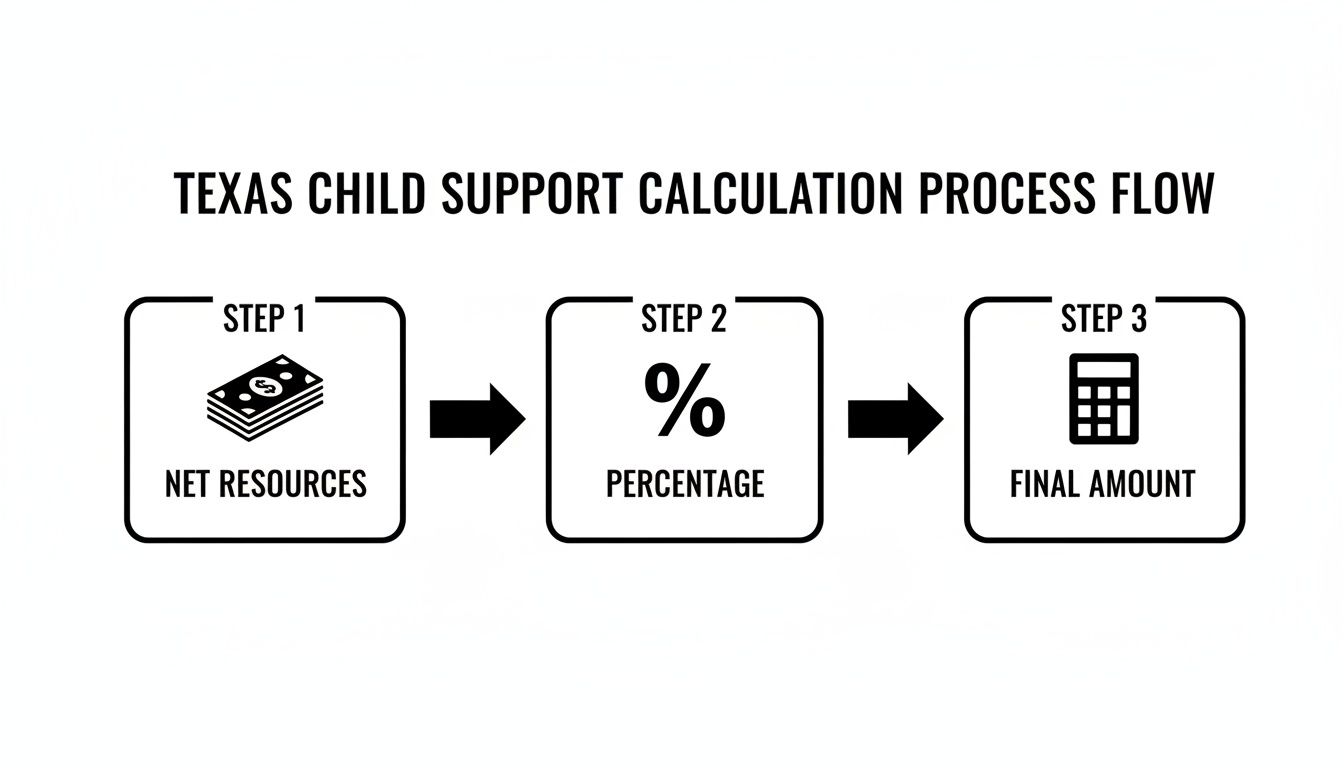
As you can see, it all funnels down from gross income, through a few specific deductions, to get to the net resources figure that the guideline percentages are applied to.
What Counts as Gross Income?
First, the court casts a wide net to identify all sources of the parent's gross income. The definition under the Texas Family Code on child support is intentionally broad and covers a lot more than just a base salary.
Here’s a look at what the court will almost always include:
- Wages and Salary: This is the obvious one—regular pay, commissions, tips, and overtime.
- Self-Employment Income: The net profit (revenue minus ordinary and necessary business expenses) from any business you run.
- Bonuses and Severance Pay: Those lump-sum payments from an employer are typically counted.
- Investment Income: Think interest, dividends, and capital gains.
- Rental Income: Your net income from properties after subtracting the mortgage (P&I), insurance, taxes, and necessary maintenance.
- Other Sources: This bucket can include retirement benefits, pensions, most Social Security benefits (but not SSI), unemployment, and workers' compensation.
A common battleground is overtime pay. If a parent works consistent overtime, a judge will almost certainly include it. If it was truly a one-time event, a good attorney can argue it shouldn't be baked into a long-term support obligation.
The Only Deductions That Matter
Once you have a gross monthly income figure, the law allows for only a handful of specific deductions to calculate net resources. This is not a budget worksheet; you can't deduct your car payment, rent, or credit card bills.
These are the only expenses you can subtract:
- Federal income tax (calculated as if you're a single person with one exemption)
- Social Security and Medicare taxes (FICA)
- State income tax (if you work in another state and pay it)
- Union dues
- Health and dental insurance premiums paid for the child(ren) involved in the case
Here's a critical detail many people miss: The income tax deduction isn't what you actually pay. The court uses a standardized tax chart that assumes a single filer with one deduction. This often means your "net resources" for child support purposes will be higher than your actual take-home pay, especially if you're married and filing jointly.
A Practical Example of the Calculation
Let's walk through a scenario to put it all together.
Imagine a parent who is a W-2 employee with a gross monthly salary of $7,000. They also pay $300 per month out of their own pocket to keep their two kids on their health insurance plan.
- Gross Monthly Income: $7,000
- Statutory Deductions:
- Social Security & Medicare (FICA at 7.65%): $535.50
- Federal Income Tax (using the official tax charts): roughly $800
- Child's Health Insurance Premium: $300
- Total Deductions: $535.50 + $800 + $300 = $1,635.50
- Monthly Net Resources: $7,000 – $1,635.50 = $5,364.50
With $5,364.50 in monthly net resources for two children, the guideline child support amount would be 25% of that, which comes out to $1,341.13 per month.
Getting this right demands careful work. You'll need to gather pay stubs, tax returns, and proof of any insurance payments to build an accurate calculation from the very start.
Understanding the Texas Child Support Cap for High-Income Earners
When you’re dealing with high net resources in a Texas child support case, the concept of a “cap” is one of the most important—and often misunderstood—rules. This cap sets a presumptive limit on the income used for the standard support calculation. Getting this wrong can lead to a major miscalculation of what a parent might be ordered to pay.
The Texas Family Code essentially says that the standard child support percentages (20% for one child, 25% for two, etc.) are only presumed to be appropriate up to a certain income level. For every dollar a parent earns above that threshold, the guideline formula doesn't automatically apply.

A Major Shift: The New $11,700 Cap
Effective September 1, 2025, the landscape for high-income cases changed dramatically. The monthly net resource cap was increased from $9,200 to $11,700. This isn't just a minor tweak; it represents a 27% jump in the maximum guideline support possible.
This change means that for parents earning more than the cap, the baseline for their obligation is now significantly higher. For example, with just one child, the maximum guideline support jumped from $1,840 to $2,340 per month. That's an extra $500 a month, or $6,000 per year.
Let’s look at a quick comparison to see the real-world impact.
Scenario: A parent with $15,000 in net monthly resources and two children.
- Before the Change (Old $9,200 Cap): The calculation was 25% of $9,200, which came to $1,840/month.
- After the Change (New $11,700 Cap): Now, the calculation is 25% of $11,700, which equals $2,925/month.
As you can see, the new cap resulted in an increase of over $1,000 per month in guideline support for this family. This legislative change is a substantial reason for many parents to file for a modification of their existing child support orders.
What if the Child's Needs Exceed the Cap?
So, what happens when a child's needs go beyond what the capped support amount can cover? The law has a built-in solution for this. While the cap creates a presumptive maximum, Texas Family Code § 154.123 gives judges the authority to order support above this amount.
However, it's not automatic. To convince a judge to deviate from the guideline, the parent receiving support must provide evidence of the "proven needs of the child." This is where you have to build a case based on facts, documentation, and a clear argument in court.
From Experience: Proving a child's needs isn't about a wish list. It’s about demonstrating, with concrete proof, what is required to maintain the child’s standard of living and support their well-being. You'll need to back up every request with receipts, invoices, and clear testimony explaining why the guideline amount just isn't enough.
A judge will want to see specific, documented expenses. Some of the most common reasons for ordering support above the cap include:
- Private school tuition and related fees.
- Specialized tutoring for academic challenges or enrichment.
- High-cost competitive sports, including travel, coaching, and equipment.
- Significant medical or dental expenses not covered by insurance, like ongoing therapy or orthodontics.
- High-level extracurricular activities like advanced music lessons or intensive arts programs.
Making a successful argument for above-guideline support demands serious preparation. You have to be ready to show the judge exactly why the standard amount falls short. If you're heading into this kind of legal battle, it helps to know the process inside and out. To get a better handle on the procedural side, you should check out our guide on how to file for child support in Texas.
What Happens When Child Support Gets Complicated?
The standard child support formula is just the beginning of the conversation. In the real world, things are rarely so simple. Life throws curveballs—from covering braces and health insurance to figuring out fair payments in a 50/50 custody schedule. These are the details where a straightforward calculation can get messy, and frankly, where most disagreements happen.
Knowing how Texas courts handle these variables is crucial. It helps you set realistic expectations and build a stronger case for what's fair for your child. While the Texas Family Code sets the rules, judges have a lot of room to make the final call based on the unique facts of your situation.

Factoring in Health and Dental Insurance
One of the most common issues is figuring out who pays for the child's health and dental coverage. Texas law is clear: a judge must order one or both parents to provide medical and dental support.
If you're the parent paying the insurance premiums, you get a credit for that cost. The amount you pay for the child's portion of the premium is subtracted from your gross income before the net resources are calculated. This directly lowers your income for the support calculation, which in turn reduces your final child support payment.
From Experience: Always provide proof of the actual amount you pay for the child's portion of the premium. If your premium covers yourself and the child, you must show what portion is solely for the child. An employer's benefits breakdown is the best evidence for this.
But what about costs that insurance doesn't cover? Things like co-pays, deductibles, and orthodontia are handled separately. A judge will typically order these out-of-pocket expenses to be split between the parents. Most of the time it’s 50/50, but a judge can order a different split if one parent is in a much better financial position than the other.
The 50/50 Custody Myth: "Equal Time Means No Child Support"
This is one of the biggest misconceptions I hear from parents. Many logically assume that if they split time with the child 50/50, then no one should have to pay child support. In Texas, that's simply not true.
A 50/50 possession schedule does not automatically cancel out child support. The court will still perform the standard guideline calculation, usually based on the higher-earning parent's income. However, the judge then has the authority to deviate from that guideline amount, specifically because of the equal parenting time.
How Courts Calculate a "Support Offset"
When parents do share time equally, many judges use what's called an "offset" calculation to arrive at a fair number. This method recognizes that both parents are already covering the child's day-to-day costs during their time. It's a way of balancing things out.
The logic is pretty simple:
- Calculate Both Obligations: First, the court figures out what each parent would owe the other based on their individual net resources and the state guidelines.
- Find the Difference: Then, they subtract the smaller obligation from the larger one.
- The Result is the Payment: The parent with the higher income pays the difference to the parent with the lower income.
Here's a quick example involving two children:
- Parent A has monthly net resources of $8,000. Their guideline support would be $2,000 (25%).
- Parent B has monthly net resources of $5,000. Their guideline support would be $1,250 (25%).
- The Offset: $2,000 (Parent A's obligation) – $1,250 (Parent B's obligation) = $750.
In this case, Parent A would be ordered to pay $750 per month to Parent B.
While this offset method isn't written into the law, it has become a very common and practical tool for judges to achieve a fair outcome. State data confirms that courts frequently adjust support in 50/50 cases, with medical expenses often handled as a separate issue. You can find more Texas child support statistics and enforcement trends on FamilyLaw-TX.com for a deeper look at how these cases play out.
Turning Your Calculation Into a Court Order
So, you've run the numbers and have a pretty good idea of what child support should look like in your case. That’s a great first step, but it's just that—a step. An informal calculation, no matter how accurate, is just a number. To give it legal teeth, you need a formal court order signed by a judge.
Without that signed order, you have nothing that can be legally enforced. This is where we move from math to the legal process, whether you're starting from scratch or looking to change an existing support amount.
The First Legal Steps: Filing and Service
Your journey into the court system starts with filing a Petition. If you don't have an existing child support order, you'll likely file a Suit Affecting the Parent-Child Relationship (SAPCR), which can be part of a divorce or a standalone custody case. If you're aiming to change an order that's already in place, you'll file a Petition to Modify the Parent-Child Relationship.
Once your petition is filed with the court clerk, the other parent needs to be formally notified. This is called service of process, and it’s not optional. You can't just text them a picture of the lawsuit or hand them the papers yourself. The law demands that a neutral third party—a sheriff, constable, or private process server—officially delivers the paperwork. This formal delivery starts the legal clock for the other parent to file a response.
I see this mistake all the time: people assume mailing papers to the other parent starts the case. It doesn't. The case only truly begins for the other party once they have been legally served. This protects everyone's due process rights and is a fundamental requirement for the court to have the power to make any orders.
Changing an Existing Child Support Order
Life is unpredictable. Incomes rise and fall, kids' needs change, and living situations are rarely static. Because of this, child support orders can be modified, but you have to go through the proper channels. You can't just start paying less if you lose your job, and you can't demand more just because you heard the other parent got a nice raise.
To get a judge to change your order, you must prove there has been a "material and substantial change in circumstances" since the day your last order was signed. This is the legal standard set out in Texas Family Code §156.401, and it’s what the judge will be looking for.
So what counts as a "material and substantial change"?
- A major jump or drop in the paying parent's income (often a change of 25% or more is a strong indicator).
- A change in health insurance coverage or costs for the child.
- The child's primary residence changing from one parent to the other.
- The paying parent becoming legally responsible for supporting another child.
For instance, if the paying parent’s net resources shot up from $6,000 to $9,000 a month, that's a clear-cut case for requesting an increase in support. On the flip side, an involuntary layoff would be solid grounds to ask for a temporary or permanent reduction.
The Path to a Final Order: Mediation and Hearings
After the initial filing and service, the case moves into a phase called discovery. This is a formal process where both sides exchange the financial information needed to correctly calculate support—things like recent pay stubs, tax returns, and health insurance premium statements. All that homework you did on calculating net resources will really pay off here.
Before you ever get to argue your case in front of a judge, most Texas courts will require you to attend mediation. Here, a neutral third-party mediator works with both of you (and your attorneys, if you have them) to find a middle ground. If you can reach a settlement, your attorneys will draft an Agreed Order for the judge to sign, and you can avoid the stress and expense of a contested trial.
If you just can’t find a way to agree, your case gets set for a final hearing. In the courtroom, you and the other parent will present your evidence and testimony. The judge will listen to both sides, apply the law, and then make a ruling. The result is a Final Order that details the exact monthly support amount, who provides health insurance, and how any uncovered medical bills are split. This document is the finish line—it's legally binding and fully enforceable.
Commonly Asked Questions About Texas Child Support
When it comes to child support, the standard rules only get you so far. Every family's situation is unique, and we find that parents often have very specific, urgent questions that a simple guideline calculation can't answer. Here are some direct answers to the questions we hear most often in our practice.
Can I Get Retroactive Child Support?
Yes, you can. Texas law gives judges the power to order retroactive child support, which is a crucial tool for parents who have been supporting a child without help. This is outlined in Texas Family Code §154.009.
This means a judge can look back—up to four years from when a suit is filed—and order the non-paying parent to make up for support they should have been paying all along. The court will determine what that parent’s net resources were during that time and calculate the support owed.
The big question a judge will ask is: did the paying parent know they had a child and an obligation to support them? If they knew about the child but simply chose not to help financially, the court will almost certainly order a significant lump-sum retroactive payment.
This retroactive amount is usually paid in installments, added on top of the regular monthly child support payment moving forward.
How Does Losing a Job Affect My Child Support Obligation?
Losing your job is a textbook example of a "material and substantial change in circumstances"—the legal reason needed to change a child support order. But here’s the critical part many people miss: your payment obligation does not change or stop automatically.
Your original child support amount is still legally due every month until a judge signs a new, modified order. This misunderstanding can lead to serious legal and financial trouble.
You must immediately file a Petition to Modify with the court to get the process started. A court might then issue a temporary order based on your unemployment income or what it believes your earning potential is. Delaying this filing is a huge mistake that can leave you with thousands of dollars in back-due support, known as arrears.
What Happens if the Other Parent Doesn't Pay Child Support?
When a parent fails to pay court-ordered child support, they are violating a court order, and Texas law provides powerful enforcement tools. Don't wait around hoping for the best. You can hire a private attorney or work with the Office of the Attorney General (OAG) to file a Petition for Enforcement.
An enforcement lawsuit gives a judge several ways to force payment:
- Wage Garnishment: The court can order the parent’s employer to take the support payment directly out of their paycheck.
- License Suspension: A judge can suspend their driver's license, professional licenses (for jobs like nursing or real estate), and even recreational licenses for hunting and fishing.
- Property Liens: A lien can be placed on bank accounts, homes, and other property, which prevents the parent from selling or refinancing until the child support debt is settled.
- Contempt of Court: If a judge finds the non-payment was willful, they can hold the parent in contempt. This can mean jail time and a judgment for all the back-due support, plus interest.
It's vital to document every single missed or partial payment. This record becomes the bedrock of a successful enforcement case. The law is squarely on your side to collect the financial support your child deserves.
Figuring out how to calculate child support in Texas is more than just plugging numbers into a calculator—it takes real legal strategy. Whether you're setting up the first order, need a modification because of the new $11,700 cap, or must enforce an order for unpaid support, our team is here to fight for you. Don't try to handle the court system by yourself. The attorneys at the Texas Child Support Law Office of Bryan Fagan can protect your rights and your child's financial future. Contact us today for a consultation.