When your child's other parent fails to pay court-ordered child support, it is a direct violation of a court order and can create immense financial strain. Texas law provides powerful legal mechanisms to enforce these orders and collect the financial support your child is legally entitled to receive.
Your primary options are to either engage the Office of the Attorney General (OAG) for administrative enforcement or hire a private family law attorney to file a judicial enforcement action directly with the court. Understanding the procedural steps and strategic advantages of each path is critical to preparing for court.
Your Options for Unpaid Child Support in Texas

Choosing the right path depends on your specific situation, particularly the urgency of your need for results and the level of control you wish to maintain over the legal process.
The OAG provides a robust service at no cost to you, but it is a large state agency with an enormous caseload. While effective, the process can be slow and impersonal, offering you limited direct input or control over the timeline.
Conversely, retaining a private attorney to file a judicial enforcement lawsuit provides a direct and expedited route to the judge. This approach is typically much faster and grants access to more potent enforcement tools, most notably holding the non-paying parent in contempt of court. This strategy puts you in control of your case.
It is also crucial to understand that you can collect all past-due support, known as "arrearages," plus 6% annual interest on the unpaid balance as mandated by the Texas Family Code. You can learn more about how to collect back child support in our comprehensive guide to understand every tool available as you prepare to enforce your order.
Preparing Your Case: Gathering the Essential Evidence
Before filing any legal action, you must meticulously prepare your evidence. A successful enforcement action is built on a foundation of clear, undeniable proof.
Your first step is to obtain a certified copy of your child support order from the district clerk's office in the county where it was issued. This document is the legal bedrock of your entire claim.
Next, you will construct a detailed payment ledger. This is your accounting to the court, tracking every payment that was ordered versus what was actually paid.
Your ledger must include:
- The date each payment was due per the order.
- The exact amount owed for that payment.
- The amount that was actually paid (if any).
- A running total of the past-due balance (the "arrearages").
A critical, often-overlooked detail is to calculate and add the 6% annual interest that accrues on the unpaid balance. This is your right under Texas law and can substantially increase the total amount owed over time.
Your documentation is your power in court. A precise, organized, and accurate payment history presents an undeniable factual record to the judge, making it exceedingly difficult for the other parent to dispute the non-compliance.
Finally, gather all written communications with the non-paying parent regarding the missed payments, such as text messages, emails, or social media messages. This evidence can be vital in proving they were aware of their obligation but willfully chose not to fulfill it.
Administrative vs. Judicial Enforcement: Which Path Is Right for You?
When child support payments cease, you face a critical decision: how to enforce the order. In Texas, the choice between administrative and judicial enforcement will significantly impact the speed, cost, and ultimate outcome of your case.
One option is to work with the Office of the Attorney General (OAG). Many parents choose this route because the OAG's services are provided at no cost. The OAG possesses powerful tools for locating non-paying parents and their assets by accessing state and federal databases unavailable to private citizens.
The primary disadvantage is the OAG's massive caseload. As a state bureaucracy, cases can languish for months before significant action is taken. You relinquish control over strategy and timelines, becoming one of thousands of cases being managed simultaneously.
The alternative is to retain a private attorney and pursue judicial enforcement directly in court. This approach places you in command. An attorney can file a Motion for Enforcement immediately and secure a court date, often within weeks. This unlocks the court's full authority. A judge can find the non-paying parent in contempt of court, a serious ruling that can result in jail time and significant financial penalties. The threat of contempt is often the single most effective motivator for compelling swift payment.
Comparing OAG Administrative vs. Private Judicial Enforcement
To assist your decision, here is a direct comparison of the two enforcement paths.
| Feature | OAG Administrative Enforcement | Private Judicial Enforcement |
|---|---|---|
| Cost | Free to the custodial parent. | Requires attorney's fees and court costs. |
| Speed | Often slow; can take many months to see action. | Much faster; a lawsuit can be filed immediately. |
| Control | Very little; you are subject to the OAG's timeline. | You and your attorney control the case strategy. |
| Remedies | Primarily administrative (wage withholding, liens). | Includes all administrative remedies plus contempt of court (jail time). |
| Caseload | One caseworker handles hundreds or thousands of cases. | Your attorney provides personalized attention. |
If time is of the essence and applying maximum legal pressure is your goal, the judicial path is superior. If you can afford to be patient and lack the funds for legal representation, the OAG is a viable, albeit slower, alternative.
Regardless of your chosen path, your success depends on solid evidence. You must prove your case with documentation.
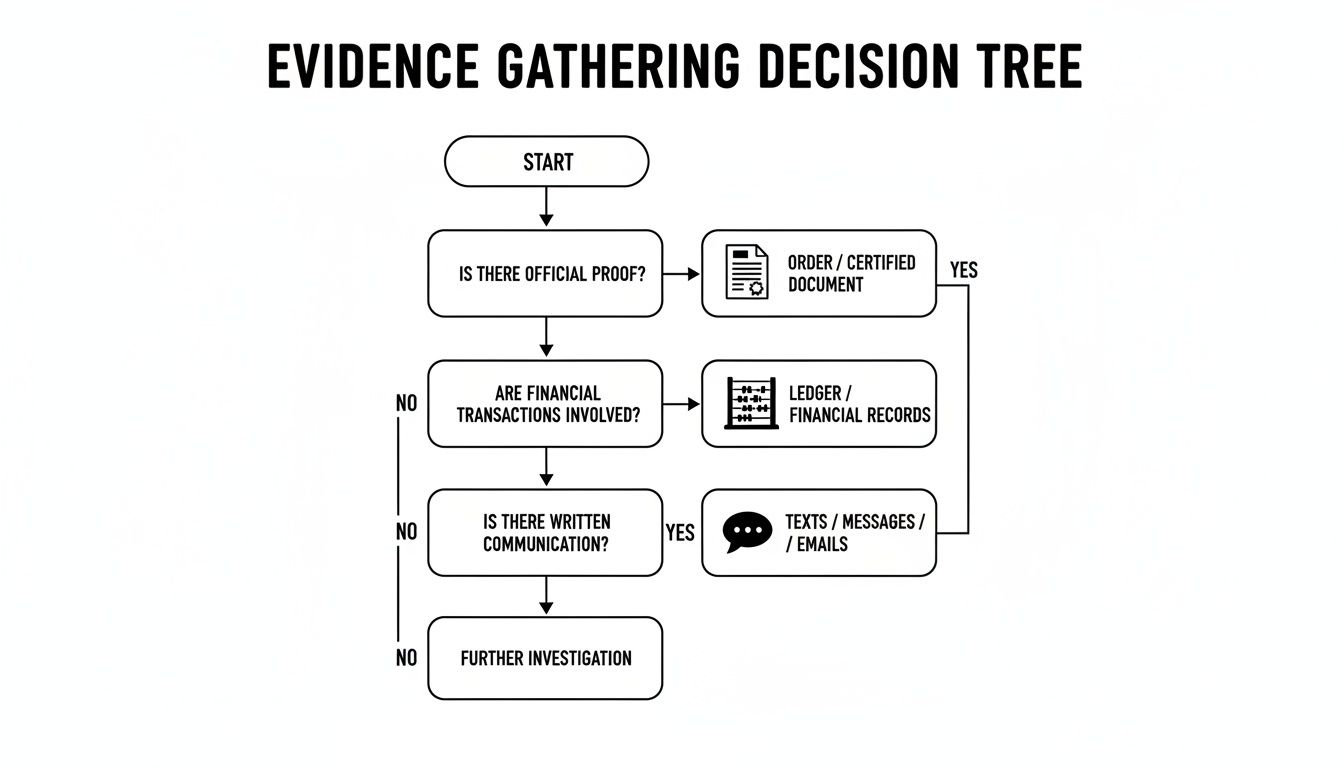
This flowchart outlines the essential documents for building your case. It rests on three pillars: the official court order, a clear payment history (or lack thereof), and any communications regarding the missed payments. Organizing these elements is your first and most critical step.
The Enforcement Toolkit in the Texas Family Code

When a parent defaults on child support, the Texas Family Code equips you with a formidable set of tools to compel payment. You are not left to handle this alone.
The most common and reliable method is wage withholding. This functions as a garnishment specifically for child support. The court issues an "Order/Notice to Withhold Income for Child Support" directly to the obligor's employer. The employer is then legally required to deduct the support amount from each paycheck and remit it to the State Disbursement Unit. It is an automatic and highly effective mechanism once in place.
But what if the other parent resides in another state? The Uniform Interstate Family Support Act (UIFSA) ensures that a Texas child support order is enforceable across state lines, preventing parents from evading their obligations by simply relocating.
For more obstinate cases, the court can employ more aggressive tactics. A child support lien can be placed on the obligor's property, such as real estate, vehicles, or bank accounts. This prevents the sale or transfer of the asset until the child support debt is satisfied.
The state can also apply pressure through license suspension. We have seen cases where suspending a parent's driver's license, professional license (e.g., medical, legal, contracting), or even a hunting and fishing license is the catalyst that finally compels payment. At the federal level, the OAG can request passport denial and intercept federal tax refunds to satisfy the debt.
These enforcement measures are essential. For a deeper look at the legal framework, you can review the foundational laws of the Texas Family Code for child support to better understand your rights.
How to File a Motion for Enforcement in Court

When administrative actions are insufficient, you must take the matter to court. Filing a Motion for Enforcement is the most direct and powerful legal instrument in Texas for compelling a parent to pay overdue child support.
This is a formal legal petition, not a simple form. It must meticulously detail every instance of non-payment. For each violation, you must plead with specificity:
- The exact date the payment was due.
- The amount ordered to be paid.
- The amount actually paid, if any.
To secure a contempt finding from a judge, you must prove three elements: (1) a clear and unambiguous court order for support exists; (2) the other parent had knowledge of the order; and (3) they willfully violated the order by failing to pay.
Procedural Steps:
- Filing: Your attorney drafts and files the Motion for Enforcement with the court.
- Service: The motion and a citation to appear in court must be personally served on the non-paying parent by a process server or constable. This provides them with formal legal notice of the hearing.
- Hearing: At the hearing, your attorney presents the evidence of non-payment. The other parent has an opportunity to present a defense (e.g., inability to pay). The judge then makes a ruling.
At the hearing, the judge has broad authority. They can grant a judgment for the entire arrearage amount—plus 6% annual interest—and can sentence the non-compliant parent to jail for contempt of court. For a detailed review of this process, see our guide on filing a motion for contempt of court.
A contempt finding can result in a jail sentence of up to 180 days for each violation. While this is a powerful tool, a wage withholding order is often the most reliable long-term solution because it intercepts income before the other parent can access it. Courts can issue these orders swiftly, and employers are legally obligated to comply. You can find additional perspectives on Texas child support enforcement on gulleylawgroup.com.
Enforcing Support for High-Income Earners
Enforcing child support against a high-income parent presents unique challenges. The issue is rarely an inability to pay, but rather the difficulty in accurately determining their "net monthly resources," especially when income is derived from businesses, investments, stock options, or irregular bonuses.
The Texas Legislature has addressed this, providing a significant update. Effective September 1, 2025, the statutory cap on net monthly resources subject to guideline child support will increase to $11,700. This can be a powerful tool for seeking higher support amounts in both enforcement and modification proceedings. You can get more details on the new Texas child support cap on versustexas.com.
Practical Example of Guideline Calculation: Under the new cap, if a non-custodial parent has net monthly resources of $15,000 and is responsible for two children, the guideline support would be 25% of the $11,700 cap, not their full income. The calculation would be: $11,700 * 0.25 = $2,925 per month.
But what if your child's needs exceed the support calculated on this cap? The law provides a path to secure additional support.
Texas Family Code §154.123 authorizes a judge to order support above the guideline amount. To achieve this, you must present clear and convincing evidence that the child's specific, proven needs justify a higher award.
This requires demonstrating the expenses necessary to provide for the child in a manner consistent with the parents' financial standing. Success depends on meticulous documentation of costs for items such as:
- Private school tuition and related fees
- Elite or competitive sports, arts, or extracurricular activities
- Specialized tutoring or therapeutic services
- Travel and other expenses that reflect the family’s established standard of living
Frequently Asked Questions (FAQ)
What if the other parent is self-employed and hiding income?
This is a common challenge. An experienced attorney can use legal tools like discovery, including depositions and subpoenas for bank records and business financials, to uncover the parent's true income. We look for discrepancies between reported income and actual lifestyle expenses to demonstrate their real ability to pay.
How is child support calculated in Texas?
Child support is calculated based on a percentage of the non-custodial parent's net monthly resources, as outlined in Texas Family Code §154.125. The percentages are:
- 1 child = 20%
- 2 children = 25%
- 3 children = 30%
- 4 children = 35%
- 5 children = 40%
These percentages apply to net resources up to the statutory cap, which will be $11,700 per month as of September 1, 2025.
Can I modify my child support order if their income has changed?
Yes. An order can be modified if there has been a "material and substantial change" in circumstances for either the child or a parent. A significant increase or decrease in the non-custodial parent's income is a common basis for modification. The standard for modification requires filing a formal Petition to Modify the Parent-Child Relationship.
What if I don't know where the other parent is?
This is a common concern but a solvable problem. Both the OAG and private law firms have access to powerful location services and databases (e.g., the Federal Parent Locator Service) to find non-paying parents, even if they have moved out of state. Locating them is the first procedural step to serving them with the lawsuit and compelling them to appear in court.
Can child support be taken directly from a paycheck?
Yes. A wage withholding order is the most common and effective enforcement tool. It is a court order sent directly to the parent's employer, legally obligating them to deduct child support from each paycheck and send it to the State Disbursement Unit for processing. This ensures consistent and timely payments.
Navigating a child support enforcement action requires legal skill and a thorough understanding of the Texas Family Code and court procedures. The attorneys at the Texas Child Support Law Office of Bryan Fagan possess the experience necessary to build a formidable case and secure the financial support your child deserves. If you are ready to take decisive action, reach out to us today for a consultation.