When you need to file for child support in Texas, your first decision is the most critical: how you will navigate the legal system. This is not a minor detail; it is a strategic choice that dictates the pace, cost, and outcome of your case.
You have two distinct paths: proceeding through the Texas Office of the Attorney General (OAG) or retaining a private family law attorney. Each option presents a different set of trade-offs in terms of control, customization, and legal advocacy. Choosing correctly from the outset is paramount to securing your child's financial future.
Your First Move in the Texas Child Support Process
Let's dissect your two primary options for establishing a child support order. This choice will define your experience in the family court system.
The first route is utilizing the Texas Office of the Attorney General (OAG). The primary advantage is that their services are provided at no cost to the parents, a significant benefit for many. However, this comes with a considerable trade-off. The OAG manages an immense caseload—approximately 70% of all child support cases in the state—which inevitably leads to a slower, more formulaic process.
The alternative is to hire a private family law attorney. While this requires a financial investment, you are securing a dedicated advocate whose sole duty is to represent your interests. A private attorney can conduct detailed financial discovery, craft a legal strategy tailored to your family’s unique circumstances, and vigorously argue for an outcome that serves your child's best interests.
The Foundational Step: Paternity Establishment
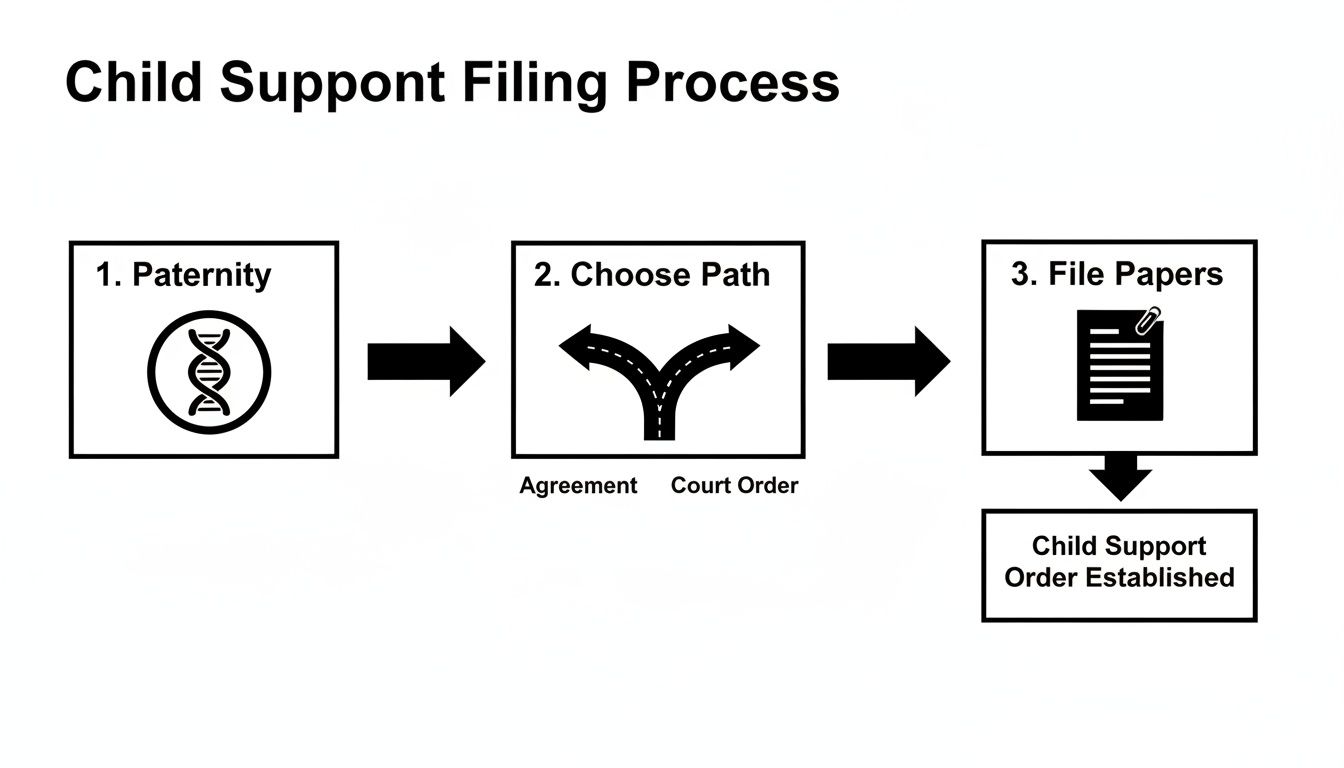
A critical legal prerequisite that many parents overlook is that a child support case cannot proceed until paternity is legally established. A Texas court lacks the jurisdiction to order child support without first identifying the child's legal father.
If the parents were married at the time of the child's birth, the husband is legally presumed to be the father, simplifying this step.
For unmarried parents, establishing paternity is an essential action. It can be done voluntarily if both parents sign a legally binding Acknowledgement of Paternity (AOP). If there is no agreement, one parent must file a suit to adjudicate parentage, which may involve court-ordered DNA testing to resolve the issue.
Securing a legal determination of paternity is not just a procedural hurdle; it is the cornerstone of your child's right to financial and medical support. Without it, the courthouse doors remain closed to any child support action.
OAG vs. Private Attorney: Which is Right for You?
Your decision hinges on a classic trade-off: cost versus control and customization. As legal counsel, we advise clients to consider the complexity of their situation.
The Office of the Attorney General (OAG) is a suitable option for straightforward cases. These are typically situations where parents are cooperative, the obligor parent is a standard W-2 employee, and there are no significant disputes over income, possession, or conservatorship. Remember, the OAG attorney represents the State of Texas; they do not provide legal advice to either parent.
A Private Attorney is essential for more complex scenarios. If you are dealing with a self-employed parent, suspected hidden income, high-value assets, contested custody, or require a customized possession schedule, an attorney is your best course of action. They possess the legal tools and expertise to conduct thorough discovery and advocate effectively for your position.
To give you a clearer picture, let's compare these two paths side-by-side.
Filing Options at a Glance: OAG vs. Private Attorney
| Feature | Office of the Attorney General (OAG) | Private Attorney (e.g., Law Office of Bryan Fagan) |
|---|---|---|
| Cost | Free to open a case. | Requires a retainer and hourly fees. |
| Timeline | Can be very slow; often takes months, sometimes over a year. | Generally much faster; timeline is driven by your case. |
| Legal Representation | The OAG represents the State of Texas, not you. | The attorney represents you and your interests directly. |
| Customization | Standard, formulaic orders. Little room for customization. | Highly customized orders for custody, support, and property. |
| Financial Discovery | Limited ability to investigate complex or hidden income. | Can conduct in-depth discovery (subpoenas, depositions). |
| Best For | Simple cases, W-2 income, cooperative parents. | Complex cases, self-employed parents, high-net-worth, contested issues. |
Ultimately, choosing between the OAG and a private attorney sets the stage for everything that follows.
Keep in mind, Texas calculates support based on a percentage of the non-custodial parent's net monthly resources, as laid out in the Texas Family Code. It starts at 20% for one child, 25% for two, and so on. You can get more details on how Texas child support caps and guidelines work. Making the right choice at the very beginning is your best move for securing an outcome that truly serves your child’s needs.
Navigating the Essential Legal Paperwork
Once you’ve determined whether to proceed with the OAG or a private attorney, the next step is initiating the legal process through formal paperwork. This is not merely an administrative task; you are laying the legal foundation for your entire case. Precision at this stage is crucial for a successful outcome.
The cornerstone legal document is the Original Petition in Suit Affecting the Parent-Child Relationship (SAPCR). This comprehensive lawsuit asks a Texas court to establish all rights and duties related to your child. A common misconception is that this is only a "child support" filing; in reality, it addresses the entire parent-child relationship.
The SAPCR is the master document that empowers the court to issue orders on all critical issues, including:
- Conservatorship: Designating which parent has the right to determine the child's primary residence.
- Possession and Access: Creating a clear and enforceable visitation schedule.
- Child Support: Ordering the payment of monthly financial support.
- Medical Support: Mandating the provision of health insurance.
- Exclusive Rights: Deciding which parent makes key decisions regarding education and healthcare.
Filing this petition officially commences the lawsuit and grants the court jurisdiction to act.
The Critical Step of Service of Process
After filing the SAPCR, you must formally notify the other parent that a lawsuit has been initiated against them. This constitutional due process requirement is called service of process. Simply texting a copy of the lawsuit is legally insufficient. Texas law requires a verifiable method to prove the other party received formal notice.
The standard method is personal service, where a sheriff, constable, or certified private process server physically delivers a copy of the lawsuit and a court-issued citation to the other parent. This creates an official record of service.
If the other parent is evading service—a common delay tactic—your attorney can file a motion for substituted service. This asks the judge to authorize an alternative method of notification, such as:
- Leaving the lawsuit papers with any person over 16 years of age at a specified location where the respondent can likely be found.
- Service via email or social media, if other methods have failed and there is proof the respondent will receive it.
A judge cannot make any rulings against a parent who hasn't been properly notified of the case. Getting service wrong is one of the most common—and expensive—mistakes we see. It can bring a case to a dead halt for months.
Essential Documents to Gather for Your Case
To ensure your case proceeds efficiently, you should begin gathering key documents before you even file. Providing your attorney with a complete financial picture allows for the strongest possible start. We advise all our clients to immediately begin assembling the following:
- Proof of Income: Your last two years of tax returns and at least six months of recent pay stubs.
- Child's Information: The child’s birth certificate and social security card.
- Paternity Documents: A signed Acknowledgement of Paternity (AOP) or any prior court orders regarding parentage.
- Expense Records: Proof of payment for the child's health insurance, daycare, and any extraordinary medical or educational expenses.
Having these documents prepared allows your attorney to accurately complete all required court filings and build a fact-based case from day one, streamlining the process of filing for child support in Texas.
Understanding How Texas Calculates Child Support
In Texas, child support is determined by a specific formula outlined in the Texas Family Code. While the state uses this formula to ensure consistency, applying it correctly requires a precise understanding of what constitutes "income" and what deductions are permissible. This is where many cases become contentious.

The entire calculation hinges on one figure: the obligor parent's monthly net resources. This is not simply their take-home pay. It is a much broader number designed to capture their full financial capacity.
What Counts as "Net Resources"?
The Texas Family Code defines "resources" broadly to include all sources of income. The calculation starts with gross income, which includes:
- Wages, salaries, commissions, overtime, and tips
- Self-employment income
- Rental income
- Dividends, interest, and royalties
- Social Security and retirement benefits
From this gross income, the court subtracts only a few specific, allowable deductions: Social Security taxes, federal income tax (calculated for a single person with one exemption), union dues, and the amount paid for the child's health insurance.
A critical point of misunderstanding is that common expenses like car payments, mortgage payments, credit card debt, and 401(k) contributions are not deducted when calculating net resources for child support. This is a frequent and often costly mistake.
Applying the Guideline Percentages
Once monthly net resources are calculated, the court applies a percentage based on the number of children before the court. These guideline percentages are established in Texas Family Code §154.125.
The table below shows the standard guideline percentages for a parent with no other children they are legally obligated to support.
| Texas Child Support Guideline Percentages |
| :— | :— |
| Number of Children | Percentage of Net Resources |
| 1 Child | 20% |
| 2 Children | 25% |
| 3 Children | 30% |
| 4 Children | 35% |
| 5 or more Children | 40% |
These percentages are adjusted if the obligor parent is legally responsible for other children not involved in the current case.
The "Cap" on Net Resources
For high-income earners, Texas law applies a "cap" to the amount of monthly income subject to the standard percentages. Effective September 1, 2025, this cap will be $11,700 in monthly net resources.
If an obligor earns at or below this cap, the calculation is direct. For example, a parent with $8,000 in net resources and one child would typically pay $1,600 per month (20% of $8,000).
If their net resources exceed the cap, the calculation has two parts. First, the court applies the guideline percentage to the capped amount. For one child, this is $2,340 (20% of $11,700). The court may then order an additional amount, but only if the custodial parent proves the child has needs—such as private school, specialized medical care, or extensive extracurriculars—that justify support beyond the guideline amount.
How This Looks in the Real World
Let's apply these rules to practical, real-world examples.
Example 1: The Salaried Employee
This is the most straightforward calculation.
- Gross Monthly Salary: $9,000
- Allowable Deductions: $2,200 (taxes, social security)
- Child's Health Insurance: $200
- Net Monthly Resources: $9,000 – $2,200 – $200 = $6,600
- Child Support for 2 Children: 25% of $6,600 = $1,650 per month
Example 2: The Self-Employed Business Owner
This requires more detailed analysis. The court will average income over a representative period, such as 12 or 24 months, to determine a fair monthly figure.
- Total Gross Income over 12 months: $150,000
- Average Gross Monthly Income: $150,000 / 12 = $12,500
- Allowable Deductions (projected): $3,500
- Net Monthly Resources: $12,500 – $3,500 = $9,000
- Child Support for 1 Child: 20% of $9,000 = $1,800 per month
A firm grasp of these calculations is the first step toward a fair outcome. An experienced attorney is invaluable in ensuring all income is properly accounted for and that the final order aligns with Texas law. You can learn more about how our firm navigates complex support calculations at The Law Office of Bryan Fagan.
When Judges Go “Off-Book” from the Standard Guidelines
The Texas child support guidelines serve as a starting point, not an unbreakable rule. While the formula provides a presumptive amount, a judge has the authority to deviate from it. This happens when applying the standard percentage would be "unjust or inappropriate" under the circumstances of the case. As your legal counsel, our role is to build a compelling, evidence-based argument for why such a deviation is necessary.
This judicial discretion is codified in Texas Family Code §154.123, which lists specific factors a court can consider. A judge will not alter the guideline amount without a well-documented reason. Our job is to present the facts of your case through the lens of these factors, especially in cases involving high incomes or unique possession schedules.
What Makes a Judge Deviate?
A judge requires concrete proof of special circumstances. The primary factors a court will consider when asked to order a non-guideline amount include:
- Age and Proven Needs of the Child: This is a crucial factor. "Proven needs" are documented necessities like ongoing medical treatments, specialized therapy, private school tuition for a child with special needs, or costs for an elite-level athlete.
- Parents' Ability to Contribute: The court assesses each parent's entire financial situation, including assets, debts, and earning potential, not just their income.
- Time of Possession: If the non-primary parent has possession of the child for a significantly greater amount of time than a standard order provides (e.g., an expanded or near 50/50 schedule), a judge may lower the support obligation because that parent is already covering more direct costs.
- Travel Costs for Possession: When parents live far apart, the significant costs of travel (flights, gas, lodging) incurred by the non-primary parent can be a reason to adjust support.
- Child Care Costs: If a parent must incur child care expenses to maintain employment, the court can factor this into the final order.
A judge’s guiding principle is always the "best interest of the child," a standard cemented in Texas Family Code §153.002. To successfully argue for a deviation, you must directly link your request to this standard and demonstrate why the guideline amount is insufficient or inappropriate.
Proving Your Case for a Different Amount
Simply telling a judge that your child's expenses are high is not enough; you must provide documentary evidence. An experienced attorney knows exactly what proof a judge requires.
For example, to argue for support above the guidelines, we would compile an evidentiary file including:
- Invoices and payment records from therapists, specialists, or tutors.
- Medical reports diagnosing a condition and recommending costly treatments.
- Tuition contracts from a private school designed to meet the child's specific educational needs.
Conversely, to argue for a downward deviation due to a near-50/50 schedule, you must prove your direct spending. We would help you organize receipts for groceries, clothing, school supplies, and extracurriculars you pay for during your possession time, demonstrating to the court that you are already shouldering a significant portion of the financial burden.
The Two Most Common Scenarios: High Earners and 50/50 Custody
Deviation requests arise most frequently in two situations. The first involves high-income earners whose monthly net resources exceed the $11,700 statutory cap (effective September 1, 2025). The burden is on the custodial parent to prove the child has established needs that justify support above the "capped" guideline amount. We recently won an above-guideline order for a mother whose child was a nationally ranked equestrian by presenting meticulous records of coaching fees, competition travel, and equipment costs.
The second common scenario is a 50/50 possession schedule. While equal time does not automatically eliminate child support, it is a strong basis for arguing for a reduction. It's crucial to understand that a parent's behavior, such as trying to turn a child against the other parent, can also sway a judge's decisions on both custody and support. You can read more about how courts handle these situations in our article on parent alienation in Texas. Grasping these nuances is a critical part of navigating the process and getting a fair result.
What Happens After You Have a Child Support Order?
Obtaining a signed child support order is a significant milestone, but it is not the end of the journey. The order is only effective if it is followed. Furthermore, life changes can render an existing order obsolete or unfair. Texas law provides two essential legal tools to address these post-order realities: enforcement and modification.

When the Payments Don't Arrive: Enforcing Your Order
If the obligor parent fails to make payments, you must take swift legal action by filing a Petition for Enforcement. This formally asks a judge to compel compliance.
The most effective enforcement tool is a wage withholding order, which directs the obligor's employer to deduct child support directly from their paycheck. It is automatic and reliable.
For self-employed obligors or in cases of continued non-compliance, judges have other powerful remedies:
- License Suspension: The court can order the suspension of the non-paying parent's driver's license, professional licenses (e.g., medical, legal, contracting), and recreational licenses (hunting and fishing).
- Property Liens: A lien can be placed on assets like bank accounts, real estate, or vehicles, preventing their sale or transfer until the child support debt is paid.
- Contempt of Court: If a judge finds a parent has the ability to pay but is willfully refusing, they can be held in contempt, which may result in fines and jail time.
In fiscal year 2023, income withholding collected over $3.47 billion for Texas children. If you are owed back child support, explore our guide on how to collect back child support for a deeper dive into these options.
When Life Changes: Modifying Your Order
A child support order can be changed, but only if a specific legal standard is met. You cannot modify an order simply because you dislike it.
Under Texas Family Code §156.401, the parent requesting the change must prove a "material and substantial change in circumstances" has occurred since the last order was signed.
This must be a significant event. Common grounds for modification include:
- A substantial increase or decrease in the obligor parent's income.
- A change in the child's needs, such as a new medical diagnosis requiring costly care.
- A change in the possession schedule where the non-primary parent now has the child for a significantly greater amount of time.
- A significant change in the cost of providing the child's health insurance.
The parent requesting the modification bears the burden of proof. You cannot simply allege a change; you must prove it with evidence like recent pay stubs, new medical bills, or updated insurance statements.
A Strategic Reason to Modify Your Order
There is a second path to modification. If at least three years have passed since your order was signed, you can request a review if the current guidelines would result in a payment that is 20% or $100 different from the current order. No "material and substantial change" is required.
This is particularly relevant now. The state's income cap for support calculations increases to $11,700 in net monthly resources on September 1, 2025. This statutory change alone will make many existing orders outdated and provides a powerful basis to seek a modification. For example, the previous guideline maximum for four children was $3,220; the new cap raises it to $4,095. To see how these numbers stack up, you can review key Texas child support figures on FamilyLaw-TX.com.
Understanding enforcement and modification is a critical part of knowing how to manage child support in Texas.
Frequently Asked Questions in Texas Child Support Cases
Navigating the Texas child support system raises many complex questions. As legal counsel, we provide clients with clear, authoritative answers based on how the law is actually applied in the courtroom. Below are answers to some of the most common questions we encounter.
Can I get child support for the time before we went to court?
Yes. This is called retroactive child support. A judge has the authority to order support payments for up to four years prior to the date the lawsuit was filed. To award it, a court must find that the other parent knew of their duty to support the child and failed to do so. The court will determine what that parent's net resources were during that past period and calculate the back-due support based on the statutory guidelines. This is a vital tool for ensuring a child receives the financial support they were entitled to all along.
Does a 50/50 custody schedule mean no one pays child support?
No. This is one of the most persistent myths in Texas family law. A 50/50 possession schedule does not automatically eliminate the child support obligation. A judge will still perform a guideline calculation, and typically, the higher-earning parent will be ordered to pay support to the lower-earning parent.
The judge may then use the equal possession time as a basis to deviate downward from the guideline amount, as permitted by §154.123 of the Texas Family Code. Another common approach is an "offset" calculation, where the court determines what each parent would owe the other, and the parent with the higher obligation pays the difference. The final decision depends on the specific financial circumstances and the arguments presented to the court.
A 50/50 schedule is a reason to discuss changing the child support amount, not a guarantee that it will be zero. The court’s primary focus will always be on the child's best interest and each parent's ability to provide.
What if the other parent is self-employed or hiding income?
This is a common and challenging scenario, particularly with business owners, independent contractors, or cash-based employees. When income cannot be verified with a simple paystub, we must use legal discovery tools to uncover the true financial picture. We utilize subpoenas to obtain bank records, profit-and-loss statements, and other business financials. If a court finds a parent is intentionally underemployed or unemployed to avoid paying support, a judge has the authority to set child support based on their proven earning potential, not their claimed income. Accepting the other parent's stated income at face value can be a critical financial mistake.
Who has to pay for the child's health insurance?
Texas courts are required to ensure a child has health and dental insurance. The judge will order one or both parents to provide it. Typically, the parent with access to the most affordable group insurance through an employer will be ordered to enroll the child. The monthly premium cost for the child's portion of that insurance is then credited to that parent in the support calculation (it is deducted from their gross income before net resources are determined). If neither parent has access to affordable private insurance, the court may order the custodial parent to apply for government-provided coverage (Medicaid or CHIP), and the other parent will likely be ordered to pay "cash medical support" to defray costs. Unfortunately, many parents face serious consequences when payments are missed; you can find out more by reading our guide on what happens if child support is not paid in Texas.
Successfully navigating the Texas child support system—from the initial filing through enforcement and modification—requires a well-defined strategy and authoritative legal guidance. The Law Office of Bryan Fagan is committed to helping parents across Texas secure fair and enforceable support orders that protect their children's well-being. If you are facing a child support matter, contact us for a consultation to determine your next steps. Visit us at https://txchildsupport.net.