Life changes, and sometimes, a Texas child support order must change with it. However, you cannot simply ask a court to adjust the amount on a whim. The Texas Family Code sets a specific legal standard you must meet.
If you are considering modifying your Texas child support order, the first step is determining your eligibility. The process commences by filing a formal "Petition to Modify the Parent-Child Relationship" with the court that issued your original order, but you must have a valid legal reason to do so. This guide will walk you through the standards, calculations, and procedural steps required for a successful modification.
Determining Your Eligibility for a Modification
Before you invest time or resources in a modification case, you must be certain your situation qualifies. Texas courts do not alter existing orders lightly; they require a legally recognized reason for the change.
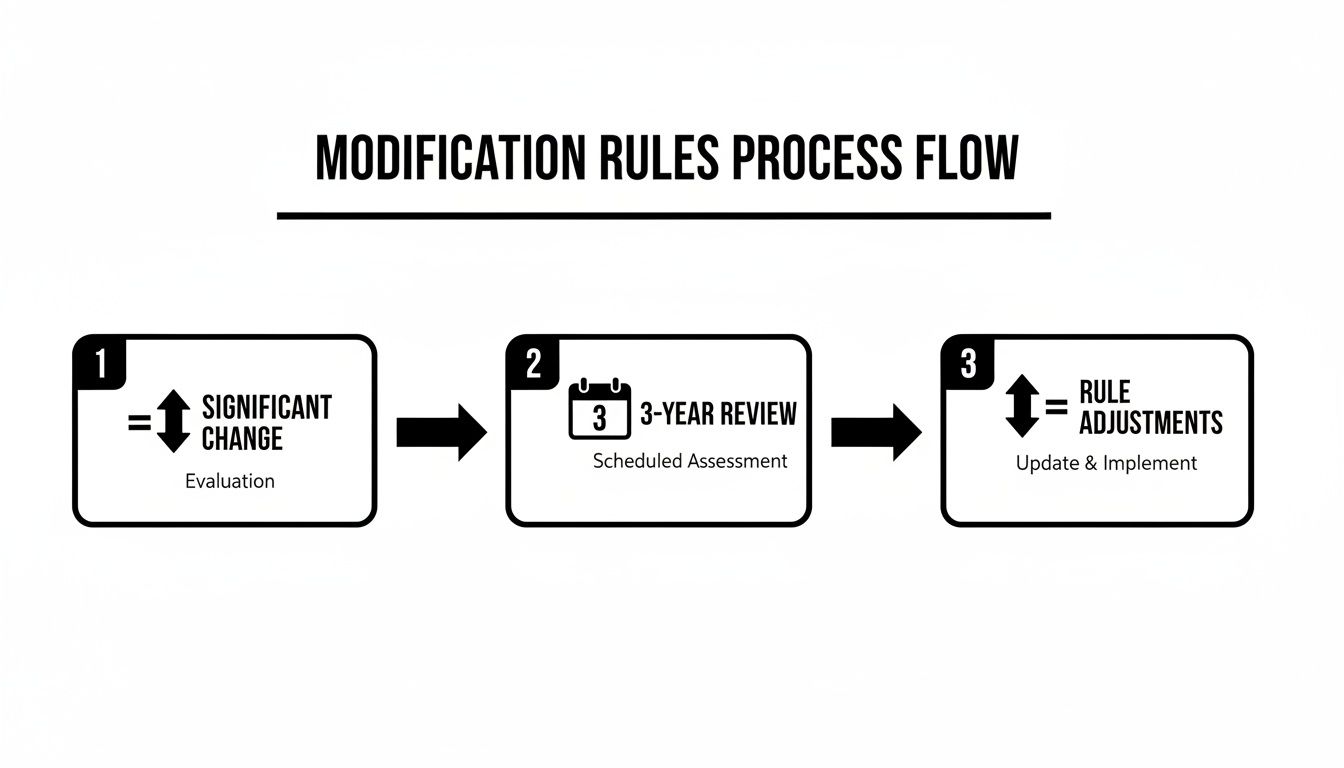
There are two primary paths to modification. The most common involves proving there has been a "material and substantial change" in the circumstances of the child or a person affected by the order. The other is a more straightforward procedural option that becomes available three years after the last order was signed.
Proving a Material and Substantial Change
This is the bedrock of most modification suits. To succeed, you must demonstrate to the court that since your last child support order was signed, something significant and lasting has changed for you, the other parent, or the child. A temporary setback or a minor pay bump will not suffice.
In practical terms, courts are looking for life events that genuinely impact a parent's ability to pay support or alter the child's needs.
Common examples that often meet this standard include:
- Involuntary Job Loss: Being laid off is a primary reason courts will consider a modification.
- A Major Shift in Income: This applies to both parents. A significant promotion for the paying parent could justify an increase, while a substantial and long-term pay cut could justify a decrease.
- Changes in Health Insurance: If the parent providing insurance loses their job, or if the monthly premium for the child's coverage increases significantly, this can be grounds for modification.
- New and Significant Needs of the Child: This could be the diagnosis of a medical condition requiring costly treatment or the need for specialized educational support.
- A Change in the Custody Schedule: If the non-primary parent's possession of the children increases substantially, the support amount may need to be adjusted to reflect that reality.
Expert Advice for Your Case: Be advised: if you voluntarily quit your job for a lower-paying one or otherwise choose to earn less, a judge will not be sympathetic. This is called "intentional underemployment or unemployment." Under Texas Family Code § 154.066, the court can—and often will—calculate child support based on what you should be earning, not what you are actually earning.
The Three-Year Review Rule
If you lack a single, dramatic event to point to, Texas law provides a second, more procedural path to modification.
Under Texas Family Code § 156.401, you can request a review if it has been at least three years since your order was signed. To qualify under this rule, you must simply show that applying the standard child support guidelines to the parents' current incomes would result in a new monthly amount that differs by either 20% or $100.
Here is a practical example:
Your original order from 2022 requires you to pay $1,000 per month. It is now 2026, more than three years later. Over that time, your income has increased. If you run the numbers today, the guideline calculation based on your current income indicates you should be paying $1,250 per month.
The difference ($250) is greater than 20% of the old amount ($200) and the $100 minimum. This is all you need to prove. You are eligible to modify the order to reflect your current income, without having to prove a single "material and substantial change." It is a practical tool for keeping orders fair over time.
To help you quickly determine if you meet the threshold, here is a clear breakdown of the two legal standards for modifying child support in Texas.
Qualifying for a Child Support Modification in Texas
| Legal Standard | What It Means | Common Examples |
|---|---|---|
| Material & Substantial Change | A significant, ongoing life event has occurred since the last court order was signed. | Involuntary job loss, major income change (up or down), new medical needs for the child, or a change in the custody schedule. |
| Three-Year Review | It's been 3+ years since the last order, AND the new guideline calculation differs from the current order by at least 20% or $100. | A parent's income has gradually increased or decreased over several years, making the old support amount outdated. |
Ultimately, whether you are citing a major life event or utilizing the three-year rule, your objective is to present a clear, compelling case to the court that the existing order is no longer appropriate for your family's current situation.
Calculating the New Child Support Amount
To determine your new potential child support payment, you must first understand how Texas courts arrive at that figure. It is not an arbitrary number; it is a specific formula based on the paying parent's "net monthly resources."
Net monthly resources can be thought of as a parent's take-home pay, with specific legal adjustments. The court will calculate all income—wages, salary, commissions, self-employment earnings, rental income, and more. Then, it subtracts a limited list of items: federal income taxes (for a single person with one exemption), Social Security taxes, union dues, and the amount paid for the child's health insurance. The remaining amount is the figure used for the calculation.
This process is a core component of any child support modification case in Texas.
The New Texas Child Support Cap
A crucial update that impacts many modification cases is the new income cap effective September 1, 2025. The Texas Legislature periodically adjusts this cap for inflation, and the maximum amount of net resources used in the standard calculation will increase from $9,200 to $11,700 per month.
This change significantly affects higher-earning parents. For one child, the maximum guideline support amount increases from $1,840 to $2,340—a $500 increase per month.
Keep in mind, this change is not retroactive and does not automatically update your current order. To apply the new cap to your situation, you must file a formal modification lawsuit.
Applying Guideline Percentages
Once the court establishes the net monthly resources (up to the $11,700 cap), it applies a standard percentage based on the number of children before the court. These guidelines are outlined in the Texas Family Code § 154.125:
- One child: 20% of net resources
- Two children: 25% of net resources
- Three children: 30% of net resources
- Four children: 35% of net resources
- Five or more children: 40% of net resources
Let's apply this with a real-world example. Imagine a non-primary parent with one child has net monthly resources of $8,000. Guideline support would be $1,600 per month (20% of $8,000). If that same parent earns $15,000 in net monthly resources, the calculation uses the cap. Guideline support would be $2,340 per month (20% of the $11,700 cap).
Important Takeaway: A common misconception is that a 50/50 possession schedule automatically eliminates the need for child support. This is not the law in Texas. If a significant income disparity exists between the parents, a judge will almost certainly order the higher earner to pay support to ensure the child's standard of living is consistent between both homes.
When Courts Deviate From Guidelines
The guidelines are not absolute. Under Texas Family Code § 154.123, a judge may order a payment higher or lower than the guideline amount if there is compelling evidence that doing so is in the child's best interest. This is known as a "deviation."
For instance, a court might order support above the guidelines if a child has proven needs that are particularly expensive, such as ongoing medical treatments, specialized therapy, or private tutoring for a learning disability.
Conversely, a judge might order less than the guideline amount if the paying parent has extraordinary expenses directly related to the child, such as the high cost of cross-country travel for visitation. If you plan to argue for a deviation, be prepared to substantiate your claim with clear and convincing evidence.
For a more granular look at these calculations, you can review our in-depth guide on how to calculate child support in Texas.
Navigating the Legal Process for Modification
Once you've established that a material and substantial change has occurred, the next phase involves navigating the court system. The Texas legal system has a clear, step-by-step process for modifying child support. Understanding the path ahead is the best way to feel in control and prepared.
Let's walk through the journey from filing the initial paperwork to obtaining a final, updated order from the judge.

Step 1: Filing the Petition and Serving the Other Parent
The first official action is filing a "Petition to Modify the Parent-Child Relationship." This legal document initiates the lawsuit. You will file it in the court with "continuing, exclusive jurisdiction"—almost always the same court that handled your original divorce or support order.
The petition identifies all parties, lists the children, and specifies the reasons for seeking a change, formally stating that a material and substantial change has occurred.
Once filed, you must ensure the other parent receives proper legal notice. This is called service of process, a non-negotiable constitutional requirement. A sheriff's deputy or a private process server must personally deliver a copy of the lawsuit (the citation and petition) to the other parent. This step is critical; until the other parent is served, the court cannot move forward, and the clock for a potential retroactive modification has not started.
Step 2: The Discovery and Mediation Phase
After the other parent is served and files an Answer, the case enters the discovery phase. This is the formal, pre-trial process where both sides exchange information to ensure all financial cards are on the table and prevent surprises in court.
You can expect to send and receive requests for documents such as:
- Recent pay stubs and proof of employment
- The last two years of federal income tax returns
- Bank and brokerage account statements
- Invoices showing the cost of the child's health insurance
The financial data gathered here forms the basis for calculating the new support amount. The rules for this phase are detailed in state family law statutes; you can find a helpful overview of the Texas Family Code and its impact on child support on our site.
Before a final trial, most Texas courts will require you to attend mediation. Here, you and the other parent will meet with a neutral third-party mediator to negotiate a settlement. If an agreement is reached, it is documented in a binding Mediated Settlement Agreement (MSA), which becomes the basis for your new court order.
Procedural Tip: A final hearing can take months. If you need a faster solution—for instance, if you just lost your job and cannot afford the current payment—you can file for a Temporary Orders Hearing. This allows you to ask the judge for short-term relief while the full case is pending.
Step 3: The Final Hearing and New Order
If you cannot reach an agreement in mediation, your case will proceed to a final hearing. This is where you and your attorney present evidence, witnesses, and legal arguments to the judge. The other parent will have the same opportunity.
After hearing all evidence, the judge will make a final ruling. If they agree that a modification is justified, the court will issue an "Order Modifying the Parent-Child Relationship." This document legally replaces your old child support order and will clearly state the new monthly payment, who provides health insurance, and the effective date of the new obligation.
Each stage of this process is sequential. A misstep, such as improper service or a weak discovery effort, can compromise your entire case. Understanding the journey from start to finish is the best strategy for a fair outcome.
Building Your Case With the Right Evidence
When you appear in court to modify a child support order, the judge expects one thing above all: proof. Your testimony alone is insufficient to change a legal order. A Texas judge needs clear, documented evidence of the “material and substantial change” you are claiming.
The most critical part of your case occurs before you enter the courtroom. It is the essential work of gathering and organizing your financial documents.

Assembling Your Financial Portfolio
Think of this as creating a complete financial snapshot for the court. Your goal is to present a credible, easy-to-understand picture of your economic reality—and the other parent's. These documents are non-negotiable.
At a minimum, you must gather:
- Recent Pay Stubs: A solid 30 to 60 days' worth to show your current, actual income.
- Federal Tax Returns: Complete copies of your federal tax returns for the past two years, including all schedules and attachments.
- W-2s and 1099s: These forms are crucial for verifying your gross income from all sources.
- Health Insurance Documentation: A recent statement that clearly itemizes the monthly cost you pay specifically for the child's health and dental insurance. This is a direct credit that reduces your net resources.
These items are the absolute foundation of your case.
Documenting the Specific Change in Circumstances
Beyond standard financials, you need proof directly related to why you are requesting a modification. The evidence will depend on your unique situation.
When you ask for a modification, the court's job is to recalculate support based on current circumstances. They will apply statutory guidelines—like 20% of net resources for one child—up to the monthly cap, which becomes $11,700 on September 1, 2025. While guidelines are the starting point, judges can deviate for factors like a child's extraordinary needs. It is critical to remember this is not automatic; you can find expert analysis on how these changes affect support calculations at Petitt Family Law.
Courtroom Tip: Organize everything into a binder with clear tabs for each category ("Pay Stubs," "Tax Returns," "Child's Expenses"). This simple step makes you look prepared and credible, and it allows your attorney to present your case without fumbling for papers during a hearing.
If You Lost Your Job (Seeking a Decrease):
You must demonstrate the job loss was involuntary and that you are actively seeking new employment. Save emails confirming job applications, screenshots of your job search efforts, and any rejection letters.
If the Child's Needs Increased (Seeking an Increase):
You must put a dollar amount on the new expenses. Gather every receipt, bill, and invoice for items such as:
- Therapy or counseling sessions
- Specialized academic tutoring
- Uncovered medical or dental bills
- New or increased prescription costs
If the Other Parent's Income Increased (Seeking an Increase):
This is often the most challenging aspect. The best way to obtain this information is through formal discovery. Your attorney can issue legal requests that compel the other parent to produce their pay stubs, tax returns, and bank statements, revealing their true financial picture.
Your modification case will rise or fall on the strength of your evidence. Entering mediation or a hearing with a complete, well-organized file gives you the power to negotiate effectively and gives the judge the concrete proof needed to rule in your favor.
Why a Family Law Attorney Is Your Greatest Asset
While Texas law permits you to file for a child support modification pro se (on your own), the question is, should you? Proceeding alone is a significant risk, especially with your financial future at stake. The other parent will have their own narrative and defenses, and without an expert in your corner, you can easily be outmaneuvered.
A classic example is the issue of income. The other parent might accuse you of being voluntarily underemployed—arguing you took a pay cut to lower your child support. An experienced attorney knows how to counter this claim by presenting hard evidence of your job hunt or proving your career change was a legitimate decision, not a scheme to avoid your obligation.
When You Absolutely Need Legal Counsel
Some modification cases are too complex and high-stakes to handle by yourself. Navigating these situations solo often leads to an unfavorable outcome, leaving you bound by an unfair support amount for years.
You will want a lawyer if you are dealing with:
- Complex or Hidden Income: Is the other parent self-employed, paid in cash, or concealing income through complicated bonus structures? Proving their true income is a battle. Attorneys have tools—like subpoenas and depositions—to uncover hidden assets and get to the truth.
- A High-Conflict Co-Parent: If every interaction becomes a conflict, an attorney acts as an essential buffer. They manage hostile communications, enforce court deadlines, and prevent intimidation tactics.
- A Child with Significant Needs: Are you requesting support above the standard guidelines due to a child's expensive medical, psychological, or educational needs? You must build a rock-solid case. An attorney is critical for gathering the required expert testimony and financial records to justify a deviation under Texas Family Code § 154.123.
- Cases Involving the New Income Cap: The updated $11,700 monthly net resource cap is new territory. A lawyer ensures this rule is applied correctly and can argue why the court should (or should not) consider income above the cap, depending on your child's proven needs.
The Strategic Edge an Attorney Provides
Hiring an attorney is about more than paperwork; it is about engaging a strategist who understands the local legal landscape. They know the judges, they have seen opposing counsel's tactics before, and they can identify potential problems before they escalate. Their job is to frame the facts of your life into a legal argument the court will accept.
From an Attorney's Perspective: The biggest mistake parents make is assuming a judge will automatically see their side as "fair." Judges rule on evidence and law, not abstract fairness. A good lawyer translates your reality into the precise language of the Texas Family Code—the only language the court speaks.
From drafting a persuasive petition to preparing you for a hearing and cross-examining the other parent, an attorney manages every crucial detail. They ensure your evidence is admitted correctly, make timely objections, and protect your rights. A modification case impacts your finances for years; a skilled advocate is a necessity.
If you are facing a complicated child support battle, experienced legal help is the single best investment you can make. You can learn more about how a Texas child support lawyer can guide you through the specifics of your case.
Frequently Asked Questions About Modifying Texas Child Support
When considering a child support modification, numerous questions arise. Here are direct, authoritative answers to the most common concerns parents face.
How long does it take to modify child support in Texas?
The timeline depends entirely on whether you and the other parent can reach an agreement.
If you are both in agreement, the process can be swift. An Agreed Order is drafted, signed by both parties, and submitted to the judge for approval, often concluding in just a few weeks.
In a contested case, the timeline is much longer. The full legal process includes:
- Filing the modification suit
- Formally serving the other parent
- Exchanging financial information (discovery)
- Attending mandatory mediation
- Awaiting a final hearing
This sequence typically takes four to twelve months, and can be longer depending on the court's docket and case complexity.
Can I get a retroactive child support modification?
No. This is a critical point that can be a costly misunderstanding. A Texas judge can only modify child support payments retroactively to the date the other parent was officially served with the modification lawsuit.
Crucial Takeaway: A judge cannot change the support amount owed for the months before the lawsuit was served. If you lose your job in January but do not file until June, you are legally obligated to pay the full, original child support amount for February, March, April, and May. You must file your Petition to Modify as soon as your circumstances change. Delay will cost you money you cannot recover.
What if the other parent is intentionally underemployed?
This is a common tactic. Under Texas Family Code § 154.066, if a judge finds that a parent is intentionally underemployed or unemployed to reduce their support obligation, the court can base child support on that parent's earning potential—not their actual income.
To prove this, we would present evidence of their past income, education, skills, and the job market in their field. The court can then calculate support based on what that parent should be earning, preventing them from gaming the system at the child's expense.
Does a new spouse's income affect child support?
Directly, no. A new spouse's income is not included in the "net monthly resources" calculation. The legal duty to support a child rests solely with the parents.
However, a new spouse's income can have an indirect impact. If a new spouse covers major household expenses (mortgage, utilities), this frees up the parent's disposable income. While the income for the guideline calculation does not change, a judge considering an upward deviation from the guidelines (for a child's special needs, for example) may factor this financial reality into their decision, concluding the parent has a greater ability to contribute. This is a nuanced area where experienced legal counsel is invaluable.
At the Law Office of Bryan Fagan, PLLC, we understand that every child support case is unique. Our attorneys specialize in Texas child support law, providing the strategic insight needed to guide parents toward a fair resolution. If you are facing a modification, do not navigate it alone. Contact us today for a consultation to protect your rights and your family's future.