When facing a child support case, a primary question is, "Do they really count my overtime and bonus?" The answer, under Texas law, is a firm and resounding yes.
It is a common misunderstanding that child support is based solely on a 40-hour work week or base salary. Texas law, however, is designed to assess the entire financial picture to ensure children are supported according to the parents' actual means. Let's break down how this works in court.
How Texas Courts Define Income for Child Support
The foundation of any child support calculation is a parent's "net resources." This term is defined broadly in the Texas Family Code § 154.062 to ensure the court can determine a parent's true, total earning capacity.
The court's goal is to understand all money available to you, which is therefore considered available to support your children. This is not limited to your predictable paycheck.
What Makes Up Your "Net Resources"?
Texas Family Code § 154.062(b) casts a wide net. "Resources" includes, but is not limited to:
- Wages and Salary: This includes base salary, overtime, tips, commissions, and severance pay.
- Self-Employment Income: All revenue earned from operating a business or professional practice.
- Bonuses and Other Compensation: Annual performance bonuses, stock options, restricted stock units (RSUs), and any other non-salary compensation are included.
- Investment and "Passive" Income: This covers everything from interest and dividends to royalties and rental income.
- Other Benefits: Retirement benefits, pension distributions, trust income, and unemployment benefits are also counted as resources.
Essentially, if it is a financial resource available to you, the court will consider it when calculating support. The guiding principle is to establish an order based on your actual financial reality.
To help clarify, here’s a quick-reference table showing how courts typically treat various forms of income.
How Variable Pay Is Treated in Texas Child Support
| Income Source | Included in Net Resources? | How Courts Typically Handle It |
|---|---|---|
| Overtime Pay | Yes | Averaged over a representative period (e.g., 1-2 years) to find a monthly amount. |
| Performance Bonuses | Yes | Often averaged over several years to account for fluctuations in size and frequency. |
| Commissions | Yes | Averaged over time; courts look for patterns and consistency in earnings. |
| Stock Options/RSUs | Yes | The value is typically included when the options are exercised or the stocks vest. |
| Severance Pay | Yes | Treated as income, though how it's spread out can be a point of negotiation. |
This table covers the most common scenarios we see in court. The key takeaway is that variability does not mean exclusion.
The Problem of Fluctuating Pay: Averaging and the Guideline Cap
If your income is not consistent, how does the court arrive at a fair number? Judges will not use your highest-earning paycheck to set an unfairly high obligation.
Instead, judges average your income over a reasonable period—usually the last 12 to 24 months—to smooth out peaks and valleys. This prevents a one-time, unusually large bonus from skewing the support amount upwards, just as it prevents a slow month from driving it unfairly down. The objective is to find a reliable monthly average that reflects your consistent earning pattern.
Finally, you must be aware of the statutory "cap." Texas law sets a maximum amount of net monthly resources for calculating guideline child support. Effective September 1, 2025, that cap is $11,700 per month.
This means the standard percentages (e.g., 20% for one child, per Texas Family Code § 154.125) are applied only to the first $11,700 of your monthly net resources. However, under Texas Family Code § 154.123, a judge can order additional support above this guideline amount if there is proof that the child has needs requiring it. This is common in cases involving special needs, expensive private school or extracurriculars, or a high standard of living established during the marriage.
Calculating Net Resources With Variable Pay
Determining child support with a fluctuating income can feel like aiming at a moving target. The Texas courts, however, follow a specific, step-by-step method for handling variable income like overtime and bonuses. The process is analogous to preparing a tax return: you begin with your total earnings and then subtract specific, court-approved deductions to arrive at your "net resources."
First, the court must establish your total gross income from all sources. This is a critical step—overtime, bonuses, commissions, and side-hustle income are all added to the total. The goal is to obtain an accurate snapshot of your actual earnings over time.
This flowchart gives you a good visual of how different income sources all funnel down into the final calculation.
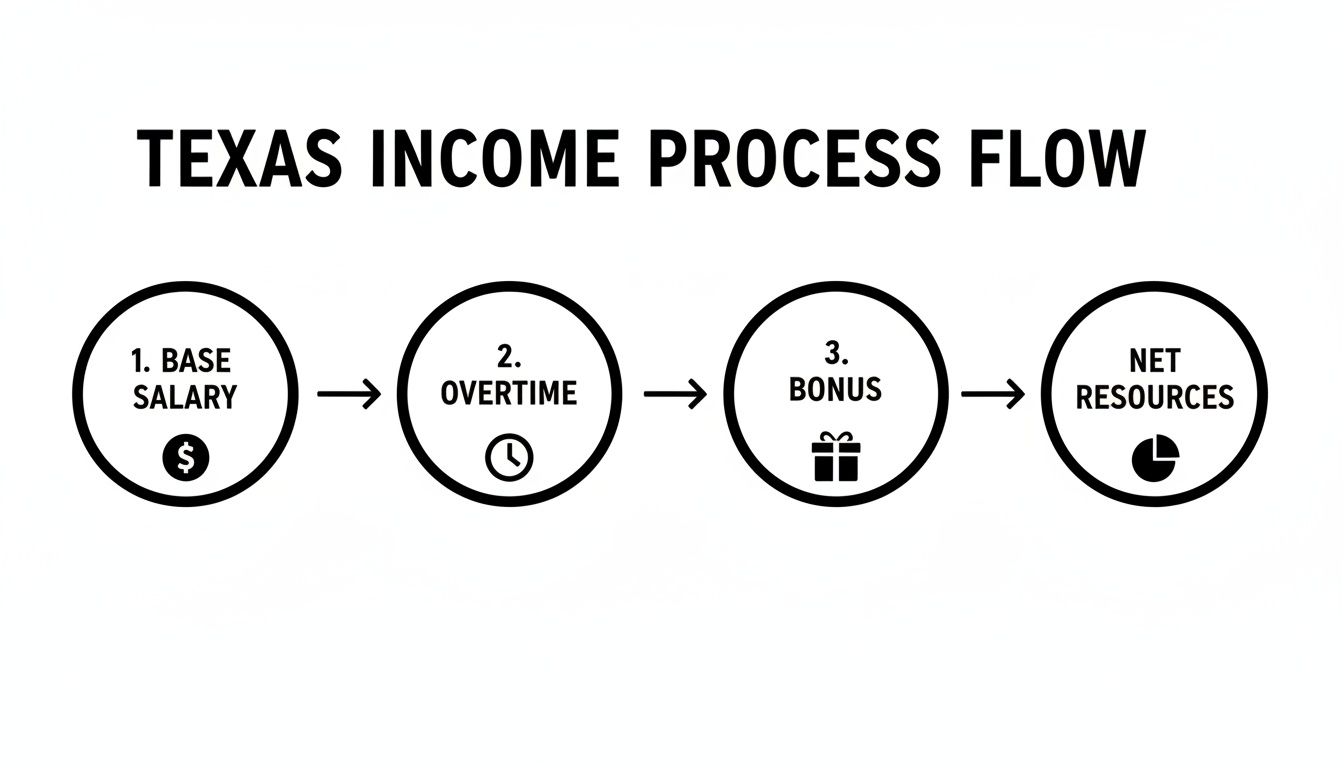
As you can see, the court's job is to aggregate everything. It’s not just about your hourly wage or salary; it's about the total financial resources you have available to support your children.
From Gross Pay to Net Resources
Once the court determines your gross annual income, it will make a handful of specific deductions to calculate your average monthly net resources. These are laid out in Texas Family Code § 154.062(d), and they are the only subtractions permitted:
- Federal income taxes (based on the tax rate for a single person claiming one personal exemption)
- Social Security and Medicare taxes (FICA)
- State income tax (if applicable)
- Union dues
- Health insurance premiums paid for the child(ren) subject to the suit
This is a point of frequent confusion. Your personal living expenses—such as rent, mortgage payments, car notes, or credit card bills—are not deductible for child support purposes. The court only considers the specific items listed above.
The Averaging Method for Variable Income
How does a judge handle an income that spikes with a large bonus or fluctuates with seasonal overtime? The court will not use a single high-earning month to set an unfair obligation.
Instead, the court uses an averaging method. A judge will examine your earnings over a sustained period—typically 12 to 24 months—to smooth out the peaks and valleys. By summing your total income from all sources over that timeframe and dividing by the number of months, the court derives a stable, representative average gross monthly income.
Practical Example: How a Court Calculates Net Resources
Imagine an engineer with a $100,000 base salary who also earned $20,000 in overtime and received a $15,000 performance bonus last year. Her total gross income is $135,000. The court will divide this by 12, resulting in an average gross monthly income of $11,250. From this figure, the judge then subtracts the standard tax and health insurance deductions to arrive at the final monthly net resources used to calculate child support.
This is precisely why bringing the right financial documentation to court is critical. Pay stubs, W-2s, 1099s, and employment contracts tell the complete story. Without them, a judge is left to make assumptions, which may not be in your favor. If you want a deeper dive into this, you can learn more about how Texas courts calculate net resources in our detailed guide. The standard child support percentages are then applied to the final net resource amount, up to the guideline cap.
The Guideline Cap for High-Income Earners
What happens when your overtime and bonuses push your income into a higher bracket? The Texas Family Code has a specific mechanism for this scenario. While all income is considered, the law applies a "cap" to prevent guideline child support calculations from becoming astronomical.
Think of it as a guardrail: the law acknowledges every dollar you earn, but it only applies the standard child support formula up to a certain threshold. This provides a predictable starting point for high-income cases.

Understanding the Updated Guideline Cap
To keep pace with inflation, the Texas legislature adjusts this cap every six years. The latest adjustment took effect on September 1, 2025, raising the monthly net resource cap from $9,200 to $11,700. This was a significant increase and directly impacts the maximum amount of "guideline" child support.
Here’s the bottom line: if your averaged net monthly resources exceed $11,700, the court will apply the standard child support percentages under Texas Family Code § 154.125 only to that first $11,700. Income earned above that amount is not automatically subject to the same percentage calculation.
Maximum Guideline Support Under the New Cap
With the $11,700 cap, the maximum guideline support amounts are straightforward. The court applies the standard percentages to that figure.
- One child: 20% of the cap = $2,340 per month
- Two children: 25% of the cap = $2,925 per month
- Three children: 30% of the cap = $3,510 per month
- Four children: 35% of the cap = $4,095 per month
- Five or more children: 40% of the cap = $4,680 per month
This creates a clear and predictable baseline for high-income cases, ensuring that even with substantial overtime and bonus income, the initial calculation is standardized.
Arguing for Support Above the Cap
Crucially, the cap is not an absolute ceiling on child support. A judge has the authority to order child support above this guideline amount.
Texas Family Code § 154.123 explicitly allows judges to deviate from the guidelines if evidence shows the child has proven needs that justify a higher amount.
The guideline cap sets the floor for high-income child support, not the ceiling. The child's demonstrated lifestyle and needs determine the final amount, and a skilled attorney is essential for proving those needs in court.
What qualifies as a "proven need"? This is determined on a case-by-case basis through evidence. You must provide specific, documented proof.
Common examples that justify an award above the guidelines include:
- Extraordinary Educational Costs: Private school tuition, specialized tutoring for a learning disability, or fees for a gifted and talented program.
- High-Level Extracurricular Activities: Competitive sports leagues, elite arts programs, or travel teams that were a normal part of the child's life before the parents separated.
- Special Needs and Medical Care: Ongoing therapy, specialized medical equipment, or treatments not fully covered by insurance.
- Maintaining the Child's Standard of Living: In cases where the child was accustomed to a certain lifestyle, courts may award additional support to ensure that standard is maintained across both homes.
Making a successful argument for support above the cap requires meticulous preparation, including budgets, receipts, bank statements, and clear testimony to paint a vivid picture of the child's true expenses for the judge. For a closer look at the new cap, check out our guide on understanding the $11,700 net resource cap.
Strategies for Proving or Contesting Variable Income
Knowing the law is the first step; proving your case in court is what matters. A judge will not take your word for it—they require financial facts. A well-constructed case supported by solid documentation is the only way to ensure the final support order is fair and accurate.

These battles are won or lost in the discovery phase. This is the formal process where your attorney requests financial information from the other party and third parties, like their employer. The goal is to create an undeniable paper trail.
Gathering the Right Evidence
We begin with a formal Request for Production, a legal demand for the other parent to provide specific documents. If they fail to cooperate, your attorney can issue a Subpoena Duces Tecum directly to their employer—a court order compelling the production of necessary records.
Essential evidence includes:
- Pay Stubs: A complete history, typically for 12-24 months, to establish income patterns.
- W-2s and Tax Returns: These provide a macro-level view of total earnings year-over-year.
- Employment Contracts: Crucial for understanding official compensation terms, especially bonus structures.
- Company Bonus Policies: This can be the "smoking gun" that shows whether a bonus is a regular part of compensation or a truly discretionary, one-time event.
These documents are foundational to the financial argument a judge will rely on to make a final decision.
Strategies for the Receiving Parent
If you are the parent to receive child support, your objective is to prove a consistent history of the other parent earning this extra income. Your attorney will analyze the documents to demonstrate a reliable pattern, even if the dollar amount fluctuates.
The argument is straightforward: If the paying parent has received a bonus every year for the past three years, it is not a surprise windfall. It is a predictable component of their "net resources" under the Texas Family Code and must be averaged in for an accurate child support calculation.
Strategies for the Paying Parent
If you are the paying parent, you cannot simply state, "I might not get that bonus again." A judge has heard this argument before. To successfully argue that certain income should be excluded or averaged differently, you need concrete proof.
For instance, if you received a large, one-time bonus for a project that is now complete, you need a letter from your employer confirming that fact. If your company formally changed its policy to eliminate overtime, you must produce the official company-wide announcement. Without such evidence, the court will likely presume the income will continue.
In high-income child support cases, these disputes over variable pay are common. This is especially true when net resources exceed the $11,700 monthly cap, where guideline support may not cover the child's proven needs. In places like Houston's energy sector or Dallas's finance world—where 30-40% of executives report significant variable pay—we often have to counter attempts to hide income, sometimes by arguing that the court should impute income if a parent is intentionally underemployed or refusing overtime. You can see how Texas stacks up by looking at child support rates across states.
Winning the argument in court comes down to who presents the most organized, compelling, and undeniable evidence.
Modifying Support After Income Changes
Life is not static, and income is no exception—especially when overtime and bonuses are involved. A big promotion could lock in a higher salary, or a company restructuring could eliminate extra hours overnight.
Because a child support order is based on your finances at a specific moment, it is not meant to last forever. Texas law provides a clear path to adjust the support amount to reflect your new reality through a Petition to Modify the Parent-Child Relationship.
The "Material and Substantial Change" Standard
Under Texas Family Code § 156.401, a judge can only modify a child support order if you prove there has been a “material and substantial change in circumstances” since the last order was signed. This is the legal key to reopening the case.
What qualifies? For parents with variable pay, several common scenarios meet this standard:
- A Major Pay Increase: A significant promotion or a consistent increase in overtime and commissions is a material change.
- A Serious Pay Decrease: A layoff, demotion, or a new company policy eliminating overtime opportunities are classic grounds for modification.
- Loss of a Reliable Bonus: If a company that paid a predictable annual bonus for years suddenly stops, this directly reduces a parent’s net resources.
- The Child’s Needs Evolve: If a child is diagnosed with a medical condition requiring expensive care or needs specialized tutoring, those new costs can also trigger a modification.
A minor fluctuation is not enough. The change must be significant enough to render the current support order unfair or unworkable. One slow month of overtime will likely not be sufficient.
The Procedural Steps to Formally Modify Your Order
Changing your child support amount is a formal legal process. A verbal agreement is not legally enforceable; you must obtain a new court order.
- File a Petition to Modify: The process begins by filing a "Petition to Modify the Parent-Child Relationship" in the court that issued your original order. This document details the material and substantial change that has occurred.
- Serve the Other Parent: The other parent must be officially notified of the lawsuit through "service of process," where a constable or private process server delivers the legal paperwork to them.
- Exchange Information (Discovery): Both sides will exchange financial documents to prove or disprove the income change. Pay stubs, tax returns, and letters from employers are critical. Many cases are resolved through negotiation at this stage.
- Attend Mediation and Final Hearing: Most Texas courts require mediation to attempt a settlement. If you cannot agree, the case proceeds to a final hearing where a judge will hear evidence, make a decision, and issue a new, binding child support order.
Whether your income has increased or decreased, acting quickly is key. A judge can only modify child support retroactively to the date the other parent was officially served with your petition—not to the date your income actually changed. For a deeper dive, check out our guide on the complete process of how to modify child support in Texas.
FAQ: Common Questions on Variable Pay and Texas Child Support
Here are answers to the most common questions we encounter when advising clients on child support matters involving overtime, bonuses, and other forms of variable income.
Q: My overtime is seasonal. How will a judge handle that?
A: A judge's primary goal is to determine a representative average of your income. It would be inequitable to set a full year of child support based on your highest-earning month. To achieve an accurate picture, the court will almost always average your pay over a longer period, usually 12 to 24 months. The judge will total everything earned during that time—including busy and slow seasons—and divide by the number of months to establish the "average monthly net resources" for the support calculation. Come to court prepared with at least 12-24 months of pay stubs and your last two years of W-2s to support this calculation.
Q: My ex just received a huge one-time bonus. Can I get more child support retroactively for past months?
A: No. Child support modifications are generally forward-looking. You cannot go back in time to claim more support for past months based on a bonus received before a modification was filed. However, that bonus is a clear example of a "material and substantial change in circumstances" under Texas Family Code § 156.401, which gives you grounds to file a Petition to Modify the support order going forward. A court will typically average that bonus over 12 months, add it to the parent's regular income, and recalculate child support at a higher amount. The new, increased support obligation is effective from the date the other parent was served with the lawsuit, so it is critical to act quickly.
Q: Does overtime matter if we have a 50/50 possession schedule?
A: Yes, it absolutely matters. It is a major myth in Texas family law that a 50/50 schedule automatically means no one pays child support. While the possession schedule is a factor, the court's first step is always to calculate the guideline support each parent would pay based on their individual net resources. If one parent's income, often inflated by overtime and bonuses, is significantly higher, the court will likely order that parent to pay "offset" child support to the lower-earning parent. This payment helps equalize the financial resources available to the child in each home, ensuring a consistent standard of living.
Q: Can my employer be forced to provide my bonus and overtime records to the court?
A: Yes. If a party in a lawsuit is uncooperative in producing financial records, an attorney can issue a subpoena duces tecum. This is a court-backed order compelling a third party—in this case, the employer's payroll or HR department—to produce specific documents directly to the attorneys. This powerful tool is used to obtain complete payroll records, copies of bonus and commission checks, employment contracts, and official compensation policies. This ensures the judge has verified, official numbers to make a decision based on financial reality, not just one party's claims.
Handling a child support case with variable pay requires a sharp understanding of both Texas law and courtroom strategy. If overtime and bonuses are part of your case, don't leave the outcome to chance. The attorneys at the Law Office of Bryan Fagan have the expertise to make sure all income is counted fairly, protecting your rights and your child's future. Contact us today to schedule a consultation.