Once a Texas court finalizes a child support order, that order has the force of law—until circumstances change. Jobs are lost, promotions are earned, and children's needs evolve. The Texas legal system anticipates these shifts but requires a parent to meet a specific legal threshold before a judge will modify an existing order.
This standard is known as a "material and substantial change in circumstances." Understanding how to prove this change is the key to successfully modifying your child support obligation.
The Foundation for Changing a Child Support Order
Your current child support order serves as the legal baseline. To alter it, you must present evidence to the court demonstrating that a significant, lasting event has occurred since the date the last order was signed, rendering the current amount unworkable or inappropriate for the child's needs.
This requirement is mandated by statute. Texas Family Code §156.401 empowers a court to modify an order only if "the circumstances of the child or a person affected by the order have materially and substantially changed."

The Texas Family Code provides two distinct legal grounds for requesting a modification.
Two Paths to Child Support Modification in Texas
| Legal Standard | Governing Law | What You Must Prove |
|---|---|---|
| Material & Substantial Change | Texas Family Code §156.401(a)(1) | A significant, non-temporary change in the financial or living situation of a parent or child has occurred since the last order was signed. |
| The "Three-Year Rule" | Texas Family Code §156.401(a)(2) | It has been at least three years since the last order, and the new guideline calculation would differ by 20% or $100 from the current payment. |
While the "Three-Year Rule" provides a numbers-based path, most modifications are litigated based on the first standard: proving a genuine, material, and substantial change.
What Does "Material and Substantial" Actually Mean?
There is no statutory formula to define this term; its application depends entirely on the specific facts of your case. The parent requesting the modification bears the burden of proof and must present clear evidence to the court. A temporary reduction in overtime for one month will likely fail to meet the standard. An involuntary layoff from a long-term position almost certainly will.
A judge will evaluate several key factors:
- Was the change voluntary? A court views a parent quitting a high-paying job to start a speculative business very differently from a parent being laid off due to corporate downsizing.
- Is the change temporary or permanent? A short-term medical leave is not equivalent to a long-term disability that permanently reduces a parent's earning capacity.
- How does the change impact the child? This is the paramount consideration. The court's final decision must prioritize the child's best interest.
Legislative Changes Can Also Trigger a Modification
A substantial change can also arise from an amendment to the Texas Family Code itself. Effective September 1, 2025, the statutory cap on net monthly resources subject to guideline child support is increasing from $9,200 to $11,700. This legislative update can, by itself, constitute a material and substantial change in circumstances, creating a basis for parents in high-income cases to seek a modification.
No matter the grounds for modification, the court's primary focus remains the best interest of the child. Your arguments and evidence must demonstrate how the requested change serves this fundamental principle.
Real-World Examples of a Substantial Change
The legal term "material and substantial change in circumstances" translates to significant life events that render a prior child support order unfair or unworkable. The following are common scenarios that Texas courts recognize as valid grounds for modification.
Involuntary Job Loss or a Major Pay Cut
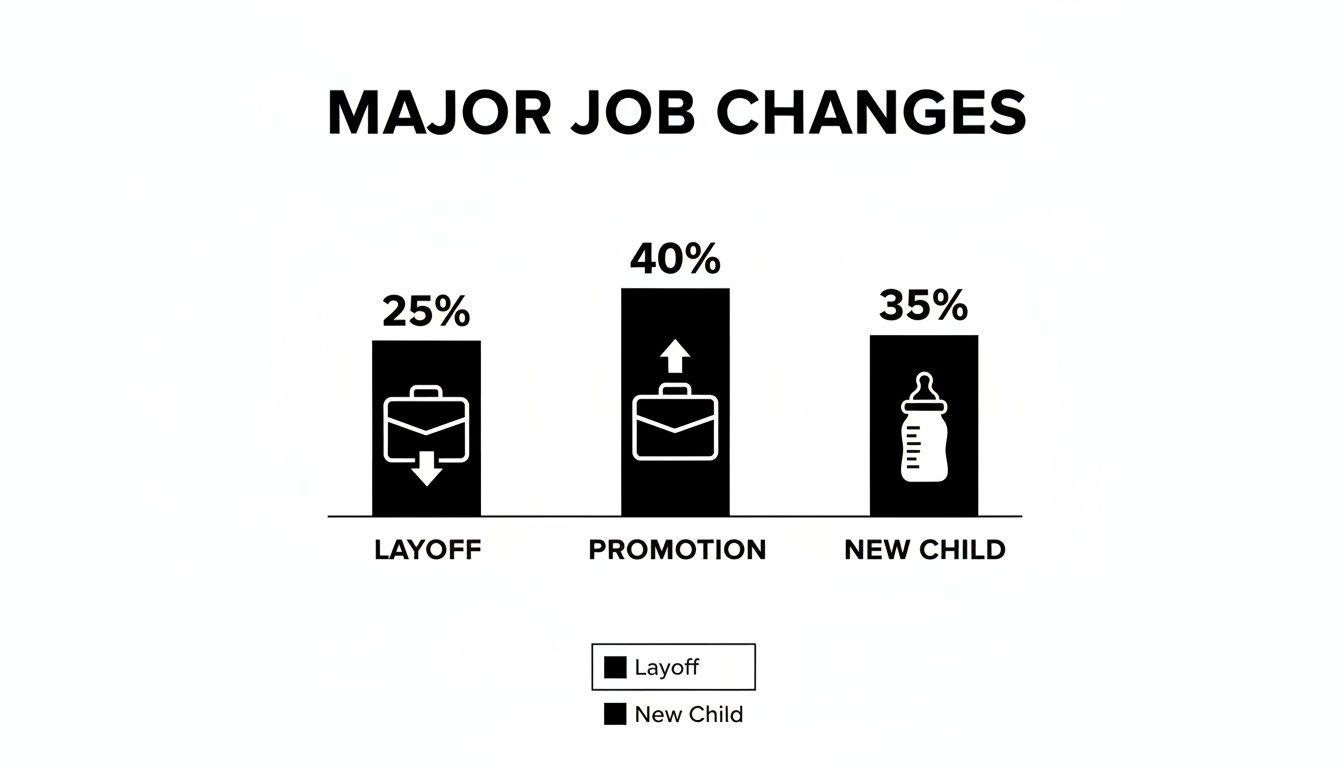
This is the most frequent basis for a modification request. A layoff due to company downsizing, a reduction in force, or the elimination of a position is a classic example of an involuntary change.
A court will scrutinize the reason for the job loss. If you voluntarily quit a stable, high-paying job, a court may refuse to lower your support. In such cases, a judge can find you are "intentionally underemployed" and calculate child support based on what you should be earning, not your current, lower income.
To succeed, you must present compelling evidence, including:
- A termination letter from your previous employer.
- Proof of application for unemployment benefits.
- A detailed log of your job search efforts to demonstrate due diligence.
A Significant Promotion or Raise
The duty to support a child is tied to a parent's financial ability. When the paying parent (obligor) receives a major promotion, a substantial bonus, or a new job with a much higher salary, this constitutes a material change. The receiving parent (obligee) can file a modification to request an increase in support so that the child benefits from the parent's improved financial standing.
New Children and Other Financial Duties
The birth of another child creates a new legal duty of support. The Texas Family Code §154.125 acknowledges this by providing a credit that reduces the guideline percentage for children from a prior relationship.
For instance, a parent paying support for one child (at the guideline 20% of net resources) who then has a new child may see their obligation for the first child reduced to 17.5%. While not a drastic reduction, it is a recognized change that accounts for the legal duty to support all of your children.
Changes in the Child's Needs
A child's circumstances can also be the catalyst for modification. These cases almost always involve a request to increase support to cover new and necessary expenses that were not present when the original order was made.
Common examples include:
- New Medical Conditions: A diagnosis of a chronic illness, such as asthma or juvenile diabetes, that requires expensive medication and frequent medical care.
- Special Needs Diagnosis: A diagnosis of autism, ADHD, or a learning disability requiring costly therapies, specialized tutoring, or private school tuition.
- A Change in Possession: If the child's primary residence changes from one parent to the other, this fundamental shift necessitates a complete recalculation of the support obligation.
In these situations, you must provide documented proof. Medical bills, school invoices, diagnostic reports, and expert testimony are required to prove why the current child support amount is no longer sufficient to meet the child's best interest.
How the New $11,700 Net Resource Cap Impacts Support
Texas courts calculate child support using a statutory formula based on the paying parent's net monthly resources. This figure is determined by calculating all income sources and subtracting specific allowable deductions, such as federal income tax, Social Security tax, union dues, and the cost of the child's health insurance.
For high-income earners, the guideline calculation is limited by a statutory "cap." After years at $9,200 per month, the Texas Legislature has updated this cap to reflect economic changes.
Understanding the New High-Income Threshold
Effective September 1, 2025, the maximum net monthly resources for guideline child support calculations will increase to $11,700. For many families with orders calculated under the old cap, this legislative change itself will qualify as a material and substantial change in circumstances.
This means that if the obligor's net resources meet or exceed this new threshold, the standard child support percentages will apply to a significantly larger income base, resulting in a higher guideline support amount.
While personal events trigger modifications, this new income cap is a universal trigger affecting high-income cases statewide.
A Side-by-Side Look at the Numbers
The practical impact of this change is significant. The table below illustrates the maximum guideline child support under the old and new caps, based on the standard percentages set forth in Texas Family Code §154.125.
Practical Example: Child Support Calculation
Let's assume an obligor has net monthly resources of $12,000 and one child.
- Under the Old Cap ($9,200): The calculation is $9,200 x 20% = $1,840 per month.
- Under the New Cap ($11,700): The calculation will be $11,700 x 20% = $2,340 per month.
This represents a $500 per month increase based solely on the legislative change.
Child Support Guideline Calculations with the New $11,700 Cap
| Number of Children | Guideline Percentage | Max Support (Old $9,200 Cap) | Max Support (New $11,700 Cap) | Monthly Increase |
|---|---|---|---|---|
| 1 | 20% | $1,840 | $2,340 | $500 |
| 2 | 25% | $2,300 | $2,925 | $625 |
| 3 | 30% | $2,760 | $3,510 | $750 |
| 4 | 35% | $3,520 | $4,095 | $875 |
| 5+ | 40% | $3,680 | $4,680 | $1,000 |
Can a Court Order Support Above the Cap?
Yes. The $11,700 cap is a presumptive maximum, not an absolute ceiling. Texas Family Code §154.123 grants a court discretion to order support above the guideline amount if the evidence shows the child has proven needs that justify a higher amount.
To secure an above-guideline award, you must present documented proof that the child’s specific, necessary expenses exceed the maximum guideline support.
Examples of proven needs include:
- Private school tuition
- Costs for high-level competitive sports or arts programs
- Tutoring or specialized therapy for a child with special needs
- Uninsured medical or dental expenses
Success requires meticulous preparation of receipts, invoices, and expert reports. You can read more about the $11,700 cap in our detailed guide.
Using the Three-Year Rule for Modification
While many modifications are driven by a single, significant event, the Texas Legislature created an alternative path for circumstances that change gradually over time.
This tool, found in Texas Family Code §156.401(a)(2), is often called the "three-year rule." It provides a clear, numbers-based ground for modification without the need to prove a specific life event.
The 20% or $100 Threshold
The rule is straightforward. If it has been at least three years since your child support order was last entered or modified, you can request a review. You do not have to prove a "material and substantial change."
Instead, you must only show that the monthly child support amount, if recalculated today under current income figures, would differ from the existing order by at least 20% or $100.
This rule acts as a periodic reset, ensuring orders do not become outdated due to inflation, cost-of-living increases, and incremental career growth. It allows support to reflect a child's current needs and a parent's current ability to pay.
How the Three-Year Rule Works in Practice
Consider a parent ordered to pay $1,000 per month in 2021 based on net monthly resources of $5,000 (20% for one child).
Four years later, consistent annual raises have increased their net monthly resources to $6,500. The other parent can now seek a modification using this rule.
Here is the court's analysis:
- The Time Test: Has it been over three years since the 2021 order? Yes.
- The New Calculation: Guideline support today would be $6,500 x 20% = $1,300 per month.
- The Difference Test: The new amount ($1,300) is $300 more than the old order ($1,000). This difference exceeds the $100 threshold and represents a 30% increase.
Because the statutory tests are met, the parent has a solid legal basis to file a Petition to Modify. The passage of time and the change in income are sufficient grounds for the court to hear the case.
The Step-by-Step Guide to the Modification Process
Knowing you qualify for a modification is the first step; navigating the Texas family court system is the next. The following procedural steps are required to prove a substantial change in circumstances and obtain a new order.

Step 1: Filing the Petition to Modify
The legal process begins by filing a Petition to Modify the Parent-Child Relationship. This formal pleading is filed with the court that has continuing, exclusive jurisdiction over your case—typically the court that issued the last order. The petition must state the legal grounds for your request, alleging that a material and substantial change has occurred.
Step 2: Service of Process
After filing the petition, you must provide formal legal notice to the other parent. This is known as service of process. An independent party, such as a sheriff's deputy or a private process server, must personally deliver a copy of the lawsuit to the other party. This is a non-negotiable constitutional requirement. Once served, the other parent has a set deadline to file a formal answer with the court.
Step 3: Financial Discovery
Once the case is active, both parties engage in discovery—the formal process of exchanging financial information and evidence. This is how you gather the proof needed to build your case.
Common discovery tools include:
- Requests for Production: Formal written requests for documents such as tax returns, pay stubs, W-2s, bank statements, and bonus/commission details.
- Interrogatories: Written questions that the other party must answer under oath.
- Financial Information Statement: A sworn court form detailing all monthly income and living expenses.
The party seeking the modification has the burden of proof. Discovery is the mechanism you use to meet that burden. A judge will not act on allegations; you must produce the documents that prove your claim.
Step 4: Mediation and Negotiation
Before proceeding to a final trial, nearly every Texas court will require the parties to attend mediation. This is a confidential settlement conference led by a neutral third-party mediator whose role is to help you and the other parent reach a mutually agreeable resolution. The vast majority of family law cases are resolved at this stage. If an agreement is reached, it is memorialized in a binding Mediated Settlement Agreement, which forms the basis for the new court order.
Step 5: The Final Hearing
If mediation fails, your case will be set for a final hearing before a judge. At this trial, both sides will present evidence, offer testimony, cross-examine witnesses, and make legal arguments. The judge will review all financial documents and testimony and then issue a final ruling. If the judge finds that a substantial change has occurred, a new child support order will be signed, which legally replaces the prior one.
How to Prove Your Case in Court
In a child support modification hearing, your testimony is important, but your documentary evidence is what wins the case. A Texas judge requires clear, credible proof to alter a court order.
Proving Your Need for a Support Increase
If you are requesting an increase in child support, you must prove either that the other parent's income has increased or that the child's needs have significantly increased.
To prove a higher income, you must use the discovery process to obtain financial records. Key documents include:
- Recent Pay Stubs: Provide a current snapshot of salary, overtime, and bonuses.
- Tax Returns (W-2s and 1099s): Offer a year-over-year view of total income.
- Bank Statements: Can reveal undisclosed income sources or a lifestyle inconsistent with stated earnings.
- Commission or Bonus Reports: Crucial for variable-income earners.
To prove the child's increased needs, you must present invoices, receipts, and professional reports documenting new and necessary expenses.
- Medical Bills: Documentation from physicians or therapists for a new diagnosis.
- Tuition Invoices: Proof of enrollment and costs for a specialized school.
- Extracurricular Costs: Receipts demonstrating significant expenses for high-level competitive activities.
Defending Against a Modification Request
If you are defending against a request to lower child support, your objective is to demonstrate that the other parent's claimed change is not material, is temporary, or was voluntarily created.
A powerful defense is to prove intentional unemployment or underemployment. If a parent voluntarily quits a job to reduce their income, Texas Family Code §154.066 allows the court to calculate child support based on their "earning potential."
To establish this defense, you can use evidence such as their social media posts about a new venture, testimony regarding their skills and work history, or job market data showing the availability of suitable employment. The goal is to show the job loss was not in good faith. You can learn more about how Texas courts calculate net resources in our detailed guide.
FAQs: Modifying Texas Child Support
Can child support be modified retroactively if I waited to file?
No. Under Texas Family Code §156.401(b), a court can only modify child support payments prospectively from the date the other parent was officially served with the modification lawsuit. The court is prohibited from retroactively modifying any payments that became due before that service date. This is why it is critical to file your petition as soon as the substantial change occurs.
How does a 50/50 possession schedule impact child support?
A true 50/50 possession schedule is a material and substantial change that warrants a modification. It does not automatically eliminate child support. Instead, the court typically calculates what each parent would owe the other under the guidelines. For example, if Parent A's guideline support would be $1,200 and Parent B's would be $800, the court offsets the two amounts. Parent A would then be ordered to pay Parent B the $400 difference, acknowledging that both parents are now incurring direct costs for the child on a more equal basis.
What if my ex is intentionally unemployed to avoid paying child support?
Texas courts can address this scenario. If you can prove that the other parent is "intentionally unemployed or underemployed" to avoid their support obligation, the judge is not required to use their artificially low income. Pursuant to Texas Family Code §154.066, the court can calculate child support based on that parent’s earning potential. You must present evidence of their past income, education, skills, and the availability of jobs in their field to convince the court to make such a finding.
Proving a substantial change in circumstances requires a strategic approach grounded in strong evidence. If you are facing a child support modification, our experienced attorneys are prepared to protect your rights and your child’s best interests. contact us to schedule a consultation to discuss the specific facts of your case.