When you're facing a Texas child support case, you need more than just a lawyer; you need a strategic partner. A skilled Texas child support attorney is your advocate, working to make sure your child’s financial needs are secured while also protecting your own financial stability under the exacting rules of the Texas Family Code.
Navigating The Texas Child Support System
Stepping into the Texas child support system can feel overwhelming. The rules are complex, the stakes are high, and it’s easy to feel lost. Let's clear the path.
At its heart, the entire system is designed for one primary purpose: to ensure children receive consistent financial support from both parents after a separation or divorce. Every calculation, every court order, and every enforcement action is governed by the Texas Family Code, the definitive rulebook for all family law matters in the state.
To understand the process, you first need to know the players. In court documents and hearings, the parent who has primary custody of the child (and receives the support payments) is called the obligee. The parent who is ordered to make the payments is the obligor. Knowing these terms is crucial, as their rights and responsibilities are spelled out very clearly by law.
OAG vs. Private Attorney
Early on, you’ll come to a major fork in the road: should you work with the Office of the Attorney General (OAG) or hire a private attorney? The OAG handles a massive volume of cases and offers its services at no direct cost to parents. Their main job is to establish and enforce basic support orders. It’s important to remember, though, that the OAG represents the interests of the State of Texas, not you personally.
A private attorney, in contrast, is your dedicated advocate. Their only loyalty is to you and your child's best interests. Their job is to secure the best possible outcome, whether that means fighting for a fair income calculation, arguing for support above the standard guidelines, or tenaciously pursuing unpaid back-support.
Hiring a private lawyer gives you a distinct edge:
- Customized Game Plan: Your attorney will dig into the specifics of your life and finances to build a strategy aimed squarely at your goals.
- Insider Knowledge: They can navigate complex financial situations, like calculating net resources for a small business owner or self-employed parent, and know how to argue for deviations when circumstances warrant it.
- Effective Advocacy: When it's time to go before a judge, an experienced attorney knows how to present your case, submit evidence properly, and make a compelling argument on your behalf.
The Legal Road Map
The legal process for establishing child support follows a predictable, step-by-step path. It all begins when one parent files a formal document called a Petition with the court, officially starting the case.
Next, that Petition has to be formally delivered—or "served"—to the other parent. Once served, they have a specific deadline to file a legal response known as an Answer. Failing to file an Answer can have serious consequences.
To give you a clearer picture of the journey, here’s a breakdown of the typical stages involved.
Key Stages in a Texas Child Support Case
| Stage | Primary Purpose | Typical Action Items |
|---|---|---|
| Filing the Petition | To formally initiate the child support case with the court. | Drafting and filing the initial lawsuit; requesting specific relief (e.g., establishing support). |
| Service of Process | To officially notify the other parent (the Respondent) of the lawsuit. | Hiring a process server or constable to personally deliver the court documents. |
| Filing an Answer | For the Respondent to formally respond to the lawsuit and avoid a default judgment. | Drafting and filing a legal Answer within the strict time limits set by law. |
| Temporary Orders | To establish a temporary child support order while the case is ongoing. | Attending a hearing where a judge makes initial rulings based on limited evidence. |
| Discovery | To gather financial information and evidence from the other parent. | Sending formal requests for documents (bank statements, tax returns, pay stubs). |
| Mediation | To attempt to reach a settlement agreement outside of court. | Negotiating with the other parent and their attorney with the help of a neutral mediator. |
| Final Hearing/Trial | To have a judge make a final, binding child support order. | Presenting all evidence and arguments to the court for a final decision. |
From temporary orders hearings to mediation and, if necessary, a final trial, each step is governed by strict rules and deadlines. A small misstep can have a big impact on the outcome. This is why engaging a Texas child support attorney from the very beginning is the single best way to protect your rights and ensure the final order is both fair and workable for the long haul.
How Texas Child Support Is Calculated
When it comes to child support, everything boils down to a single number: the monthly payment. My job, as a Texas child support attorney, is to make sure that number is calculated fairly and correctly based on the law. Texas courts don't just pull figures out of thin air; they follow a specific formula laid out in the Texas Family Code.
The entire calculation starts with a term you'll hear a lot: net monthly resources. This is a crucial concept to grasp because it's much more than just a parent's paycheck.
Determining Net Monthly Resources
To get to the right support amount, the court first has to figure out the paying parent’s (the "obligor's") total net monthly resources. Think of this as a two-step process: add up all income, then subtract only the legally approved deductions.
What Courts Consider Income:
- Wages, salary, overtime, tips, and bonuses
- Income from self-employment or a business
- Rental income from any properties
- Retirement benefits and pensions
- Social Security benefits (but not SSI)
- Unemployment or workers' compensation payments
From that total gross income, the court will subtract a few specific items: federal income taxes (as if filing single with one exemption), Social Security taxes, union dues, and what's paid for the child's health insurance. The number that's left is the net monthly resource figure that drives the rest of the calculation.
This infographic helps visualize how everyone involved—the parents and their attorneys—fit into the state's legal framework.
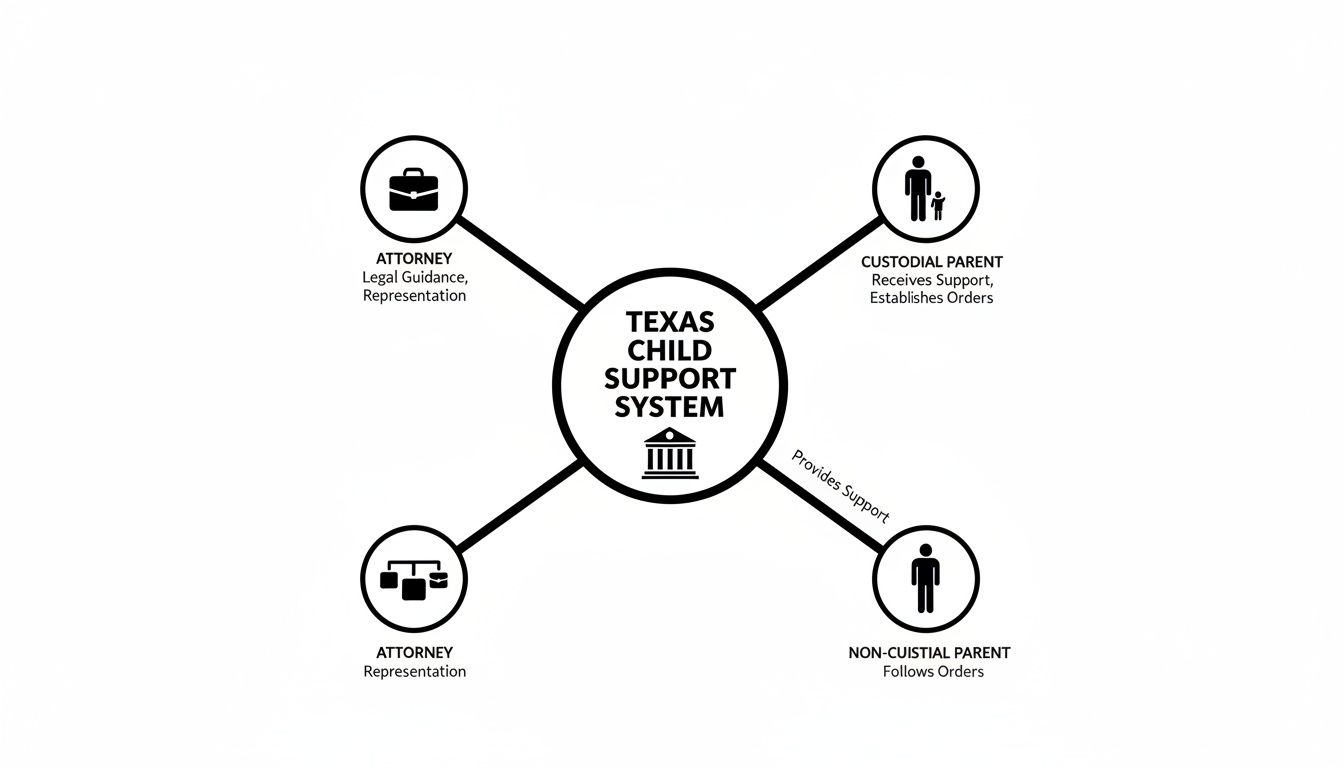
As you can see, a skilled attorney is the bridge between the parents and the legal system, turning complex rules into a clear, actionable plan.
Applying Guideline Percentages
Once that net resource number is locked in, the court applies a simple percentage based on how many children are involved. These guidelines are spelled out in Texas Family Code §154.125:
- 1 Child: 20% of net resources
- 2 Children: 25% of net resources
- 3 Children: 30% of net resources
- 4 Children: 35% of net resources
- 5 or more Children: 40% of net resources
Let's make this real. If a parent has $6,000 in net monthly resources and two kids, the starting point for child support would be $1,500 per month (25% of $6,000). To see how these rules might play out in your own case, it's helpful to review our detailed guide on how to calculate child support in Texas.
The High-Income Cap and Upcoming Changes
Now, what about high earners? Texas law puts a "cap" on the income used in the standard calculation. This is a big deal, and there's a major change on the horizon.
Effective September 1, 2025, this cap is increasing to $11,700 a month. This adjustment reflects the rising cost of living and will significantly affect high-income families. For any new child support order issued after that date, the higher cap means the maximum guideline support for one child will jump from the current maximum to $2,340 per month.
Important Takeaway: If the paying parent's net resources are over the cap, the guideline percentage is only applied up to that cap. However, a judge can absolutely order more support if the child has proven needs that justify it—things like private school tuition, specialized tutoring, or expensive extracurricular activities.
When Can a Judge Deviate From the Guidelines?
While these guidelines are the starting point and are presumed to be in the child's best interest, they aren't set in stone. Under Texas Family Code §154.123, a judge has the power to order a different amount if the standard calculation would be unfair or inappropriate for the family's situation.
Some common reasons a judge might deviate include:
- A child has special needs or extraordinary medical costs.
- The paying parent has very high travel expenses just to see the kids.
- There's a massive gap between the parents' ability to provide for the child.
- One parent is found to be intentionally unemployed or underemployed to avoid paying support.
Successfully arguing for a deviation—either for more or less support—requires compelling proof. An experienced child support lawyer knows exactly how to build this case by presenting financial records, receipts, and even expert testimony to show the judge why a different number is needed to truly meet the child's best interests.
Enforcing Your Child Support Order
Having a child support order in your hands is a huge relief, but what happens when the payments are late or just stop coming? A court order is just a piece of paper until it's enforced. When the other parent isn't paying, it throws your family’s finances into chaos. My job, as a Texas child support attorney, is to step in and use the full force of the law to turn that order back into the consistent support your child deserves.

When you're owed support, you have two main routes: you can work with the Office of the Attorney General (OAG), or you can hire a private attorney to file a lawsuit on your behalf. The OAG is a powerful agency, but it’s no secret they are overwhelmed with an enormous caseload, which can mean frustrating delays.
Taking Control with a Private Enforcement Lawsuit
For many parents I work with, the fastest and most direct path to getting paid is by hiring a private attorney to file an Enforcement Lawsuit. This court action is specifically designed to compel the non-paying parent (the obligor) to follow the judge’s original order. Going this route puts you in the driver's seat of your own case, often leading to much faster results than waiting in line at a state agency.
A private lawsuit gives us access to the court's most powerful tools. We can ask a judge to:
- Order the other parent to pay every penny of the missed payments (arrears), plus 6% annual interest.
- Hold the non-paying parent in contempt of court, which can result in jail time.
- Order the suspension of their driver’s license, professional licenses, and even hunting and fishing licenses.
- Force the other parent to pay for your attorney’s fees and all court costs.
The real point of an enforcement action isn't just to get the money you're owed from the past; it's to guarantee the payments keep coming in the future. The threat of jail or losing a license is a powerful motivator for a parent who has been ignoring their responsibility.
The Enforcement Process Step-by-Step
When you hire our firm, we don't waste time. We follow a clear, purposeful process designed to get you paid as quickly as possible.
- File the Motion for Enforcement: We immediately draft and file a formal legal motion. This document acts as a detailed ledger, outlining every missed or partial payment, calculating the total amount owed with interest, and asking the judge for specific consequences.
- Serve the Other Parent: The non-paying parent has to be officially notified of the lawsuit. We use a constable or a private process server to hand-deliver the court documents, which legally requires them to show up for a hearing.
- The Enforcement Hearing: In court, we present the judge with clear evidence of non-payment. The other parent can try to offer a defense, but the burden of proof is on them. If the judge agrees the order was violated, they will issue a judgment for all the back-support and hand down the punishments.
Don't let unpaid child support become a source of constant stress for your family. The most powerful tool you have is a proactive legal strategy. For a more detailed look at the legal side, check out our guide on how to enforce child support in Texas. Contact a Texas child support attorney today to start the process of collecting the financial support your child is rightfully owed.
Modifying An Existing Child Support Order
Life doesn’t stand still, and neither do our financial situations. A child support order that made perfect sense three years ago might be completely unworkable today. Thankfully, Texas law recognizes this and allows parents to ask a court to change, or modify, an existing support order.
But it’s not as simple as just wanting a different payment. You have to meet a specific legal standard to even get your foot in the courthouse door. This is where having an experienced attorney on your side becomes critical; they can analyze your situation to see if it qualifies and then build the strongest case for the change you need.
The Legal Grounds for Modification
In Texas, a judge will only consider changing a child support order if you can prove one of two things:
- There has been a material and substantial change in the life of the child or one of the parents.
- It’s been at least three years since the order was made, and the new amount would be different by 20% or $100.
The first reason is the most common, but it's also the most open to interpretation. So, what actually counts as a "material and substantial change"? It has to be more than a minor hiccup in your finances. We’re talking about a significant, lasting event that fundamentally alters the circumstances.
Examples of a Material and Substantial Change:
- A parent involuntarily loses their job or takes a major, long-term pay cut.
- The paying parent gets a huge promotion or lands a much higher-paying job.
- The child develops a health condition that comes with expensive, ongoing medical bills.
- The custody arrangement flips, and the child now lives primarily with the parent who was once paying support.
You can't just walk into court and say your income dropped. You need to prove it with hard evidence like termination letters, unemployment benefit statements, and a log of your job applications.
The Three-Year Review Rule
The second path to modification is much more black-and-white. If it's been at least three years since your order was signed, you have the right to ask for a review.
If a new calculation, based on today's incomes, shows that the support amount should be at least 20% or $100 different from the current payment, a judge is very likely to grant the modification. This rule is a built-in mechanism to make sure support orders keep up with changing incomes and the cost of living over time, without needing to point to a single dramatic event.
Strategic Consideration: The new $11,700 monthly net resource cap, which goes into effect on September 1, 2025, is a major opportunity for many parents. If your original order was based on the old cap and the paying parent's income has grown beyond that, you could be eligible for a significant increase under the new, higher cap.
The Modification Process Step-by-Step
Requesting a modification isn't an informal chat with a judge; it's a formal court process that mirrors how the first order was established. A good lawyer will navigate you through every stage.
- File a Petition to Modify: It all starts by filing a formal "Petition to Modify the Parent-Child Relationship" with the same court that handled your original case. This document lays out why you are asking for the change.
- Serve the Other Parent: The other parent has to be officially served with the lawsuit. This gives them legal notice and a deadline to file their own response.
- Exchange Financial Information: Both you and the other parent will have to exchange financial records. This usually includes tax returns, recent pay stubs, and bank statements.
- Attend Mediation: In most Texas counties, you'll be required to try mediation first. This is a chance to sit down with a neutral third party and see if you can negotiate an agreement without a full-blown court battle.
- Final Hearing: If you can’t reach an agreement in mediation, a judge will hear testimony and review evidence from both sides. The judge then makes a final, binding ruling on what the new child support amount will be.
Whether your income has taken a nosedive or you know your child deserves more support based on the other parent's success, the law provides a clear pathway. To get a better handle on your specific situation, you can learn more about how to modify child support in Texas from our team of experts.
Handling Complex Child Support Scenarios
The standard Texas child support calculator is a great starting point, but let’s be honest—most family situations aren’t “standard.” Real life is messy. What happens when one parent is self-employed, gets paid in cash, or you share custody equally?
These are the scenarios where the simple math ends and the real legal work begins. It's about more than just plugging numbers into a formula; it’s about digging into the facts to build a case that ensures your child’s needs are met and the outcome is truly fair.

Retroactive Child Support
What about the time before a court order was in place? If a parent should have been paying support but wasn't, the court can step in and order retroactive child support. This is a powerful tool that allows a judge to order back-payments, often going back to the date the parents separated. It ensures a child doesn't lose out financially just because it took time to get to court.
When deciding on retroactive support, a judge will consider what the non-paying parent was earning during that time and whether they were aware of their responsibility to provide for the child. Our job is to gather the financial records and evidence needed to paint a clear picture for the court and secure a judgment for that past-due support.
Custody and Its Impact on Support
One of the most common questions we get is how a 50/50 custody schedule affects child support. Many parents assume that equal possession time means no one pays support, but that's a myth in Texas. The court's primary duty is to the child's best interest, which includes ensuring their standard of living is consistent between both homes.
Even with a 50/50 split, the higher-earning parent will almost always be ordered to pay support. The judge will look at what each parent would pay under the guidelines and then typically order an "offset" amount. This helps equalize the financial resources in each household, preventing a situation where the child's life is drastically different from one week to the next.
Texas law is crystal clear on this: child support and visitation are completely separate legal duties. A parent cannot legally stop paying court-ordered support because the other parent is denying visitation. Those are two distinct problems that have to be addressed separately through the legal system.
Uncovering Complex Income Sources
Figuring out income for a salaried, W-2 employee is easy. But what about a business owner, a freelancer paid in cash, or a salesperson with huge, unpredictable commissions? This is where having a sharp attorney becomes invaluable.
We use the legal discovery process to get the full story. By demanding bank statements, profit-and-loss records, and tax returns, we can uncover the true income. For business owners, we comb through "business expenses" to make sure personal luxuries aren't being written off to artificially lower their income for support calculations. For irregular income streams, we can argue that the court should use an average taken over several years to arrive at a fairer, more realistic number.
Child Support Above the Guideline Cap
As we've covered, Texas law puts a ceiling on the income used for the standard support formula (this cap rises to $11,700 a month on September 1, 2025). So, what happens if the guideline amount isn't enough to cover the child's actual needs?
Under Texas Family Code §154.123, a judge can order support above this capped amount if it's proven to be in the child’s best interest. To make this happen, you can't just ask for more money—you have to present concrete evidence of the child's "proven needs." This could include things like:
- Private school tuition
- Expenses for elite sports teams or specialized arts programs
- Tutoring and other academic support
- Significant medical, dental, or therapy costs
Successfully arguing for above-guideline support requires detailed documentation. We work with our clients to create a comprehensive budget that justifies every single dollar, showing the judge exactly why the additional support is essential to maintain the child’s established lifestyle and meet their unique needs.
Frequently Asked Questions for Texas Parents
As family law attorneys, we sit down with parents every single day who are trying to make sense of the Texas child support system. They come to us with good questions and real worries, looking for straight answers based on how things actually work under the Texas Family Code. Here are some of the most common questions that come up, along with the practical advice we share with our clients.
What happens if my ex is self-employed or gets paid in cash?
This is a huge source of anxiety for many parents, and for good reason. When someone doesn't get a regular W-2 paycheck, figuring out their true income takes some serious legal digging. You can't just take their word for it, especially if you have a gut feeling they're lowballing their earnings to shrink their child support payment.
This is where a good attorney proves their worth. We use a formal process called "discovery" to uncover the financial facts. We can legally require them to turn over all sorts of documents, including:
- Personal and business bank statements
- Profit and loss statements for their business
- Credit card statements
- Complete tax returns (both personal and business)
- Invoices, receipts, and customer payment logs
We then comb through these records to piece together the real story of their cash flow. If a parent claims they only make $3,000 a month, but their bank records show $10,000 in deposits and their credit card bills show a lifestyle that doesn't match, we have our evidence. We can show this to the judge, who has the power to set child support based on the income they actually have, not just what they claim on paper.
Do I still have to pay child support if my ex won't let me see our kids?
Let me be crystal clear on this: yes, you absolutely do. This is a tough pill to swallow for many parents, but it's a critical point of Texas law. Your responsibility to pay child support and your right to see your children (possession and access) are treated as two completely separate issues by the court. One doesn't hinge on the other.
A parent cannot legally stop paying court-ordered child support just because they're being denied visitation. On the flip side, a parent can't legally deny visitation just because the other parent is behind on child support.
Think of them as two separate lanes on a highway; you have to stay in your lane. If your ex is violating the custody order and keeping you from your kids, the right move is to file an Enforcement of Possession lawsuit. If they aren't paying support, the solution is a Child Support Enforcement action. Trying to fix one problem by creating another will only land you in hot water with the judge and hurt your case.
Can we just agree on a child support amount without going to court?
Yes, and many parents do. But—and this is a big but—that agreement isn't legally binding or enforceable until it's written into a formal court order and signed by a judge. It's common for parents to work out a support amount on their own, through their attorneys, or in mediation.
The key thing to know is that a judge will look very closely at any agreement that's different from the standard Texas guidelines (found in Texas Family Code §154.125). Before signing off, the judge has to be convinced that what you've agreed to is in the child’s best interest. For instance, if you agree to an amount that's way below the guideline figure, the judge will want to know why. They might worry the child’s needs won't be met and could refuse to sign the order.
An attorney can help you draft the agreement with the specific legal language needed to explain why your arrangement makes sense for your child, which greatly increases the chances a judge will approve it. Once signed, your private deal becomes an official, enforceable court order.
What if I'm already supporting kids in another household?
Texas law accounts for this. It recognizes that you might have legal duties to support children from different relationships, and it adjusts the formula accordingly. The Texas Family Code provides a specific chart that reduces the standard percentages so you aren't unfairly burdened.
For example, the guideline for one child is typically 20% of your net monthly resources. But if you are also legally obligated to support one other child from a different relationship, that percentage drops to 17.5% for the child in your current case. An experienced attorney will make sure you get the proper credit for these other obligations. It's vital that you bring copies of any other child support orders you have so the calculation is done right from the start.
At the Law Office of Bryan Fagan, PLLC, our attorneys are focused exclusively on Texas family law, including complex child support cases. We offer the strategic guidance and strong advocacy you need to protect your rights and secure your child’s future. If you're facing a child support battle, contact us for a consultation today. You can learn more about our services at https://txchildsupport.net.