The Texas Family Code establishes the legal framework for child support, but its core purpose is to ensure children receive the financial stability they need from both parents. These court-ordered obligations are serious and legally enforceable, typically lasting until a child turns 18 or graduates from high school, whichever occurs later.
Understanding the Fundamentals of Texas Child Support
When first encountering a child support case, the legal terminology can be intimidating. To navigate the process effectively, it's crucial to understand the core principles. The system is not designed to be punitive; rather, it creates a clear, predictable plan for a shared financial responsibility.
To begin, you must be familiar with the two primary roles in any child support proceeding:
- The Obligor: This is the legal term for the parent ordered to pay child support, typically the non-custodial parent.
- The Obligee: This is the parent who receives the child support payments, almost always the custodial parent who manages the child's daily expenses.
Every decision a judge makes—from the payment amount to enforcement methods—is governed by one overarching standard: the best interest of the child. This principle is the benchmark against which every action is measured.
The Procedural Steps and Legal Rationale
The legal process begins when one parent files a "Suit Affecting the Parent-Child Relationship" (SAPCR). This petition formally asks a court to issue orders regarding custody, visitation, and child support. Once filed, the other parent must be formally notified through a process called "service of process." The court then schedules hearings to gather evidence and issue a final, binding order.
The law presumes the custodial parent contributes financially through the direct costs of raising a child—housing, food, clothing, and daily care. Child support payments from the non-custodial parent (obligor) are designed to balance this financial load, ensuring the child benefits from the resources of both parents. This is why the obligor is typically the one making the payment.
A court's perspective is grounded in a fundamental legal duty: both parents are obligated to support their child. When parents live separately, a child support order is the legal instrument used to enforce this financial duty. The system is designed to ensure the child's standard of living is maintained, reflecting the financial resources of both parents.
This duty is enforced with powerful legal tools, reflecting a strong public policy to protect a child's financial well-being. Understanding that the system's goal is to create a stable foundation for your child allows you to approach the process with greater clarity and purpose.
How Child Support Is Calculated Under the Texas Family Code
Texas courts do not arbitrarily determine child support amounts. The process starts with a statutory formula known as "guideline child support," which is detailed in the Texas Family Code. While a judge can deviate from this formula, understanding its application is the essential first step in anticipating the outcome.
The calculation hinges on one key figure: the paying parent's (obligor's) monthly net resources.
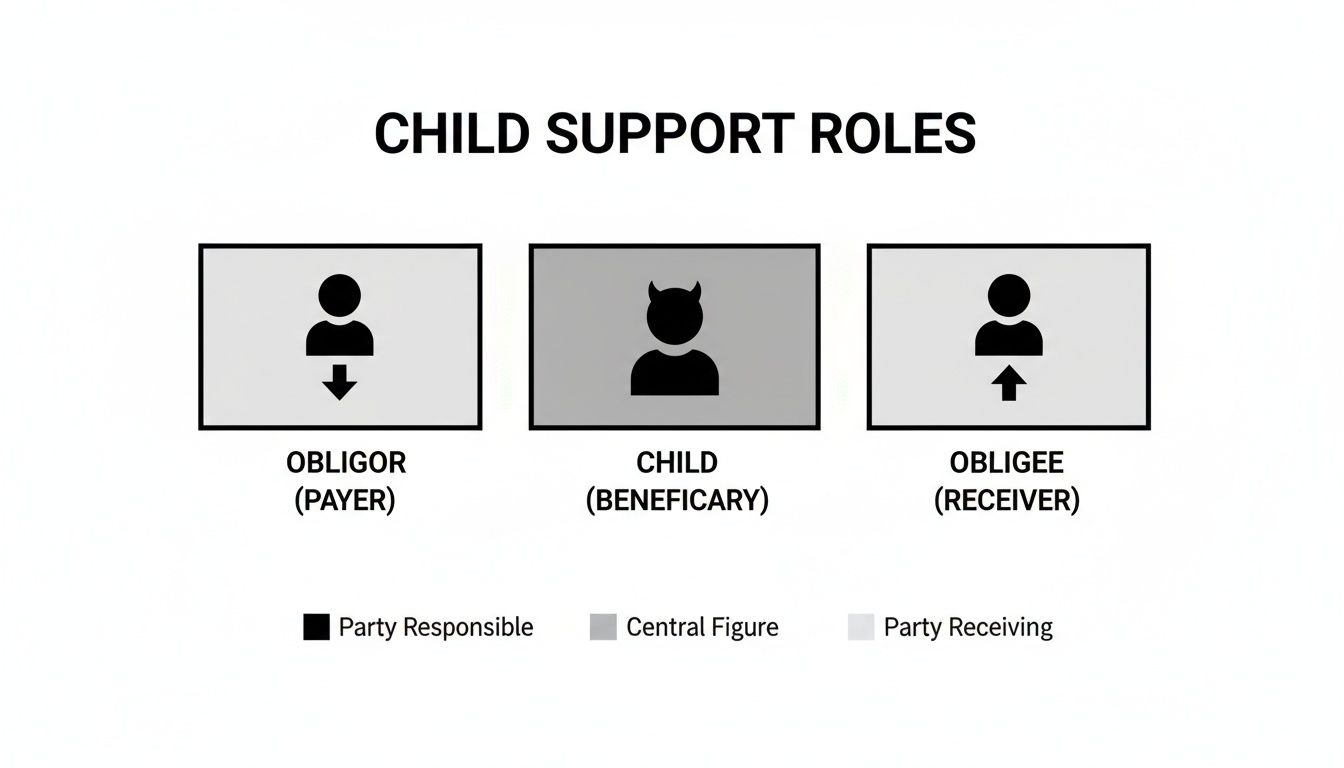
This diagram illustrates the flow of support. The obligor pays the obligee for the benefit of the child, forming the financial relationship at the heart of every support order.
Step 1: Calculating Monthly Net Resources
Before applying percentages, we must calculate the obligor's monthly net resources. This is analogous to take-home pay but is computed according to specific statutory definitions. It is not merely salary; the court considers all income streams.
The Texas Family Code defines "resources" to include:
- All wage and salary income, including commissions, overtime, tips, and bonuses.
- Income from self-employment, after deducting ordinary and necessary business expenses.
- Income from investments, such as interest, dividends, and royalties.
- Other income sources, including rental income, retirement benefits, and unemployment.
Once gross income is totaled, the court subtracts only a few specific items to determine the "net" amount. Permissible deductions are:
- Federal and state income taxes (using the tax rate for a single person claiming one exemption).
- Social Security taxes.
- Union dues.
- The amount paid for the child's health and dental insurance premiums.
It is critical to recognize what is not deductible. Monthly car payments, rent, mortgage payments, or credit card debt do not reduce your net resources for child support purposes. The law is explicit and strict on this point.
Step 2: Applying the Guideline Percentages
With monthly net resources calculated, the court applies a percentage based on the number of children before the court, as mandated by Texas Family Code §154.125. These percentages are presumed to be in the child's best interest.
Example Calculation: If an obligor has $6,000 in monthly net resources and one child, the guideline support is $1,200 per month (20% of $6,000). For two children, it would be $1,500 per month (25% of $6,000).
Texas Guideline Child Support Percentages (Based on Monthly Net Resources)
| Number of Children Before the Court | Percentage of Net Resources Applied |
|---|---|
| 1 Child | 20% |
| 2 Children | 25% |
| 3 Children | 30% |
| 4 Children | 35% |
| 5 or more Children | At least 40% |
The Updated Child Support "Cap" on Net Resources
There is a statutory cap on the income used for the guideline calculation. For orders signed on or after September 1, 2025, the cap on monthly net resources increases from $9,200 to $11,700. This legislative adjustment accounts for inflation and significantly raises the maximum guideline support amount.
For one child, this change increases the maximum guideline support from $1,840 (20% of $9,200) to $2,340 (20% of $11,700)—an additional $500 per month. This will have a substantial impact on high-income cases.
However, this cap is not a hard ceiling on the total support obligation. If an obligor's net resources exceed $11,700 per month, the guideline calculation is merely the starting point. A court may order additional support if the obligee proves the child's needs warrant an amount above the guideline calculation. Under Texas Family Code §154.123, a judge has the discretion to order this additional support based on evidence of the child's specific needs. This is where complex litigation arises and skilled legal counsel becomes invaluable.
Securing a fair child support order requires a deep understanding of the Texas Family Code and meticulous attention to financial detail. If you are preparing for a divorce or custody case, ensure you have an expert in your corner. Find out more about how a Texas child support lawyer can guide you through these critical calculations.
When Courts Can Deviate from Guideline Support
While the Texas child support guidelines provide a predictable formula, they serve as a rebuttable presumption, not an absolute mandate. Family law judges understand that real-life circumstances often do not fit neatly into a percentage calculation.
In situations where strict adherence to the guidelines would be unjust or fail to meet a child's needs, a judge has the authority to deviate—ordering child support that is either higher or lower than the standard amount. This decision is not made lightly. The parent requesting the deviation must present clear and convincing evidence that it is in the child’s best interest, and the judge must articulate the specific reasons for the deviation in the final order.
The Legal Framework for Deviation: Texas Family Code §154.123
The statutory authority for these decisions is Texas Family Code §154.123. This section provides a non-exhaustive list of factors a court may consider when determining if the guideline amount is unjust or inappropriate for a particular family.
Key factors include:
- The age and proven needs of the child (e.g., infants, teenagers, or children with disabilities).
- The ability of the parents to contribute to the support of the child.
- Any financial resources available for the support of the child.
- The amount of time of possession of and access to a child.
- The cost of travel to exercise possession of and access to a child.
These factors empower a judge to look beyond pay stubs and tailor an order that fits the family's unique reality.
Real-World Examples of Guideline Deviation
Understanding how these factors are applied in court is essential. Here are common scenarios where a judge might order non-guideline support.
Ordering Support Above the Guideline Amount
A court will often order more than the standard amount when a child has documented, extraordinary expenses.
- Practical Example (Special Needs): A child is diagnosed with autism and requires weekly applied behavior analysis (ABA) therapy costing $1,200 per month, which is not fully covered by insurance. The receiving parent provides invoices and a therapist’s recommendation. A judge can order support above the guideline amount to cover a portion or all of this proven, ongoing expense.
- Practical Example (High-Income Earners): The guideline cap on net resources is $11,700 (effective Sept. 1, 2025). The obligor is a surgeon earning $40,000 in net monthly resources. The child has been attending a private school with an annual tuition of $30,000 and participates in competitive equestrian sports. The obligee can present evidence of these "proven needs" to justify a support award significantly higher than the guideline maximum to maintain the child’s established standard of living.
Under the Texas Family Code, the court’s primary duty is to ensure the child’s needs are met. If you can prove with specific evidence that the guideline amount is insufficient, a judge has both the power and the obligation to order an amount that serves the child’s best interests.
Ordering Support Below the Guideline Amount
A court also has the discretion to order less than the guideline amount, not to excuse a parent's duty, but to account for other significant financial realities.
- Practical Example (High Travel Costs): The obligor lives in New York and the child lives in Houston. To exercise his standard possession order, the obligor must spend approximately $800 per month on airfare. He can present receipts and flight cost data to the court, which may grant a modest downward deviation in his monthly support obligation to facilitate his ability to maintain a relationship with the child.
- Practical Example (Supporting Other Children): An obligor has a guideline support obligation of $1,200 for one child. However, he also has two other children from a different relationship for whom he is legally obligated to pay support. The court will apply a credit, reducing the percentage of net resources used for the current calculation, resulting in a lower monthly payment.
Proving that a deviation is justified requires more than a mere request. It demands clear documentation, compelling evidence, and a strong legal argument focused squarely on the child's best interest.
Handling Complex and High-Stakes Child Support Issues
The standard Texas child support calculator is effective for straightforward cases, but many families face circumstances that do not fit the mold. High incomes, self-employment, shared custody, or a parent's long-term absence can introduce significant complexity.

When the stakes are high, you must look beyond the basic formula. This is where a deep understanding of the Texas Family Code is critical, whether you are proving a self-employed parent's true income or pursuing support that should have been paid years ago.
Retroactive Child Support and the Four-Year Rule
If you have been financially supporting your child alone for years without a court order, you may be entitled to retroactive child support. This is a court order compelling the other parent to pay for past periods when they failed to provide support. A court has the authority to order support dating back to the date of the parents' separation.
However, there is a rebuttable presumption that limits such an award to the four years preceding the date the petition for support was filed. To overcome this four-year presumption and obtain support for an earlier period, you must provide compelling proof that the other parent:
- Knew of their paternal duty but intentionally avoided their financial obligation.
- Attempted to avoid service of process or otherwise hid from the court's jurisdiction.
A judge will scrutinize the facts carefully. Did the other parent know about the child? Did they have the financial means to pay support? Did they make any voluntary contributions? Overcoming the four-year rule requires strong, clear evidence to convince the court that a longer retroactive period is in the child's best interest.
Medical and Dental Support Obligations
Child support extends beyond a monthly payment; it includes ensuring the child's health. The Texas Family Code mandates that every child support order must specifically address medical and dental support.
This is a separate obligation from the monthly cash support. Typically, the court will order the obligor to:
- Provide health and dental insurance for the child through their employer or a private plan.
- Reimburse the obligee for the cost of maintaining the child on their insurance policy.
For uninsured costs like co-pays, deductibles, and orthodontia, the court's order will specify how these out-of-pocket expenses are divided. The statutory default is a 50/50 split, but a judge has the discretion to order a different percentage based on each parent's financial resources and ability to pay.
50/50 Possession and Offset Child Support
A prevalent myth in Texas family law is that a 50/50 possession schedule automatically eliminates the child support obligation. This is incorrect. While equal possession is a significant factor, it does not negate the duty of support, especially when a significant income disparity exists between the parents.
The court's primary objective is to ensure the child enjoys a similar standard of living in both households. To achieve this in a 50/50 arrangement, judges often use an "offset" calculation:
- First, the court calculates the guideline child support Parent A would owe Parent B.
- Then, it calculates the guideline support Parent B would owe Parent A.
- The parent with the higher obligation pays the difference to the other parent.
Practical Example: Parent A's guideline obligation is calculated to be $2,000 per month. Parent B's guideline obligation is $800 per month. The judge would likely order Parent A to pay Parent B $1,200 per month ($2,000 – $800 = $1,200). This approach ensures both parents contribute financially in proportion to their incomes. Of course, things can get messy when parental conflict affects the child's relationships; our guide on what to do about parent alienation in Texas explores these difficult situations in more detail.
How to Modify or Enforce a Child Support Order
A child support order is a legally binding directive, but it is not set in stone. Life circumstances change, incomes fluctuate, and children's needs evolve. The Texas Family Code provides clear procedural avenues for both changing (modifying) an existing order and compelling compliance (enforcing) when payments cease.

Whether you are paying or receiving support, understanding these processes is vital to ensuring the order remains fair and your child is consistently supported.
The Standard for Modifying a Child Support Order
You cannot modify a child support order simply because you disagree with it. To succeed, you must file a formal "Petition to Modify" and prove that there has been a material and substantial change in circumstances since the date the last order was signed. This is a legal threshold that requires evidence.
Common examples of a material and substantial change include:
- A significant, involuntary decrease or increase in the obligor's income.
- Loss of employment.
- A change in the child's needs, such as a new medical diagnosis requiring costly care.
- A change in the primary custody arrangement.
A critical warning: Informal agreements to change child support are unenforceable and dangerous. If you agree to reduce payments without a new court order, the original order remains legally effective. The paying parent will accrue arrears for the unpaid difference, plus statutory interest, and can be subject to an enforcement action later.
Alternatively, if it has been at least three years since the last order was signed, a modification can be sought if the current guideline calculation would change the monthly payment by either 20% or $100.
The Enforcement Power of the Texas Family Code
When a parent violates a court order by failing to pay child support, the system provides powerful remedies. The goal is not only to collect the past-due amount ("arrears") but to compel future compliance.
The process begins by filing a "Motion for Enforcement." Once filed, a judge can utilize a formidable toolkit to force payment.
Wage Withholding Order: This is the primary tool. The court issues an order directly to the obligor's employer, who is legally required to deduct child support from each paycheck.
Child Support Lien: A lien acts as a legal encumbrance on assets. It can be placed on real estate, vehicles, or bank accounts, preventing the parent from selling or transferring the property until the debt is satisfied.
License Suspension: The court can order the suspension of the obligor’s driver's license, professional licenses (e.g., medical, legal, contracting), and recreational licenses (e.g., hunting and fishing).
Contempt of Court: This is the most severe consequence. If a judge finds the parent had the ability to pay but willfully refused to do so, they can be held in contempt. Punishments include fines and jail time, often until a lump-sum payment is made to secure release.
Enforcement actions are technical and require precise adherence to legal procedure. To understand the process for holding a non-paying parent accountable, it is helpful to review the steps for filing a Motion for Contempt of Court. Acting quickly is essential, as statutory interest accrues on all unpaid support.
FAQ: Common Questions About Texas Child Support Law
Navigating Texas child support involves practical, real-world questions. As a parent, you need clear answers to make informed decisions. Here, we address some of the most common issues our clients face.
Does a 50/50 Custody Schedule Eliminate Child Support in Texas?
No. This is one of the most persistent myths in Texas family law. A 50/50 possession schedule does not automatically cancel the child support obligation. The court's primary duty under the Texas Family Code is to ensure the child's needs are met and to maintain a consistent standard of living between both homes. If a significant income disparity exists, child support will almost certainly be ordered.
The most common method a judge uses is an "offset" calculation. They determine the guideline support Parent A would owe Parent B, then calculate what Parent B would owe Parent A. The higher earner pays the difference. Other factors listed in §154.123, such as who pays for health insurance, can also influence the final amount.
How Far Back Can I Request Retroactive Child Support?
Under the Texas Family Code, a court has jurisdiction to order retroactive child support back to the date the parents separated. However, the law establishes a rebuttable presumption that ordering support for the four years immediately preceding the filing of the lawsuit is reasonable and in the child's best interest.
To go back further than four years, you carry the burden of proof. You must present strong evidence that the other parent intentionally avoided their duty, such as proof that they:
- Knew they were the parent but deliberately chose not to provide support.
- Actively evaded service of process or concealed their whereabouts to avoid court.
A judge will examine the obligor's knowledge, actions, and financial capacity during the past period before ordering support beyond the four-year presumptive limit.
What Happens if My Ex Stops Paying Child Support?
If court-ordered child support payments stop, you must file a formal enforcement action immediately. Do not rely on informal promises to "catch up," as these agreements are legally unenforceable. The Texas Family Code provides judges with powerful tools to compel compliance.
The procedural first step is filing a Motion for Enforcement. From there, a court can order remedies including:
- Income Withholding: An order sent directly to the obligor's employer for mandatory payroll deduction.
- Property Liens: A legal claim against assets like a house, land, or bank accounts, preventing their sale until the debt is paid.
- License Suspension: Suspension of the non-paying parent’s driver's, professional, and recreational licenses.
- Contempt of Court: If the failure to pay was willful, a judge can find the parent in contempt, resulting in fines and potential jail time.
It is critical not to delay. Statutory interest accrues on unpaid balances from the moment they become delinquent.
Does the New $11,700 Cap Automatically Apply to My Old Order?
No. The new $11,700 monthly net resource cap, which goes into effect for orders signed on or after September 1, 2025, does not automatically update existing child support orders. Your current order remains governed by the statutory cap that was in effect when it was signed (for most recent orders, this is the $9,200 cap).
To benefit from the new, higher cap, you must file a Petition to Modify the Child Support Order. You must still prove that a "material and substantial change" in circumstances has occurred since your last order. While the increased cap can be part of your argument, particularly if the obligor's income has risen above the old cap, it does not, by itself, guarantee a modification.
At the Texas Child Support Law Office of Bryan Fagan, we provide the experienced guidance and courtroom advocacy needed to handle these complex questions. Whether you are establishing, modifying, or enforcing a child support order, our attorneys are committed to protecting your rights and securing your child's financial future. Contact us today for a consultation to talk about your case. You can learn more by visiting us at https://txchildsupport.net.