First things first, let's clear up a common misunderstanding. In Texas, having child support taken directly from your paycheck isn't a penalty for being behind on payments. It's actually the standard, default way things are done from day one.
This process is officially called an Income Withholding Order for Support. Think of it less like a punishment and more like an automatic bill pay system set up specifically for your child's benefit. As your counsel, we want you to understand that the court's goal is to make sure support is consistent and on time, right from the start.
Understanding Texas Child Support Withholding
When a Texas judge signs a child support order, they almost always sign an income withholding order at the same time. This isn't an extra step taken later; it's a built-in part of the process under the Texas Family Code. It’s a proactive approach designed to prevent missed payments before they ever become an issue.
It’s crucial to understand that this is completely different from wage garnishment for things like credit card debt or a personal loan. In fact, Texas law heavily protects your wages from most creditors. Child support, however, is a major exception because the law prioritizes a child's financial needs above almost all else.
The entire point of an Income Withholding Order is to create financial stability for the child. It’s a legal tool that treats child support as a top-tier financial obligation, making the payment automatic and predictable for everyone.
Key Roles in the Withholding Process
To really get how this works, it helps to know who the main players are and what they're responsible for. It’s a straightforward system once you see how the pieces fit together.
- The Paying Parent (Obligor): This is the parent ordered to pay child support. Your main job is to keep your employment information updated with the court and to immediately report any job changes.
- The Receiving Parent (Obligee): This is the parent who receives the support payments for the child.
- The Employer: Once your employer gets a valid withholding order, they are legally bound to deduct the correct amount from your paycheck and send it to the Texas Child Support Disbursement Unit.
- The Court: A judge makes it all official by signing the Income Withholding Order, which gives it the force of law.
This system is built to be reliable. Automating the payment takes the guesswork and potential for conflict out of the equation. No more "the check is in the mail" issues that can cause stress and create instability for a child. It also provides a perfect, official record of every payment made.
As you navigate your child support case, understanding your obligations is key. A knowledgeable Texas child support lawyer can be an invaluable resource in making sure you're prepared. Ultimately, the system is designed to put the child's well-being first.
The Legal Path to an Income Withholding Order
Getting an Income Withholding Order in Texas isn't some side quest you embark on after the fact. It's actually a standard part of the main event. The withholding order is created right alongside the primary child support order during the very first court hearing. It’s a foundational piece of the puzzle from day one.
Think of it as a direct line of communication, legally mandated, that runs from the judge's bench straight to the paying parent's payroll department. This ensures payments are consistent and reliable.
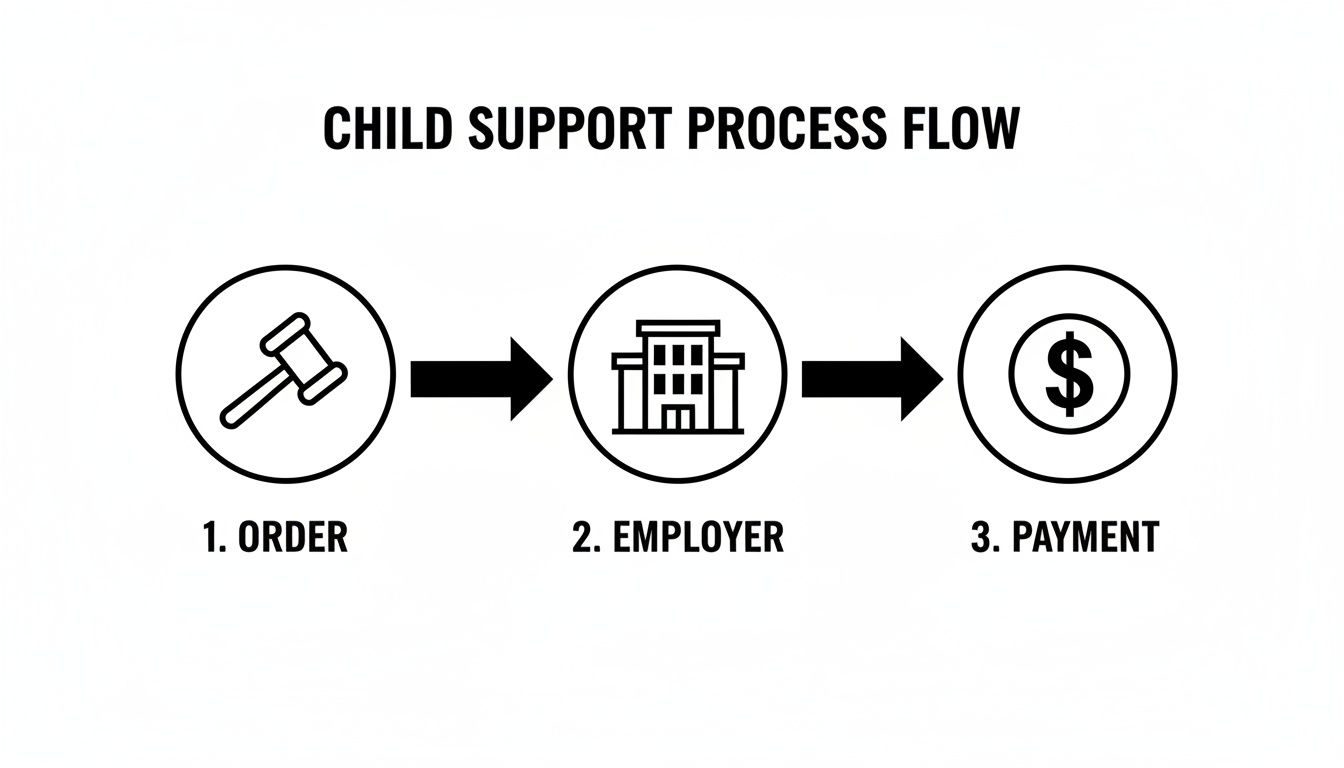
The flowchart above shows exactly how this works—from the court’s order to the employer’s action, and finally, to the payment itself.
The Procedural Steps in Court
Whether your case begins with a Petition for Divorce or a Suit Affecting the Parent-Child Relationship, the process culminates in a hearing where the judge will sign the final orders. This includes the Income Withholding Order. This isn't just a simple form; it's a powerful directive that has to be filled out with pinpoint accuracy to be legally binding. One wrong digit can cause serious delays.
Here’s the critical information that absolutely must be on the order:
- The paying parent's full legal name and Social Security number.
- The employer’s official name and service address (usually the payroll department or registered agent).
- The exact amount of current child support to be withheld each pay period.
- Any extra amounts for medical or dental support.
- If child support is past-due (in arrears), the specific amount to be withheld to start paying down that debt.
Once the judge signs off, this document becomes legally enforceable. The next move is getting it into the hands of the person who will actually cut the checks—the employer.
Notifying the Employer: Service and Legal Duties
The order must be officially "served" on the employer, which usually means sending a certified copy by mail to their registered agent for service of process. This formal delivery kicks off a strict set of legal responsibilities for the employer under the Texas Family Code. They don't have a choice in the matter.
Once an employer receives the order, they are required by law to:
- Start Withholding Immediately: The employer has to begin taking out the specified child support amount no later than the first pay period after getting the order.
- Send Payments Promptly: On every single pay date, they must send the withheld money to the Texas Child Support Disbursement Unit.
- Keep Withholding: The employer is legally obligated to continue this process without interruption until a court tells them to stop.
An employer cannot simply ignore a valid withholding order. It is also illegal for a company to fire, discipline, or refuse to hire someone just because they have a child support withholding order. These are crucial protections for the paying parent.
It’s important to realize how common this is. National data shows that 71% of garnished U.S. workers are men, and child support is the leading reason for it at a 3.4% incidence rate. This is more frequent than garnishments for student loans or tax debt. The action most often affects middle-aged employees (35-54) and those with mid-range incomes ($40k-$60k). We use these real-world statistics to prepare our clients for what to expect in court.
If a parent falls behind on payments after the initial orders are already in place, the other parent can file an enforcement action. In those cases, the court will issue an Income Withholding Order to get payments back on track, often adding an extra amount to chip away at the arrears. If you find yourself in this situation, it’s critical to understand how to enforce child support in Texas.
How Is the Child Support Amount Calculated for Withholding?
When a Texas court issues an Income Withholding Order, the amount taken from your paycheck isn't just a number pulled out of thin air. It's the result of a very specific formula laid out in the Texas Family Code. If you’re facing a child support case, understanding how the court gets to that final number is crucial. It’s the only way to know if the amount is fair and accurate.
Everything hinges on a key figure called your "net monthly resources." This isn't the same as your take-home pay. It's a legal calculation that starts with your total earnings and allows for only a handful of specific deductions.
To find your net monthly resources, the court first adds up all your gross monthly income. This is a broad category that includes your salary, wages, overtime, bonuses, commissions, and even income from self-employment or rental properties. From that total, the court is only allowed to subtract a few things:
- Federal income taxes (calculated as if you were a single person claiming one deduction)
- Social Security and Medicare (FICA) taxes
- Union dues (if they're mandatory)
- The cost of health and dental insurance for the child(ren) involved in the case
What's important is what isn't on that list. The court will not deduct your 401(k) contributions, car payments, or payments on personal loans. The law is designed to focus on the resources available for supporting the child, not your personal budget choices.
Applying the Guideline Percentages
Once your net monthly resources are locked in, the court applies a set percentage based on how many children the support order covers. These percentages are the bedrock of Texas child support law, found in Texas Family Code §154.125.
- 1 Child: 20% of net monthly resources
- 2 Children: 25% of net monthly resources
- 3 Children: 30% of net monthly resources
- 4 Children: 35% of net monthly resources
- 5 or more Children: 40% of net monthly resources
Keep in mind, these percentages can be adjusted if the paying parent has a legal duty to support other children who aren't part of the current lawsuit.

What About High Earners? The Statutory Cap
So, what happens if a parent makes a very high income? Does the percentage just keep applying, leading to a massive child support payment? Not exactly. The law anticipates this and sets a ceiling, or "cap," on the amount of income used for the guideline calculation.
As of September 1, 2025, the statutory cap on net monthly resources is $11,700 per month. This means for anyone whose net resources are at or below this amount, the calculation is a straightforward application of the guideline percentages.
Let’s walk through a practical example. Say a parent has a gross monthly income of $9,000. The court would subtract estimated taxes (e.g., ~$2,000) and the monthly cost of the child's health insurance (e.g., ~$300), resulting in net monthly resources of $6,700. For one child, the guideline support would be 20% of $6,700, which is $1,340 per month.
Texas Guideline Child Support Calculation Example (Post-Sept 1, 2025)
| Calculation Step | Description | Example Value |
|---|---|---|
| Step 1: Determine Net Monthly Resources | The parent's gross income less the legally allowed deductions (taxes, insurance for the child, etc.). | $8,000 |
| Step 2: Check Against the Cap | Compare the net resources to the $11,700 statutory cap. | $8,000 (Below the cap) |
| Step 3: Apply Guideline Percentage | Multiply the net resources by the percentage for the number of children (in this case, one child at 20%). | $8,000 x 0.20 |
| Step 4: Calculate Final Support Amount | The result is the monthly guideline child support obligation. | $1,600 per month |
In this case, the Income Withholding Order would direct the parent's employer to withhold $1,600 each month. Things get more complicated, however, when income goes above this cap. You can dig deeper into the nuances by reviewing our comprehensive guide on how to calculate child support in Texas.
When Can a Judge Deviate from the Guidelines?
While the guidelines are the starting point, they aren't completely rigid. A judge has the authority under Texas Family Code §154.123 to order a different amount if there's compelling evidence that doing so is in the "best interest of the child."
This is especially common in high-income cases. If a parent's net resources are over the $11,700 cap, the judge will first calculate support on that capped amount (e.g., for two children, that's 25% of $11,700, or $2,925). Then, the other parent can present evidence to show the children have "proven needs" that require additional support beyond that guideline amount.
A judge will look at several factors to determine these needs:
- The age of the children and their specific needs, like tutoring, competitive sports, special medical care, or private school tuition.
- The lifestyle the children were accustomed to during the marriage.
- The financial resources and earning potential of both parents.
Proving these additional needs isn't a simple matter; it requires solid evidence like receipts, budgets, and clear testimony. These contested hearings are where an experienced family law attorney becomes invaluable, fighting to ensure the final child support amount—and the resulting wage garnishment—is fair, just, and truly serves the children's best interests.
Employer Responsibilities and Employee Rights
When a court issues an Income Withholding Order for child support, it isn't just a piece of paper. It sets in motion a series of serious legal obligations for your employer while also granting you, the employee, some powerful rights. Getting a handle on both sides of this equation is crucial for any parent navigating the wage garnishment process in Texas.

Once your employer receives that withholding order, the clock starts ticking. They don't have a choice in the matter—the Texas Family Code is crystal clear, and they are legally required to comply.
The Employer's Legal Obligations
From the moment that order lands on their desk, your employer has to follow a strict process and timeline. Failing to do so can expose them to legal penalties, so they tend to take these orders very seriously.
Here’s what the law requires them to do:
- Start Withholding Immediately: Your employer must begin taking child support out of your paycheck no later than the first pay period after they get the order.
- Send the Money Promptly: On every payday, they are required to forward the withheld amount directly to the Texas Child Support Disbursement Unit.
- Keep Withholding: This process doesn't just stop. The deductions must continue with every paycheck until the court issues a brand new order that officially tells them to stop.
This system is built to be an automatic and consistent pipeline, ensuring that the funds needed to support your child are delivered without interruption.
How Much Can Legally Be Withheld from Your Paycheck?
While a Texas court determines your child support amount, it's actually federal law that puts a ceiling on how much can be taken from your pay. The Consumer Credit Protection Act (CCPA) steps in to make sure the garnishment doesn't leave you completely high and dry, which is especially important if you've fallen behind and owe arrears.
Your employer can only garnish a percentage of your disposable earnings—that’s what’s left of your paycheck after mandatory deductions like federal and state taxes are taken out. The federal limits are:
- Up to 50% of your disposable earnings if you are also supporting another spouse or child.
- Up to 60% if you are not supporting another family.
- These caps can jump to 55% and 65%, respectively, if you are more than 12 weeks behind on your child support payments.
In Texas, wage garnishment for child support is a prevalent enforcement tool. A comprehensive 2013 ADP Research Institute study revealed that 7.2% of all U.S. workers were subject to wage garnishment, with child support being the single largest cause at a 3.4% rate. Sectors like manufacturing and transportation showed higher rates, underscoring how widespread this practice is across various industries. To gain a deeper understanding of these employment trends, you can explore the full findings of the U.S. wage garnishment landscape research.
Your Rights as an Employee in Texas
This is probably the single most important thing for a paying parent to know: it is flat-out illegal for your employer to punish or retaliate against you because of a child support withholding order.
The Texas Family Code provides very strong protections for employees. An employer cannot legally:
- Fire you.
- Refuse to hire you.
- Discipline you or take any other negative action against you.
This protection is absolute. The law recognizes a simple reality: your ability to keep your job is what makes paying child support possible in the first place. If you have any reason to believe an employer has discriminated against you because of a wage garnishment order, you have clear legal rights and should seek help immediately.
How to Legally Change or Challenge a Withholding Order
When that first paycheck comes out with a huge chunk missing for child support, it's easy to feel backed into a corner. I've had countless parents call my office feeling trapped, but here’s the good news: while an Income Withholding Order is a serious court command, it isn't necessarily permanent.
However, you can't just call up your HR department and ask them to stop. That order came from a judge, and only a judge can change it. You must return to court, and it is vital that you understand the correct legal path to take.
Contesting an Order vs. Modifying an Order
First things first, it's critical to know the difference between contesting the withholding order itself and modifying the child support amount it’s based on. They are two completely different legal actions.
Contesting the withholding order is for fixing simple, factual mistakes. The window for this is incredibly narrow. You can file a Motion to Stay Issuance of Withholding Order, but only if you can prove a clear error, such as:
- The amount of back child support (arrears) listed is wrong.
- You've been mistaken for the person who actually owes support.
- The support obligation has legally ended because the child has emancipated.
This isn't a chance to argue about whether you can afford the payments. It's strictly about correcting a clerical error. For most people, the real solution lies in changing the child support amount itself.
The Standard for Modifying Child Support
The most effective way to lower your garnishment is to modify the original child support order. In Texas, you can ask the court to change your child support payments if you can show there has been a material and substantial change in circumstances since the judge signed the last order.
This is the key phrase that unlocks the whole process.
A "material and substantial change" has to be more than just a bad month or a temporary setback. Courts are looking for a significant, often long-term shift in the financial or living situation of you, the other parent, or your child. Proving this change is how you win a modification case.
So, what does that actually look like in the real world? Courts often consider things like:
- Involuntary Job Loss: Getting laid off is the classic example.
- A Major Swing in Income: This could be a big promotion that justifies higher support or, more commonly for modification, a significant and lasting pay cut.
- Changes in Custody: If your child comes to live with you instead of the other parent, the entire support calculation needs to be redone.
- New Medical Needs: A child developing a condition that requires expensive, ongoing care can be grounds to adjust support.
- A Child's Living Arrangements Change: This might happen if a child goes to live with a grandparent or another relative, changing the financial dynamic.
The Modification Process: Procedural Steps
To get the ball rolling, your attorney will file a Petition to Modify the Parent-Child Relationship with the same court that handled your original case. Once filed, the other parent must be officially served with the lawsuit, usually by a private process server or constable. They will then have an opportunity to file a formal Answer.
From there, the court will schedule a hearing where you'll present your evidence—pay stubs, termination letters, medical bills—to prove that a material and substantial change has happened.
If you're in a real financial crisis, like a sudden job loss, you don't have to wait months for a final hearing. You can ask for temporary orders to reduce or even pause your child support payments while the case moves forward. This is a crucial step to avoid falling deeper into debt.
Taking proactive steps is so important. Government data paints a stark picture: only 43.4% of custodial parents receive the full amount of child support they are owed, and a shocking 25.9% get nothing at all. As you can see from these findings on child support collection challenges on crownschool.uchicago.edu, this enforcement gap is why courts rely so heavily on tools like wage garnishment. By filing for a modification when your life changes, you stay on the right side of the law and avoid becoming a statistic.
If the judge agrees that your circumstances have materially and substantially changed, they will sign a new child support order. That new order is then used to create a new Income Withholding Order, and the amount garnished from your paycheck will finally reflect your new reality.
Why You Need an Experienced Attorney for Your Case
The Texas laws around wage garnishment for child support are a maze. You have calculations for net monthly resources, specific guideline percentages from Texas Family Code §154.125, and now the new $11,700 monthly cap that takes effect on September 1, 2025. Each step is loaded with legal nuances that can make a huge difference in your financial life for years to come.
Trying to handle these issues on your own—whether you're setting up a support order for the first time, trying to enforce one, or asking for a change—is like trying to perform surgery on yourself. A single mistake could result in an unfair support payment, a mountain of back-pay, or a missed chance to give your children the financial security they need. This isn't a time for guesswork. It's a time for a solid, experienced-backed strategy.
Your Advocate in and Out of the Courtroom
At the Law Office of Bryan Fagan, we see our role as more than just legal representation. We're your advocates, dedicated to understanding your family's unique circumstances so we can craft a plan that aligns with your specific goals.
Our hands-on experience gives parents a critical advantage across all kinds of child support situations:
- For parents establishing the first order: We work tirelessly to ensure income is calculated correctly right from the start. Our goal is to fight for a fair and sustainable order that protects your financial future.
- For parents who need to enforce support: We move quickly to get withholding orders in place and use every legal tool available to collect unpaid support and arrears.
- For high-income earners: We have a deep well of experience in cases where income exceeds the standard cap. We know how to present clear, compelling evidence of a child's needs as outlined in Texas Family Code §154.123.
- For parents whose circumstances have changed: Life happens. We know how to build a powerful case for modification by proving a material and substantial change has occurred, giving you the best shot at adjusting your support obligation.
A wage garnishment case isn't just about interpreting the law. It’s about your life, your paycheck, and your child's well-being. Having an experienced attorney isn't a luxury; it's a fundamental part of reaching a fair outcome and getting some peace of mind.
Don't leave your family’s financial future to chance. The fine print in Texas child support law requires precise legal skill and confident courtroom advocacy. Whether you're at the beginning of a case or need to change an order that’s already in place, the right guidance is everything. Contact the Law Office of Bryan Fagan today for a consultation to get clear on your options and start building a winning strategy.
Answering Your Questions About Texas Child Support Garnishment
When it comes to wage garnishment for child support, it's easy to feel lost in a sea of rules. Let's clear things up by tackling some of the most common questions we hear from parents across Texas.
Can My Ex and I Just Agree to Stop the Wage Garnishment?
No. This is a common and understandable question, but a private agreement between you and the other parent won't cut it. Think of the withholding order as a direct command from the court to your employer—they are legally required to follow it, regardless of what you and the other parent decide.
To legally stop the withholding, you must go back to court and get a new order officially ending the child support obligation. This usually only happens when a child emancipates (turns 18 and graduates high school) or for another specific reason a judge signs off on. Trying to handle this "off the books," even if you both agree, can backfire and lead to contempt of court charges and a pile of back-due support.
What Do I Do If I Change Jobs?
You must let the court and the child support agency know about your new job immediately. The Texas Family Code is very clear on this: you are required to provide your new employer’s name and address. This isn't a suggestion; it's a mandatory part of your court order.
Once you report the change, the withholding order will be sent to your new employer, ensuring payments continue without a hitch. If you don't report the change, you're violating a court order, which can trigger enforcement actions like fines or even jail time for contempt. The system is built to ensure the child receives consistent support, and it relies on you to provide this key information.
The biggest mistake we see is when a parent assumes the system will just "figure it out" when they change jobs. It won't. You have to be proactive to stay in compliance and avoid a mountain of legal trouble down the road.
How Does Garnishment Work for Past-Due Child Support?
If you've fallen behind on payments, that past-due amount is called arrears. The court will order an additional amount to be taken from your paycheck specifically to pay down that debt. This is on top of what you already pay for current monthly support.
Your withholding order will spell out exactly how much is for current support and how much is going toward the arrears. There are limits, though. The total amount withheld can’t be more than the federal cap, which usually sits between 50-65% of your disposable income, based on your family situation. This extra withholding for arrears will continue until the debt is paid off completely.
How Does Withholding Work If I’m Self-Employed?
A standard wage garnishment order sent to a traditional employer obviously won't work if you're self-employed, a 1099 contractor, or earn income mainly through commissions. In these cases, the court has to get more creative to make sure support gets paid.
A judge has several options and might order you to:
- Make your payments directly to the Child Support Disbursement Unit.
- Set up automatic drafts from your bank account.
- Issue a special withholding order to a specific client who pays you as a 1099 contractor.
- Pay a certain percentage of any bonus or commission you receive.
Because non-traditional income is more complex, it’s crucial to have an attorney help structure an order that works with your income flow. This ensures you can stay compliant with the law and avoid falling behind.
Navigating the complexities of wage garnishment for child support requires smart, strategic legal help. The experienced attorneys at the Law Office of Bryan Fagan are here to protect your rights, whether you're setting up, changing, or enforcing a support order. To get a clear path forward, contact us by visiting our child support information page.