When you fall behind on child support in Texas, the system doesn't just sit back and wait. A court order for child support isn't a suggestion; it's a legal command. Ignoring it is a direct violation that gives the court and the Office of the Attorney General a green light to start aggressive enforcement actions.
You might face automatic wage withholding, the suspension of your driver's and professional licenses, and even liens on your property. These aren't far-off threats; they are standard tools used every day to make sure children get the financial support they are owed.
The Immediate Consequences of Unpaid Child Support
In Texas, we treat child support orders with the seriousness they deserve. When a parent doesn't pay, they're not just breaking a promise—they're defying a court order. The entire system is built to respond quickly and decisively to protect the child's right to that support.
Every missed payment starts a running tab. It's not just an informal IOU between parents; it becomes an official legal debt that only gets bigger over time.
Understanding Arrears and Interest
The total of all those missed child support payments is known as "arrears" or "arrearages." This is the core debt you owe. But it doesn't stop there. Texas law adds interest to unpaid child support, which can cause the total amount you owe to swell dramatically over the years.
Think of this debt as a permanent financial shadow. Unlike credit card bills or personal loans, child support arrears can't be wiped away in bankruptcy. It's a persistent legal obligation that will follow you until it's paid off completely.
The First Wave of Enforcement Actions
The Texas legal system is designed for speed. As soon as you miss payments, a number of penalties can be set in motion. These first steps are designed to be disruptive enough to get your attention and get the payments flowing again.
Some of the most common and immediate actions include:
- Automatic Wage Withholding: This is a standard feature in most child support orders. Your employer will receive a legal notice to deduct the support payments directly from your paycheck and send them to the state.
- License Suspension: The state has the power to suspend a whole range of licenses you rely on. This includes your driver's license, hunting and fishing licenses, and even the professional licenses you need for your career (like a medical, law, or real estate license).
- Property Liens: A legal claim, or lien, can be placed on your assets. This could be your house, land, bank accounts, or other personal property. A lien effectively freezes the asset, meaning you can't sell or refinance it without paying the child support debt first.
These initial actions send a clear message: failing to pay child support comes with a heavy price. And they're just the tip of the iceberg when it comes to the legal tools the state can use to enforce a court's order.
The Texas Family Code gives the Attorney General and custodial parents a wide array of tools to collect what's owed. Here is a quick look at some of the most common enforcement mechanisms.
Texas Child Support Enforcement Actions at a Glance
| Enforcement Action | What It Means for the Non-Paying Parent | Authority |
|---|---|---|
| Wage Withholding | Your employer is ordered to deduct child support directly from your paycheck. This is often the first and most common step. | Texas Family Code Ch. 158 |
| License Suspension | The state can suspend your driver's, professional, and recreational (hunting/fishing) licenses. | Texas Family Code Ch. 232 |
| Property Lien | A legal claim is placed on your property (real estate, vehicles, bank accounts), preventing you from selling or transferring it until the debt is paid. | Texas Family Code Ch. 157 |
| Contempt of Court | You can be ordered to appear in court and may face jail time (up to 6 months) and fines for intentionally violating the support order. | Texas Family Code Ch. 157 |
| Tax Refund Intercept | The state can seize your federal income tax refund and apply it to your child support arrears. | U.S. Code, Title 42 |
| Passport Denial | If your arrears exceed $2,500, the U.S. State Department can deny your passport application or revoke your current passport. | U.S. Code, Title 42 |
As you can see, these measures are designed to be highly disruptive. The goal isn't just to be punitive; it's to ensure that the financial lifeline for the child is restored as quickly as possible.
How Texas Enforces Child Support Orders
When a parent falls behind on child support, the Texas legal system doesn't just send a polite reminder. It has a whole toolbox of enforcement methods designed to collect the money owed to a child. Think of it less as a single action and more as a series of escalating consequences.
These tools are meant to be disruptive for a reason. They send a powerful message that a court-ordered child support payment is a legal obligation, not an optional expense.
The Role of the Office of the Attorney General
For many parents, the first line of defense is the Texas Office of the Attorney General (OAG). The OAG acts as the state's enforcement arm, and they have some serious power to collect overdue support—often without the custodial parent needing to hire a private lawyer.
Here are a few of the heavy-hitting tools the OAG regularly uses:
- Intercepting Tax Refunds: The OAG can flag a non-paying parent in the federal system and have their income tax refund seized and rerouted to cover child support arrears.
- Seizing Lottery Winnings: If a parent with back child support wins over $600 in the Texas Lottery, the OAG can intercept those winnings before the check is ever cut.
- Denying Passport Renewals: Federal law gives the state another powerful tool. If a parent owes more than $2,500 in child support, the U.S. State Department can refuse to issue or renew their passport, effectively grounding them from international travel.
This flowchart gives you a good idea of how one missed payment can quickly spiral into much bigger problems.
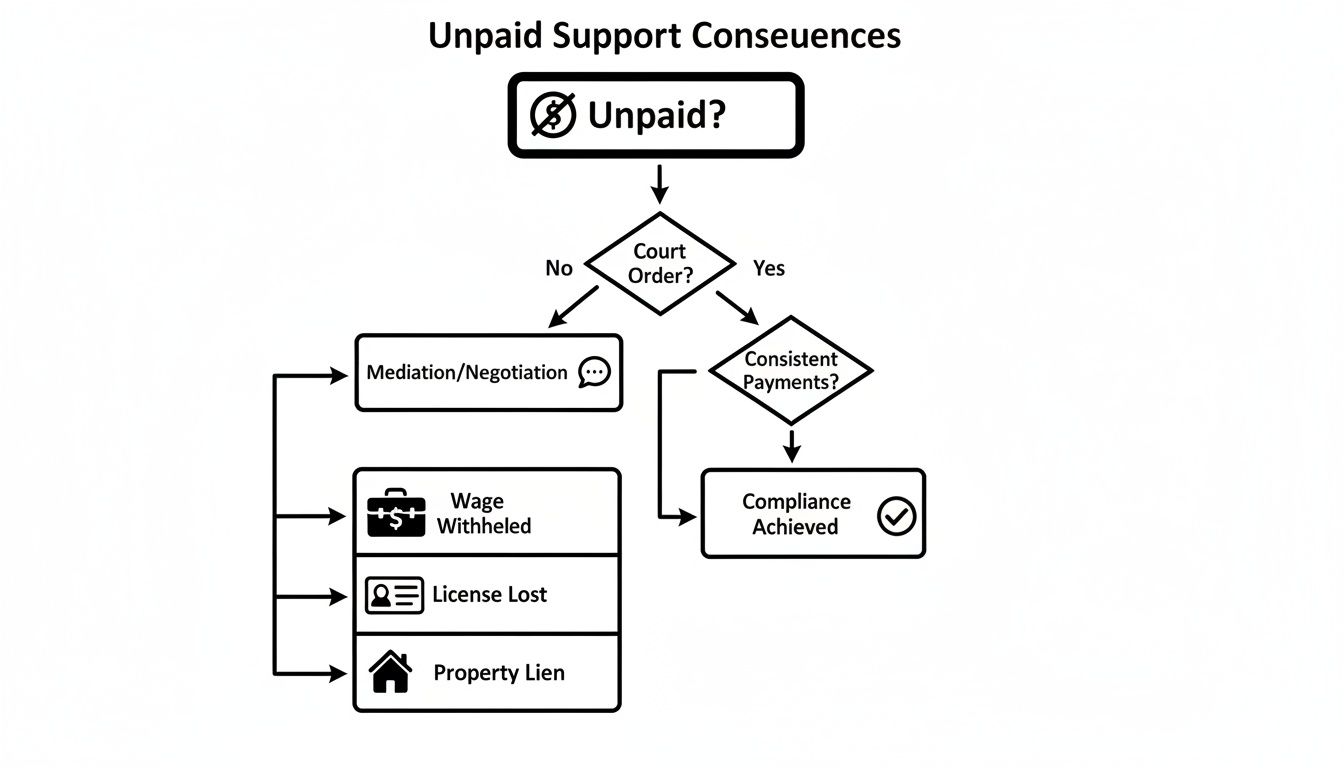
As you can see, what starts as a financial issue can lead to a cascade of legal actions, from having your wages garnished to losing professional licenses. These aren't just empty threats; they are the standard operating procedure for child support enforcement in Texas.
Taking Private Legal Action Through a Motion for Enforcement
While the OAG is a fantastic resource, sometimes you need a more direct and aggressive approach. That's where a private attorney comes in. By filing a Motion to Enforce Child Support, you are essentially initiating a private lawsuit against the non-paying parent, asking a judge to step in and force them to pay up.
The process is methodical and court-driven:
- Filing the Motion: Your attorney will draft a legal document that lists every single missed payment—down to the date and the exact amount owed. The motion asks the judge to order the other parent to pay everything they owe, plus interest and your attorney’s fees.
- Serving the Other Parent: You can't sue someone in secret. The non-paying parent (known as the "Respondent") has to be formally notified. This is called "service of process," and it’s usually handled by a sheriff, constable, or private process server who physically delivers the paperwork.
- Preparing for the Hearing: Before you go to court, your attorney will build your case by gathering evidence. This includes official payment records from the State Disbursement Unit and any other documents that prove the non-payment.
The Hammer of the Court: Contempt
The most serious tool in an enforcement action is a charge for "contempt of court." This isn't just about being behind on payments; it's an accusation that the parent intentionally and willfully violated the judge's order. If the judge agrees, they can sentence the parent to up to six months in county jail for each missed payment and tack on hefty fines.
Non-payment doesn’t just strain a family’s finances; it triggers a powerful legal response. The consequences in Texas are severe and swift. The OAG's standard actions—like suspending a driver's license, intercepting lottery winnings, or seizing federal tax refunds—are just the beginning. The threat of jail time for contempt is very real.
For parents in Houston, Dallas, and across the state, navigating these battles is what we do. Our firm specializes in forcing compliance, whether that means securing wage garnishment, enforcing medical and dental support orders, or collecting years of back child support.
For a deeper look into the private enforcement process, you can read our guide on how to collect back child support in Texas.
Understanding Arrears and Retroactive Support

When a parent misses child support payments, the legal penalties are serious. But the financial fallout is often what causes the most long-term damage. Unpaid child support doesn't just disappear; it morphs into a significant legal debt that can shadow a person for decades.
To really grasp what's at stake, you need to know the difference between arrears and retroactive support. These are the two main ways a child support debt is created, and Texas courts are incredibly aggressive when it comes to collecting both.
What Are Child Support Arrears?
In simple terms, arrears (or arrearages) is the running total of all the court-ordered child support payments you've missed. Each time a payment is due and isn't made, that amount gets added to your tab.
But the debt doesn't just sit there. It grows. Under the Texas Family Code, a judgment for child support arrears automatically accrues interest. Think of it like a high-interest credit card you can't cancel. This is how a few thousand dollars in missed payments can quickly swell into a much larger, more intimidating debt.
A child support judgment is one of the toughest financial judgments in Texas law. It can't be wiped out in bankruptcy, and there is no statute of limitations for collecting it. That means the debt will follow you forever until it’s paid off.
Here’s a quick look at how fast arrears can stack up.
Example Calculation of Arrears
Let's imagine a common scenario:
- Monthly Child Support: $800
- Payments Missed: 12 months in a row
- Principal Arrears: $800/month x 12 months = $9,600
That $9,600 immediately becomes a legal judgment against the parent. From that point on, interest starts compounding on the balance, making the total amount owed bigger every single month it goes unpaid.
What Is Retroactive Child Support?
While arrears cover payments missed after a court order is in place, retroactive child support is different. It looks backward in time.
This is support a court orders a parent to pay for the period before a child support order was ever established. It’s common in situations where parents separate but don't finalize custody or support through the court system for months or even years. The law recognizes that a child needs support from birth, not just from the day a judge signs a paper.
Under Texas Family Code § 154.009, courts start with the presumption that ordering retroactive support for the past four years is reasonable and in the child's best interest. A judge can even go back further if there's proof the paying parent was intentionally dodging their responsibility or hiding to avoid being served with papers.
To figure out the amount, the court reviews the parent's income and net resources during that past period and applies the standard Texas child support guidelines. The result is often a large, lump-sum judgment that comes as a shock—and it's owed in addition to the regular monthly child support payments moving forward.
The Bottom Line on Child Support Debt
Whether it’s arrears from missed payments or a retroactive support order, failing to pay creates a uniquely powerful and persistent debt. Both types of judgments are legally binding and grow over time with interest. Since these debts have no expiration date in Texas and can't be discharged in bankruptcy, they pose a massive financial risk for any parent who falls behind.
How Texas Child Support Is Calculated
Before we dive into what happens when child support goes unpaid, it’s crucial to understand how that monthly figure is determined in the first place. It’s not a number a judge pulls out of thin air. The process is guided by a specific formula in the Texas Family Code, designed to be fair and directly tied to what the paying parent can actually afford.
The entire calculation hinges on one key number: the paying parent’s "net monthly resources." Getting this figure right is arguably the most important step in any child support case.
What Counts as "Net Monthly Resources"?
This isn't just about your take-home pay from a 9-to-5 job. The law requires a wide-angle view of all income streams to get a complete financial picture.
Under the Texas Family Code, "resources" can include:
- Wages and salary, along with any commissions, overtime, tips, or bonuses.
- Self-employment income, which is your total business revenue minus the ordinary and necessary expenses to run that business.
- Investment income from things like interest, dividends, and royalties.
- Rental income from properties you own (after subtracting operating costs and mortgage interest).
- Other sources like retirement benefits, pensions, trust distributions, and even unemployment benefits.
From that total "gross" amount, the court subtracts only a few specific things to find the final "net" number. This includes Social Security taxes, federal income taxes (calculated as if you're single with one exemption), state income taxes (if any), union dues, and how much you pay for the child's health insurance.
What isn't deducted is often a point of contention. The court won’t subtract your car payment, mortgage, credit card bills, or other personal spending. The law makes it clear: a child’s financial needs come before a parent's lifestyle choices.
The Guideline Calculation Cap
Texas law also sets a "cap" on the income used for the standard calculation. This is to ensure that for high-earning parents, the child support amount is based on the child's needs, not just a straight percentage of a massive income.
As of September 1, 2025, this cap is scheduled to increase to $11,700 per month. This means the court applies the standard percentage formula only to the first $11,700 of a parent's net monthly resources. If a parent earns more than that, a judge can order additional support, but only if the custodial parent can prove the child has needs that justify a higher amount.
A Real-World Calculation Example
Let's walk through a straightforward example to see how this all comes together. The guideline percentages are laid out in Texas Family Code § 154.125.
- Parent's Net Monthly Resources: $7,000 (which is below the cap)
- Number of Children Before the Court: 2
- Guideline Percentage for 2 Children: 25%
The math is simple from here. You just multiply the net resources by the appropriate percentage:
$7,000 (Net Resources) x 0.25 (Guideline Percentage) = $1,750 per month
This is the starting point for almost every child support order in Texas. The court automatically presumes this amount is in the child's best interest unless someone provides compelling evidence to the contrary.
When Can a Judge Deviate from the Guidelines?
While the formula provides a solid framework, it isn't set in stone. Texas Family Code § 154.123 gives judges the discretion to order a different amount if applying the guidelines would be "unjust or inappropriate" in a specific situation.
A judge might consider deviating from the standard calculation based on several factors:
- The age and proven needs of the child (e.g., special needs, costly extracurriculars, or private school tuition).
- Extraordinary medical or educational expenses.
- Significant travel costs for one parent to see the child.
- A parent being intentionally unemployed or underemployed to avoid paying support.
- The overall financial resources available to both parents.
For instance, if a child requires expensive therapy that isn't covered by insurance, a judge has the power to order support above the guideline amount. On the flip side, if a paying parent lives out of state and has to spend thousands on flights just to exercise their visitation rights, a judge might grant a small reduction in the support obligation.
Understanding how this number is built is the first step in seeing why the state takes enforcement so seriously when these court-ordered payments are missed.
Legal Options for Parents Who Cannot Pay

When a financial crisis hits, a court-ordered child support payment can suddenly feel like an anchor dragging you down. Many parents I've worked with genuinely want to provide for their kids but find themselves in a bind, unable to afford the amount the court has ordered.
The absolute worst thing you can do is ignore the order. It won't go away, and burying your head in the sand only guarantees that the legal and financial fallout will be much, much worse.
It's also crucial to know what a judge will not consider a valid excuse. Quitting your job in frustration, withholding payment because the other parent is denying visitation, or simply feeling the amount is unfair won't get you anywhere. In fact, a court will see these actions as a deliberate refusal to follow a legal order.
The Only Real Solution: Modification
If you truly cannot afford your child support payments, your one and only viable path forward is to file a Petition to Modify the Child Support Order. This is a formal legal action that asks the court to officially lower your monthly obligation because your financial situation has dramatically changed.
To be successful, you have to prove to the judge that there has been a "material and substantial change in circumstances" since your last child support order was put in place. This is the legal standard set by the Texas Family Code, and the responsibility to prove it falls squarely on your shoulders.
So, what counts as a material and substantial change? Here are a few common examples:
- Involuntary Job Loss: You were laid off, your position was eliminated, or you were fired for reasons that weren't your fault.
- Significant Drop in Income: You've experienced a major, ongoing reduction in your salary, commissions, or self-employment income.
- Long-Term Disability: A serious medical issue now prevents you from working or severely limits your ability to earn a living.
- Change in Custody: The child now lives with you most of the time, and you've become the primary caregiver.
This isn't just about weathering a tough month. It's about demonstrating that meeting the current order has become legally and financially impossible. The pressure is immense, and if you're feeling it, you're not alone. The reality is that over half of all U.S. parents paying child support find themselves living below the poverty line because of these orders, making full compliance an uphill battle. This is a key reason Texas has such strict enforcement penalties—including jail time for contempt—to ensure children receive support. You can discover more insights about these child support statistics and how they affect families across the state.
How to File for a Child Support Modification
Taking formal legal action is the only way to shield yourself. A handshake deal with the other parent to pay less isn't legally binding. It leaves you wide open to an enforcement lawsuit covering everything you didn't pay, which explains what happens if child support is not paid.
The process itself is straightforward, but every step must be handled correctly:
- File the Petition: Your attorney will draft and file the formal Petition to Modify the Child Support Order with the same court that handled your original case.
- Serve the Other Parent: The other parent must be officially notified of the lawsuit through a formal delivery of the court papers, known as service of process.
- Gather Your Proof: This is where you build your case. You'll need to collect documents like a termination letter, pay stubs showing your lower income, medical records, or a log of your job applications.
- Attend the Hearing: Finally, you and your attorney will go before the judge to present your evidence and argue why the modification should be granted.
A Crucial Piece of Advice: While your modification case is moving through the court system, you must keep paying something. Pay as much as you possibly can toward your current order, even if it's not the full amount. This shows the judge you're acting in good faith and not just trying to dodge your responsibility. It can make all the difference in the final outcome.
Why You Need an Experienced Family Law Attorney
Trying to handle a child support case on your own is incredibly risky, whether you're the parent who needs to collect or the one struggling to pay. The rulebook for all of this, the Texas Family Code, is a maze of complex statutes and deadlines. One wrong move or missed deadline while representing yourself can unfortunately lead to a devastating outcome.
All the issues we've covered—from calculating income correctly to filing enforcement actions and requesting modifications—aren't just legal theory. These are the real-world situations where your financial stability and your child's well-being hang in the balance. Without a clear legal strategy, you can easily lose your rights, face the threat of jail, or be stuck with a crushing financial weight for years to come.
Where an Expert Can Make All the Difference
Having a seasoned attorney in your corner completely changes the dynamic. We've been in these trenches for years and know the playbook inside and out, especially when it comes to:
- Aggressive Enforcement Actions: We understand how to use the full force of the law—wage withholding, property liens, and contempt charges—to compel a non-paying parent to meet their obligations.
- Strategic Support Modifications: Life happens. We guide parents through the process of proving a "material and substantial change" to get a fair adjustment to their support order.
- High-Income Disputes: We are well-versed in handling cases that involve the guideline cap, including the new $11,700 net monthly resource cap that takes effect on September 1, 2025.
- Retroactive Claims: Our attorneys have extensive experience building strong cases to establish claims for past-due support and defending clients against unfair retroactive demands.
This isn’t just a Texas problem; it’s a global one with very local consequences. Non-payment is a struggle everywhere. For example, a recent UK report showed that a shocking 28% of parents in their official system paid nothing at all in a single quarter. The situation in the US is just as serious, with custodial parents receiving an average of only $3,431 a year. For Texas parents, these numbers highlight why professional legal help is often essential to secure a child's financial future. If you want to see the broader data, you can review the UK government's child maintenance statistics.
Your Advocate in and Out of the Courtroom
We see our role as more than just legal representation; we're your dedicated advocates. Our job is to give you clear-eyed advice, stand up for you in the courtroom, and build a structured plan that protects what matters most. We dig into every detail of your case, from income stubs to court history, to craft a strategy aimed at your specific goals. You can learn more about our hands-on approach to Texas family law matters and how we help clients regain a sense of control.
The most expensive legal advice is often the advice you didn't get. A single mistake in a child support case—like miscalculating income or missing a deadline—can cost you thousands more than hiring the right attorney from the start.
Don't leave your family's future to chance. Contact the Law Office of Bryan Fagan for a consultation. Let us help you put a definitive legal plan in place and fight for the outcome you and your child deserve.
Frequently Asked Questions About Texas Child Support
When you're dealing with the stress of unpaid child support, a lot of urgent questions can come up. We hear these same concerns from our clients all the time, so let's get right to the answers you need.
Can I go to jail for not paying child support in Texas?
Yes, absolutely. A judge can find you in contempt of court if you have willfully and intentionally violated the court's order to pay child support. For each violation, a judge can sentence you to up to six months in county jail, levy fines, and order you to pay the other party's attorney's fees. It's one of the most serious enforcement tools in the Texas Family Code.
How long can Texas collect child support arrears?
Forever. There is no statute of limitations on collecting a judgment for child support arrears in Texas. This means the debt, along with any accrued interest, will follow you until it is paid in full, regardless of how many years or even decades have passed.
What if my ex is preventing me from seeing my child?
You are still legally required to pay your child support. In the eyes of Texas law, child support and visitation are two completely separate legal duties. Withholding support payments will only expose you to serious enforcement actions and potential jail time. You must address visitation issues separately by filing a Motion to Enforce Possession and Access.
Does child support stop when my child turns 18?
Usually, but not always. Your current support obligation continues until your child either turns 18 or graduates from high school, whichever occurs last. However, if you have unpaid back support (arrears), you remain legally obligated to pay that debt off in full, even after your regular monthly payments end.
For more detailed answers to other common questions, you can check out our complete list of Texas child support FAQs.
Whether you're facing an enforcement action or you're the parent struggling to get the support your child is owed, it can feel overwhelming. The attorneys at the Law Office of Bryan Fagan have the experience to protect your rights and help secure your child’s financial future. Contact us to build a clear strategy for your case at https://txchildsupport.net.