When you have a child in Texas and are not married to the other parent, you will encounter a document called the Acknowledgement of Paternity (AOP). It is critical to understand that this is not routine paperwork. Signing it is a major legal act that establishes a man as the child's legal father, carrying the same weight as a court order.
This document creates permanent parental rights and responsibilities. Our firm is dedicated to ensuring you understand every facet of this document before you make a decision that will last a lifetime.

What the AOP Really Does
For unmarried parents in Texas, the Acknowledgement of Paternity is the primary method for establishing legal fatherhood. This document is the legal bridge connecting a biological father to his child. Once you sign it, a new set of rights and serious obligations immediately comes into effect.
Without a signed AOP or a court order, an unmarried father has no legal rights to his child. This means no right to custody (possession and access), no authority to make major decisions, and no legal standing to petition a court. Conversely, he has no legal duty to provide financial support. The AOP changes all of that instantly.
The Official Texas Form and Its Timing
In Texas, the specific form used is the Form VS-159.1, Acknowledgement of Paternity. Hospital staff will present this to unmarried parents shortly after the child is born. While this seems convenient, making a lifelong legal commitment in a hospital room—when you are exhausted, emotional, and overwhelmed—is far from the ideal setting for such a monumental decision.
The push to formalize paternity is a growing trend. One study looking at 2 million Michigan birth records found that paternity acknowledgements for unmarried births jumped from less than 10% in 1993 to nearly 25% by 2006. For parents in Texas, this trend highlights a critical point: establishing paternity is the non-negotiable first step before you can even begin to sort out child support or custody. You can learn more about paternity and parental leave trends to see how this issue is handled across the country.
Why You Must Be 100% Certain Before Signing
Let us be perfectly clear: signing an AOP is a legally binding act. It creates a "presumption of paternity" that is incredibly difficult, expensive, and time-sensitive to undo.
Under the Texas Family Code, a signed and filed AOP is considered a final determination of paternity. To challenge it later, you must file a lawsuit and prove there was fraud, duress, or a material mistake of fact. A DNA test proving you are not the biological father may not be enough to overturn the AOP if you wait too long to act.
This is why you must be absolutely, 100% certain you are the father before your signature is on that document. If there is even a sliver of doubt, your only safe move is to pause and request a genetic (DNA) test. Giving in to pressure or signing with unresolved questions is a massive gamble that will follow you for years.
This single document lays the groundwork for all future legal proceedings, including:
- Child Support: It grants the court authority to order you to pay financial and medical support.
- Custody and Visitation: It gives a father the legal standing to go to court and ask for rights to see his child and make decisions for them.
- Inheritance: It ensures the child can legally inherit from their father.
- Benefits: It makes the child eligible for the father's Social Security, veteran's, or life insurance benefits.
To help clarify what's at stake, the table below shows the direct legal impact of signing an AOP versus not signing one.
Legal Implications of Signing vs Not Signing an AOP
| Scenario | Legal Rights & Obligations for Father | Legal Rights & Obligations for Mother | Legal Rights & Benefits for Child |
|---|---|---|---|
| AOP is Signed | Becomes legal father. Gains rights to seek custody/visitation. Incurs legal obligation for child support. Child's name can be changed. | Can seek child support orders. Must co-parent and allow court-ordered visitation. | Can inherit from father. Can receive father's Social Security/veteran benefits. Has a legal right to financial support from both parents. |
| AOP is NOT Signed | No legal rights to custody or visitation. No legal obligation to pay child support. Cannot make legal decisions for the child. Name is not on the birth certificate. | Has sole legal and physical custody. Cannot get a court order for child support from the father. | Cannot inherit from the father (unless specified in a will). Cannot claim father's benefits. Has no legal right to financial support from the father. |
Ultimately, understanding the AOP isn't just about filling out a form—it's about making an informed decision that will shape your future and your child's life. It’s the first, and arguably most important, step in defining your parental journey in Texas.
The Legal Rights and Duties Created by an AOP
Signing an Acknowledgement of Paternity (AOP) is a massive step. It is the legal mechanism that transforms a biological link into a formal, court-recognized parent-child relationship. This single document gives a father a powerful set of rights, but it also triggers very real and permanent responsibilities.
Once that AOP is signed and filed with the state, it is just as powerful as a judge's order declaring you the legal father. It is the key that unlocks the courthouse door. Without it, or a separate court order, a man has no legal standing to ask a court for custody or visitation rights.
A Father’s Right to a Relationship
Perhaps the most important right an AOP confers is the ability to build a legally protected relationship with your child. By becoming the legal father, you gain the right to file a Suit Affecting the Parent-Child Relationship (SAPCR). This is the formal court case where you petition a judge to define your specific rights and responsibilities.
These rights typically cover:
- Conservatorship: The right to be named a conservator, giving you the power to make important decisions regarding the child’s education, medical care, and general welfare.
- Possession and Access: The right to a clear, legally enforceable visitation schedule that specifies exactly when the child will be in your care.
- Information Access: The right to directly access your child’s medical and educational records.
Without an AOP, an unmarried father is a legal stranger to his child, and the mother has sole custody by default. The AOP is the first and most crucial step to changing that and securing your place in your child's life.
The Duty of Financial and Medical Support
On the other side of that coin, the AOP formally establishes a father's legal duty to support his child. This is not a moral suggestion—it is a legal obligation that courts will enforce. As soon as paternity is established, a court can order you to pay both financial and medical support based on the guidelines in Texas Family Code Chapter 154.
A court cannot order a man to pay child support until he is adjudicated as the legal father. The AOP gives the Office of the Attorney General (OAG) or the other parent the legal grounds needed to initiate a child support case.
This responsibility is a serious, long-term commitment that typically continues until your child turns 18 or graduates from high school, whichever occurs later.
The AOP as a Cornerstone for Legal Action
The importance of the AOP in streamlining legal proceedings cannot be overstated. National data shows how vital this form is. In Louisiana, for instance, about 85% of birth certificates for children of unmarried parents have the father’s name on them because an AOP was signed at the hospital. The other 15%, which adds up to around 9,400 births each year, miss this step, creating major delays in getting child support orders in place.
For Texas parents, this data tells a simple story: signing an AOP is the most direct path to settling custody and support. It allows you to bypass a potentially long and expensive court fight over parentage and enables everyone—including the judge—to focus on what truly matters: creating a stable plan that is in the best interest of the child.
How to Navigate the AOP Process in Texas
The moments and days after a child is born are a whirlwind, but the decisions you make then will shape your legal rights and responsibilities for a lifetime. What you do in the first 60 days after signing is especially critical. Let’s walk through the procedural steps for handling the Acknowledgement of Paternity (AOP) form, whether you’re ready to sign, having second thoughts, or facing a challenge long after the ink has dried.
It’s hard to overstate how important this document is. While 63% of countries guarantee paid paternity leave, the United States has no such federal mandate. This gap makes establishing legal fatherhood incredibly important for American parents. In Texas, where there's no state-level paid leave either, the AOP becomes the single most direct path for a father to secure his rights and for a mother to secure child support. You can see just how paternity leave policies differ worldwide and why this formal legal step carries so much weight here at home.
The Correct Way to Sign an AOP
Signing an AOP is a formal legal act, not just hospital paperwork. It usually happens in the hospital after the baby arrives. For the AOP to be valid, both the mother and the man acknowledging paternity must sign the form, and their signatures must be witnessed by a notary public. Hospital staff are often certified to handle this.
The most important rule? Be absolutely certain of paternity before you sign. If you have any doubt—any hesitation at all—that is your cue to stop and request a genetic test. Feeling pressured by family or even well-meaning hospital staff is not a valid reason to sign a document that has the same legal power as a court order.
Rescinding an AOP Within 60 Days
You signed the AOP, but now have second thoughts. Texas law provides a very brief, very strict window to change your mind. This process is called rescission.
Under Texas Family Code §160.307, anyone who signed an AOP (or a Denial of Paternity) can rescind it, but the clock is ticking. You have exactly 60 days from the date the AOP is filed with the Texas Vital Statistics Unit to act. To rescind, you must complete the following procedural steps:
- Fill out the Rescission of Acknowledgment of Paternity form (VS-158).
- File this form with the Vital Statistics Unit before the 60-day deadline expires.
- You must also provide a copy of the completed rescission form to the other parent.
That 60-day window is an absolute deadline. If you miss it, you cannot simply file a form; your only path forward is through the courthouse.
This flowchart maps out the critical choices and deadlines you face once you've signed an AOP.
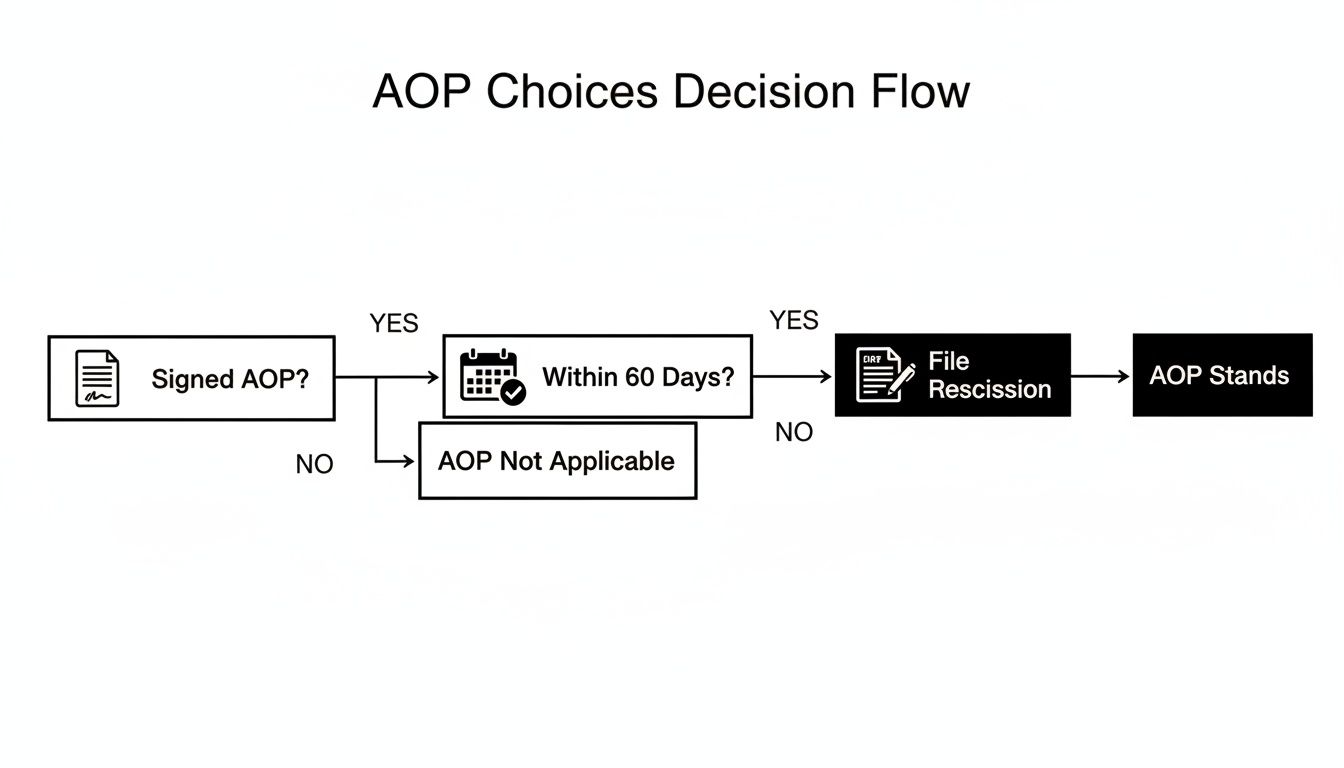
As you can see, that 60-day calendar icon represents a non-negotiable deadline. After that, your options change dramatically.
Challenging an AOP After the Deadline
What if the 60-day rescission period has long passed, and you now have reason to believe you are not the biological father? This is a difficult position. You can no longer file a rescission form; you must file a formal lawsuit to challenge the AOP in court.
To have any chance of prevailing in this type of case, you must prove to a judge that your signature was the result of fraud, duress, or a material mistake of fact. Simply changing your mind or having regrets is not sufficient.
This is a very high legal standard. You will need compelling evidence, which almost always requires a DNA test that excludes you as the biological father. However, even with a negative DNA test, a judge can still deny your challenge. This is especially true if you acted as the child's father for a significant period while knowing there was a possibility you were not the biological parent.
This kind of lawsuit is complicated, emotionally draining, and can be very expensive. It underscores the importance of being 100% certain about paternity before your pen ever touches that AOP form. If you find yourself in this situation, consulting with an experienced family law attorney is essential.
Genetic Testing vs. AOP: What Comes First?
When unmarried parents have a child in Texas, they arrive at a critical fork in the road. One path involves signing the Acknowledgement of Paternity (AOP), and the other involves ordering a genetic (DNA) test. A DNA test is like "measuring twice," and signing the AOP is "cutting once." Once that legal commitment is made, it is incredibly difficult to undo.
Our advice is always crystal clear: if you have any doubt whatsoever about paternity, you must get a DNA test before you sign anything. This is a crucial step to protect yourself legally and financially for the next 18-plus years.

Why Signing First Is a Major Risk
Signing an AOP creates a powerful legal presumption that you are the father. In Texas, this presumption is extremely difficult to overturn, even if a DNA test later proves you are not the biological parent. After the 60-day rescission period passes, your only option is to file a lawsuit to challenge the AOP, which is both expensive and rarely successful.
To win that lawsuit, you would have to prove you were a victim of fraud, duress, or a material mistake of fact. Courts often deny these challenges, leaving men legally and financially responsible for children who are not biologically theirs. The emotional and financial devastation of this scenario is immense.
Practical Options for Genetic Testing
Fortunately, obtaining a DNA test is a simple and straightforward process. You have two main avenues for getting definitive proof of paternity before committing to a lifelong legal obligation.
Private Genetic Testing: You and the mother can agree to use a private, accredited lab. This is usually the quickest and most private method. The lab provides a simple cheek swab kit, and you receive a report with near-perfect accuracy. The results will provide the certainty needed to either sign the AOP with confidence or halt the process entirely.
Office of the Attorney General (OAG): If the OAG has opened a child support case, they will arrange for genetic testing as part of their standard procedure. The OAG will order the mother, child, and alleged father to appear for DNA collection (usually a cheek swab). This process is managed by the state, and the results are legally binding for the purposes of the child support case.
The key takeaway is that the law provides clear pathways to confirm biology before legal parentage is established. Never let pressure from a partner, family, or hospital staff push you into signing an AOP if you have any uncertainty. Demanding a DNA test is not an insult; it is a responsible and legally sound decision.
The entire paternity system is designed to establish one, permanent legal father for every child. Once that AOP is signed and filed, the law treats you as the father for all purposes—including child support. A court can order you to pay, and that financial obligation will accrue whether you are biologically related or not.
By obtaining a genetic test first, you ensure your decision is based on solid fact, not on hope, assumptions, or pressure. It is a simple, proactive step that can prevent a catastrophic legal mistake and provide total clarity moving forward.
How a Signed AOP Shapes Child Support and Custody
A signed Acknowledgement of Paternity (AOP) is the legal key that unlocks the courthouse doors for both child support and custody matters. Once filed, it serves as a final, binding declaration of a child's legal father. This simple act gives a Texas court the authority to make enforceable orders that will shape your child's life and your financial future.
Without an AOP or a court order establishing paternity, an unmarried father has no legal grounds to petition for custody. Similarly, a mother cannot obtain a court-enforced child support order. The AOP is the foundational document that allows the legal system to intervene, which is why the Office of the Attorney General (OAG) relies on it to establish child support cases.
From AOP to Child Support Order: The Legal Process
Once you are established as the legal father, the court can order you to pay child support. This process starts when one parent, or the OAG, files a Suit Affecting the Parent-Child Relationship (SAPCR). The other parent must be formally notified through a process called "service of process." The court will then hold hearings to determine the appropriate amount of support based on the Texas Family Code.
The calculation starts with the non-custodial parent's average monthly net resources.
Here are the basic guideline percentages from Texas Family Code §154.125:
- 1 Child: 20% of net resources
- 2 Children: 25% of net resources
- 3 Children: 30% of net resources
- 4 Children: 35% of net resources
- 5+ Children: 40% of net resources
These percentages are not absolute. Under Texas Family Code §154.123, a judge can deviate from the guidelines if evidence shows it is in the child's best interest. For a deep dive into the entire process, you can read our firm's detailed guide on how to file for child support in Texas.
Real-World Example: Calculating Guideline Child Support
Let's walk through a practical example of how a court calculates child support. Imagine a father who has acknowledged paternity and earns a gross monthly income of $8,000.
- Calculate Net Resources: To determine his net resources, we subtract federal income tax, Social Security tax, Medicare tax, union dues, and the cost of the child's health insurance premium. Let's assume after these deductions, his monthly net resources are $6,200.
- Apply the Guideline Percentage: For one child, the guideline is 20%.
$6,200 (Net Resources) x 0.20 (20%) = $1,240 per month
This $1,240 is the presumptive amount he would be ordered to pay in monthly child support. Texas law also caps the income used for this calculation.
Important Update: Net Resource Cap: The current guideline cap is $9,200 in monthly net resources. Effective September 1, 2025, this cap will increase to $11,700. If a parent's net resources exceed this amount, child support will be calculated based on the cap unless the child's proven needs justify a higher amount. This change will significantly impact high-income cases.
Using the AOP to Secure Custody Rights
Just as the AOP opens the door for child support, it also empowers an acknowledged father to formally pursue his parental rights by filing a Suit Affecting the Parent-Child Relationship (SAPCR). This is the official court case where custody (conservatorship), visitation (possession and access), and decision-making authority are determined.
Procedurally, after filing the SAPCR, the father must ensure the mother is served with the lawsuit. The parties may then proceed to mediation or temporary orders hearings to establish a short-term plan while the case is pending.
Through a SAPCR, a father can ask the court to:
- Name him a Joint Managing Conservator, giving him the right to make major decisions about the child's life, usually alongside the mother.
- Establish a clear, enforceable possession schedule detailing when the child will be in his care.
- Grant him specific rights, such as direct access to the child's school and medical records.
Without the AOP, a father is, from a legal standpoint, a stranger to his own child and cannot ask a court for these fundamental rights. The AOP is the critical first step that allows him to build a legally protected relationship.
Common Texas Child Support FAQs
How do I modify a child support order in Texas?
To modify a child support order, you must file a Petition to Modify the Parent-Child Relationship. You must prove there has been a "material and substantial change" in the circumstances of the child or a parent since the last order was entered. This could include a significant job loss, a major increase in income, or a change in the child's needs. Alternatively, if it has been at least three years since the order was set, and the new calculation would differ by 20% or $100 from the current amount, the court may also grant a modification.
What happens if the other parent is not paying court-ordered child support?
If a parent is not paying, you can file an enforcement action with the court. Procedurally, you file a Motion for Enforcement, which details each missed payment. The court will hold a hearing where the non-paying parent must explain why they have not complied. If found in contempt, a judge can order them to pay what is owed, sentence them to jail time, suspend their driver's license, and order them to pay your attorney's fees.
What if the father's income is unknown?
If the father's income is unknown, the court can still set child support. A judge may order him to produce financial documents like tax returns and pay stubs. If he fails to do so, the court can presume his income is sufficient to support the child at the federal minimum wage for a 40-hour work week. The court can also consider evidence of his lifestyle and earning potential to impute a higher income for the child support calculation.
Does signing an AOP automatically start child support payments?
No. Signing an AOP is a critical first step, but it does not trigger child support payments by itself. Think of it this way: the AOP establishes your legal obligation to support the child. To turn that obligation into an enforceable payment, someone—either a parent or the Office of the Attorney General (OAG)—has to file a suit in court. Only a judge can issue a formal child support order that sets the exact monthly payment, outlines who provides health and dental insurance, and determines any back-pay owed based on Texas Family Code guidelines.
I Signed an AOP Years Ago and Now Believe It Was a Mistake. What Can I Do?
Trying to undo an Acknowledgment of Paternity years after the fact is incredibly difficult. The simple 60-day window to rescind it has long since closed. Your only option is to file a lawsuit to terminate the parent-child relationship.
To have any chance of success, you must prove to a judge that you signed the AOP because of fraud, duress, or a material mistake of fact. A DNA test proving you are not the biological father is essential, but it might not be enough on its own.
A court could still deny your request, especially if you acted as the child's father for a long time even after you had doubts. This is a high-stakes legal fight that absolutely demands the help of an experienced family law attorney. This situation is very different from issues like parental alienation in Texas, which involves a parent actively undermining an already established parent-child relationship.
If you are facing a dispute over an Acknowledgment of Paternity or need to establish, enforce, or modify a child support order in Texas, the attorneys at the Law Office of Bryan Fagan are here to provide the strategic legal guidance you need. We understand the complexities of Texas family law and are prepared to fight for your rights and your child's best interests. Contact us today for a consultation at https://txchildsupport.net.