The payment was due Friday. It did not arrive. You check the bank app again on Monday, then the state disbursement record, then your text thread. School expenses are still due. So is rent. At that point, most parents are not asking abstract legal questions. They want to know one thing. How do I force compliance with the order already in place?
At this point, an enforce child support texas attorney becomes useful. A support order is not a suggestion. It is a court command. If the other parent ignores it, Texas law gives you enforcement tools that can reach wages, property, licenses, and in serious cases, contempt remedies.
Texas handles child support enforcement at scale. In Fiscal Year 2021, Texas courts processed over 6.9 million case filings, and post-judgment enforcement cases for orders such as child support fell 11%, underscoring both the volume of family litigation and the difficulty many parents still face in collection, according to the Texas courts annual statistical report.
When Unpaid Child Support Becomes a Legal Battle
Missing one payment often starts a pattern. First it is a partial payment. Then a promise to catch up next month. Then excuses about a job change, a delayed commission, or a disagreement about possession time. None of that changes the existing order.

Texas courts treat enforcement seriously because the order exists to support the child, not the other parent. If support is unpaid, the legal question is usually not whether the court can act. The key questions are how fast you can get in front of a judge, what proof you need, and whether you should proceed through the Office of the Attorney General or private counsel.
What parents usually get wrong
Many parents wait too long because they assume the missed amount is “not enough yet” to justify court. That can be a mistake. A small arrearage can grow quickly once missed payments stack up, and delay also makes records harder to organize.
Others believe they can solve the problem by repeated informal demands. Sometimes a demand letter works. Often it does not. Once the other parent learns there are no immediate consequences, nonpayment tends to continue.
If you are dealing with repeated nonpayment, reviewing what happens if child support is not paid in Texas can help you see the range of consequences that may follow.
The two roads most parents must choose between
In most Texas cases, enforcement begins through one of two paths:
- OAG enforcement: The Texas Office of the Attorney General can pursue support enforcement without attorney’s fees to you.
- Private enforcement: A private attorney can file a Motion for Enforcement directly with the court and push the case on a tighter, more focused timeline.
Practical point: The strongest enforcement cases are rarely the loudest. They are the best documented.
The order, the payment record, the missed dates, and the requested relief matter more than outrage. Judges expect precision. If you bring a clean record and ask for remedies the Family Code authorizes, your case gets stronger fast.
Understanding Your Enforcement Toolkit in Texas
Texas gives courts several enforcement tools, and each one does a different job. The right remedy depends on the kind of nonpayment, whether the parent is employed, whether assets exist, and whether the violation is isolated or ongoing.
Income withholding is usually the first tool to reach for
The most effective collection device is the Income Withholding Order, authorized by Texas Family Code Chapter 158. It directs an employer to deduct support from wages and send it through the Texas State Disbursement Unit.
The data point that matters most here is clear. The Income Withholding Order succeeds in 95% of activated cases, and attorney-filed IWOs recover up to 85% of arrears within 12 months, compared with 60% through standard OAG processes, according to the assigned source discussing Texas child support wage withholding and enforcement results.
Why it works is not mysterious. It removes choice from the process. If the parent receives payroll, support comes out before the money reaches their account.
Under the enforcement guidance provided in the verified material, withholding can reach up to 50% of disposable earnings, or 65% with arrears, subject to applicable limits. In practice, this is often the cleanest remedy when the obligor has regular employment.
Contempt is the pressure tool
Texas Family Code Chapter 157 governs many enforcement remedies, including contempt. If a parent had the ability to comply and chose not to, the court can treat that noncompliance as contempt of court.
Contempt matters because it changes the tone of the case. Wage withholding collects. Contempt compels. The possibility of jail time, a commitment order, or strict payment terms gets attention fast.
That does not mean contempt fits every case. If the problem is genuine inability to pay, counsel should build the record carefully before asking a court for punitive relief.
Key takeaway: Courts do not punish confusion well, but they do punish clear, repeated violation of a clear order.
Liens and property-based remedies
When a parent hides cash flow but owns assets, liens can become important. Under Texas Family Code §157.317, child support liens may attach to certain property interests. That can matter in cases involving vehicles, real property, settlement proceeds, or other reachable assets.
These cases often require more preparation than a standard wage case. You need to identify the asset, confirm ownership, and match the lien strategy to the arrears record. But when wage withholding is weak because the obligor is self-employed, paid irregularly, or moves from job to job, lien practice becomes much more useful.
License pressure and related remedies
Texas enforcement also reaches beyond wages and bank records. Depending on the case, support delinquency can affect licenses. In the right matter, license suspension is effective because it interrupts daily life and professional activity.
This is not always the first move. It is often more effective as part of a broader strategy after the payment history is established and the noncompliance is undeniable.
A support order can cover more than base child support
Parents often focus only on the monthly support amount. That is too narrow. Enforcement may also apply to medical support, cash medical support, and other obligations contained in the order.
If the decree or order requires payment of a specific amount on a specific date, and the parent failed to do it, that term may be enforceable. The language of the order controls.
Texas child support enforcement mechanisms compared
| Method | Primary Purpose | Typical Speed | Best For |
|---|---|---|---|
| Income Withholding Order under Ch. 158 | Collect support directly from wages | Fast once employer is reached | Parents with regular payroll income |
| Motion for contempt under Ch. 157 | Force compliance through court sanctions | Depends on court setting | Repeated nonpayment despite a clear order |
| Child support lien under §157.317 | Reach assets instead of wages | Case-specific | Self-employed obligors or asset-heavy cases |
| License-related enforcement remedies | Increase pressure to comply | Case-specific | Chronic noncompliance where collection alone is not enough |
The calculation side still matters in enforcement
Guideline child support in Texas is governed by Texas Family Code Chapter 154, including §154.125 for guideline support and §154.123 for deviations. The basic percentages many parents know still matter because the order being enforced was built from those rules or from a justified deviation.
Texas applies guideline percentages to the paying parent’s net monthly resources. These figures typically involve varying percentages based on the number of children, up to a statutory net resource cap that changes periodically. For instance, the cap for net monthly resources has seen increases, with a planned rise in September 2025. In enforcement court, however, the judge is usually not recalculating from scratch. The judge is asking whether the existing order was obeyed.
The Core of Enforcement Filing the Motion in Court
Private enforcement lives or dies on the quality of the motion. A judge cannot grant strong relief on a vague complaint. Texas Family Code §157.002(a) requires a Motion for Enforcement to identify the provisions violated and the manner of noncompliance with precision.
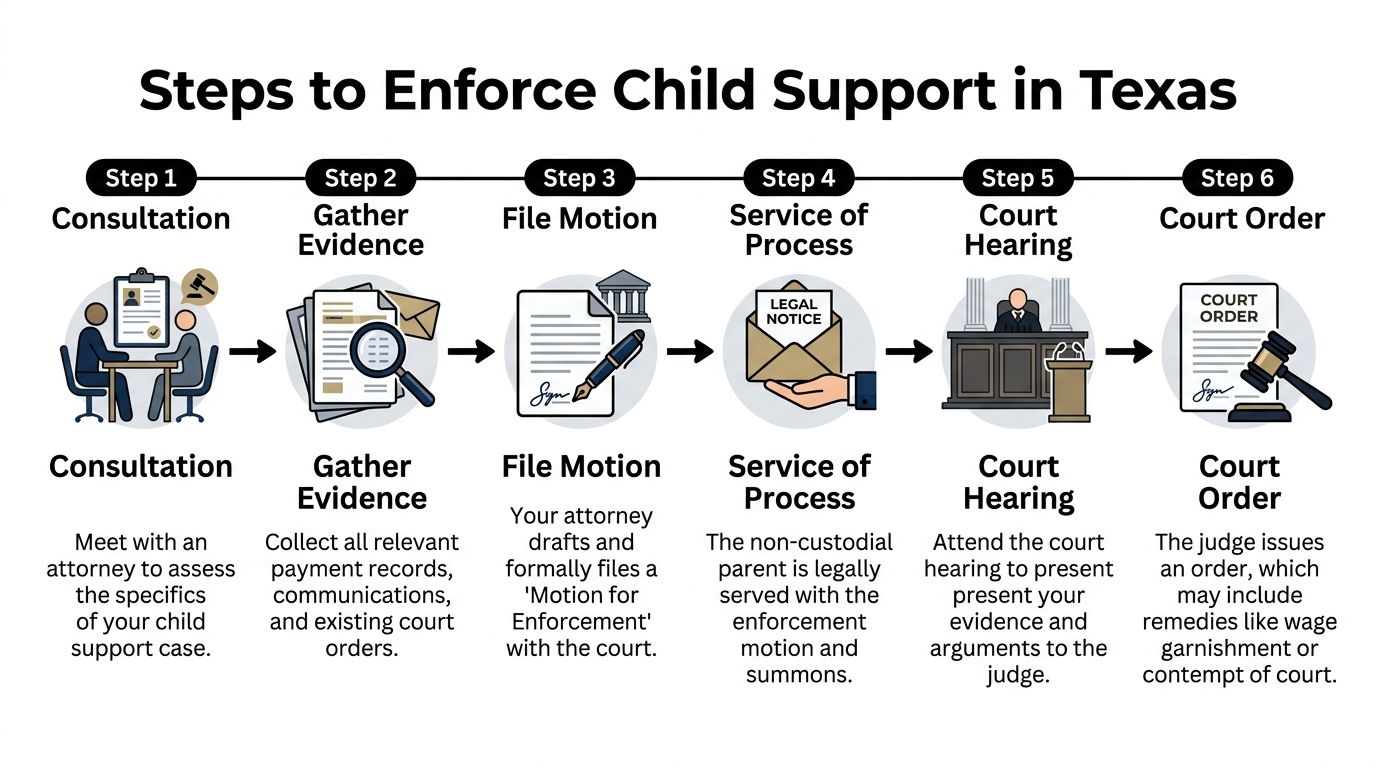
The assigned practitioner benchmark is worth paying attention to. Motions with quantified violations, such as each missed date and amount, achieve 80% to 90% approval rates, while vague petitions are frequently dismissed, according to the source discussing how to enforce child support with a detailed motion under Texas Family Code §157.002(a).
Start with the order, not the argument
Before drafting anything, read the current order line by line. Confirm:
- Exact obligation: The monthly child support amount, medical support terms, and payment due dates.
- Current controlling order: Any later modification changes what can be enforced.
- Payment route: Whether payments were ordered through the state disbursement unit or another channel.
This sounds basic, but many failed enforcement cases begin with a parent relying on memory instead of the written order.
Build the evidence file the court wants to see
A strong file usually includes the original order, any later modification order, the official payment record, and supporting communications. If payment should have gone through the state system, certified records are especially useful.
Helpful evidence often includes:
- Certified payment history: This is usually the backbone of the arrears claim.
- Communication records: Texts or emails where the other parent acknowledges nonpayment can help.
- Bank records: These matter if direct payments were claimed outside the state system.
- Proof of related noncompliance: If medical support or reimbursement obligations were ignored, gather those documents too.
If you need a deeper look at contempt procedure, filing a motion for contempt of court in Texas child support matters is part of the same enforcement context.
Draft the motion with painful detail
Many self-filed cases break down at this stage. The motion should not say, “He is behind on support.” It should identify each violation. Date. Amount due. Amount unpaid. Total arrears. Requested relief.
A clear enforcement pleading often does five things:
- Names the violated provision: For example, the paragraph ordering payment of monthly child support.
- Lists each missed payment: Courts want dates and amounts, not estimates.
- States the cumulative arrears: The total should match the payment history.
- Requests specific remedies: Wage withholding, judgment for arrears, contempt, liens, or other authorized relief.
- Attaches the proof: The order and records should support every allegation.
Practice tip: If the court has to reconstruct your case from scattered exhibits, you have already made the hearing harder than it needed to be.
File, serve, and set the hearing correctly
After the motion is drafted, it must be filed in the court with continuing jurisdiction over the child support order. Then the other party must receive proper legal notice.
Service problems can derail an otherwise strong case. If the respondent is not properly served, you may show up prepared and still leave without meaningful relief. The procedural steps matter as much as the merits.
A private attorney usually handles the sequencing this way:
| Stage | What happens | Why it matters |
|---|---|---|
| Filing | Motion for Enforcement is filed with the proper court | Establishes the issues and requested remedies |
| Service | Respondent is formally served | Protects due process and keeps the order enforceable |
| Hearing prep | Records, exhibits, and testimony are organized | Lets the judge follow the violation history quickly |
| Hearing | Court hears evidence and defenses | At this stage, relief is won or lost |
What happens in the courtroom
At hearing, the court will usually focus on four practical questions:
- What did the order require?
- What was paid?
- Is the claimed arrearage supported by admissible records?
- What remedy fits the violation history?
If the respondent contests the numbers, the records become central. If the respondent claims inability to pay, the evidence shifts toward employment history, assets, and financial circumstances. Good preparation gives the judge a clean path to rule.
Enforcement is not the same as modification
This distinction matters. If the current order is wrong, too high, or based on outdated income, the proper response is usually a modification, not unilateral nonpayment. Courts enforce the order in place until a judge changes it.
That means a parent cannot usually defend an enforcement action by saying the amount “should have been lower.” Without a signed modified order, the prior amount remains due.
OAG vs Private Attorney A Strategic Decision
The hardest decision is not whether to enforce. It is how. Texas parents usually choose between using the Office of the Attorney General and hiring private counsel.

The assigned data gives a practical timeline difference. OAG services are free, but the average case processing time for enforcement actions is 6 to 12 months. A private attorney filing a Motion for Enforcement under Texas Family Code §157.002 can often reach resolution in 2 to 4 months, according to the source discussing Texas child support enforcement timelines and attorney involvement.
When the OAG makes sense
The OAG is a real option, especially when cost control matters most and the case is relatively straightforward. If the other parent has standard payroll employment and the primary goal is collection rather than customized litigation strategy, the OAG may be enough.
It also matters that the OAG can use some government-driven enforcement channels that private attorneys do not control directly. In some cases, that makes the agency path useful even if it moves more slowly.
When private enforcement is worth the cost
Private enforcement is often the better route when delay is expensive. If the missed support is affecting housing, childcare, medical expenses, or school stability, waiting many months can be more damaging than the legal fee.
Private counsel also becomes more valuable when the case has any of these features:
- Disputed income: The other parent is paid through bonuses, contract work, or self-employment.
- Multiple violations: Support, medical support, and reimbursement obligations are all in issue.
- Need for speed: You want a direct filing and a hearing setting rather than waiting in an administrative queue.
- High-conflict litigation history: The other parent ignores informal demands and tests boundaries.
An attorney can also decide whether to pair remedies. A wage withholding request alone may not be enough if the parent changes jobs often or has attachable assets.
What you are paying for
A private lawyer is not selling paperwork. You are paying for case framing, evidence control, hearing preparation, and pressure applied in the right order. Those things matter because family courts reward precision.
The Texas Child Support Law Office of Bryan Fagan is one private-firm option for parents needing representation in enforcement, modification, high-income support disputes, and related Chapter 154 and Chapter 157 issues.
Practical rule: If your case is simple and patience is affordable, the OAG may work. If your case is urgent, contested, or financially complex, private counsel usually gives you more control.
A side-by-side view
| Question | OAG path | Private attorney path |
|---|---|---|
| Cost to start | No direct attorney fee to open enforcement | Paid legal representation |
| Speed | Slower on average | Faster on average |
| Strategy | System-driven | Case-specific |
| Best fit | Straightforward collection matters | Urgent, contested, or complex enforcement |
A short overview may help if you want to see a general discussion of legal representation before deciding:
The hybrid approach many parents overlook
In some cases, the smart move is not either-or. It is both, in sequence. A parent may begin with the OAG because it is available and then move to private counsel when delay, evasion, or complexity makes agency enforcement inadequate.
That approach can be sensible when the other parent has become difficult to locate, changed jobs, or raised defenses that require courtroom preparation rather than administrative follow-up.
Special Considerations in Texas Child Support Enforcement
Some enforcement cases look simple on paper and become complicated once you read the order closely. That is common in high-income matters, equal-possession schedules, and cases involving medical support or older arrears.
High-income cases do not erase enforceability
Parents sometimes assume that if income exceeds the guideline cap, support becomes too discretionary to enforce cleanly. That is wrong. The court enforces the order that exists.
Under Texas Family Code §154.125, guideline percentages apply to net monthly resources up to the statutory cap. Under §154.123, the court may deviate from guideline support when the facts justify it. Currently, guideline calculations consider net monthly resources up to a certain statutory cap. This cap is subject to change, with a scheduled increase in September 2025. If your order already sets support above the baseline guideline amount because the court found a reason to deviate, that higher ordered amount is still enforceable unless modified.
In practice, high-income enforcement cases often turn on proof of what was ordered, not debate over what the formula might be if the case were recalculated today.
Equal possession does not mean zero support
A 50/50 schedule creates confusion for many parents. Shared time can affect calculation, and courts may consider a deviation under §154.123, but equal possession does not automatically cancel support.
If the signed order requires one parent to pay support, that obligation remains in force until a judge changes it. Parents get into trouble when they decide on their own that “we have the kids equally now” and stop paying. That is not self-help. It is noncompliance.
Medical and dental support are enforceable too
Many enforcement consultations start with, “He pays some child support, but not the insurance.” That still matters. If the order requires medical support, health insurance coverage, or cash medical support, those provisions can be enforced.
The same is true for other specific reimbursement terms in the order. The key question is whether the obligation is stated clearly enough for the court to enforce. Vague understandings between parents are hard to enforce. Written, court-ordered duties are different.
Retroactive support is not the same claim
Parents also mix up arrears under an existing order with retroactive child support. Enforcement concerns unpaid obligations already ordered by the court. Retroactive support usually concerns support sought for a past period before the current order existed.
Those are different legal theories, different pleadings, and often different evidence sets. If you ask the court for the wrong relief, you can waste time.
Important distinction: Enforcement collects what the court already ordered. Modification changes future obligations. Retroactive support addresses a prior period not covered by the current order.
Orders control until they are changed
This is the thread running through every special-case dispute. A parent may believe the old income figure is wrong, the possession schedule changed in practice, or the child’s needs look different now. Maybe all of that is true. But Texas courts enforce signed orders until another signed order replaces them.
That is why experienced counsel often handles enforcement and modification as related but separate tracks. One addresses past noncompliance. The other addresses future fairness.
Frequently Asked Questions About Child Support Enforcement
Can a parent really go to jail for unpaid child support
Yes. In the right case, contempt can lead to confinement. In certain situations, contempt can lead to potential confinement under Texas enforcement law. It also states that in 2025 the OAG pursued 45,000 contempt cases, and 40% of obligors successfully defended against incarceration by proving financial hardship or negotiating payment plans, according to the source discussing defenses to child support enforcement in Texas.
That tells you two things. First, jail is a real risk. Second, defense strategy matters.
Is inability to pay a real defense
It can be, but it must be proved. Courts usually want evidence, not a bare statement that money was tight.
Useful proof may include job loss records, medical limitations, bank statements, tax records, and evidence of efforts to find work. A parent who chose other expenses over support is in a far weaker position than a parent who can document genuine hardship.
Can I stop paying because I now have the child more often
No. Not without a modified court order.
Possession changes in real life do not rewrite the decree automatically. If the parenting schedule has materially shifted, the answer is to file for modification. Until that happens, the existing support order remains enforceable.
What if the other parent paid me directly in cash or through an app
That can create proof problems. Texas courts prefer a clear payment history, and the state disbursement record often becomes the primary source. If support was paid outside the official channel, gather every receipt, transfer record, message, and account statement available.
The court may consider credible proof of direct payments, but undocumented cash is difficult to establish later.
How do Texas courts calculate support in ordinary cases
Texas guideline support is governed by §154.125. Texas courts apply guideline percentages to the paying parent’s net monthly resources, typically starting with a certain percentage for one child and increasing for additional children.
A simple example helps. If a parent’s net monthly resources fall within the cap and there is one child before the court, the guideline is typically a certain percentage of those net monthly resources. If there are two children before the court, the guideline often increases. Courts may depart from that under §154.123 when the facts justify a deviation.
What changes on September 1, 2025
The net monthly resource cap used in guideline analysis is scheduled to increase in September 2025. That matters most in establishment and modification cases, especially for higher-income parents.
As a practical example, if a parent’s net monthly resources exceed the cap, the guideline calculation applies to the capped amount for the baseline analysis, and then the court considers whether a deviation under §154.123 is appropriate. In enforcement, however, the operative question remains the amount in the existing signed order.
Should I file enforcement and modification at the same time
Sometimes yes. If the other parent owes substantial arrears but the current order also needs to be updated, filing both can make sense. They address different time periods. Enforcement targets missed obligations already due. Modification addresses what should happen going forward.
This requires strategy. In some cases, pairing them helps the court see the full picture. In others, separate timing is cleaner.
Do I need a private lawyer if the OAG exists
Not always. Some cases fit the OAG well. But if your matter is urgent, document-heavy, or likely to be contested, a private enforce child support texas attorney can often move more directly and tailor the remedy request to the facts in front of the court.
If you need to enforce, defend, modify, or recalculate child support under the Texas Family Code, Texas Child Support Law Office of Bryan Fagan handles these cases for parents across Texas, including support enforcement, arrears disputes, medical support issues, high-income calculations, and 50/50 custody support questions. A focused legal strategy can clarify what relief is available, what records you need, and how to move your case toward a court order that is enforced.