For many parents, a child turning 18 marks a major milestone—and the end of child support obligations. But when your child has a disability, their need for financial care doesn't vanish on their 18th birthday.
Texas law recognizes this reality. You can secure ongoing child support for a disabled adult child for an indefinite period, but it is not automatic. Your attorney must prove two crucial elements to the court: the disability was present before they turned 18, and because of it, your child cannot be self-supporting. This guide will walk you through the legal standards, procedural steps, and strategic considerations required for success in court.
Securing Support for Your Disabled Adult Child in Texas

Unlike standard child support that terminates when a child graduates high school or turns 18, support for an adult with a disability acknowledges the reality of a lifetime of care. The legal authority for this comes directly from Texas Family Code § 154.302. This powerful statute gives a judge the discretion to order support payments for as long as the adult child needs them.
Think of it as extending the safety net. The court's goal is to ensure your child’s needs continue to be met, but it is your responsibility to build the case and present the necessary evidence.
The Two Pillars of Your Case
To be successful, you must convince the court of two non-negotiable facts:
- The disability originated before age 18. You will need to show that a physical or mental disability was diagnosed or its symptoms appeared on or before your child's 18th birthday. This is most effectively proven with medical records, school IEPs (Individualized Education Programs), or expert testimony from physicians.
- The child is not self-supporting. This means the disability is significant enough that your child requires substantial care and personal supervision. You must demonstrate they are unable to hold a job and earn a living sufficient to provide for their own basic needs.
To help clarify what a Texas court is looking for, here's a quick breakdown of the legal standards and the kind of proof you'll need to gather.
Quick Guide to Eligibility for Adult Child Support
| Legal Requirement | What It Means Under Texas Law | Key Evidence to Prove Your Case |
|---|---|---|
| Disability Before Age 18 | The court must find that the physical or mental disability existed on or before the child's 18th birthday (§ 154.302(a)(2)). | Medical diagnoses, school records (IEPs/504 Plans), testimony from doctors or therapists, historical treatment records. |
| Not Self-Supporting | The adult child lacks the ability to earn enough income to provide for their own essential needs due to the disability. | Vocational assessments, evidence of inability to maintain employment, testimony about daily care needs, proof of reliance on others for financial and personal support. |
| Needs Substantial Care | The adult child requires significant help with daily living activities and personal supervision (§ 154.302(a)(1)). | Testimony from caregivers (including yourself), schedules of care, documentation of expenses for medical needs, therapy, and supervision. |
Meeting these requirements is the foundation of a successful case. Without strong evidence for each point, a judge cannot legally order support.
The first step is to formally file a suit asking the court to order this specific type of support. While the general process shares similarities with an initial child support filing, the stakes and the evidence required are much higher here.
A successful outcome isn't just about a check; it's about validating the need for ongoing care and securing your child’s financial future long after they've become an adult.
This is your chance to advocate for the resources your child will continue to need. In the sections ahead, we’ll dig into the specific evidence you need to collect and the step-by-step process for building a powerful case in court.
Understanding the Texas Family Code's Legal Standard
When we are fighting for child support for a disabled adult child, we aren't just asking a judge to do what feels fair. We must work within the strict rules set out by Texas law. A judge's power here is tied directly to the Texas Family Code, so knowing these statutes allows us to build a case that hits every legal point the court needs to see.
The most important law is Texas Family Code § 154.302. Think of this as the gateway. Without it, the court has no authority to order support. This statute requires a judge to make two specific findings before they can act.
The Two-Prong Test of § 154.302
To succeed, you have to prove both of the following things are "more likely than not" true:
- The child needs substantial care and personal supervision because of a mental or physical disability. This is more than just having a diagnosis on paper. We have to show the judge that the disability actually prevents your child from being able to support themselves.
- The disability was present on or before the child's 18th birthday. The court has to be convinced that the disabling condition existed when your child was still a minor, even if you didn't get a formal diagnosis until much later.
If you cannot prove both of these elements, the court’s hands are legally tied—it cannot order support. This is exactly why gathering solid medical records and evidence of daily life is the absolute foundation of your case.
This two-part test is non-negotiable. Your entire legal strategy must be built around presenting clear, compelling evidence that satisfies both requirements of § 154.302. It's a high bar with no room for guesswork.
Determining the Amount of Support Under § 154.306
Once the judge agrees they have the power to order support, they then turn to Texas Family Code § 154.306 to determine the amount. Unlike the formula-driven calculations for minor children, this process is much more flexible. The judge has significant discretion and must weigh several factors to land on a fair and just number.
The court will look at:
- The actual, specific needs of the adult child. This is where a detailed budget is absolutely essential. We need to clearly lay out the monthly costs for your child’s housing, food, medical care, therapy, transportation, and anything else they require.
- Each parent’s ability to contribute financially. The court will examine the income, assets, and overall financial picture of both parents to see who can provide what.
- Any financial resources available to the child. This includes any money the child might have themselves, but also government benefits like Supplemental Security Income (SSI) or Social Security Disability Insurance (SSDI).
This evaluation is incredibly fact-specific. For instance, if one parent earns a much higher income but the other parent provides all the day-to-day, hands-on care, the judge will work to balance those different kinds of contributions. The ultimate goal is to craft a support order that works in the real world, for both your child and the parents.
By understanding these key sections of the Family Code, you can start gathering the targeted evidence you'll need. To get an even more detailed perspective, you can dive deeper into our complete guide to the Texas Family Code and child support. Now, let's look at how a judge applies these rules to real numbers.
How Texas Courts Calculate Adult Child Support
Figuring out child support for a disabled adult child in Texas isn't as simple as plugging numbers into a calculator. It’s a process where a judge first looks at the standard state guidelines and then, crucially, considers the child’s unique, proven needs. Let's break down exactly how this works so you can understand the numbers and what to expect in court.
Everything starts with the paying parent’s net monthly resources. This is the foundation for the entire support calculation. Under Texas Family Code § 154.062, this number includes all sources of income—salary, bonuses, self-employment earnings, rental income, and retirement benefits. From that total, the court subtracts specific deductions like federal income and Social Security taxes and the cost of health insurance for the children.
The Guideline Calculation and the Income Cap
Once the court has the net resources figure, it applies a percentage based on how many children are involved. For one child, the guideline is 20%. However, there is a statutory cap.
Texas law puts a "cap" on the income used for this initial calculation. As of September 1, 2025, that cap is set at $11,700 in net monthly resources. If the paying parent’s income falls at or below this number, the math is straightforward.
Example 1: Income Below the Cap
A parent has $8,000 in net monthly resources. The guideline child support is $1,600 per month ($8,000 x 20%). The cap does not apply.
When a parent's income goes over the cap, the calculation changes. The 20% is only applied to the portion of their income up to that cap.
Example 2: Income Above the Cap
A parent earns $15,000 in net monthly resources. The court first applies the guideline percentage to the cap: $11,700 x 20% = $2,340. The initial guideline support is $2,340, not $3,000 ($15,000 x 20%).
This initial calculation is just the starting point, not the end of the story—especially in cases involving a disabled adult child.
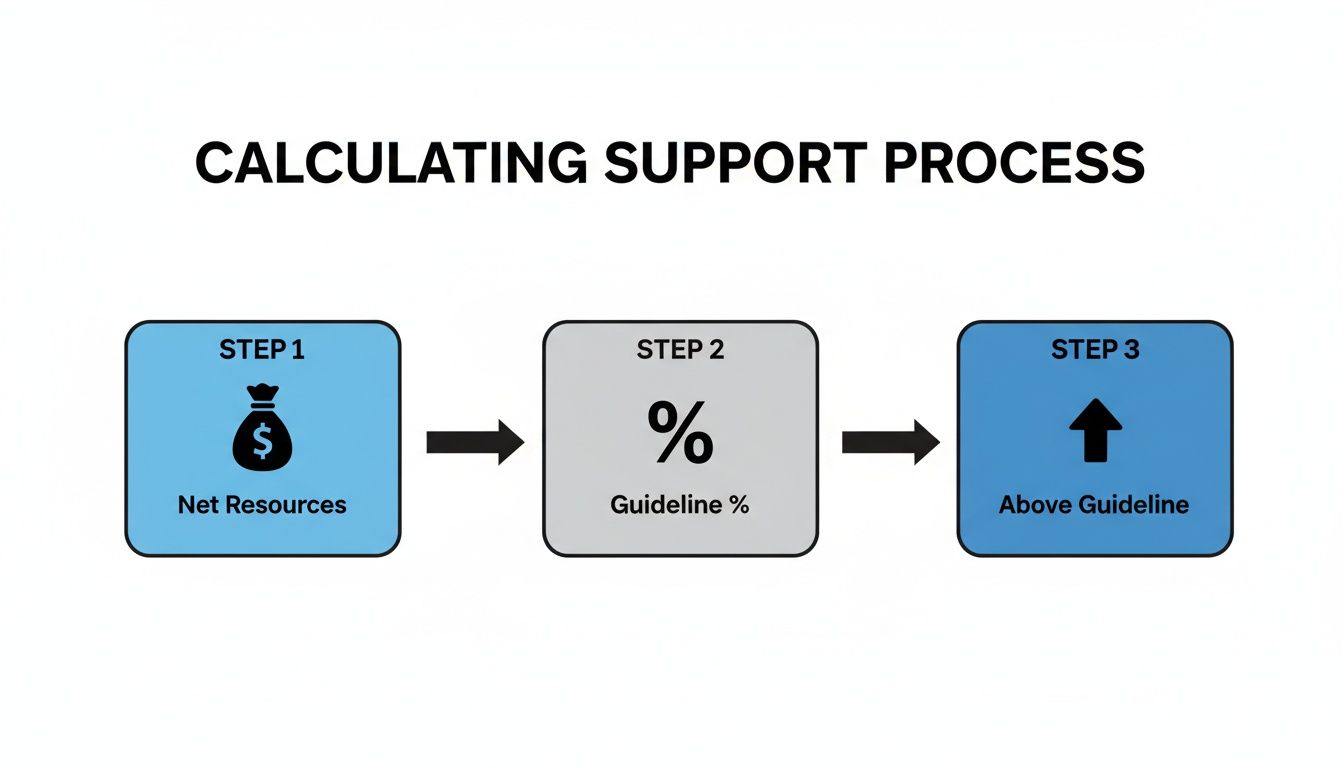
As you can see, that first guideline number is just a baseline.
Going Above the Guideline Amount
This is where cases for child support for disabled adult children really stand apart. While the guideline calculation sets a floor, it often does not cover the actual costs of care. That's why Texas Family Code § 154.123 specifically allows judges to order support above the guideline amount.
To get an above-guideline award, you must show the judge clear, convincing evidence of the adult child's real-world needs. The court will want to see documentation for things like:
- Extraordinary medical expenses not covered by insurance.
- Costs for specialized care like physical, occupational, or speech therapy.
- Expenses for a personal attendant or a residential care facility.
- The price of adaptive equipment or special dietary needs.
- Transportation costs for getting to and from medical appointments.
Let’s return to our high-earning parent. The baseline support was $2,340. If you can prove the adult child’s actual monthly needs are $4,000, the judge has the power under § 154.123 to order the parent to pay that full amount. That's $1,660 more than the standard guideline. Success here depends entirely on your ability to back up every expense with receipts, expert reports, and a detailed monthly budget.
To get a better handle on the standard formulas and deductions, we recommend you check out our guide on how to calculate child support in Texas. Knowing the basic rules is the first step in building a strong case for the additional support your child truly needs. Ultimately, a judge's decision will focus on the child's best interest, which in these situations means making sure all their unique needs are met.
Your Step-By-Step Guide to the Court Process

The idea of going to court for child support for a disabled adult child can feel intimidating, but it helps to view it as a roadmap. The legal system has a clear, step-by-step process designed to provide a judge with all the information needed to make a fair decision. Once you understand the path forward, you can approach each stage with confidence.
Step 1: Filing the Petition
Everything officially begins when your attorney files an Original Petition in a Suit Affecting the Parent-Child Relationship. This document formally introduces the case to the court. It identifies all parties, explains your adult child's situation, and tells the judge exactly what you are asking for—an order for ongoing support under Texas Family Code § 154.302.
Step 2: Service of Process
After filing the petition, the court requires a crucial next step: service of process. This is non-negotiable. It is the formal, legal notification to the other parent (the Respondent) that a lawsuit has been filed. A sheriff, constable, or certified private process server will personally deliver a copy of the petition and a court summons, known as a citation. This step gives the court authority to make binding orders. Without proof of proper service, a judge cannot move forward or issue enforceable rulings against the other parent.
Step 3: Gathering Critical Evidence Through Discovery
With the other parent officially served, the case moves into the discovery phase. Think of this as the fact-finding mission. It's a structured, pre-trial process where both sides are required to exchange information and evidence. This is where most cases are won or lost, as it is your opportunity to gather the medical and financial proof you need.
Standard discovery tools include:
- Requests for Disclosure: Standard questions asking the other parent to identify people with knowledge of the case and outline their legal arguments.
- Requests for Production: A formal demand for documents, such as the other parent’s financial records—tax returns, pay stubs, bank statements—to establish their net resources.
- Interrogatories: Written questions the other parent must answer in writing, under oath.
- Depositions: Live, out-of-court testimony where your attorney questions the other parent or key witnesses (like your child's doctor) under oath while a court reporter records everything.
Discovery is our chance to nail down the other parent’s income and build an undeniable case for your child's disability and ongoing needs.
Step 4: Temporary Orders and Final Trial
Because cases can take months, you can request a Temporary Orders Hearing to address immediate needs. We can ask the judge to put temporary support payments in place, order a parent to provide health insurance, and make other essential rulings to ensure stability until the case is finalized. The temporary orders hearing is like a mini-trial, where limited evidence is presented to justify interim support.
If you and the other parent cannot reach a settlement, the case proceeds to a Final Trial. Here, we present your entire case to the judge, including expert testimony from doctors, detailed medical records, and a budget showing your child's actual expenses. The judge will listen to both sides and then issue a Final Order that sets the amount and duration of the child support.
Protecting Government Benefits from Child Support

Winning an order for child support for a disabled adult child is a major victory. However, a hidden pitfall can undo all your hard work. If those support payments go directly to you or your child, you could accidentally torpedo their eligibility for crucial government benefits like Supplemental Security Income (SSI) and Medicaid.
This is where a smart legal strategy is non-negotiable. The Social Security Administration (SSA) views direct child support payments as "unearned income" for your adult child. This new income can wreak havoc on the monthly SSI benefit, which is designed to provide for basic food and shelter.
The Problem of Benefit Reduction
The result is often a dollar-for-dollar reduction, leaving your child with no real financial gain.
The numbers are stark. For an adult child over 18, the SSA will count almost every penny of the child support payment against their SSI benefit (after a small $20 general income exclusion). A $300 monthly child support payment, for instance, could shrink your child's SSI check by a staggering $280. The Special Needs Alliance offers great insights into this interaction. In the end, the support you fought for just ends up replacing the government assistance you were already counting on.
The Solution: A Special Needs Trust
Fortunately, Texas law provides an excellent tool to prevent this: the Special Needs Trust (SNT). Authorized under Texas Property Code § 142.005, an SNT is a specialized legal instrument created to hold assets for a person with a disability. When structured correctly, funds inside the trust are not counted as resources for means-tested programs like SSI and Medicaid.
We can ask the judge to order the paying parent to send all child support payments directly into this trust. The trust essentially builds a protective financial wall around the money.
By ordering child support payments into a properly structured Special Needs Trust, a Texas court ensures the funds supplement—rather than replace—your child’s vital government benefits. This is the key to maximizing all available financial resources.
A person or entity called a Trustee manages the SNT. Their job is to use the funds for the "sole benefit" of your adult child, specifically for expenses that SSI and Medicaid do not cover. This clever approach lets your child continue receiving their full SSI payment for basic needs while the trust money is used to enhance their quality of life.
What Can an SNT Pay For?
The purpose of an SNT is to pay for "supplemental" needs that go beyond the food and shelter covered by government benefits. Think of it as the fund for everything that makes life richer, safer, and more fulfilling.
Common examples of what SNT funds can be used for include:
- Medical and Dental Care: Expenses that Medicaid won't touch, like specialized therapies, treatments, or extensive dental work.
- Personal Care: Paying for a home health aide, a personal care attendant, or respite care.
- Education and Vocation: Covering tuition for special classes, job coaching, or educational software.
- Recreation and Travel: Funding hobbies, social activities, vacations, and accessible transportation.
- Technology and Equipment: Purchasing a computer, adaptive devices, or a specially equipped vehicle.
By routing child support into an SNT, you are layering parental support on top of government aid, not swapping one for the other. This strategy creates a much more robust financial foundation, ensuring your adult child has the security and quality of life they deserve.
FAQ: Adult Child Support in Texas
When you're fighting to secure support for a disabled adult child, the legal system can feel like a maze. Here are answers to common questions we encounter from parents preparing for court.
Can I get retroactive support for my adult child?
Yes, but you must act quickly. Under Texas Family Code § 154.009, you have a four-year window after your child's 18th birthday to file a suit for retroactive support. If you file within this timeframe, a judge can order the other parent to pay for the four years preceding the date of filing. The court will determine the amount based on the other parent's past income and the support you provided during that time. This deadline is firm.
What if the other parent’s income changes?
A support order is not set in stone. Under Texas Family Code § 156.401, an order for adult child support can be modified if there has been a "material and substantial change" in circumstances. This could include a significant job loss or promotion for either parent, new medical costs for the adult child, or a change in the child's government benefits. To change the order, you must file a formal Petition to Modify the Parent-Child Relationship and prove to the judge that circumstances are now different.
How does a 50/50 caregiving arrangement affect support?
Once a child turns 18, legal concepts of "custody" and possession schedules no longer apply. However, a judge will absolutely consider the reality of who provides the hands-on, daily care for a disabled adult. There is no rigid formula. If both parents genuinely share caregiving responsibilities, a judge has significant leeway under Texas Family Code § 154.123 to deviate from standard guidelines. The court might calculate what each parent would pay and have the higher-earning parent pay the difference to equalize the resources. The court's primary focus remains the adult child's best interest and proven needs.
What is the most important evidence I need to present?
Your case for child support for a disabled adult child is built on two pillars: medical evidence and financial evidence.
- Medical Evidence: You need up-to-date, detailed records from doctors and therapists that clearly state the diagnosis and, crucially, prove the disability existed before your child turned 18. A letter or live testimony from a physician explaining why the condition prevents self-sufficiency is extremely persuasive in court.
- Financial Evidence: You must show the judge the exact cost of care. Create a detailed monthly budget itemizing every expense: housing, food, medication, therapy, personal care, and transportation. You will provide your own financial documents and use legal discovery to obtain the other parent's financial information to show their ability to contribute.
How do support payments affect government benefits?
This is a critical strategic consideration. Direct child support payments are counted as income by the Social Security Administration and can drastically reduce or even terminate benefits like Supplemental Security Income (SSI). This is not just a Texas issue; it is a national one. As one analysis of how child support changes benefits for disabled children shows, a support payment of just $300 a month can slash a maximum SSI payment by $280. The most effective solution is to have the court order support payments directly into a properly drafted Special Needs Trust. This allows the money to be used for the child's benefit without counting as "income" and jeopardizing their SSI eligibility.
At the Law Office of Bryan Fagan, PLLC, we help parents secure the financial stability their disabled adult children need. If you are preparing for court or have questions about establishing or modifying an order, we can provide the strategic guidance you need. Contact us to schedule a consultation.