Handling a child support case in Houston without legal counsel is like navigating a maze blindfolded. Engaging a specialized child support attorney in Houston is not merely about filing paperwork—it's about securing an expert guide who understands the Texas Family Code, protects your rights, and ensures the outcome is just and sustainable.
Why You Need a Houston Child Support Attorney
Attempting to manage a child support case alone is a significant risk. The Texas Family Code is dense with specific rules and strict deadlines where a single misstep can have lasting financial consequences. An attorney does more than fill out forms; they develop a robust legal strategy tailored to your circumstances, whether you are establishing an initial order, modifying an existing one, or enforcing delinquent payments.
Your attorney's role is critical in several key scenarios:
- Establishing Fair Initial Orders: They ensure income is calculated accurately according to Texas Family Code §154.062, a crucial step for business owners, contractors, or those with complex compensation.
- Enforcing Missed Payments: When the other parent fails to pay, your attorney can initiate swift enforcement actions to compel payment and collect what is owed.
- Modifying Support Orders: Life changes. If your income has significantly increased or decreased, your attorney can file a Petition to Modify to adjust the support amount to reflect your current reality, per Texas Family Code §156.401.
- Defending Against Unfair Claims: They protect you from unreasonable demands or false financial accusations, ensuring the court has a true and accurate picture of the facts.
Securing Your Child's Financial Future
The stakes in a Texas child support case are exceptionally high. The Texas Attorney General's Child Support Division is one of the most aggressive enforcement agencies in the country. In fiscal year 2020 alone, it collected $4.8 billion, with over $3.4 billion obtained through income withholding (wage garnishment).
Without an advocate who knows the law, you risk severe penalties, including driver's license suspension, property liens, or even frozen bank accounts.
A critical mistake we frequently see is parents making verbal agreements to alter support payments. These informal arrangements are not legally binding. Only a new court order signed by a judge can officially change your legal support obligation. Relying on a handshake deal can expose you to liability for thousands of dollars in back-support, known as arrears.
An experienced child support attorney in Houston is your strongest asset. They anticipate legal challenges, gather the necessary financial evidence, and advocate effectively for you in Harris County family courts. They act as a professional buffer between you and the other parent, ensuring every action is strategic and compliant with the law.
Hiring an expert is about protecting your finances and restoring your peace of mind. You can learn more about how our legal team serves the Houston area and fights to protect our clients' interests.
How Texas Calculates Child Support Payments
When a Houston judge determines a child support amount, they apply a specific formula outlined in the Texas Family Code. The process begins with calculating the obligor's (the paying parent's) "monthly net resources."
Determining this figure is the most crucial step. It encompasses more than just a paycheck. A court will examine all gross income sources and then subtract a specific list of statutory deductions. These include federal income taxes (calculated for a single person claiming one exemption), Social Security and Medicare taxes, union dues, and the amount paid for the child's health insurance premium.
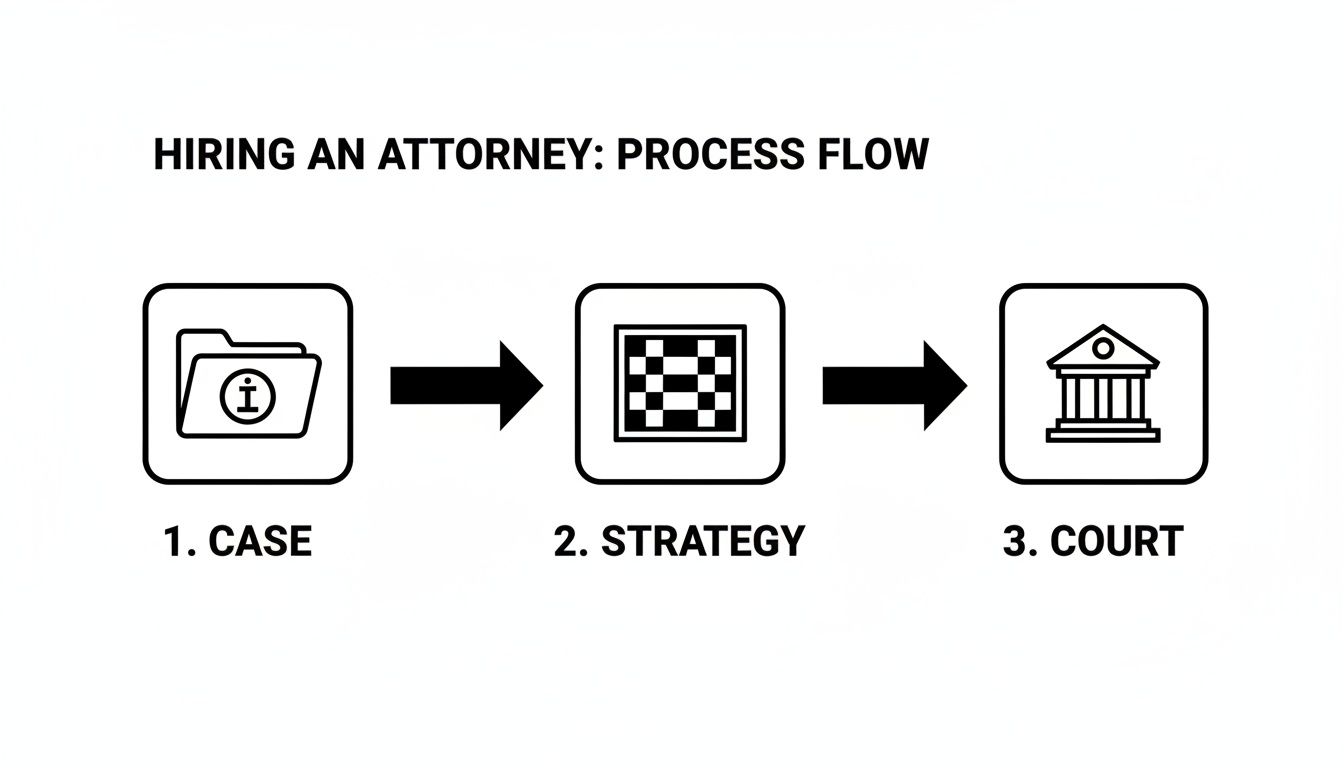
From there, the path forward involves a clear legal strategy, from the initial case review all the way to the courtroom.
Applying the Guideline Percentages
Once the court establishes the monthly net resources, it applies a percentage based on the number of children before the court. These standard guidelines are codified in Texas Family Code §154.125. For a much deeper dive, you can check out our detailed guide on how to calculate child support in Texas.
Unless evidence shows the guidelines would be unjust or inappropriate, judges adhere to these percentages:
- 20% for one child
- 25% for two children
- 30% for three children
- 35% for four children
- 40% for five or more children
These percentages apply to the obligor's net resources up to a statutory cap. For parents with lower incomes, the law provides some relief. If your net resources are $1,000 or less per month, the guidelines are reduced, starting at 15% for one child, as detailed in Texas Family Code §154.125(b).
Putting It All Together: A Real-World Example
Let's walk through a practical example. Imagine a Houston-based engineer is the non-primary parent, earns a gross monthly salary of $12,000, and has one child. Effective September 1, 2025, the statutory cap on net monthly resources will increase to $11,700. Since the engineer's net resources will likely exceed this new cap, the calculation applies to the cap itself.
- Gross Monthly Income: $12,000
- Statutory Deductions: After accounting for taxes and the child's health insurance premium, let's assume their total deductions amount to $3,000.
- Monthly Net Resources: $12,000 (Gross) – $3,000 (Deductions) = $9,000.
Since this $9,000 is below the upcoming $11,700 cap, we apply the guideline percentage directly to it. With one child, the court applies the 20% guideline.
Guideline Child Support: $9,000 (Net Resources) x 0.20 (20%) = $1,800 per month.
If the engineer's net resources were, for instance, $15,000, the calculation would be applied to the $11,700 cap, resulting in a guideline support amount of $2,340 per month (20% of $11,700). An experienced child support attorney in Houston can help you determine how this law impacts your specific case.
The New $11,700 Income Cap and What It Means for You
A significant legislative update is set to impact Texas child support, particularly for high-income earners. The Texas legislature has increased the maximum income level used to calculate guideline child support to better reflect the current cost of living.
For years, guideline calculations were capped at $9,200 in monthly net resources. Starting September 1, 2025, that cap will rise to $11,700. This is a substantial change that will have a direct financial impact on many parents across Houston and the state.
Breaking Down the Financial Impact
What does this mean in practical terms? Previously, courts applied standard percentages to a maximum of $9,200 of a parent's net monthly income. Now, that same percentage applies to the higher $11,700 figure.
This change acknowledges that the old cap often failed to align with the actual earnings of many professionals, executives, and business owners. The new law allows the court to consider a greater portion of a high-earner's income before requiring proof of a child's needs beyond the guideline amount, as laid out in Texas Family Code §154.125(a). For more on the specifics, check out this post on the new cap and its effects on VersusTexas.com.
The table below illustrates the significant potential monthly increase in maximum guideline support.
Texas Child Support Cap Increase Comparison (Effective Sept 1, 2025)
| Number of Children | Max Guideline Support (Old $9,200 Cap) | Max Guideline Support (New $11,700 Cap) | Monthly Increase |
|---|---|---|---|
| 1 Child (20%) | $1,840 | $2,340 | +$500 |
| 2 Children (25%) | $2,300 | $2,925 | +$625 |
| 3 Children (30%) | $2,760 | $3,510 | +$750 |
| 4 Children (35%) | $3,220 | $4,095 | +$875 |
| 5+ Children (40%) | $3,680 | $4,680 | +$1,000 |
These are not minor adjustments. For a parent with five or more children, this represents a potential $1,000 per month increase in the baseline support obligation.
Old Orders Do Not Update Automatically
This is the most critical point regarding the new law: existing child support orders will not change on their own. The court will not retroactively adjust your payments.
To apply the new $11,700 cap to an existing order, a parent must file a formal Petition to Modify.
This creates a crucial call to action. For the parent receiving support, this is an opportunity to seek an increase that reflects the paying parent's true income under the new cap. For the paying parent, it is a notice that a modification suit is likely.
Under Texas Family Code §156.401, a "material and substantial change in circumstances" is required to modify an order. The legislature's increase of the statutory cap is widely considered to meet this standard. However, you must be the one to initiate the legal process.
This is precisely where working with a knowledgeable child support attorney in Houston is essential. They can file the modification paperwork correctly, ensure the other parent is properly served, and build the case for why the change is warranted under the new law. For a deeper dive into the legal details, read our guide on Understanding the $11,700 Texas Child Support Cap.
Navigating the Harris County Court Process
Walking into the Harris County Family Law Center can be intimidating, but understanding the legal roadmap ahead provides clarity and confidence. A child support case is not a single court date but a series of deliberate procedural steps.

A skilled child support attorney in Houston guides you through every phase, ensuring deadlines are met, evidence is handled correctly, and your rights are protected from the moment the case begins.
The Initial Steps: Filing and Service
Every case begins when one parent files a Petition—the official document that initiates the lawsuit and informs the court of the relief you are seeking.
However, filing the petition is not enough. The other parent must be formally notified of the lawsuit through a process called Service of Process. A constable, sheriff, or private process server will personally deliver a copy of the lawsuit paperwork to them. This ensures they have legal notice of the case and an opportunity to respond.
Once served, the other parent has a strict deadline to file a formal Answer with the court. Failure to respond can result in a default judgment against them, making it critical to act quickly if you are served with a lawsuit.
Discovery: The Fact-Finding Phase
After the initial pleadings are filed, the case enters the discovery phase. This is a formal, mandatory exchange of information. Both sides are legally required to provide financial documents and other relevant evidence to each other.
This is often where the case is won or lost. Your attorney will use legal tools like Requests for Production and Interrogatories to obtain the necessary financial proof, including:
- Tax Returns: Typically, the last two years to establish an income history.
- Pay Stubs: Current pay stubs are the best evidence of present earnings.
- Bank Statements: These can reveal undisclosed income sources or hidden assets.
- Business Records: For self-employed parents, we demand profit-and-loss statements, balance sheets, and other business financials.
This process ensures the final child support calculation is based on verified numbers, not speculation, and lays the foundation for a fair and accurate court order.
Changing an Existing Order: The Modification Process
Life is not static, and child support orders can be changed to reflect new realities. To alter the current support amount, you must file a Petition to Modify. As per Texas Family Code §156.401, you must prove that a "material and substantial change" in circumstances has occurred since the last order was signed.
A verbal agreement to change child support is completely unenforceable in Texas. If you rely on a handshake deal to pay less, you could find yourself on the hook for thousands in back support down the road. Only a new order signed by a judge can legally change your obligation.
What qualifies as a material and substantial change?
- Example 1: Job Loss. The paying parent is involuntarily terminated from their job. They can file to have their support obligation temporarily reduced while they actively seek new employment.
- Example 2: Significant Promotion. The paying parent receives a 30% raise. The other parent can file to increase the support amount to reflect that new income.
- Example 3: Increased Needs of the Child. A child is diagnosed with a chronic medical condition requiring expensive, long-term care. The custodial parent can file for an upward deviation from guideline support to cover these costs.
The upcoming increase of the statutory income cap to $11,700 effective September 1, 2025, is itself considered a material and substantial change, providing grounds for many parents to seek a modification. Navigating these procedures requires a precise legal strategy, which a seasoned Houston attorney provides.
Beyond the Basics: Navigating Complex Child Support Cases
While standard child support guidelines work for many families, they are not a one-size-fits-all solution. Real life is often more complex, involving high-income parents, 50/50 custody schedules, or years of unpaid support.
These situations demand a deep understanding of the Texas Family Code and how Harris County judges apply it. A misstep in a complex case can have financial repercussions that last for years, making an expert legal strategy essential from the outset.

High-Income Earners and Proving Your Child's Needs
Texas law caps the income subject to guideline child support, but this does not give high-income parents an automatic discount. Effective September 1, 2025, that cap on monthly net resources increases to $11,700. For one child, this sets the new maximum guideline amount at $2,340 (20% of the cap).
However, Texas Family Code §154.123 empowers judges to order support above this guideline amount. To achieve this, you must present evidence demonstrating that the proven needs of the child justify a higher payment. "Proven" is the key word—you cannot simply ask for more; you must build a compelling case.
We accomplish this by meticulously documenting the child's actual expenses that reflect the family's standard of living, including:
- Private School Tuition: Invoices, enrollment contracts, and proof of payment.
- Expensive Extracurriculars: Costs for competitive travel sports, advanced arts instruction, or specialized academic tutoring.
- Lifestyle and Travel: Expenses associated with maintaining the lifestyle the child enjoyed before the parents' separation.
The court's objective is not to punish a high-earning parent but to ensure the child continues to benefit from the parents' financial success. Our role is to present a clear, documented financial picture to the judge, making a persuasive argument for why above-guideline support is necessary and in the child's best interest.
The Myth of 50/50 Custody and No Child Support
One of the most persistent myths in Texas family law is that a 50/50 possession schedule automatically eliminates child support. This is false. Child support is still ordered in the vast majority of 50/50 custody cases, though the calculation method differs.
Instead of a simple one-way payment, the court performs an "offset" calculation in three steps:
- Calculate the guideline support Parent A would owe based on their income.
- Calculate the guideline support Parent B would owe based on their income.
- The parent with the higher income pays the difference between the two amounts to the other parent.
For example, if Parent A's guideline support is $2,000/month and Parent B's is $1,200/month, Parent A would pay Parent B $800 per month ($2,000 – $1,200). This method ensures that even with equal possession time, both parents contribute to the child's expenses in proportion to their respective incomes.
Going Back in Time: Retroactive Child Support
What happens if a parent should have been paying support but never did because no court order was in place? Texas law allows a custodial parent to file for retroactive child support for up to the four years preceding the date the lawsuit was filed.
When deciding whether to order retroactive support, a judge will consider several factors:
- Did the non-paying parent know of their duty to support the child?
- Did they attempt to avoid this responsibility?
- What was their income and ability to pay during that four-year period?
- Would ordering a large lump sum of back-support create an undue financial hardship now?
The court begins with a presumption that ordering retroactive support is in the child's best interest. A diligent attorney will investigate the other parent's financial history to build a strong case for recovering the maximum amount of back-support your child is owed.
Enforcing an Order When a Parent Won't Pay
A court order for child support is a legal mandate. When a parent refuses to pay, you must take decisive legal action by filing a Petition for Enforcement.
Texas judges have a wide range of powerful tools to compel compliance:
- Wage Garnishment: An order sent directly to the non-paying parent's employer to deduct support from their paycheck.
- Property Liens: A legal claim against their assets, like a house or land, which must be paid before the property can be sold.
- License Suspension: The state can suspend their driver's license, professional licenses (e.g., for doctors, lawyers, realtors), and recreational licenses (e.g., hunting and fishing).
- Asset Seizure: The government can intercept tax refunds, lottery winnings, and funds from bank accounts.
- Jail Time: For contempt of court, a judge can sentence a parent to up to six months in jail for each missed payment.
A child support attorney in Houston will swiftly file the necessary motions to trigger these enforcement measures, holding the other parent accountable and securing the financial support your child is legally entitled to receive.
Common Questions About Houston Child Support
When facing a child support matter, you have questions. We provide authoritative answers based on years of experience in Harris County family courts.
How Is Child Support Calculated If a Parent Owns a Business in Houston?
This is one of the most complex scenarios in child support litigation. Unlike a salaried employee, a business owner's income is not transparent. We must conduct a forensic analysis of the business's finances to determine their true "net resources" under the Texas Family Code.
Through the discovery process, we compel the business owner to produce financial records, including:
- Business bank account statements
- Corporate tax returns (state and federal)
- Profit and loss (P&L) statements
- Balance sheets and general ledgers
Our team scrutinizes these documents to identify the parent's actual income available for support. We look for personal expenses paid by the business, diverted income, and other accounting tactics used to artificially suppress their stated income. This detailed work is essential to ensure a fair and accurate child support calculation.
Can My Child Support Change If I Lose My Job?
Yes, but immediate action is critical. An involuntary job loss is a classic example of a "material and substantial change" in circumstances, which is the legal standard for modifying a support order under Texas Family Code §156.401.
However, the order does not change automatically. You must file a Petition to Modify immediately. The court can only adjust your obligation retroactively to the date the other parent was served with the petition. If you wait months to file, you will be liable for the full amount under the old order, and that debt (arrears) will accumulate quickly.
It is critical to act fast. If you lose your job, you must file to modify your order immediately. The court cannot go back in time and change support to the day you were laid off—only to the date you filed your petition.
You must also prove you are diligently searching for new employment. Maintain detailed records of job applications, interviews, and networking efforts to show the judge you are not "voluntarily underemployed or unemployed." An attorney can get the petition filed swiftly to protect your financial stability.
Does the New $11,700 Cap Automatically Update My Old Order?
No, it absolutely will not. The new $11,700 monthly net resource cap, effective September 1, 2025, only applies to orders created or modified after that date.
If your order was finalized before then, it remains governed by the old $9,200 cap. To apply the higher cap, one of the parents must file a formal Petition to Modify. The legislative change itself provides the "material and substantial change" needed to initiate the case. For a parent receiving support from a high-earner, this is a clear opportunity to seek an increase.
What Happens If the Other Parent Refuses to Pay Child Support?
When a parent ignores a court order to pay child support, your recourse is to file a Petition for Enforcement. This brings the matter back before a judge to compel compliance.
Texas law provides judges with powerful enforcement remedies, including:
- Wage Garnishment: An order to the obligor's employer to deduct payments directly from their salary.
- Property Liens: A legal claim placed on property that must be paid before it can be sold.
- License Suspension: Suspension of driver's, professional, and recreational licenses.
- Asset Seizure: Interception of bank accounts, tax refunds, and other assets.
- Jail Time: A sentence of up to six months in jail for each missed payment as punishment for contempt of court.
A dedicated child support attorney in Houston will utilize every available legal tool to collect current and past-due support, ensuring your child receives the financial stability they are owed by law.
You don't have to figure out these complex child support issues on your own. The attorneys at the Texas Child Support Law Office of Bryan Fagan have the expertise and courtroom experience to guide you. Contact us today to set up a consultation and start taking control of the situation.