When child support is determined for high earners in Texas, the case centers on a specific figure established by state law: the statutory cap on monthly net resources. This isn't a hard limit on what a parent might be ordered to pay, but it is the mandatory starting point for every calculation a court makes.
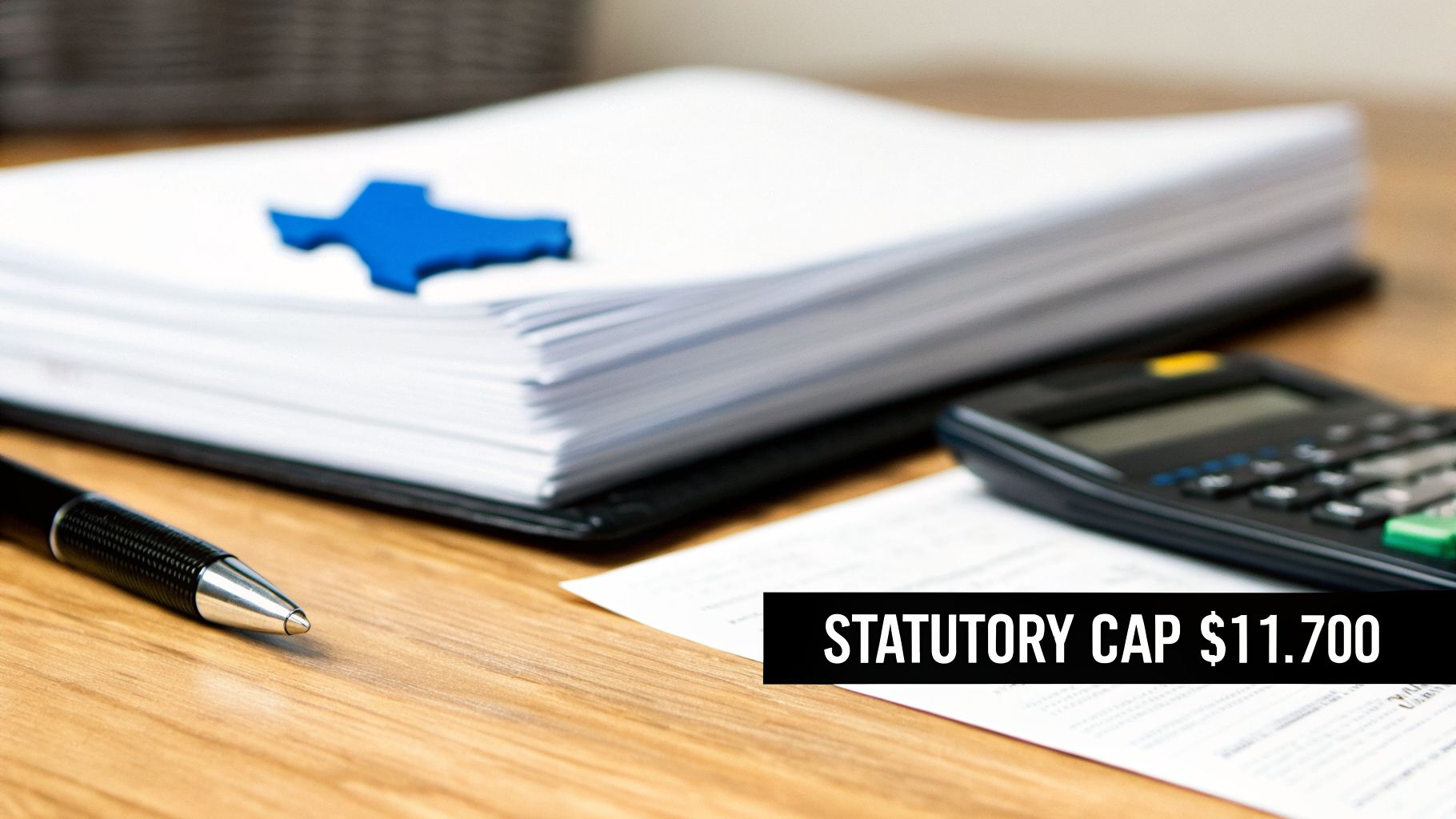
As of September 1, 2025, that critical number is $11,700. If the paying parent (the obligor) earns more than this amount per month in net resources, the court still begins its guideline calculation using this specific figure. Think of it as the foundation of the child support order. The legal battle then focuses on whether the child's proven needs justify an award built on top of that foundation.
The "Cap": The Starting Point for High-Income Child Support
Texas courts do not determine child support arbitrarily. The Texas Family Code provides a structured, predictable formula. For parents with significant income, however, this formula has a unique feature that becomes the central focus of the entire case: the "presumptive maximum" on net monthly resources.
For many years, this presumptive cap was set at $9,200. Courts would apply the standard child support percentages (20% for one child, 25% for two, etc.) only to this amount, even if the obligor earned far more.
The New $11,700 Cap Has Arrived
To keep pace with inflation and the rising cost of living, the Texas Legislature periodically adjusts this cap. A significant update took effect on September 1, 2025, raising the cap from $9,200 to $11,700 in net monthly resources.
This is not a minor adjustment; it fundamentally changes the baseline for high-income child support cases. For any new or modified order after this date, the court must automatically apply the guideline percentages to a much larger income base. The result is a significantly higher "guideline" support amount before any arguments for additional support are even heard.
The law is explicit on this point. Texas Family Code §154.125 directs the court to presumptively apply the standard percentages to the first $11,700 of the obligor's net monthly resources. This figure represents the floor, not the ceiling, for what can be ordered.
If an obligor's net resources are, for example, $20,000 a month, the court must first calculate the guideline support based on the $11,700 cap. The legal battle then shifts to the next critical question: Do the child's proven needs justify an award above that guideline amount? This is where Texas Family Code §154.123 and §154.126 provide the legal framework for the court's decision.
How This New Cap Affects Your Case
It is crucial to understand this two-step process. The first step is simple math, but the second step is all about evidence.
- Guideline Support: This is the automatic, baseline calculation using the $11,700 cap. It's the mandatory starting point.
- Above-Guideline Support: To obtain more than the guideline amount, the receiving parent (the obligee) has the burden to prove the child’s specific needs—such as private school tuition, specialized tutoring, or high-level extracurricular activities—require additional funds.
The table below provides a clear, side-by-side look at the immediate financial impact of this new cap on the maximum guideline child support. This is the new baseline for all high-income cases.
Texas Child Support Cap Change (Effective September 1, 2025)
The table below shows how the increase in the net resource cap from $9,200 to $11,700 directly impacts the baseline monthly child support amounts.
| Number of Children | Max Guideline Support (Old $9,200 Cap) | Max Guideline Support (New $11,700 Cap) | Monthly Increase |
|---|---|---|---|
| 1 | $1,840 | $2,340 | +$500 |
| 2 | $2,300 | $2,925 | +$625 |
| 3 | $2,760 | $3,510 | +$750 |
| 4 | $3,220 | $4,095 | +$875 |
| 5 or more | $3,680 | $4,680 | +$1,000 |
As you can see, the new baseline obligation for high earners has jumped significantly, even before any arguments are made for needs above the cap. A firm grasp of this new landscape is the first step in building a winning legal strategy. Whether you're seeking to secure an appropriate support order or defending against an unreasonable request, it all starts here.
How Texas Calculates Guideline Child Support

Before a Texas judge will consider arguments about a child's elevated needs in a high-income case, they must first perform the standard calculation. This initial amount is called "guideline child support," and it's based on a precise formula from the Texas Family Code. Mastering this formula is the first step in building your case.
The process begins by determining the paying parent's net monthly resources. This isn't just their salary; the law defines it much more broadly.
What Counts as Net Resources
Under Texas Family Code §154.062, "resources" is an all-encompassing term. The court will sum income from nearly every conceivable source, including:
- Wages and salary, covering commissions, overtime, tips, and bonuses.
- Self-employment income, which requires a detailed review of the business's financials.
- Investment income such as interest, dividends, capital gains, and royalties.
- Rental income from any real estate holdings.
- Other income, a broad category that can include retirement benefits, pensions, trust income, annuities, and even regular financial gifts.
After totaling this gross income, the court makes specific, allowable deductions to arrive at the final "net resources" figure. These deductions include Social Security taxes, federal income tax (calculated for a single person with one exemption), state income tax (if applicable), union dues, and the amount paid for the children's health insurance.
Applying the Guideline Percentages
Once the court establishes the net monthly resources figure, it applies a percentage based on the number of children before the court. These percentages are mandated by Texas Family Code §154.125. For a more detailed walkthrough, you might find our guide on how to calculate child support in Texas helpful.
Here’s the critical component for high-income earners: this percentage is applied only to net resources up to the statutory cap. As of September 1, 2025, that cap is $11,700 per month. Even if an obligor's net resources are much higher, the guideline calculation starts with that $11,700 figure.
From a legal perspective: Think of this guideline amount as the presumed fair amount of child support. A judge will order this amount by default. The real legal fight in a high-income case is showing the judge why they should order more than this baseline. The burden of proof is on the parent receiving support to prove the child’s needs justify a higher award.
Let’s apply this with a practical example.
Practical Calculation Example
Assume an obligor has $25,000 in net monthly resources and has two children who are the subject of the child support order.
Here is how a Texas court would approach the initial calculation:
- Identify Net Resources for the Formula: Although the parent's actual net income is $25,000, the court uses the statutory cap of $11,700 for this first step, as required by Texas Family Code §154.125(a).
- Find the Guideline Percentage: Texas Family Code §154.125(b) sets the rate for two children at 25% of net resources.
- Calculate the Guideline Support: The court multiplies the capped resources by the percentage: $11,700 x 0.25 = $2,925.
In this scenario, the baseline or "guideline" child support amount is $2,925 per month. This number is just the starting line. From here, the obligee must present clear, compelling evidence of the children's proven needs to justify an award above that $2,925 floor.
When Courts Order Support Above the Guideline Cap
In a high-income child support case, the guideline calculation is merely the first step. When an obligor’s monthly net resources exceed the statutory cap—$11,700 as of September 1, 2025—it does not automatically trigger a higher support payment. The real work begins when the obligee asks the court to order child support above that guideline amount.
At this stage, the case shifts entirely to the "proven needs of the child." This is a critical legal concept. The obligee carries the entire burden of proof. They must present compelling evidence showing why the standard guideline amount is insufficient to meet the child's needs and maintain the lifestyle the family established.
The Legal Standard for Exceeding the Cap
A judge cannot simply order more child support because a parent has a large income. Any decision to deviate upward must be firmly rooted in the Texas Family Code. Specifically, Texas Family Code §154.123 lists the factors a court must consider, including the child's age and needs, the parents' ability to contribute, and the financial resources available to support the child.
When an obligor's income surpasses the cap, the court first calculates the guideline percentage on that capped amount. Then, Texas Family Code §154.126 grants the judge discretion to order additional support, but only if the proven, documented needs of the child justify a higher payment.
From a legal standpoint: This process is not about equalizing the parents' lifestyles. It is a strictly evidence-based inquiry. The court must be convinced that the child's specific, demonstrable needs require more funding than the guideline calculation provides. Without solid proof, a request for above-guideline support will fail.
Proving the "Needs" of the Child
What exactly constitutes a "proven need"? This is the central question in these disputes. A court looks for expenses that are either part of the child's established lifestyle or are genuinely necessary for their well-being and development, consistent with the parents' financial standing.
Common examples that require strong documentation include:
- Private School Tuition: If a child has always attended private school, or it was part of the family plan, the tuition costs are powerful evidence.
- Elite Extracurriculars: Costs for competitive travel sports, advanced music or art lessons, or specialized summer camps that were part of the child's life are often considered.
- Specialized Medical or Educational Support: This can include therapy, counseling, tutoring for learning differences, or ongoing medical treatments not fully covered by insurance.
- Nannies and Childcare: The expense of quality childcare that was customary for the family or is necessary to allow the custodial parent to work.
- Housing and Travel: In some cases, the cost of maintaining a home in a specific high-cost school district or travel expenses related to the child’s activities may be factored in.
A Practical Courtroom Scenario
Consider a common scenario: the paying parent has net monthly resources of $30,000, and there is one child. The standard guideline support, calculated on the $11,700 cap, would be $2,340 (20%). The receiving parent argues this is insufficient.
To succeed, the obligee must present a detailed budget backed by hard evidence like invoices, school registration forms, receipts, and bank statements.
- Private School Tuition: $2,500/month
- Competitive Tennis Coaching & Travel: $800/month
- Tutoring for Dyslexia: $600/month
- Health Insurance & Unreimbursed Medical: $400/month
Here, the documented needs total $4,300 per month. The obligee can present this evidence to argue that the guideline amount of $2,340 falls short. A judge, presented with this clear proof, would have the legal grounds under §154.126 to order a child support amount much closer to the $4,300 required to meet the child's proven needs.
Understanding where the ceiling is for these calculations is critical, which is why we've put together a detailed post on the maximum child support possible in Texas. Without this level of documentation, the request to exceed the cap is almost certain to be denied.
Your Court Order and the New $11,700 Cap
If you are a party to a Texas child support order, you must be aware of the major change effective September 1, 2025. The legislature raised the "cap" on monthly net resources used for guideline child support calculations. However, one detail is absolutely critical: the change is not retroactive.
This new $11,700 cap only applies automatically to child support orders signed or modified on or after that date. If your order was finalized before September 1, 2025, it remains governed by the old $9,200 cap. The date on your final order is the first thing to check.
Will My Existing Child Support Order Increase Automatically?
No. The court system does not automatically adjust prior orders to conform to new legislation.
For the new $11,700 cap to affect an existing case, a party must take legal action. Either the obligor or the obligee must file a formal Petition to Modify the existing order. Without that filing, your order remains in effect exactly as written, governed by the financial rules in place at the time it was signed.
How to Modify an Order Under the New Law
To successfully modify a child support order, you must prove a "material and substantial change in circumstances" has occurred since the last order was signed, as required by Texas Family Code §156.401. The good news for many obligees is that this major statutory update can constitute such a change.
The child support cap on net monthly resources had not been adjusted for inflation since 2019. This 27% jump from $9,200 to $11,700 represents the legislature’s effort to align the guidelines with current economic realities.
Here is what that looks like in terms of maximum guideline support:
- For one child: The maximum guideline support is now $2,340 per month (20% of $11,700), up from $1,840.
- For two children: The maximum guideline support is now $2,925 per month (25% of $11,700), up from $2,300.
These new calculations only apply if you obtain a new order or modify an old one after September 1, 2025. Otherwise, the old cap remains in place unless challenged in court.
This flowchart breaks down how a court approaches ordering support above the standard guideline cap.
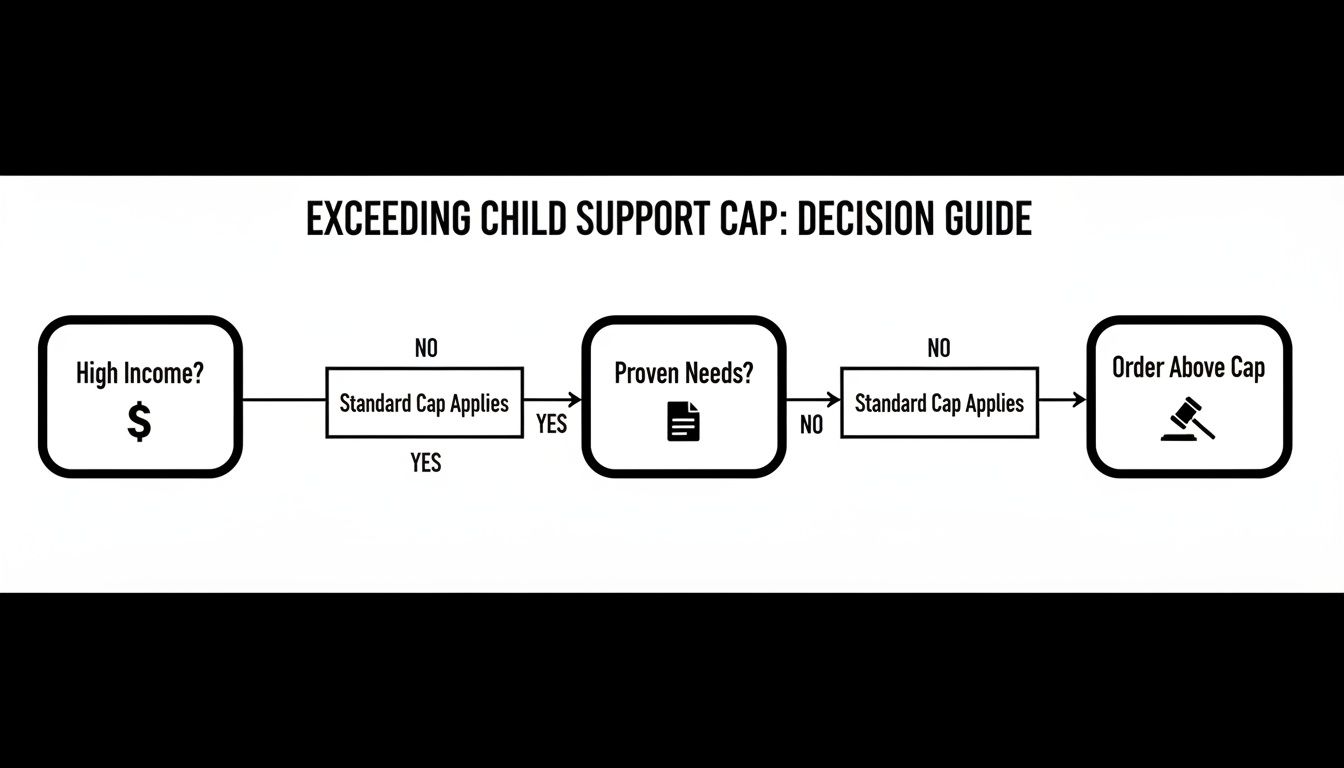
As the chart illustrates, high income alone is not enough. A judge needs to see clear evidence of the child's proven needs to justify an order beyond the capped amount.
What This Means for Your Strategy
This legal update demands a fresh strategic review, whether you are paying or receiving child support.
If You Receive Child Support: If the obligor is a high earner and your current support is based on the old $9,200 cap, you now have a powerful reason to file a Petition to Modify. The change in the law itself provides the "material and substantial change" needed to get back before a judge.
If You Pay Child Support: If your income exceeds the new cap and your current order is based on the old $9,200 figure, you should anticipate a modification suit. It is wise to get ahead of this by gathering your financial documents and calculating what your new guideline obligation might be.
A common question is whether the change in law alone is sufficient grounds for modification. When the statutory formula itself has been significantly altered, the answer is typically yes. The new guideline amount is likely to be more than 20% or $100 different from the current order, which is another statutory basis for modification under Texas Family Code §156.401(a)(2). The bottom line is that this change requires action. For a deeper dive into the numbers, check out our post on understanding the $11,700 cap.
How a High-Income Child Support Case Unfolds in Court
Navigating a high-income child support case in Texas requires a clear understanding of the legal process. Knowing the key procedural steps helps you prepare for the journey and build a much stronger case.
The process starts when one parent files an Original Petition (or a Petition to Modify for existing orders). This is the official kickoff—a legal document outlining what the filing parent is asking the court to do, including setting or changing a child support amount.
The other parent must then be formally notified through service of process. Typically, a constable or private process server will hand-deliver a copy of the lawsuit. This is a critical step that brings the other parent under the court's jurisdiction and starts the legal clock.
The Discovery Phase: Where the Case is Won or Lost
Once the initial filings are complete, the case moves into discovery. This is the most crucial part of any high-income child support case. Here, the financial details come to light under oath. The process is focused on two primary goals: establishing the paying parent's true net resources and documenting the child’s proven needs.
We use several key legal tools to gather this evidence:
- Requests for Production: Formal demands for documents like tax returns (personal and business), pay stubs, complete bank and credit card statements, and business records like profit-and-loss statements.
- Interrogatories: Written questions that the other party is legally required to answer in writing, under oath.
- Depositions: Out-of-court testimony where attorneys question parents and key witnesses (like a CFO or CPA) under oath, with a court reporter transcribing every word.
This is where cases are made. For the parent seeking support, this is the opportunity to build a detailed, evidence-backed picture of the child's established lifestyle. For the paying parent, this is the chance to ensure all income and deductions are accounted for accurately.
The Path to a Final Order: Hearings, Mediation, and Trial
Final trials can be months away, but a child's needs are immediate. That's why we often request a Temporary Orders Hearing. A judge hears a "mini-version" of the case and issues a temporary child support order to provide stability while the case proceeds.
Before a final trial, Texas judges almost universally require the parties to attend mediation. This is a confidential negotiation where a neutral third-party mediator helps both sides try to reach a settlement. A significant number of high-income cases are resolved here.
Mediation gives you control. A negotiated settlement allows you to craft a custom agreement that works for your family—often including creative solutions a court could not order. If you leave it to a judge, their ruling is final.
If mediation fails, the final step is a Final Hearing or Trial. Both sides will present their evidence, call witnesses, and make legal arguments to the judge, who will then issue a binding Final Order. For modification cases, the party seeking the change must prove a "material and substantial change" in circumstances, as outlined in Texas Family Code §156.401. The recent increase of the statutory cap to $11,700 provides a clear example of such a change.
High-Income Child Support: Frequently Asked Questions (FAQ)
When significant income is involved in a Texas child support case, the standard rules often feel like just the starting point. These are some of the most common and critical questions we address for our clients.
Does a 50/50 possession schedule eliminate child support in Texas?
This is the most pervasive myth in Texas family law. While a true 50/50 possession schedule can influence the final support amount, it does not automatically cancel the child support obligation, especially when a significant income disparity exists between the parents. The court's primary duty is to ensure the child's standard of living is reasonably consistent between both homes. If one parent earns substantially more, the court will often order that parent to pay child support to prevent the child from experiencing a jarring financial "downshift" in the lower-earning parent's home. The court may use an "offset" calculation, but the higher earner is still very likely to be an obligor.
What kind of proof do I need for a child's "needs" above the cap?
Claiming a child "needs" more than the guideline support amount requires much more than simply asking. The burden of proof is entirely on the parent requesting support above the statutory cap (calculated on $11,700 in net resources as of September 1, 2025). You must prove it with documentation. General statements will not suffice. You need to build a case with concrete evidence that quantifies the child's established lifestyle and expenses.
- Invoices and receipts for private school tuition, specialized tutoring, or therapy.
- Bank records and registration forms showing costs for high-level extracurriculars like competitive travel sports, advanced music instruction, or equestrian activities.
- Financial records detailing costs of nannies, tutors, or other care that was part of the child's routine.
- Expert testimony from educational consultants or doctors regarding a child's unique needs.
Your job is to show the judge with verifiable documentation that the child's actual, quantifiable needs exceed the standard guideline support amount.
How do courts handle income from a business or self-employment?
This is where cases become complex. For business owners and self-employed individuals, determining "net resources" under Texas Family Code §154.062 is not as simple as looking at a pay stub. The court will scrutinize the business's full financial picture to determine the income truly available to the parent. This involves examining:
- Business and personal tax returns
- Profit and Loss (P&L) statements and Balance Sheets
- Business bank and credit card statements
A major focus will be identifying personal expenses paid by the business. These "add-backs"—such as personal car payments, family vacations disguised as business trips, or non-business-related "discretionary" spending—can be added back to the parent's income by the judge. Due to this complexity, hiring a forensic accountant is often a necessary step to produce a credible report for the court on the parent's true income.
What are the procedural steps to modify my child support order?
To change an existing order, you must file a Petition to Modify Parent-Child Relationship with the court that issued the original order. You must then ensure the other parent is formally served with the lawsuit. To be successful, you must prove that a "material and substantial change" in the circumstances of a parent or the child has occurred since the date of the last order, as required by Texas Family Code §156.401. The increase of the statutory cap to $11,700 is a prime example of such a change, providing a clear basis for many parents to seek an updated order.
Successfully navigating a high-income child support case in Texas demands a sharp legal strategy and a thorough understanding of the evidence needed to win. At the Law Office of Bryan Fagan, PLLC, we focus on these complex financial issues every day, giving parents the clear-eyed guidance they need. If your case involves substantial income, reach out to schedule a consultation and learn how we can help you prepare. Visit us online to get started.