The envelope arrives, or the email from opposing counsel hits your inbox, and the first question is usually not legal. It is practical. What is this going to cost me every month, and how much of my financial life is about to be examined in court?
That concern is justified in a high-income case. A physician with production bonuses, a founder taking draws and K-1 distributions, a private equity executive with deferred compensation, or an oil and gas professional with uneven pay does not walk into the same child support dispute as a salaried employee with simple payroll records. The Texas statutes are the same, but the fight is different.
A standard case turns on straightforward math. A high-income case turns on classification, proof, and credibility. Which income streams count. Which expenses are for the child. Which lifestyle claims can be documented. Which parent has the cleaner financial story when the judge starts asking hard questions.
That is why people searching for a high income child support lawyer texas are not looking for a generic explanation of percentages. They need a strategy. Paying parents need to know how to prevent inflated claims from becoming court orders. Receiving parents need to know how to prove needs in a way that survives scrutiny under the Texas Family Code.
Navigating High-Stakes Child Support in Texas
High-income child support cases begin with a false assumption. One parent assumes the case is simple because Texas uses guidelines. The other assumes the judge will automatically increase support because the paying parent earns well above the cap. Both assumptions create problems.
Take a familiar pattern. A parent with substantial earnings has been covering private school, travel, health costs, activities, and a higher standard of living informally. The relationship breaks down. Once the case is filed, those informal arrangements lose value unless they are backed by records and framed correctly under the statute.
The first court battle is not about willingness to support the child. It is about how Texas law organizes the dispute.
What makes these cases different
In a high-income case, the court may have to sort through:
- Compensation that does not fit a paycheck. Bonuses, commissions, business income, rentals, trusts, and equity-based compensation can complicate the net-resource calculation.
- Arguments over lifestyle versus need. One parent may call an expense necessary to preserve the child’s accustomed life. The other may call it discretionary.
- Competing financial narratives. One side presents abundance. The other side shows irregular cash flow, tax burdens, debt service, and business volatility.
That is why early preparation matters. The parent who organizes documents first controls the first draft of the story.
Practical point: Courts do not reward vagueness. In high-income child support disputes, unsupported claims collapse under discovery, while well-documented claims drive settlement.
What works and what does not
What works is disciplined preparation. Gather tax returns, pay records, K-1s, bank statements, health insurance records, school invoices, and proof of recurring child-related costs. Build a timeline. Separate personal spending from child-specific spending.
What does not work is showing up with broad statements like “the child is used to a certain lifestyle” or “my income varies too much to calculate.” Judges hear both arguments constantly. They expect documents.
A seasoned attorney prepares the case with that reality in mind. Not dramatic rhetoric. Not posturing. Evidence, pleadings tied to the Family Code, and a presentation that gives the court a reliable basis to rule.
The Foundation Texas Child Support Guidelines and the New Cap
A common high-income dispute starts the same way. One parent assumes a seven-figure income means support will scale without limit. The other assumes the statutory cap ends the discussion. Texas law does neither.
Texas child support still begins with the guideline framework in Texas Family Code §154.125. The court applies a percentage to the obligor’s monthly net resources, but in higher-income cases the guideline formula applies only up to the current cap. Effective September 1, 2025, that cap increased from $9,200 to $11,700 in monthly net resources, as noted in this discussion of the Texas child support cap increase effective September 1, 2025.
That change affects settlement posture immediately. A higher cap raises the baseline guideline number before either side argues about extraordinary needs, private school, travel costs, medical expenses, or any other item offered under §154.123.
If you want a broader explanation of the revised framework, this overview of the updated $11,700 net resource cap is a useful reference.
Why the new cap matters
In practice, the cap sets the first serious anchor in the case.
For one child, applying 20% to $11,700 produces a guideline amount of $2,340 per month. For two children, 25% produces $2,925. For three children, 30% produces $3,510. Those numbers matter because they shape temporary orders, mediation ranges, and trial expectations.
High-income parents often focus on the wrong fight. The paying parent may focus only on the cap and ignore the evidence needed to defend against an above-guideline request. The receiving parent may focus only on the obligor’s wealth and ignore the need to prove the child’s needs with records the court can trust.
The guideline table at the new cap
Under §154.125, the guideline percentages increase with the number of children before the court.
| Number of Children | Percentage of Net Resources | Maximum Monthly Guideline Support |
|---|---|---|
| 1 | 20% | $2,340 |
| 2 | 25% | $2,925 |
| 3 | 30% | $3,510 |
| 4 | 35% | Calculated from the capped net-resource amount under the statute |
| 5 or more | 40% | Calculated from the capped net-resource amount under the statute |
How courts use the guideline amount
The guideline number is the starting point. In high-income cases, that starting point often determines who has the burden of producing better proof.
For the paying parent, the cap blocks any automatic percentage award on income above $11,700 in monthly net resources. That is the defensive value of the cap. It forces the other side to move from rhetoric to proof if they want more.
For the receiving parent, the cap is not a ceiling on the final order. If the child’s proven needs exceed the guideline amount, the court can order additional support under §154.123. The word that matters is proven. Judges do not award more support just because the obligor earns more money.
This distinction affects both sides.
A well-prepared paying parent builds a record showing that the guideline amount already covers the child’s reasonable needs, or that the claimed extras are inflated, duplicated, or really benefit the parent more than the child. A well-prepared receiving parent itemizes the child’s expenses, separates ordinary household spending from child-specific costs, and ties each claimed amount to evidence the court can follow.
A practical example
Assume one child is before the court and the obligor’s monthly net resources exceed the cap. The guideline calculation stops at $11,700, so the baseline support figure is $2,340 per month under the current statute.
That does not end the case. It frames it.
From there, the key strategic questions are whether the net-resource figure is accurate and whether the evidence supports going above guideline based on the child’s demonstrated needs. In a high-income case, those two issues usually decide whether the cap operates as a limit or merely the opening number on the page.
Calculating Net Resources in High-Income Cases
In high-income child support cases, disputes over net resources usually decide the baseline number long before anyone argues about proven needs. A parent earning well above the cap can still gain or lose ground based on how income is classified, timed, documented, and challenged.
Texas courts look at the obligor’s economic benefit, not just the number printed on a base-salary line. That puts pressure on both sides to get the financial record right early. The paying parent needs a clean, defensible accounting that separates income from paper entries, reimbursements, and irregular events. The receiving parent needs to identify every income stream the court may count and test whether the other side’s presentation leaves money out.

A focused explanation of how Texas courts calculate net resources is useful to review alongside pay records, tax returns, and business documents.
Income is broader than salary
High earners often have compensation structures that do not fit neatly into a monthly paycheck. Courts know that. In practice, the net-resource analysis may involve salary, bonuses, commissions, self-employment income, partnership or business distributions, rental income, trust income, and other sources that create financial benefit.
That is where cases become technical.
A W-2 may show one part of the picture, while bank records, K-1s, deferred compensation statements, or employer payment histories show another. For business owners and executives, the dispute often centers on whether money was legitimately retained in a business, temporarily deferred, or still available for personal use. Those are fact questions, and judges usually decide them by comparing documents over time, not by accepting a single summary spreadsheet.
Texas Family Code §154.061(b) also matters here because permitted deductions affect the final net number. Small errors in withholding assumptions, health insurance treatment, or the handling of irregular compensation can change the support calculation enough to matter in settlement and at trial.
The strategic pressure points
The percentage itself is usually straightforward. The fight is over what goes into the calculation.
Common problem areas include:
- Annual and discretionary bonuses that are described as uncertain but appear year after year
- Commissions that fluctuate and require averaging over a fair period
- Closely held business income where personal expenses may run through the company
- Entity distributions that one side calls available income and the other side calls retained capital
- Trust or rental income that may offset claimed cash-flow limits
- Compensation changes during the case that raise underemployment or manipulation concerns
For the paying parent, this is a defensive exercise. The goal is to present a net-resource calculation the court can trust, with enough context to show why an unusual payment was unusual, why a retained distribution was not spendable income, or why a temporary drop in earnings was real.
For the receiving parent, the goal is different. The record has to show patterns. If "one-time" payments happen every year, if owner distributions continue while reported salary drops, or if lifestyle and reported income do not match, those facts can support a higher net-resource finding or an imputation argument.
Tax returns rarely finish the job
Tax returns matter, but they rarely answer the whole question in a high-income case. They are backward-looking. They may also reflect tax treatment that does not match cash available for support.
I often see parties rely too heavily on returns without pairing them with current pay stubs, general ledgers, bank statements, profit-and-loss reports, compensation agreements, and evidence showing whether a business expense reduced personal resources. That shortcut creates openings in cross-examination and usually makes mediation harder.
A judge trying to set child support wants a usable monthly picture. If the file contains only annual tax documents and broad testimony, the court may fill gaps with averaging, credibility calls, or adverse inferences the parties could have avoided with better preparation.
Practice tip: Sort records by source and year. Keep salary, bonus history, business distributions, K-1s, rental receipts, and trust documents in separate folders. That organization helps a mediator value the dispute quickly and helps a judge follow your position without guesswork.
Imputed income can reshape the case
Imputed income is a risk in high-income litigation, especially when compensation suddenly changes after separation or after suit is filed. Courts may look past a reduced paycheck if the broader record suggests income is being deferred, redirected, or understated.
That issue comes up often with owner-operators, commission earners, and executives who can influence the timing or structure of their compensation. It also appears when a parent leaves a high-paying role without a persuasive explanation or blends personal and business spending in ways that damage credibility.
The practical answer is preparation. Explain fluctuations with documents, not conclusions. Tie tax returns to bank activity. Tie distributions to operating needs. If a year was abnormal, prove why. In a case where the statutory cap already limits the baseline calculation, credibility on net resources often determines whether the cap protects the paying parent or gives the other side room to argue that reported income is only part of the story.
When Courts Go Above the Cap Deviations Under §154.123
A familiar high-income fight starts the same way. One parent assumes the new $11,700 cap ends the analysis. The other assumes a very high income guarantees support above the guideline amount. Both positions are wrong, and both can lose a case that should have been handled more strategically.
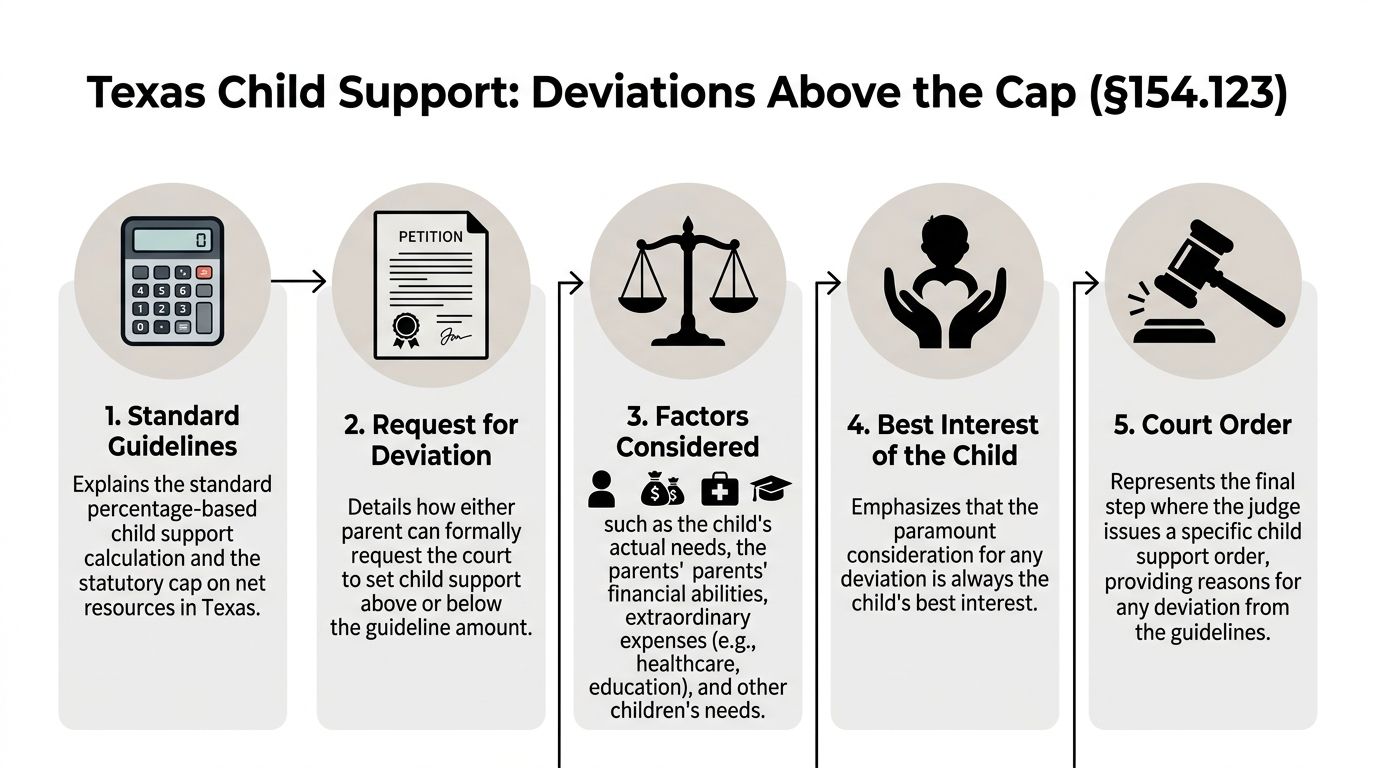
In Texas, the cap limits the guideline calculation under §154.125. It does not cap support if the child’s proven needs justify more. In high-income cases, the main contest is usually not over whether the obligor earns enough. It is over whether the requesting parent can prove child-specific expenses above the capped guideline amount, and whether the responding parent can keep household spending from being relabeled as child need.
Texas courts generally use a two-step approach in these cases, as described in this discussion of the two-component approach for high-income Texas child support cases). The court starts with the guideline amount using capped net resources. The court then decides whether the child has proven needs above that baseline and, if so, how much of that additional amount each parent should bear.
The legal standard in practice
Courts do not award above-cap support just because one parent has an exceptional income. They look for evidence that the child needs more than the guideline amount covers.
That matters because §154.123 arguments often get framed too broadly. A receiving parent may present a lifestyle-based budget that mixes child expenses with adult preferences. A paying parent may resist every add-on and lose credibility by appearing unwilling to support legitimate needs. The stronger position is usually narrower and better documented.
The court’s sequence is straightforward:
- Set the baseline using the statutory cap.
- Examine the child’s proven needs that exceed that amount.
- Assign any additional support after considering both parents’ financial resources and the evidence offered.
What usually qualifies as proven needs
The phrase “proven needs” does work in these cases. It requires proof, and it requires a connection to the child.
Common categories include:
- Private school tuition
- Nannies, tutors, or specialized childcare
- Medical, dental, psychological, or therapy expenses
- Extracurricular costs with a documented pattern
- Certain standard-of-living expenses if they are tied to the child’s circumstances rather than a parent’s preferred household budget
Some categories are much easier to prove than others. Tuition statements, recurring therapy invoices, and childcare contracts usually carry more weight than broad testimony about luxury travel, premium housing, or social expectations. If the expense began only after separation or after suit was filed, expect hard questions.
Strategy for the parent seeking support above the cap
The best above-cap presentations are disciplined. Judges see inflated budgets all the time.
A persuasive request usually includes:
- Invoices, contracts, and payment records showing the expense is real
- School, medical, or therapy records showing why the expense benefits the child
- A child-focused budget that separates child need from adult overhead
- Proof of history and continuity if the request depends on preserving an existing arrangement
- Clear pleadings that ask for deviation and identify the grounds
One mistake comes up repeatedly. The requesting parent proves that the family lived well, but does not prove what the child needs above the guideline level. Those are different issues. Under §154.123, “we always had it” is weaker than “here is the bill, here is the reason, here is the history, and here is why this child needs it to continue.”
If you are building that request, it also helps to prepare the case as if retroactive issues may surface later. Historical records often become important beyond the current monthly amount, especially when support claims reach back in time. This guide to retroactive child support in Texas gives useful context on that separate procedural fight.
Strategy for the parent defending against an above-cap request
A good defense is not a generic complaint that the other parent is asking for too much. It is a category-by-category challenge backed by facts.
Focus on five questions:
- Is the expense for the child?
- Is it recurring or just occasional?
- Is it reasonable given the family’s history?
- Is it already covered by the guideline amount or by another parent-paid expense?
- Is the documentation reliable?
Private school is a good example. A long enrollment history, strong performance, and evidence that changing schools would disrupt the child can support an above-cap request. A sudden enrollment after litigation starts, with no prior plan and no educational justification, is easier to contest.
The same principle applies to childcare, tutoring, travel, and extracurricular claims. Courts tend to respond better to precise objections than blanket resistance. If three line items are legitimate, concede them. Then press hard on the six that are padded, duplicative, or unsupported.
A practical way to frame the numbers
For one child, the capped guideline amount may be the starting point. It is never the full analysis in a serious §154.123 dispute.
The next question is whether the evidence proves a shortfall between that baseline and the child’s needs. If there is a proven shortfall, the court can allocate that additional amount between the parents based on their financial resources. In practice, that means the parent asking for more support should prove the amount with clean records, and the parent resisting it should force each claimed need to stand on its own documentation.
That is the strategic center of a high-income support case. The cap protects against support being driven by income alone. Proven needs can push the case above the cap. Preparation usually decides which side of that line the court accepts.
What tends to work in court
Measured presentations usually perform better than maximalist ones. Judges are more receptive to a parent who asks for support tied to documented needs than to one who submits an aspirational household budget dressed up as a child support exhibit.
The same is true for the defense. A parent who disputes every dollar can look evasive. A parent who accepts legitimate needs, isolates the weak categories, and shows the court exactly where the request exceeds §154.123 usually has the stronger courtroom position.
Key Procedural Battles Retroactive Support and Enforcement
A parent earning well above the guideline cap can lose a support case on procedure long before the court reaches the harder arguments about income or claimed needs. I see it often. One side spends weeks fighting over compensation structure, while the primary exposure builds in two places: retroactive support and enforcement.

Those fights matter because they change the size and collectability of the obligation. A parent seeking support may have a strong monthly claim but recover far less if the filing date came late or the historical records are thin. A parent paying support may focus on beating an above-cap request under §154.123, then get hit with arrears, interest, withholding, and an enforcement record that is harder to contain than the original support dispute.
For a focused discussion of timing and pleadings, this resource on retroactive child support in Texas gives helpful context.
Retroactive support turns on timing and proof
Retroactive support cases are built backward. The court has to reconstruct what should have been paid, over what period, and from what income sources. In a high-income case, that usually means more than pay stubs. Bonuses, K-1 income, owner draws, deferred compensation, restricted stock, trust distributions, and irregular deposits can all matter depending on the facts.
Timing affects negotiating power. If you represent the parent asking for retroactive support, filing delay can narrow the period in dispute and weaken the paper trail. If you represent the parent facing that claim, early analysis may show missing records, inconsistent deposit patterns, or periods where the other side cannot tie alleged income to available net resources under Texas law.
The side with the cleaner chronology usually has the advantage. Judges want dates, amounts, and exhibits that line up.
Enforcement strategy depends on how the money is paid
Enforcement in a high-income case is rarely as simple as sending an income withholding order to one employer. Many obligors are paid through multiple channels. Some receive a base salary through payroll but build cash flow through quarterly distributions, retained earnings, partnership income, consulting payments, or family-controlled entities. Enforcement has to match that structure.
That cuts both ways. A parent trying to collect support should identify the payment streams before the hearing and frame relief around them. A parent defending an enforcement action should expect the court to look past labels if the compensation history suggests funds were available but support was not paid.
Imputed income also becomes a live issue here. If the court believes a parent reduced reported income, redirected funds, or chose a compensation structure that obscures available resources, the defense gets harder fast.
Practical warning: In high-income enforcement hearings, complexity does not impress the court. It often creates suspicion unless the records are organized and the explanation is credible.
A short explanation from a practitioner can help frame these issues for clients before hearings:
The hearing process often decides the result
Procedural discipline matters more than rhetoric.
- Pleadings: Ask for the exact relief you want. Retroactive support, confirmation of arrears, contempt, income withholding, offsets, and defenses should be stated clearly.
- Service and notice: Defective service can stall a strong case or undo a hearing result.
- Financial records: Variable-income cases usually require tax returns, account statements, payment histories, entity records, and documents tying deposits to the support period at issue.
- Exhibits and calculations: Judges expect the math to be transparent. If the court cannot follow how a party reached the arrearage number, the argument loses force.
- Credibility: Overstating needs, hiding income, or producing records in fragments can hurt either side.
The strategic overlap with the $11,700 cap matters here too. A paying parent may have a solid defense to an above-cap support request because the claimed child needs are weak under §154.123, yet still face serious exposure on unpaid guideline support from prior periods. A receiving parent may not win every claimed add-on above the cap, but can still put meaningful pressure on the case through a well-documented retroactive or enforcement claim. Smart case preparation keeps those issues separate and proves each one on its own record.
Retaining Your High Income Child Support Lawyer
A high-income child support case is not the place for a general approach. These disputes involve financial tracing, statute-driven pleadings, discovery planning, and courtroom judgment about when to fight and when to narrow the issue for settlement.
The best time to retain counsel is early. If you are served, act immediately. If you are preparing to file, do not wait until after informal negotiations fail. The first pleadings and first disclosures shape the rest of the case.
What to look for in counsel
The right lawyer for this work should be comfortable with more than the Family Code. The attorney should know how to read business records, identify income manipulation issues, and work with accountants when needed.
Look for practical experience with:
- Complex compensation such as bonuses, owner distributions, and trust income
- Above-guideline disputes under §154.123
- Modification and enforcement work, where the numbers often need to be reconstructed
- County-specific courtroom practice, because local expectations matter
How the process unfolds
A serious high-income case tends to move through recognizable stages:
Initial case assessment
Counsel reviews the support issue, the existing order if there is one, and the likely pressure points in income and needs.Financial discovery
This often includes tax returns, pay information, bank records, entity documents, insurance records, and child-expense support.Temporary orders or interim hearings
In many cases, the parties need a workable payment structure before final resolution.Negotiation or mediation
Many high-income cases settle once both sides understand the proof problems.Trial preparation
If the case does not resolve, success depends on concise exhibits, clean witness preparation, and a legal theory tied tightly to the statutes.
What clients underestimate
Clients underestimate the time required to assemble reliable financial proof. They also underestimate how judges react to presentation quality. A messy but correct financial story can lose to a cleaner, documented, more credible one.
Another common mistake is hiring based only on personality fit. That matters, but so does technical capability. The lawyer handling a high-income support case should be able to challenge a budget, cross-examine an income claim, and frame requests under the right statutory sections without drifting into vague fairness arguments.
Bottom line: In a high-income support dispute, legal skill is not just about knowing the percentage. It is about controlling the evidence before the hearing starts.
Frequently Asked Questions About High Income Child Support
Does 50 50 custody eliminate child support in a high-income Texas case
Not necessarily. Verified guidance notes that in 50/50 custody situations, presumptive support may be zero, but under Texas Family Code §154.131, courts may deviate upward if there is a significant income disparity and the child’s accustomed lifestyle supports that result. The same verified data also notes a 25% rise in 50/50 modification filings among high-income tech and oil executives in the post-2025 period as volatile bonuses complicate net-resource calculations (50/50 custody and high-income Texas child support issues).
If I earn above the cap, will the court automatically order more than the guideline amount
No. Above-cap support is not automatic. The parent requesting more support must prove the child’s needs and tie that request to admissible evidence under §154.123.
Can a court look beyond my salary
Yes. In high-income cases, the court may examine other income sources and may impute income if it concludes the reported figure does not reflect earning capacity or available resources.
What should a receiving parent gather before filing
Start with child-focused proof. School bills, medical bills, health insurance costs, childcare invoices, activity expenses, and records showing the child’s established routine matter more than broad lifestyle descriptions.
What should a paying parent do first after being served
Preserve records and avoid informal explanations that are not backed by documents. Gather tax returns, compensation records, business records if relevant, and proof of what you already pay for the child. Then build a case theory before the first hearing, not after.
If you are facing a high-income support dispute, modification, or enforcement action, Texas Child Support Law Office of Bryan Fagan helps parents across Texas address net resource calculations, cap-based guideline issues, deviations under §154.123, 50/50 custody disputes, and complex income questions with a structured legal strategy suited to court realities.