When you file for child support, the court establishes a parent’s financial obligation moving forward. But what about the months or even years before the order was in place, when you were shouldering the financial burden alone? This is where retroactive child support comes in. It is a court order compelling a parent to pay for a past period when no formal support order existed.
This guide will prepare you for what to expect in court, explaining the legal standards, calculation methods, and procedural steps involved in a retroactive child support case in Texas.
What Is Retroactive Child Support in Texas?

When parents separate, there is often a significant delay before a court finalizes a child support arrangement. Retroactive child support is the legal mechanism used to bridge this financial gap for the child.
Under Texas Family Code §154.009, a court is authorized to order a parent to make payments covering past months or years when they were not providing court-ordered support. This action is typically initiated when a new child support case is filed, often as part of a paternity suit. In fact, legally establishing fatherhood is a prerequisite. You can learn more about this crucial first step by reading about what an Acknowledgement of Paternity is and its role in the process.
Retroactive Support vs. Back Child Support (Arrears)
While many use the terms "retroactive support" and "back child support" interchangeably, they have distinct legal meanings. Understanding this difference is essential for your case.
- Retroactive child support is ordered for a past period where no prior court order for support existed. The court is creating a new financial obligation.
- Back child support, or arrears, is the total of unpaid support from an existing court order. It is a debt that accumulates when a parent violates a court's directive.
The table below clarifies the key distinctions.
Retroactive Support vs Back Child Support (Arrears)
| Support Type | Legal Basis | When It Applies | Example Scenario |
|---|---|---|---|
| Retroactive Child Support | Creates a new obligation | For a past period where no support order existed | Parents separated in 2024, but the custodial parent only filed for support in 2026. The court orders support for the two-year gap. |
| Back Child Support (Arrears) | Enforces an existing obligation | When a parent fails to pay on a current support order | A parent was ordered to pay $800/month but has missed the last six payments. The $4,800 owed is arrears. |
Retroactive support ensures that a child receives the financial backing they were entitled to from both parents from the moment of separation, not just from the date a lawsuit is filed. It prevents one parent from shouldering 100% of the financial responsibility while the other contributes nothing.
A retroactive order establishes a duty to pay for the past where no legal order existed. In contrast, an enforcement action for arrears is about collecting on a duty that was already defined by a court but was ignored.
By establishing this past-due obligation, the court affirms a core principle: a child’s needs don’t wait for paperwork, and neither should a parent’s responsibility to meet them.
Understanding the Four-Year Rule for Retroactive Support
The cornerstone of retroactive child support in Texas is the four-year rule. This rule establishes a "rebuttable presumption" that ordering support for the four years preceding the date the petition was filed is reasonable and in the child’s best interests.
This guideline, found in Texas Family Code §154.131(c), creates a predictable framework. For the parent seeking support, it defines a clear window for recovery. For the parent asked to pay (the obligor), it provides a crucial safeguard against claims stretching back indefinitely without a compelling reason.
Texas courts rely heavily on this four-year timeframe. It balances holding a parent accountable with avoiding a financially crippling order. This is particularly relevant in cases where parents separate but do not formalize a court order for several years. You can find more real-world examples of how Texas courts interpret this rule at thetxattorneys.com.
When Can the Court Go Beyond Four Years?
The term "rebuttable presumption" is critical—it means the four-year rule is a strong guideline, not an absolute law. A judge has the discretion to look back further, but the parent requesting the extension must prove why it is necessary.
The most common justification for extending the lookback period is if the obligor actively evaded their parental responsibilities. A judge may order support beyond four years if the petitioner can prove the other parent:
- Knew they were the parent of a child but made a conscious choice to avoid providing financial support.
- Intentionally hid from the other parent, moving or changing contact information to prevent being served with a lawsuit.
- Engaged in other conduct specifically designed to obstruct the establishment of a support order.
Courtroom Example: A father knew about his child but moved to another state without informing the mother. He intentionally changed jobs frequently and used a P.O. box, making him nearly impossible to find. After six years of searching, the mother finally located him and filed a petition. In such a case, a court would likely disregard the four-year presumption and order him to pay retroactive support for all six years because his actions demonstrated a clear intent to evade his obligations.
Defenses to Limit the Retroactive Period
Conversely, the obligor has the right to argue that ordering a full four years of retroactive support would be unjust or create an undue hardship. An effective attorney can help build a case to reduce the financial obligation.
Common arguments for limiting the retroactive period include:
- Undue Hardship: Demonstrating that a large retroactive payment would cause an extreme and unreasonable financial crisis for the paying parent and their current family.
- Unreasonable Delay by the Petitioner: Arguing that the other parent knew the obligor's whereabouts for years but chose not to file for support, and that this delay was not in the child's best interest.
Ultimately, the decision rests with the judge, who will weigh the actions of both parents, review the evidence, and make a ruling based on the best interest of the child.
How Texas Courts Calculate Retroactive Payments
Calculating retroactive child support is a meticulous, evidence-based process, not an estimation. A judge will not use the obligor's current income. Instead, they will reconstruct the financial reality for each month support should have been paid.
The first step is determining the obligor's net monthly resources for the entire retroactive period. This requires producing historical financial records—pay stubs, tax returns, and bank statements—to prove what was actually earned during those past years. For a detailed breakdown, you can review our guide on how Texas courts calculate net resources.
This process follows clear procedural steps from the initial filing to the final court order.
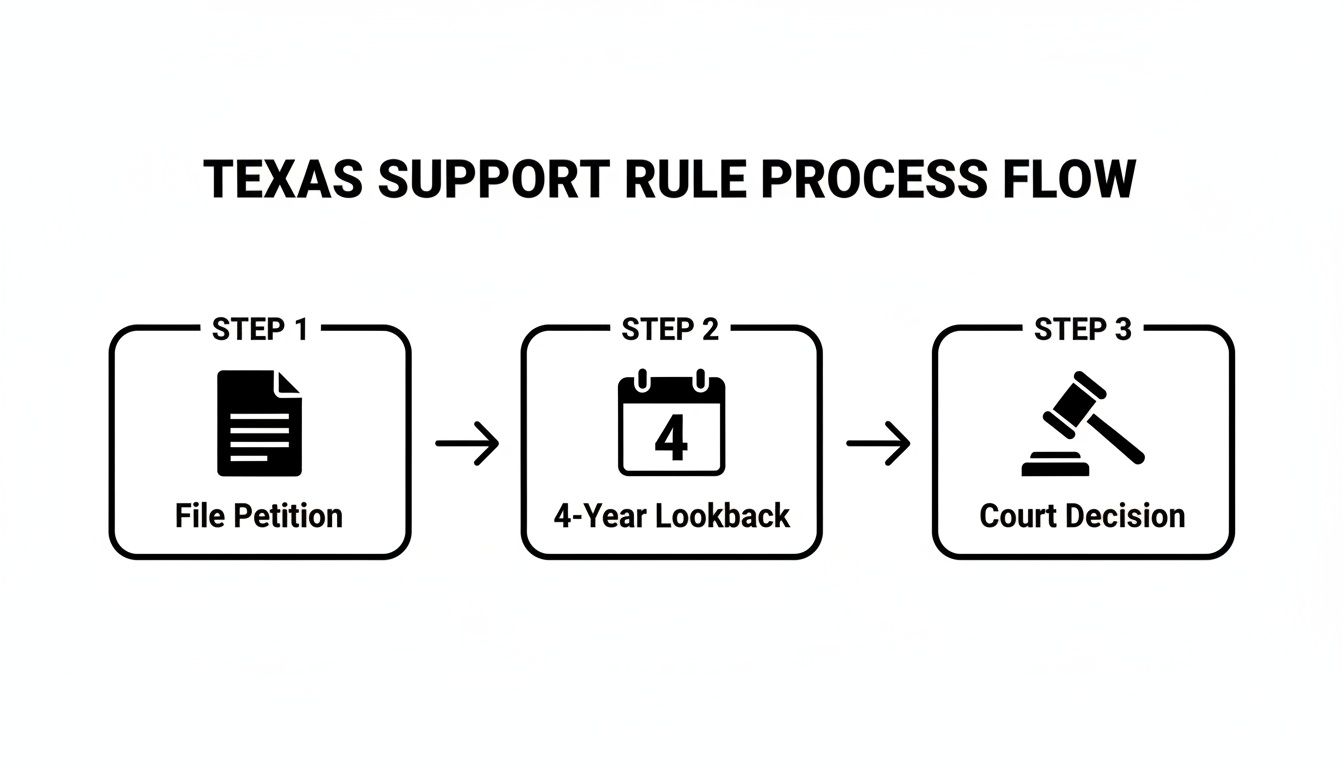
As the chart shows, a claim begins when a petition is filed. The court then examines the obligor's financial history—presumptively for up to four years—before making a final support determination.
Applying the Guideline Percentages
Once historical income is established for each month, the court applies the standard child support guidelines from Texas Family Code §154.125. The percentage of net resources owed is based on the number of children before the court.
- 1 Child: 20% of net resources
- 2 Children: 25% of net resources
- 3 Children: 30% of net resources
- 4 Children: 35% of net resources
- 5 Children: 40% of net resources
The court performs this calculation for each month within the retroactive period to determine the total obligation.
For high-income earners, the statutory cap is critical. Effective September 1, 2025, the cap is set at $11,700 in net monthly resources. While income above this amount is not automatically included in the guideline calculation, a judge can order additional support if evidence shows the child has proven needs—such as special education or medical expenses—that justify a higher amount.
The most important takeaway is this: retroactive support is not a single lump sum based on an average income. It is a detailed, month-by-month calculation reflecting the obligor's actual financial circumstances at the time.
A Practical Calculation Example
Let's walk through a simplified example for one child over a 24-month retroactive period.
The Obligor's Income Changed Over Time:
- Months 1-12: The father's net monthly resources were $4,000.
- Calculation: $4,000 x 20% = $800 per month
- 12-Month Total: $800 x 12 = $9,600
- Months 13-24: After a promotion, his net monthly resources increased to $6,000.
- Calculation: $6,000 x 20% = $1,200 per month
- 12-Month Total: $1,200 x 12 = $14,400
Based on this, the total retroactive support owed before any adjustments is $24,000 ($9,600 + $14,400).
However, the father provides evidence that he directly paid the child's $300/month daycare bill for the entire 24-month period. The court confirms these direct payments and grants him an "offset" totaling $7,200 ($300 x 24).
Final Judgment:
$24,000 (Total Guideline Support) – $7,200 (Offsets) = $16,800
The judge would issue a judgment for $16,800, which the father must pay, typically through a structured repayment plan. It is also important to note that Texas Family Code §154.123 grants a judge the authority to deviate from the guidelines if evidence proves that a strict application would be unjust to the child or parents.
Key Factors Judges Consider in Retroactive Awards
When deciding a retroactive child support claim, a judge acts as a fact-finder. Their role is to reconstruct the past to determine what is fair and in the child's best interest. Texas Family Code §154.131(b) provides a specific four-point framework for this analysis.
Understanding these four factors is crucial, whether you are requesting support or defending against a claim. The evidence you present on these points will directly influence the outcome.
Did the Custodial Parent Try to Give Notice?
The court will first ask the custodial parent: Did you make a reasonable effort to notify the other parent of their paternity and potential support obligation? The court doesn't expect a formal legal summons, but it does want to see that you did not conceal the child's existence.
Your case becomes much stronger if you can show good-faith attempts to communicate. Evidence can include:
- Written records: Saved emails, text messages, or social media messages discussing the pregnancy or child.
- Witness testimony: Statements from friends or family who witnessed you informing the other parent.
Demonstrating that you acted to inform the other parent of their duty is a key first step.
Did the Other Parent Know They Were the Father?
Next, the focus shifts to the non-custodial parent (the obligor). What did they know, and when did they know it? A judge will seek to determine if the obligor knew—or reasonably should have known—that they fathered a child.
Any informal acknowledgment of the child strengthens the case for retroactive support. Did they visit the hospital? Is their name on the birth certificate? Did they tell their friends or family they had a child? A parent who was aware of their child but chose not to provide support will receive little sympathy from the court.
Would the Award Cause an Unfair Financial Strain?
The court must also consider the practical consequences of its order. Specifically, would ordering a large retroactive payment create an undue financial hardship for the obligor and their current family? This is often the central element of the obligor's defense.
Arguing "undue hardship" requires complete financial transparency. The obligor must present detailed evidence of their financial situation: pay stubs, tax returns, a monthly budget, debt statements, and proof of their duty to support a current spouse or other children. The judge must then balance the needs of the child who went without support against the risk of financially devastating the obligor's current household.
Was Any "Actual Support" Already Provided?
Finally, the judge must account for any support the obligor provided before the court case began. As outlined in Texas Family Code §154.131(b)(4), any provable, direct contribution can be credited as an "offset," which reduces the total amount of retroactive support owed.
Actual support is not limited to cash. It can include:
- Contributing to rent or utilities for the child's home.
- Covering significant one-time costs like medical procedures or private school tuition.
- Directly purchasing necessities like groceries, clothing, or school supplies.
- Making direct cash payments to the other parent for the child's care.
To receive credit, the obligor must provide proof. Bank statements, canceled checks, receipts for major purchases, or sworn testimony are essential. Without documentation, a judge is unlikely to grant an offset based on word alone.
How to File or Defend a Retroactive Support Claim

Navigating the Texas court system requires strict adherence to procedure. Whether you are initiating a claim or defending against one, understanding the procedural steps is vital.
The Petitioner's First Steps: Filing and Service
The process begins by filing the correct legal documents. If paternity has not been established, you will file a "Petition to Adjudicate Parentage," which includes a request for retroactive support. If paternity is already legally established, you will file a "Suit Affecting the Parent-Child Relationship" (SAPCR). This petition formally asks the court to order retroactive support and establish ongoing monthly support.
After filing, the next mandatory step is service of process. This is the formal delivery of the lawsuit papers to the other parent (the respondent). It must be performed by a sheriff, constable, or certified private process server; you cannot simply hand the documents to the other parent. Proper service gives the court jurisdiction and starts the clock for the respondent's answer. Once service is complete, your focus should shift to evidence gathering.
- Financial Records: Compile your income information for the entire retroactive period, including pay stubs, W-2s, and tax returns. Gather any similar information you may have for the respondent.
- Proof of Parentage: Be prepared for the court to order genetic (DNA) testing if paternity is contested.
- Evidence of Knowledge: Collect any text messages, emails, or witness statements proving the respondent knew about the child.
The Respondent's Critical Response: Answering the Suit
If you are served with a lawsuit for retroactive child support, inaction is your worst enemy. Failure to file a formal "Answer" with the court by the deadline allows the petitioner to seek a default judgment against you.
A default judgment means the judge can—and likely will—grant everything the petitioner requested without you having a chance to present your side of the story. The deadline to file an Answer is typically by 10:00 a.m. on the first Monday after 20 days have passed from the date you were served. Filing your Answer secures your right to participate in the case. From there, you must build your defense with your own evidence.
As the respondent, your primary objective is to present a full and accurate financial history to the court. This means meticulously documenting your income and, equally important, any "actual support" you have already provided. Without hard evidence like receipts or bank statements, your claims will hold little weight.
Common Defenses and Evidence
To effectively challenge a retroactive claim, you must come to court prepared. The most common and effective defenses include:
- Proving Actual Support: If you paid for diapers, daycare, rent, or medical bills, gather every receipt, canceled check, or bank transfer record to prove it.
- Arguing Undue Hardship: You must demonstrate that a large retroactive order would create a severe financial crisis for you and your current family. This requires a detailed budget and transparent financial disclosures.
- Challenging the Lookback Period: If the petitioner knew your location for years and could have filed sooner, you can argue they waited an unreasonable amount of time.
Once a judge issues an order, ensuring payment involves a different set of legal tools. We often assist clients with this next phase, and you can learn more by reading about how to collect back child support in our detailed guide. For both parties, success depends on organized evidence and strategic legal action from the very beginning.
FAQ: Common Questions on Texas Retroactive Child Support
In our practice, we field many of the same practical questions from parents facing retroactive child support issues. Here are clear, authoritative answers to the most common concerns.
Can I Get Retroactive Child Support If Paternity Was Never Established?
Yes, but establishing paternity is the non-negotiable first step. A court cannot order child support from a person who is not the legal parent.
You will file a "Petition to Adjudicate Parentage" along with your request for retroactive support. Once the court legally confirms the father—either through genetic testing or a signed Acknowledgment of Paternity—it gains the authority to address the financial support that should have been provided. The court can order this support dating back to the child's birth.
What if the Other Parent Was Unemployed During the Retroactive Period?
A parent's unemployment can complicate calculations, but it does not automatically absolve them of responsibility. If a parent was genuinely and involuntarily unemployed, a judge might not order support for that specific period. However, the key is involuntarily.
If the court finds that the parent was "intentionally unemployed or underemployed" to avoid their support obligation, it can "impute income."
Imputing income means the court calculates child support based on what the parent should have earned, considering their skills, education, work history, and local job market conditions at that time. Proving intentional unemployment requires presenting strong evidence to the court.
Do Informal Payments for Clothes and Supplies Count?
Yes, they can. Under Texas Family Code §154.131, a court must consider any "actual support" the obligor provided before a formal order was in place. These payments serve as an "offset," which is credited against the final retroactive support amount owed.
However, the burden of proof is on the paying parent. Meticulous records are essential. This includes:
- Receipts for items like diapers, clothing, and school supplies.
- Canceled checks or bank statements showing direct transfers.
- Proof of payment for major expenses like daycare or medical bills.
Without clear documentation, a judge is unlikely to grant credit based on testimony alone.
How Is a Retroactive Child Support Judgment Enforced in Texas?
Once a judge signs an order for retroactive support, it is a legally enforceable judgment. The court typically requires the total amount to be paid back through a structured monthly payment, which is added to any ongoing child support obligation.
If the obligor fails to pay, the law provides powerful enforcement tools, including:
- Wage Garnishment: Intercepting payments directly from the obligor's paycheck.
- Bank Account Levies: Seizing funds from checking or savings accounts.
- Property Liens: Placing a legal claim on assets such as a house or land.
- License Suspension: Suspending the obligor's driver's license, professional licenses, and even recreational licenses.
The Office of the Attorney General (OAG) also plays a major role in enforcement, assisting parents in collecting court-ordered support. The law is designed to ensure these judgments are taken seriously.
The authority to order retroactive support, granted by Texas Family Code §154.009, is a powerful tool for parents who have been financially supporting a child alone. As this guide shows, the details of your case matter. Your success, whether pursuing a claim or defending against one, will depend on your preparation and understanding of these legal standards.
Navigating a retroactive child support case requires a deep understanding of Texas law and a strategic approach to gathering evidence. At the Texas Child Support Law Office of Bryan Fagan, our attorneys are dedicated to protecting your rights and securing a fair outcome for your family. Contact us today to schedule a consultation and learn how we can help you build the strongest possible case. Learn more at https://txchildsupport.net.