A lot of parents land here the same way. They get served with a petition, open a letter from the Office of the Attorney General, or hear a hearing date in court and realize they do not know how Texas will decide the number.
That uncertainty is expensive. If you walk into a child support hearing without knowing how net resources, guideline support, medical support, and deviation arguments work, you are letting the other side frame the facts for you.
A texas child support calculation lawyer does more than plug income into a calculator. Their primary role is to identify what counts as income, what gets deducted, whether the guideline amount applies, whether the court should depart from it, and how to prove your position with records a judge will trust.
Facing a Texas Child Support Order
The most common reaction to a child support case is not anger. It is confusion.
One parent thinks the number should be simple because both sides already know what each person earns. The other assumes the court will look at both households and split the child’s expenses down the middle. In Texas, that is often not how the process works.
Under the Texas Family Code, child support usually starts with the obligor’s monthly net resources, not a broad balancing of both households. That catches many parents off guard. A parent with a steady paycheck may think the case will be routine, then learn that insurance costs, prior support duties, possession schedules, and disputed income records can change the outcome.
I see the same practical problems repeatedly:
- Paying parents often underestimate how closely the court looks at payroll records, bonuses, side income, and insurance deductions.
- Receiving parents often assume the judge will automatically add every child-related expense into support.
- Both sides often wait too long to gather the documents that decide the hearing.
The better approach is to treat the hearing like a financial proof case. Bring the right records. Know the rule the judge starts with. Know where the court has discretion. Know which arguments sound reasonable to a parent but do not carry legal weight.
Practical point: Judges do not reward broad complaints about unfairness. They respond to organized proof tied to the Texas Family Code.
That is where a strategic legal review matters. Before a hearing, the key question is not just “What should support be?” It is “What number can I prove under the statute, with admissible documents, on this court’s docket?”
The Foundation of Texas Child Support The Guideline Formula
A parent walks into court expecting the judge to split the child’s expenses between two households. Instead, the court starts with one question: what are the obligor’s monthly net resources under the Texas Family Code? That starting point controls more hearings than any argument about fairness.
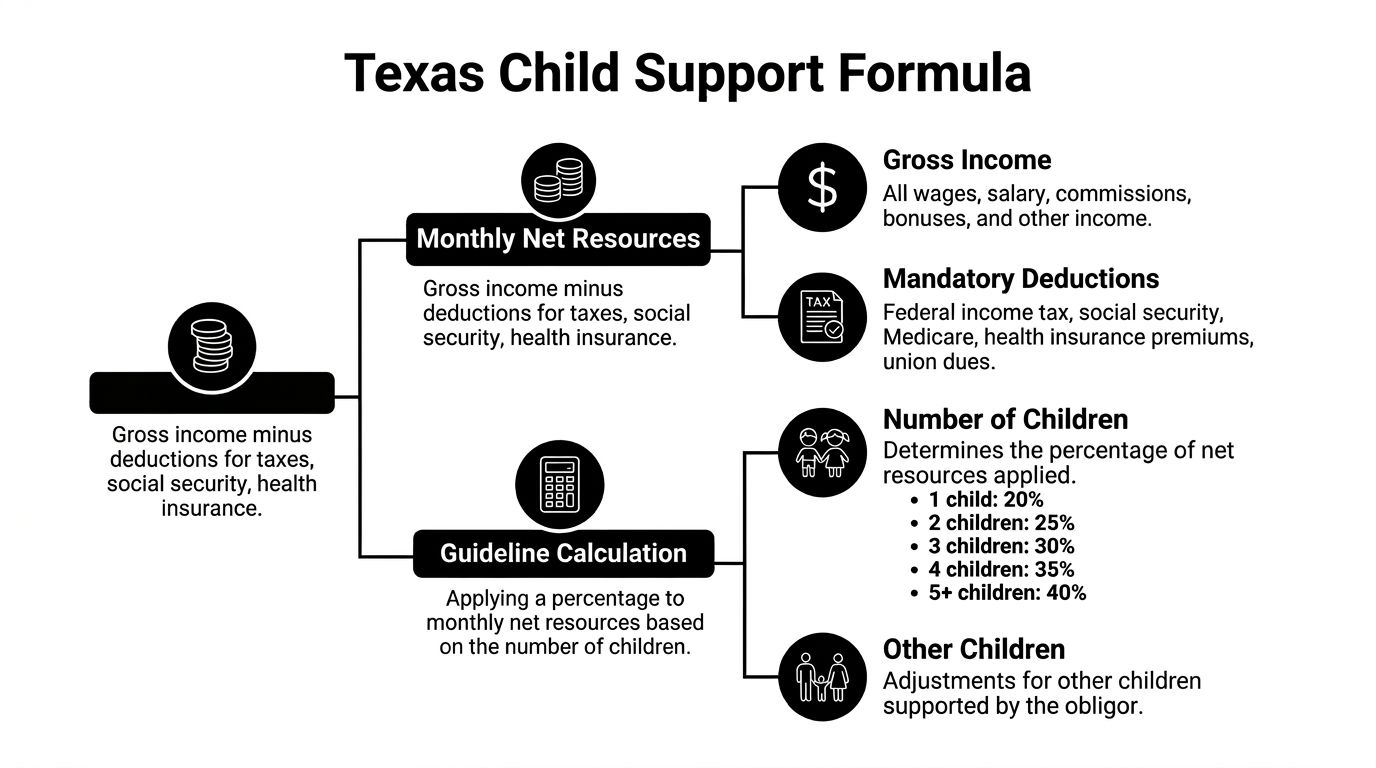
Texas uses a percentage-of-net-resources model. The main guideline statute is Texas Family Code §154.125. Net resources are defined under Texas Family Code §154.062, and the Attorney General provides a Texas child support calculator that tracks the same general framework.
What the court calculates
The court does not begin with gross pay and does not accept whatever hits a bank account after deductions. It calculates monthly net resources using the statute. For many parents, that is the first place the case goes off track.
Net resources can include wages, salary, commissions, overtime, self-employment income, rental income, severance, retirement income, and other compensation recognized by §154.062. The court then applies the deductions allowed by law, which commonly include:
- Social Security taxes
- Federal income tax, based on the tax rate for a single person claiming one personal exemption and the standard deduction
- State income tax, if any
- Union dues
- The cost of the child’s health insurance or cash medical support
Those details matter. A parent who uses gross income usually overstates support. A parent who uses take-home pay often understates it. Judges expect the math to match the statute.
The guideline percentages under §154.125
Once net resources are established, the guideline percentage is usually straightforward for children before the court:
| Texas Guideline Child Support Percentages | |
|---|---|
| Number of Children | Percentage of Net Resources |
| 1 child | 20% |
| 2 children | 25% |
| 3 children | 30% |
| 4 children | 35% |
| 5 or more children | 40% |
The percentages look simple on paper. The primary dispute is usually whether the income figure is accurate, whether the deductions are supported, and whether the parent has other children the court must account for under the multiple-family adjusted guidelines.
A clean example
If proven monthly net resources are $10,000, the guideline calculation is usually direct:
- One child: $2,000
- Two children: $2,500
- Three children: $3,000
That is basic arithmetic. Hearings are rarely about arithmetic.
They are about proof. If one side has year-to-date pay stubs, W-2s, tax returns, insurance records, and a worksheet tied to the Family Code, that side usually has the stronger position.
The records that carry weight
In a routine support hearing, these documents often decide the number:
- Recent pay stubs and payroll summaries
- W-2s, 1099s, and recent tax returns
- Profit and loss statements and business account records for self-employed parents
- Health insurance records showing who pays the child’s premium
- Orders for other children, if another support duty affects the calculation
Self-employment cases need special attention. Courts do not have to accept a parent’s claimed income at face value, especially if personal expenses are running through a business account or cash income is poorly documented. In those cases, a thin paper trail usually hurts the parent who controls the records.
Common mistakes I see before hearings
Parents often bring a household budget and assume the judge will build support from monthly bills. Texas guidelines do not work that way. The court starts with net resources, then applies the statutory percentage unless a valid reason exists to depart.
Another mistake is using one unusually low month of income and presenting it as the full story. Judges look for patterns. If income recently dropped, bring the earlier records too and be ready to explain whether the change is temporary, voluntary, seasonal, or permanent.
A third mistake is ignoring health insurance. The cost of the child’s coverage can affect the net-resource calculation, and the order needs to state who is responsible for medical support with enough precision to avoid enforcement problems later.
For a step-by-step breakdown of the underlying math, this guide on how to calculate child support in Texas is a useful starting point. The legal advantage comes from applying that math to admissible records and preparing for the 2025 cap rules that will matter in higher-income cases filed on or after September 1, 2025.
The 2025 Child Support Cap and High-Income Cases
High-income cases are where many online explanations break down. They explain the percentages correctly, then stop before the most important question. What happens when the paying parent earns more than the guideline cap?
For actions filed on or after September 1, 2025, the net resource cap for guideline calculations rises to $11,700 per month, up from $9,200. That update is described in this discussion of the 2025 Texas child support cap change.
What the new cap changes
The practical effect is direct. Courts apply the guideline percentage to the first $11,700 in monthly net resources in a standard guideline analysis.
For example, the verified data gives a clean illustration. A parent with $11,700 in monthly net resources and three children reaches a guideline obligation of $3,510 under the cap-based formula.
That matters because it shifts where the legal fight happens. In many higher-income cases, the issue is no longer whether support should be ordered under the guidelines. It will be. The issue becomes whether the court should go beyond the cap based on the child’s proven needs.
Above-cap cases are evidence cases
Texas Family Code §154.126 governs support for net resources above the cap. The court does not keep applying percentages forever. It must consider the proven needs of the child.
That changes litigation strategy in a serious way.
If you are asking for support above the cap, broad statements about lifestyle usually fall flat. Courts want evidence tied to the child. Think in terms of documented needs, recurring expenses, and proof that the request is for the child’s benefit, not a disguised redistribution between parents.
If you are defending against an above-cap request, the strongest position is often not “the other parent does not deserve more.” The stronger position is “the evidence does not establish additional proven needs under §154.126.”
The old cap versus the new cap
The move from $9,200 to $11,700 shifts the dynamics.
A parent who would previously have litigated quickly over above-cap support may now see a larger share of the dispute resolved inside the standard guideline framework. That can narrow the contested amount. It can also change settlement posture because the presumptive baseline is higher before anyone argues about additional child-specific needs.
A focused explanation of that shift appears in this resource on understanding the $11,700 cap.
Key takeaway: In a high-income case, winning starts with identifying whether your dispute is really about net resources, the cap, or the child’s proven needs above the cap. Those are different hearings with different proof problems.
Where parties miscalculate
Parents often make one of two mistakes.
The first is assuming higher income automatically means unlimited child support. Texas does not work that way. The second is assuming the cap ends the inquiry in every high-income case. It does not. If a child has proven needs beyond the guideline amount, the court can consider additional support under the statute.
Those cases reward disciplined preparation. The number alone does not win them. The proof does.
When Standard Calculations Don't Apply Deviations and Special Circumstances
Guideline support is presumed to be in the child’s best interest, but it is still a presumption. Under Texas Family Code §154.123, courts can deviate when the facts justify a different number.
That is where legal strategy matters most. The argument is no longer “apply the formula.” The argument becomes “the formula does not fit this family unless the court adjusts it.”

Equal parenting time is not automatic equality
A common example is a 50/50 possession schedule. Parents often assume equal time means no support. Texas courts do not treat it as a simple matter.
The verified data notes that under §154.123, a 50/50 possession schedule may lead to a 10-20% reduction through an equal parenting credit, as discussed in this analysis of Texas child support deviations under §154.123.
That does not mean every equal-possession case gets the same reduction. Judges still look at who pays what, who carries insurance, whether incomes are far apart, and whether the proposed adjustment serves the child.
Extraordinary needs require proof
Another common deviation issue is a child with unusual expenses.
The verified data gives a concrete example. A court can add $500 per month for specialized therapy when the need is proven with medical evidence. That is a strong reminder that the request must be tied to evidence, not just a sincere concern.
If you want the court to deviate upward for extraordinary needs, prepare the file like this:
- Medical records: Show the diagnosis, treatment plan, and ongoing need.
- Billing statements: Tie the amount requested to actual recurring expense.
- Provider letters: Explain why the service is necessary, not optional.
- Payment history: Show the cost is real and ongoing.
Without that proof, the request often sounds sympathetic but unsupported.
Practice tip: Courts respond better to one clean binder of records than a last-minute stack of loose papers and text message screenshots.
Other reasons a court may depart from the formula
Deviation arguments can also arise when the standard guideline amount does not fairly account for the structure of the case.
Examples include:
- Travel costs for possession: If one parent incurs significant travel expenses to exercise visitation, the court may consider that burden.
- Other supported children: Existing legal duties to support children in another household can affect the calculation.
- Insurance and unreimbursed costs: If one side carries major recurring child-related expenses, that can influence the support analysis.
- Unusual educational or therapeutic expenses: These need documentation and a clear connection to the child’s welfare.
What works in deviation cases
The strongest deviation cases have three features.
First, the requested departure is tied to a specific statute, usually §154.123. Second, the parent presents documents, not just testimony. Third, the requested number has a clear method behind it.
What fails is asking the judge to “be fair” without showing how the law supports the adjustment. Courts hear fairness arguments every day. They change orders when facts and evidence support a departure from the presumption.
The trade-off clients need to understand
Deviation requests can help. They can also broaden the hearing.
If you ask the court to move away from the guideline number, expect closer scrutiny of your finances, your parenting schedule, and your credibility. Sometimes that is absolutely worth it. Sometimes the better strategy is to lock in a solid guideline order and preserve the larger fight for modification if the facts develop more clearly.
A seasoned texas child support calculation lawyer earns value here by deciding which battles are worth proving and which arguments create more risk than benefit.
Enforcing Your Rights Retroactive Support and Collections
Getting an order is one stage. Getting paid is another.
Many parents assume a signed child support order means compliance will follow. Sometimes it does. Sometimes the paying parent falls behind immediately, pays irregularly, changes jobs, works around withholding, or ignores the order until enforcement becomes unavoidable.

Retroactive support
Texas courts can address retroactive support in appropriate cases. In practice, that issue often comes up when no prior order existed but support should have been paid earlier.
The first step is to build the timeline. You need to show when the obligation should have been addressed, what support was or was not paid, and what evidence exists for the parent’s income during the relevant period. This guide on retroactive child support in Texas gives a useful overview of the issue.
Parents make a major mistake when they assume memory is enough. It is not. Gather payment histories, bank records, messages discussing support, and any proof of prior requests for help with the child’s expenses.
Collection tools that have force
When current support or arrears are unpaid, Texas uses serious enforcement tools. The most common is wage withholding.
The verified data states that wage garnishment can reach 50-65% of disposable earnings for arrears, reflecting federal limits adapted locally in Texas practice. That is why ignoring an order becomes dangerous quickly. Once arrears build, collection pressure increases.
Other enforcement tools may include liens, license-related consequences, and court enforcement proceedings depending on the facts and the procedural posture.
Important: Enforcement cases turn on precision. The motion, payment ledger, missed dates, and requested relief all need to line up.
How an enforcement case is usually prepared
A clean enforcement file usually includes:
- The signed order with the exact payment terms
- A payment record showing what was due and what was paid
- Proof of nonpayment or underpayment
- A proposed arrearage calculation
- Evidence of employment or income sources if collection is contested
Do not assume the court will calculate the history for you from scratch. Present the ledger in a format the judge can follow.
A short explainer can also help clients understand the process before hearing day:
What improves collection
The best enforcement strategy is rarely emotional pressure. It is paperwork plus timing.
File before arrears become harder to trace. Use the actual order language. Identify the missed amounts clearly. If the obligor changed jobs, update employment information fast. If payment was made outside the state disbursement system, bring documentary proof.
Parents who wait too long often create avoidable proof problems. Payments get disputed. Records disappear. Informal agreements become impossible to verify. Good enforcement practice fixes that by reducing the case to dates, amounts, and enforceable language.
The Strategic Advantage of a Texas Child Support Lawyer
A child support case looks simple until the numbers are disputed.
If both parents are salaried, all income is reported cleanly, possession is standard, and neither side wants a deviation, the process can be fairly direct. The difficult cases are different. They involve self-employment, bonuses, inconsistent records, prior support duties, disputed deductions, above-cap arguments, or modification requests after a major life change.
Where legal counsel changes the result
A lawyer adds value when the case requires proof, not just math.
That often includes:
- Hidden or unclear income: Self-employed parents may have business records that need careful review before net resources can be determined.
- Above-cap claims: High-income cases require evidence focused on the child’s proven needs, not just gross earnings.
- Deviation disputes: The court needs a legally grounded reason to move away from the guideline amount.
- Modification and enforcement litigation: These hearings require strict attention to prior orders, filing dates, and supporting documents.
In those settings, legal work is practical. Organize evidence. Subpoena records if needed. Frame the issue under the right Family Code section. Present a number the court can adopt.
Cost is a real consideration
Not every parent can hire private counsel for every stage of the case. That is a trade-off, and parents should approach it transparently.
The verified data notes that Legal Aid of NorthWest Texas and Texas RioGrande Legal Aid may serve families with incomes up to 200% of the federal poverty level, which can be an important option for enforcement or modification matters, as discussed in this overview of low-income options for Texas child support representation.
That means your strategic options may include:
- Limited-scope advice before a hearing
- Full representation in a contested case
- Legal aid screening if income qualifies
- Using the OAG process for a more administrative path in some matters
The Texas Child Support Law Office of Bryan Fagan handles establishment, modification, enforcement, and defense of support orders under the Texas Family Code, including disputes over net resources, deviations, and the updated cap.
Bottom line: The more disputed the facts are, the more dangerous it is to treat child support like a calculator problem. In contested cases, the winner is usually the parent who proves the cleaner financial story.
Frequently Asked Questions About Texas Child Support
How does child support work if I have children in more than one household
Texas does not ignore other legal support duties. Under Texas Family Code §154.128, the guideline percentage can be adjusted when the paying parent has a legal duty to support children from another relationship.
The verified example is useful. For three children before the court, the ordinary guideline percentage is 30%, but it might be reduced to 25% if the parent also has a legal duty to support children from a previous relationship, as explained in this discussion of multiple-family child support adjustments in Texas.
The practical lesson is clear. If another support obligation exists, prove it early and document it clearly. Do not assume the court will discover it on its own.
If I have equal possession, do I still pay child support
Possibly, yes.
Equal parenting time does not automatically eliminate support. Courts may consider the schedule as part of a deviation analysis, but the result depends on the full financial picture, not just the calendar. In practice, equal-possession cases often turn on income differences, insurance responsibility, and who pays recurring child-related expenses.
Can the court use income that is not on a regular paycheck
Yes, that issue comes up often in practice.
When income is irregular, self-generated, or mixed with business activity, the hearing usually focuses on records and credibility. Courts look for a dependable basis to calculate net resources. If you earn income outside a standard payroll system, your documentation matters more, not less.
What should I bring to a child support hearing
Bring documents the judge can use immediately.
A practical hearing file usually includes recent pay records, tax information if relevant, proof of insurance costs for the child, prior court orders, and any records tied to the issue in dispute. If you are asking for a deviation, bring the records that prove the reason for it. If you are contesting someone else’s calculation, bring the documents that show why it is wrong.
Can child support be changed after the order is signed
Yes, if the legal standard for modification is met.
In practice, modification cases usually arise after an income change, a shift in the child’s needs, or a significant change in the possession arrangement. The key mistake parents make is waiting while an unworkable order remains in place. The court enforces signed orders unless and until they are changed.
Is the Office of the Attorney General enough, or do I need a lawyer
It depends on the case.
If the case is straightforward and undisputed, the OAG process may be enough. If income is contested, the other parent is self-employed, a deviation is requested, multiple families are involved, or enforcement has become complicated, legal representation is often the safer path. A lawyer helps when the issue is not just processing paperwork, but proving which number the court should adopt.
If you need help preparing for a hearing, challenging an inaccurate calculation, pursuing enforcement, or evaluating how the $11,700 cap may affect your case, the Texas Child Support Law Office of Bryan Fagan provides legal guidance on establishing, modifying, enforcing, and defending child support orders across Texas.