Life is not static. When your financial or family circumstances change significantly, your existing Texas child support order may become unsustainable or unfair. While arranging a new payment amount with your co-parent directly might seem easy, this "handshake deal" offers no legal protection. Only a judge has the authority to legally modify your child support obligation.
To secure a formal modification, you must prove to a court that the circumstances of a parent or the child have undergone a material and substantial change. This is the legal key required to modify your court order. Your Texas child support modification lawyer will build your case around this critical standard.
The Legal Grounds for Modifying a Texas Child Support Order

Texas law acknowledges that life is unpredictable, but courts cannot be burdened with modification requests for every minor financial fluctuation. This is why the legal system sets a high bar for altering a court order. You must have a legitimate, significant reason to justify the change.
There are two primary legal avenues for seeking a modification.
1. Proving a Material and Substantial Change
This is the most common basis for a modification. As defined in Texas Family Code § 156.401, you must demonstrate to the judge that a "material and substantial change in circumstances" has occurred for either parent or the child since the date your last order was signed.
Consider this: a few weeks of reduced overtime is like a brief rain shower and unlikely to be sufficient grounds for a modification. However, a permanent job loss due to a company-wide layoff is a major flood—a life-altering event that a court will recognize as a valid reason to re-evaluate the support obligation.
This standard is the foundation of most modification cases. You are essentially arguing that the financial reality that existed when the original order was created no longer applies.
So, what qualifies? Here are the most common reasons a Texas court will consider modifying an existing order.
Qualifying Reasons for Child Support Modification in Texas
This table outlines the primary legal grounds that can justify a change in your child support payments.
| Reason for Modification | What You Must Prove | Relevant Texas Family Code Principle |
|---|---|---|
| Significant Income Change | A parent was involuntarily laid off, received a major promotion, or experienced a permanent, involuntary pay cut. | The support amount is directly linked to the paying parent's income. A substantial change in that income warrants recalculation. |
| New Needs for the Child | A child develops a new medical condition, requires costly therapy, or has increased educational needs. | Child support must always serve the child's best interest and meet their proven needs (§154.123). |
| Change in Primary Custody | The child's primary residence has changed, and the parent who was paying support is now the primary caregiver. | Support is paid by the non-primary parent to the primary parent to assist with the child's daily expenses. |
| Increased Child-Rearing Costs | The cost of the child's health insurance or daycare has risen significantly with no expectation of decreasing. | These are mandatory "add-on" costs included in the total support calculation. A major change can trigger a modification. |
Crucially, the change must have occurred after your current order was put in place. A court will not relitigate past circumstances.
2. The Three-Year Review Rule
Texas law also provides a second, more direct option. If it has been at least three years since your child support order was last modified or originally signed, you can request a review without needing to prove a material and substantial change.
Under this rule, found in Texas Family Code § 156.401(a)(2), you only need to show that the new guideline calculation would differ from your current payment by either 20% or $100. For example, if you pay $1,000 per month, a 20% change is $200. If a new calculation shows the payment should be $800 or $1,200, you qualify for a modification.
This rule acts as a safeguard, ensuring that child support orders do not become drastically outdated due to inflation and gradual income changes over time.
Crucial Takeaway: A court order is legally binding until a new one replaces it. Never rely on a verbal agreement with your co-parent to change support. Without a formal modification, you could face enforcement actions and find yourself owing thousands in back-support "arrears," even if you both agreed to the change. Our guide on understanding a substantial change in circumstances offers more detailed insights.
The Impact of the New $11,700 Cap on High-Income Child Support
When one or both parents have a high income, calculating child support is more complex than applying a simple percentage. Texas law establishes a "cap" on the income used for guideline calculations, but that is not the end of the analysis. For high-earning families, understanding how courts handle both guideline and above-guideline support is critical.
A significant legislative change took effect on September 1, 2025, which fundamentally altered the calculations for high-income families. The state raised the maximum amount of monthly net resources used in the guideline formula from $9,200 to $11,700.
This increase is substantial. A parent with $15,000 in monthly net resources previously paid guideline support based on only $9,200. For two children (25%), that was $2,300. Now, that same parent pays 25% on $11,700, which is $2,925 per month—an automatic guideline increase of over $600.
This update means many existing support orders for high-earners are now well below the current state guidelines, providing a clear basis for filing a modification.
First, What Are "Net Resources"?
Before applying the cap, we must determine a parent's "net resources" as defined by the Texas Family Code. This figure is not the same as take-home pay.
Think of it as starting with a bucket filled with all sources of income, from which only specific deductions are permitted.
What Goes IN the Bucket (Gross Resources): This includes all forms of income—salary, self-employment earnings, overtime, tips, bonuses, and commissions. It also encompasses passive income streams like interest, dividends, and rental income. The definition is intentionally broad.
What Comes OUT (Deductions): The list of allowable deductions is very short and specific. It includes federal income taxes (calculated for a single person with one exemption), Social Security and Medicare taxes, state income tax (if applicable), mandatory union dues, and the amount paid for the child's health insurance.
Crucial Point: Common personal expenses like mortgage payments, car notes, or 401(k) contributions are not deductible when calculating net resources for child support. A common error is assuming your personal budget dictates your support obligation; the court adheres strictly to the statutory formula.
Once this final net monthly resource number is determined, we apply the guideline percentages—but only up to the new $11,700 cap.
Going Above the Cap: Proving the Child's Needs
What if the guideline amount, even at the higher cap, is insufficient to meet the child's actual expenses? This is where Texas Family Code § 154.123 becomes relevant. This statute empowers a judge to order support above the guideline amount, but only if there is compelling evidence of the child's "proven needs."
This is where retaining an experienced Texas child support modification lawyer is indispensable. "Proven needs" are not merely a reflection of an expensive lifestyle; they require a case built on concrete, documented evidence.
Examples of Needs That Can Justify Above-Guideline Support:
- Private School Tuition: Requires enrollment contracts, invoices, and proof of payment.
- Specialized Medical or Therapeutic Care: This includes physical therapy, orthodontics, or mental health counseling not fully covered by insurance.
- High-Level Extracurricular Activities: For a child who is a competitive athlete, a gifted musician, or a traveling performer, the costs for elite coaching, equipment, and travel can easily exceed guideline support.
- Specialized Tutoring or Educational Support: If a child has learning differences, reports from educational psychologists and invoices for specialized tutors can justify additional support.
To successfully argue for support above the cap, your lawyer will compile every invoice, expert report, and financial statement necessary to present a clear and convincing picture to the court. The objective is to demonstrate that the child's established and unique needs genuinely require more than the standard formula provides. For a deeper dive, check out our guide on understanding the details of the $11,700 cap.
The Step-by-Step Legal Process for Modification
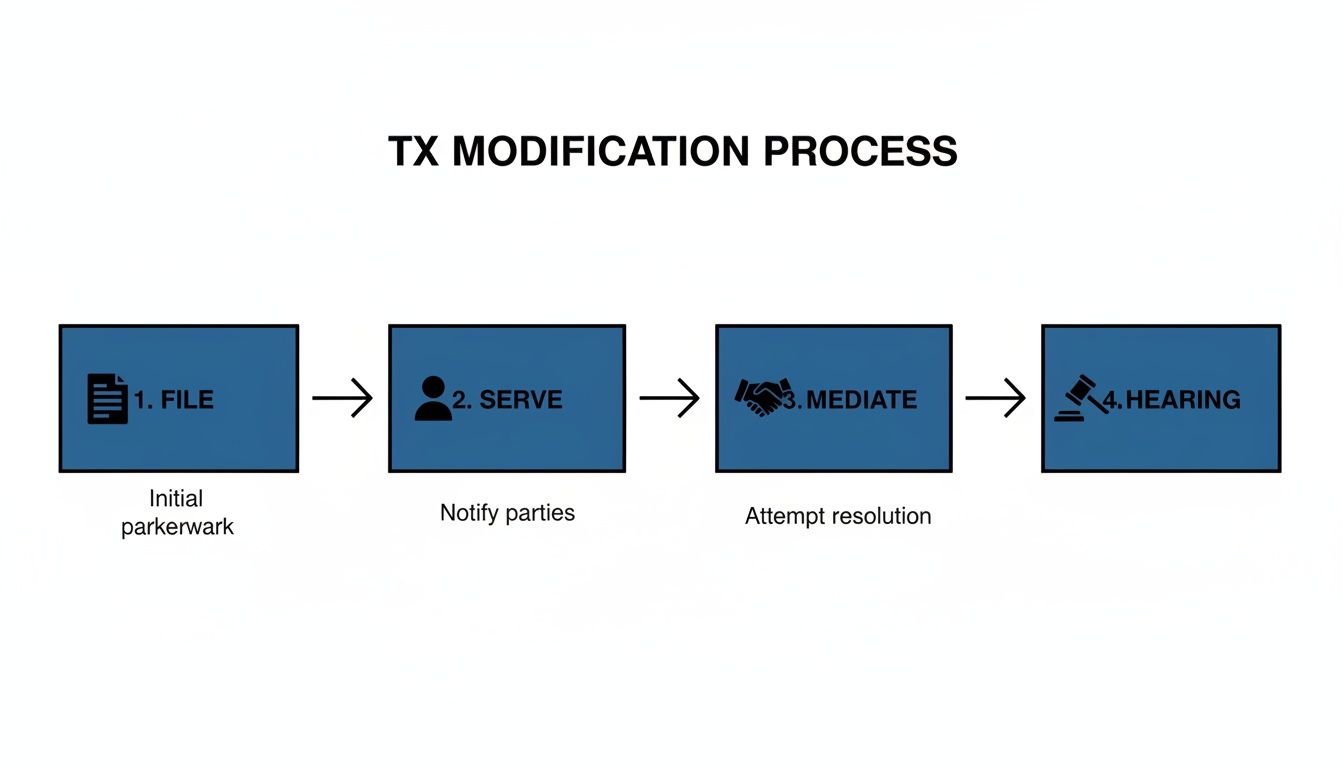
Understanding the procedural steps of a child support modification can demystify the legal process. As your counsel, our role is to navigate you through each stage, ensuring all deadlines are met and all filings are executed properly. This roadmap has distinct checkpoints, each moving you toward an updated, equitable court order.
Stage 1: Filing the Petition to Modify
The process begins when your attorney files a Petition to Modify the Parent-Child Relationship. This legal document formally requests that the court change your current child support order. It articulates why you are seeking the change, detailing the material and substantial change in circumstances that justifies the modification. The petition must be filed in the court that has continuing, exclusive jurisdiction—usually the same court that issued your last order.
Stage 2: Service of Process
After the petition is filed, the other parent must receive formal, legal notice of the lawsuit. This constitutional requirement is known as service of process. Typically, a private process server or a sheriff’s deputy will personally deliver a copy of the petition and a legal summons (a "citation") to the other parent. This step is what initiates the legal timeline. Critically, any modification can generally only be made retroactive to the date the other parent was served. Prompt and proper service is essential.
A critical mistake is assuming an email or text message is sufficient notice. Only formal service of process legally obligates the other parent to respond and protects your retroactive modification date.
Stage 3: Discovery and Financial Disclosure
Once service is complete, the discovery phase begins. This is the formal evidence-gathering stage. Both parties are required to exchange key financial information and documents. We will serve formal requests for items such as:
- Pay stubs for the past six to twelve months
- Complete personal and business tax returns with all schedules
- Statements from bank, investment, and retirement accounts
- Proof of costs for the child's health insurance
The objective is transparency. This exchange ensures all parties and the court are working from a complete and accurate financial picture. The data gathered here forms the basis for all subsequent calculations and negotiations.
Stage 4: Mediation
Before a final trial, most Texas courts require the parties to attend mediation. This is a structured, confidential negotiation session facilitated by a neutral third-party mediator. The goal is to reach a mutually acceptable agreement, thereby avoiding the expense and uncertainty of a courtroom trial. Your attorney will be present to provide counsel and advocate on your behalf. If an agreement is reached, it is documented in a binding Mediated Settlement Agreement, which is then submitted to the judge to be signed as a final order.
Stage 5: Final Hearing
If mediation is unsuccessful, the final step is a Final Hearing before a judge. Here, both attorneys present evidence, question witnesses, and make legal arguments. Your lawyer will present your case, cross-examine the other parent, and demonstrate to the judge precisely how the requested modification is justified under the Texas Family Code. After hearing all evidence and arguments, the judge will render a final, binding decision and sign a new order that officially replaces your old child support arrangement.
Child Support Calculations for 50/50 Custody
A 50/50 possession schedule in Texas does not automatically eliminate the child support obligation—a common misconception. While equal parenting time is a significant factor, the court’s primary focus remains on the child's best interest and ensuring their needs are met consistently in both households.
To achieve this, judges typically employ an "offset" calculation method. This approach acknowledges the financial responsibility of both parents and balances any significant income disparity between them. The goal is to provide the child with a similar standard of living in each home.
The Offset Calculation Method Explained
The offset method is a straightforward, three-step process. First, the court calculates what each parent would owe in child support if they were the non-primary parent under standard guidelines. Next, the smaller obligation is subtracted from the larger one. The higher-earning parent pays the difference to the lower-earning parent.
Let's review a practical example.
Example: The Offset Method in Action
Consider a couple, Alex and Bailey, who share one child 50/50.
Calculate Alex's Guideline Support: Alex’s net monthly resources are $8,000. For one child, the Texas guideline (§154.125) is 20% of net resources. Alex's theoretical obligation is $1,600 per month ($8,000 x 0.20).
Calculate Bailey's Guideline Support: Bailey’s net monthly resources are $5,000. Using the same 20% guideline, Bailey's theoretical obligation is $1,000 per month ($5,000 x 0.20).
Determine the Offset Amount: We subtract Bailey's lower obligation from Alex's higher one: $1,600 – $1,000 = $600.
In this scenario, a judge would likely order Alex to pay Bailey $600 per month. This payment helps equalize the financial resources available for the child in each household.
Key Insight: The purpose of the offset is to prevent a significant lifestyle disparity between the two homes, ensuring the child does not experience a "feast or famine" cycle.
Modifying Support for Other Factors
Income is not the only variable. Other major financial responsibilities can also trigger a modification in a 50/50 custody arrangement. To explore this topic further, learn more about 50/50 custody and its impact on child support in our dedicated article.
Common changes that lead to modification include:
- Health Insurance Costs: If one parent begins covering the child’s health insurance premiums (or the cost changes significantly), the support order can be adjusted. The parent paying the premium typically receives a credit in the final calculation.
- Special Needs: If a child is diagnosed with a condition requiring expensive therapy, medical devices, or specialized care, the support order can be modified to cover these new, proven needs. This is a classic example of when a court may use its authority under Texas Family Code § 154.123 to deviate from standard guidelines to better serve the child.
Ultimately, whether you have a 50/50 schedule or a standard possession order, the legal standard for modification remains the same: you must prove a material and substantial change in circumstances, and all decisions are guided by the child's best interest.
How a Lawyer Builds Your Winning Modification Case

Retaining a Texas child support modification lawyer is not merely about assistance with paperwork; it is about engaging a legal strategist to build an evidence-backed case designed to prevail in court. Our function is to translate your life circumstances into a compelling legal argument that withstands judicial scrutiny.
From our initial engagement, we conduct a comprehensive financial investigation to paint the clearest, most accurate picture possible. This is where an experienced lawyer provides immense value—we know precisely what evidence to seek, where to find it, and how to present it effectively to a judge.
Deep Financial Analysis and Evidence Gathering
At the core of a successful modification is irrefutable financial proof. Our first step is a meticulous analysis of both parents' finances to determine the exact net monthly resources for each party—the foundational number in the Texas Family Code's support formula.
This process extends far beyond a cursory review of a W-2. We scrutinize complete tax returns with all schedules, analyze profit and loss statements for business owners, and examine bank records to ensure every source of income is accounted for. If we suspect a parent is intentionally underemployed or hiding income, we escalate our investigation.
Our Strategic Approach: We do not hesitate to issue subpoenas for business records, conduct depositions of employers, or engage forensic accountants to trace hidden assets or income streams. Our goal is to present the court with the undeniable financial truth, whether that involves proving your own income has decreased or exposing the other parent's true earning potential.
By compiling this level of evidence, we put you in a commanding position and prevent the opposing party from controlling the narrative. This ensures the judge's decision is based on hard facts, not competing claims.
Crafting a Compelling Legal Argument
With the financial data secured, we construct the legal argument. This involves framing the facts of your case within the specific language of the Texas Family Code. We don't simply state that "income changed"; we demonstrate precisely how that change meets the legal standard of a "material and substantial change."
For example, when arguing for support above the guideline cap, we must prove the child's specific needs pursuant to §154.123. This is not a wish list but a detailed portfolio of evidence we assemble, which may include:
- Invoices and Receipts: For private school tuition, specialized therapies, or expenses for elite competitive sports.
- Expert Reports: From physicians, educational psychologists, or therapists explaining the necessity of these expenses.
- Affidavits: From coaches, tutors, or other professionals detailing the child’s unique commitments and associated costs.
A critical part of our role is preparing you to testify confidently and credibly. This preparation helps you present your case as an organized and reliable witness, which can be pivotal to the outcome.
Negotiation, Mediation, and Courtroom Advocacy
A strong case built on a mountain of evidence provides significant leverage in negotiations. Most Texas counties mandate mediation before a final hearing, and this is often where cases are resolved. Our exhaustive preparation allows us to enter mediation with a clear, fact-based settlement position that is difficult for the other side to dismiss.
We also act as your advocate, protecting you from pressure to accept an unfair settlement. Because we have done the work, we know what a fair outcome should be and can provide you with direct advice on whether to accept an offer or proceed to trial.
If mediation fails, we are prepared to litigate. We will present the evidence, cross-examine opposing witnesses, and deliver a closing argument that ties everything back to the legal standards the judge must follow. Hiring an expert lawyer is about achieving results.
FAQs: Common Questions About Modifying Texas Child Support
Navigating a child support modification raises many questions. The process is governed by specific legal rules and deadlines that can be confusing. Here are authoritative answers to some of the most common inquiries.
How long does a child support modification take in Texas?
The timeline varies significantly, typically ranging from 4 to 12 months. The primary factor is whether the modification is contested.
If it is an uncontested modification—meaning both parents agree on the new amount and sign the necessary legal documents—the process can be relatively swift. Once the agreed order is submitted to a judge for approval, the case may conclude within a few months.
A contested modification, however, involves a much longer timeline. The process will likely include formal discovery, mandatory mediation, and potentially a final hearing, all of which are subject to the court's busy calendar.
Key Takeaway: Time is of the essence. A judge can typically only modify support retroactively to the date the other parent was officially served with the lawsuit. Every month you delay filing is a month you are bound by the old payment amount.
Can child support be modified retroactively in Texas?
Generally, no. Texas courts can only modify child support payments prospectively. They lack the authority to retroactively reduce or eliminate past-due support, legally known as "arrears."
For example, if you were laid off in January but your attorney did not serve the other parent with a modification lawsuit until April, you remain legally obligated for the full, original support amount for January, February, and March. This rule underscores the critical importance of acting immediately when your circumstances change.
What happens if I just stop paying my original support amount?
Unilaterally altering your court-ordered payment is a severe mistake. A verbal agreement with the other parent is not legally enforceable. Until a judge signs a new order, the existing one remains in full force.
When you underpay, the unpaid balance becomes an arrearage, a legal debt that accrues interest at 6% per year. More significantly, it empowers the other parent and the Office of the Attorney General (OAG) to use powerful enforcement tools against you, including:
- Wage Garnishment: An order sent to your employer to deduct payments from your paycheck.
- License Suspension: Suspension of your driver's, professional, and recreational licenses.
- Asset Liens: A legal claim placed on your bank accounts, real estate, or retirement funds.
- Enforcement Action: A lawsuit for contempt of court, which can result in fines and even jail time.
A drop in income is a valid reason to file for a modification; it is not a legal defense for non-payment.
My ex quit their job to avoid paying support. What can I do?
This scenario is addressed directly by Texas law as intentional unemployment or underemployment. Judges have little tolerance for parents who attempt to evade their financial obligations to their children.
Under Texas Family Code § 154.066, if a court finds a parent is purposefully earning less than their potential, the judge is not bound by their current low income. Instead, the court can calculate child support based on that parent's proven earning potential.
To win this argument, your attorney must present clear evidence of what the other parent should be earning. This may include:
- Their employment history and past income
- Their education, skills, and professional certifications
- Evidence of available jobs in their field and corresponding salaries
- Testimony from a vocational expert who can assess their earning capacity
The court will then "impute" income to that parent, calculating child support as if they were earning what they are capable of. Proving intentional underemployment requires the skill of an experienced lawyer to gather the necessary evidence and present a convincing case.
At the Law Office of Bryan Fagan, we focus exclusively on Texas child support and family law. Our dedicated team has the deep experience required to navigate these complex legal matters effectively. Whether your case involves a straightforward income change or a complex dispute over earning potential or a 50/50 schedule, we are prepared to advocate for a fair outcome for you and your child. To discuss the specifics of your case, contact us for a consultation through our website at https://txchildsupport.net.