If you're preparing for a child support case in Texas, it's essential to understand that there isn't one fixed dollar amount for "maximum" child support. Instead, the Texas Family Code establishes a presumptive maximum by placing a ceiling on the paying parent's income for standard guideline calculations. This framework is the starting point for all high-income cases.
The Guideline Cap on Texas Child Support
Texas courts use a statutory formula to ensure child support calculations are predictable and consistent. A core component of this formula is an income cap placed on the paying parent's (the obligor's) monthly net resources.
The process begins when a judge calculates the obligor's net monthly resources. A guideline percentage is then applied based on the number of children requiring support. However, for high-income earners, Texas Family Code §154.125 dictates that this percentage is only applied up to a specific income level—the statutory cap.
Understanding the New $11,700 Cap
A significant legislative change will soon impact high-income child support cases. Effective September 1, 2025, the cap on net monthly resources used for guideline calculations will increase from $9,200 to $11,700.
This means for parents earning above the cap, the baseline for their support obligation will rise. Where the calculation previously stopped at the first $9,200 of their net monthly income, it will now extend to the first $11,700.
For any new or modified child support order finalized after September 1, 2025, the presumptive maximum will be higher. For example, for one child, the guideline support amount rises from $1,840 to $2,340 per month—a $500 monthly increase.
How This Works in Practice: A Real-World Example
The amount a court orders using this capped income is "presumptive guideline support." It is the standard maximum the court is expected to award unless a party proves the child's needs justify a different amount. The percentages are set by Texas Family Code §154.125.
Let's apply this to a real-world scenario. Imagine a parent in Houston has net monthly resources of $20,000 and one child. A common mistake is to assume child support would be 20% of $20,000 ($4,000). This is incorrect. The court applies the 20% only to the cap.
- Calculation: 20% of the $11,700 cap = $2,340 per month.
Whether that parent's net resources are $15,000, $25,000, or $50,000, their presumptive child support obligation for one child is the same: $2,340. For a more thorough breakdown of the statutes, you can explore our guide on the Texas Family Code and child support.
To make this even clearer, here is a table showing the maximum guideline support amounts once the new cap takes effect.
Guideline Maximum Child Support in Texas Under the 2026 Cap
This table illustrates the presumptive maximum monthly child support based on the upcoming $11,700 net resource cap and the standard Texas Family Code percentages.
| Number of Children | Applicable Percentage | Maximum Guideline Monthly Support |
|---|---|---|
| 1 | 20% | $2,340 |
| 2 | 25% | $2,925 |
| 3 | 30% | $3,510 |
| 4 | 35% | $4,095 |
| 5 | 40% | $4,680 |
| 6+ | Not less than 40% | At least $4,680 |
This cap provides a solid financial baseline for understanding your rights and obligations, but it's important to remember this is just the starting point for high-income cases.
Calculating Your Net Monthly Resources Correctly
Before determining a child support payment, you must first establish the obligor's net monthly resources. This figure is not simply take-home pay; it is a specific number calculated using a strict formula outlined in Texas Family Code §154.062. An error in this step can significantly alter the final support order.
What Counts as Income
The court begins by calculating gross resources, which encompasses nearly all income sources. This reflects a parent's total financial capacity before any deductions. The Texas Family Code defines resources broadly to include:
- Wages and Salary: Your base pay, tips, and overtime.
- Commissions and Bonuses: Courts typically average these over a representative period (e.g., 1-2 years) to determine a predictable monthly figure.
- Self-Employment Income: Net profits from any business you own or operate.
- Investment Income: Interest, dividends, and capital gains.
- Rental Income: Gross rental receipts minus necessary operating expenses.
- Benefits: Social Security (excluding SSI), retirement and pension payouts, unemployment, and workers' compensation benefits.
In essence, if it is a financial resource, the court will likely count it.
Allowed Deductions to Reach Net Resources
Once gross resources are tallied, only a few specific items may be subtracted to calculate net monthly resources. This is a frequent point of contention in court because the list of permissible deductions is short.
According to §154.062, the only allowed deductions are:
- Federal income tax (for a single person claiming one exemption)
- State income tax (if applicable)
- Social Security and Medicare (FICA) taxes
- Union dues (if mandatory for employment)
- The actual amount paid for the child's health and dental insurance
This infographic shows just how much the child support cap is changing, which directly impacts parents with higher net resources.
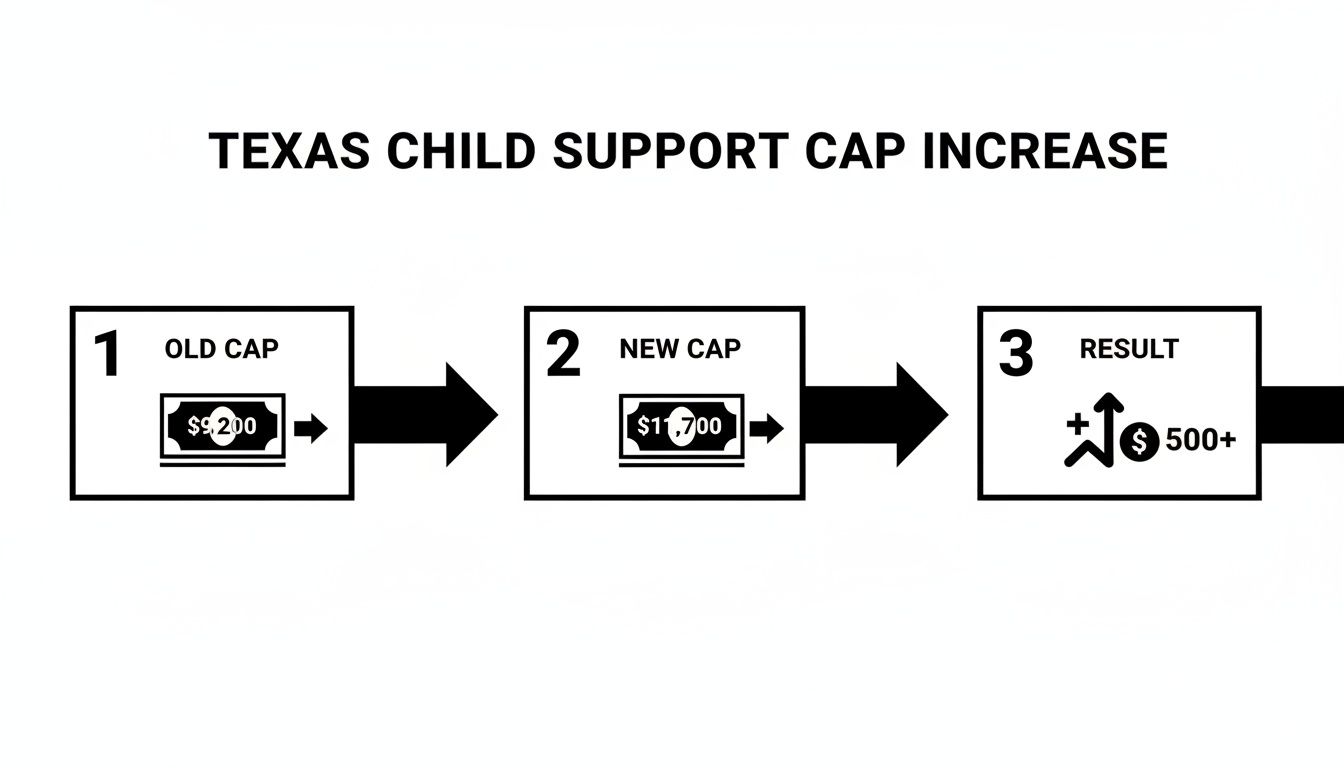
As you can see, by raising the net resource cap from $9,200 to $11,700 on September 1, 2025, the maximum guideline support amount will jump by $500 or more each month.
Common Misconceptions: What Is Not Deductible
Many parents are surprised to learn that everyday bills and financial obligations are not deductible when calculating net resources.
Crucial Point: The Texas Family Code does not permit deductions for personal lifestyle expenses or voluntary savings. Items like your mortgage, car payment, credit card bills, and personal loans are not deductible.
Similarly, voluntary contributions to retirement accounts like a 401(k) or IRA are not deductible. While financially prudent, the law prioritizes the child's financial needs first.
For a more detailed walkthrough of this math with specific examples, you should read our full guide on how to calculate child support in Texas. Properly calculating net monthly resources is the essential first step to understanding what the maximum child support in Texas might look like in your case.
Applying Guideline Percentages to High-Income Parents
Once an obligor's net monthly resources are determined, the court applies the standard guideline percentages. For high earners, the key is that these percentages are not applied to the parent's entire income.
The percentages outlined in Texas Family Code §154.125—20% for one child, 25% for two, and so on—are applied only to net resources up to the statutory cap.
The calculation stops at the cap, regardless of how much more the parent earns. For orders finalized after September 1, 2025, that income cap will be $11,700.
This is a critical point. It means that whether a parent’s net resources are $15,000 a month or $50,000 a month, the starting point for their guideline support is exactly the same.

A Real-World Example of the Cap in Action
Let's see how this works in practice. Picture a Dallas executive with $20,000 in net monthly resources and two children. A common misconception is that they would pay 25% of their $20,000 income, which would be a staggering $5,000 per month. That’s not how Texas law works.
Instead, the court applies the 25% guideline only to the $11,700 cap.
- Guideline Calculation: $11,700 (Capped Net Resources) x 25% (Guideline for 2 Children) = $2,925 per month
This $2,925 is their "presumptive" support amount. It’s the maximum child support in Texas under standard guidelines for anyone with two kids earning at or above the cap. A judge will order this amount unless one of the parents presents compelling evidence showing the child’s needs require a different figure. The court will typically ignore any income above the cap unless a parent can prove the child has additional needs that justify a deviation under §154.123. To see how the new figures affect your situation, it helps to understand the latest Texas child support calculator updates.
Adjustments for Other Children
What if the paying parent has children from another relationship for whom they have a legal duty of support? This detail can significantly lower the final child support amount. The law recognizes that an obligor's resources must be divided fairly among all of their children.
To account for this, the guideline percentages are adjusted downward according to a chart in the Texas Family Code.
Let’s go back to our Dallas executive with $20,000 in monthly resources and two children in the current case. Now, imagine they also have one other child from a previous marriage whom they are legally obligated to support.
The standard 25% for two children no longer applies.
- Standard Percentage (2 Children): 25.00%
- Adjusted Percentage (2 Children, with 1 other child): 22.50%
- New Guideline Calculation: $11,700 x 22.50% = $2,632.50 per month
This adjustment drops the presumptive support obligation by nearly $300 a month. It is a powerful example of why you must provide the court with proper documentation of your legal responsibility for other children.
Exceeding the Guideline Maximum in Court
While the Texas child support cap is a powerful guideline, it is not absolute. Texas Family Code §154.123 grants a judge the authority to order child support above the presumptive maximum if evidence shows it is in the child's best interest. This is a crucial tool for ensuring a child's specific needs are met in high-income cases.
The Standard for Going Above the Cap
To persuade a court to deviate upward from the guidelines, you cannot simply argue that the paying parent has a high income. An argument that the child should automatically share in a parent's lavish lifestyle is insufficient.
Instead, the law requires you to demonstrate the proven needs of the child.
This shifts the focus to the child's actual, documented expenses. You must present concrete evidence showing that the child's reasonable and necessary costs exceed what the presumptive child support amount can provide.
The burden of proof rests on the parent requesting the additional support. You must build an evidence-based case demonstrating why a higher amount is necessary.
What Qualifies as a Proven Need?
"Proven needs" extend beyond basic food and shelter to include expenses necessary to support the child’s established standard of living and unique developmental requirements.
Courts often consider:
- Private School Tuition: Especially if the child has a history of attending private school or requires a specific academic environment.
- Significant Medical or Therapy Costs: Expenses for chronic conditions, specialized treatments (e.g., ABA therapy), and mental health counseling not covered by insurance.
- Elite-Level Extracurriculars: Substantial fees for high-level coaching, travel, and equipment for a competitive athlete or gifted musician.
- Special Needs Support: Costs for tutors, specialized childcare, or other services required for a child with developmental or educational challenges.
These are considered essential to the child's well-being and upbringing.
Winning Your Case with Strong Evidence
To successfully argue for support above the cap under §154.123, you must present clear, organized proof. Your evidence should paint a detailed financial picture of the child's life. This includes:
- Detailed Budgets: A spreadsheet breaking down the child’s monthly expenses.
- Receipts and Invoices: The paper trail is critical for proving tuition, therapy, medical bills, and activity costs.
- Contracts and Enrollment Agreements: Official documents from schools or programs that state the required financial commitment.
- Expert Testimony: Testimony from a doctor, therapist, or coach can be effective in explaining why an expense is a necessity for the child's development.
Successfully arguing for support above the cap is a complex legal challenge. A Texas child support lawyer can help you build a compelling case based on your child’s specific needs and present a well-documented and persuasive argument to the court.
Modifying an Existing Child Support Order
A child support order reflects the law, your incomes, and your family's circumstances on the day it was signed. It does not update automatically. If your order was finalized before the cap increase, it is based on the old, lower income cap of $9,200.
With the new cap rising to $11,700 on September 1, 2025, you have a significant opportunity to seek a more appropriate support amount. However, the court will not act on its own—the parent seeking the change must initiate the process.

The Legal Standard for Modification
To change a Texas child support order, you must prove a “material and substantial change in circumstances” has occurred since the last order was signed. This is the legal threshold for recalculating support.
The Texas Family Code provides clear grounds for modification:
- The New Statutory Cap: If the obligor's income exceeds the old cap, the legislative increase to $11,700 can itself serve as the material and substantial change.
- A Significant Change in Income: A major promotion, raise, or new bonus structure for the obligor is a clear change in financial circumstances.
- A Change in the Child’s Needs: As discussed under Texas Family Code §154.123, new and proven needs (e.g., significant medical expenses) can also be grounds for modification.
- The Three-Year Rule: If it has been at least three years since the order was signed, and a new calculation shows the support amount would change by at least 20% or $100, the court will generally grant the modification.
How to Start the Modification Process
You must follow the formal legal process to make any changes official and enforceable.
- File a Petition to Modify: File a Petition to Modify the Parent-Child Relationship in the court that issued your original order. This formally requests that the judge review and update the support amount.
- Serve the Other Parent: The other parent must be formally notified of the lawsuit through service of process, a legal requirement to ensure they have an opportunity to respond.
- Gather and Exchange Evidence: Both parties will exchange financial documents like tax returns, pay stubs, and expense records during the discovery phase to build their case.
- Attend Mediation or a Hearing: Most courts require mediation to attempt a settlement. If no agreement is reached, you will present your evidence to a judge, who will make the final decision and issue a new order.
Whether you need to update your order to match the new income cap or enforce an existing one, taking decisive legal action is crucial for protecting your child’s financial security.
Answering Your Top Texas Child Support Questions
In high-income child support cases, several questions consistently arise. Here are clear, authoritative answers to some of the most common concerns.
Does 50/50 Custody Eliminate Child Support in Texas?
No. This is a common misconception. A 50/50 possession schedule does not automatically eliminate the child support obligation in Texas. While equal time can influence the final amount, the court's primary duty is to ensure the children enjoy a similar standard of living in both homes.
If one parent earns significantly more than the other, a judge will almost always order child support to bridge the financial gap. The most common method is an "offset" calculation:
- Calculate the guideline child support Parent A (the higher earner) would pay.
- Calculate the guideline child support Parent B (the lower earner) would pay.
- Parent A is ordered to pay Parent B the difference between the two amounts.
For example, if Parent A's guideline support is $2,340 and Parent B's would be $800, a judge would likely order Parent A to pay $1,540 per month. This ensures the child benefits from both parents' resources, a core principle of Texas child support law.
How Does the New $11,700 Cap Affect My 2024 Order?
It does not affect it automatically. If your child support order was finalized before September 1, 2025, it is based on the previous $9,200 net monthly resource cap. The new $11,700 cap will not apply to your existing order unless you take action.
To benefit from the new cap, the parent receiving support must file a formal Petition to Modify the Parent-Child Relationship. The new law, combined with proof that the paying parent's income exceeds the old cap, provides a strong basis for modification under the "material and substantial change in circumstances" standard.
How Is Child Support Handled for Inconsistent Income?
For obligors with variable income (e.g., commissions, bonuses, self-employment), a judge will not rely on a single pay stub. The court’s goal is to determine a reliable monthly average that reflects the parent’s true earning capacity.
To do this, a judge will examine income over a representative period, typically one to two years. It is critical to be prepared with comprehensive financial records, such as:
- Personal and business tax returns
- 1099s and W-2s
- Profit and Loss statements
- Bank statements showing deposits
Without clear documentation, you leave the judge to estimate income, which can result in an inaccurate child support order.
Can We Agree to Child Support Above the Guideline Max?
Yes. Parents are free to agree to a child support amount that exceeds the state's presumptive maximum. This is often a practical solution in high-net-worth cases, allowing you to maintain your children's lifestyle while avoiding a costly court battle.
Such an agreement is fully enforceable if properly written into your final divorce decree or child support order. A judge will review it to ensure it is in the "best interest of the child"—a standard easily met when parents agree to provide more financial support than the law requires. It is vital to have an experienced family law attorney draft this agreement to clearly detail how monthly support and other major expenses like private school tuition or extracurricular activities will be handled, thereby preventing future disputes.
Navigating the complexities of high-income child support, modifications, and enforcement requires deep knowledge of the Texas Family Code and strategic courtroom advocacy. If you are facing a child support case in Houston, Dallas, Austin, or the surrounding counties, the experienced attorneys at the Texas Child Support Law Office of Bryan Fagan are here to protect your rights and your child's future. For a clear strategy on your case, contact us today to schedule a consultation.