When support stops, the problem rarely stays on paper. Rent comes due. School costs keep coming. Medical bills don't wait because the other parent decided to wait. In Houston, Dallas, and San Antonio, I routinely see the same pattern. One parent keeps carrying the child financially while the other parent still has a truck, a bank account, a house, or a pending insurance claim.
That’s when many parents realize a simple demand for payment won’t fix the problem. A court order matters, but an order by itself doesn’t always force movement. A texas child support lien often does. It turns unpaid support into a claim against property, and that changes the conversation fast.
For the parent owed support, a lien can stop an asset sale, block a title transfer, and create a strong position where repeated promises have failed. For the parent who owes support, a lien can disrupt a closing, a refinance, a settlement, or access to funds you assumed were available. Either way, once arrears build, this becomes a property problem, not just a payment problem.
If you're dealing with missed payments right now, start with a clear understanding of what happens if child support is not paid in Texas. Then look closely at liens, because they’re one of the strongest enforcement tools in the Family Code.
Introduction When Unpaid Child Support Becomes a Crisis
A child support case becomes urgent when unpaid support starts changing daily life for the child. The missed payment is only the beginning. The actual harm is seen when groceries get cut, activities stop, or a parent has to choose which bill gets paid first.
In Harris County, Dallas County, and Bexar County, the facts often look ordinary at first. There is an order. There were payments. Then the payments slowed down or stopped. Meanwhile, the obligor still appears to be functioning financially. Maybe there’s a home on the market in Houston. Maybe a vehicle is being traded in around Dallas. Maybe a personal injury claim in San Antonio is close to settlement.
That’s where many parents make a mistake. They assume enforcement must begin and end with wage withholding or a contempt hearing. Those are useful tools, but they aren't always the fastest way to reach value. A lien can be more strategic because it reaches property and proceeds, not just paycheck flow.
Practical rule: If the obligor has assets but inconsistent income, a lien may produce better leverage than waiting on payroll deductions alone.
A texas child support lien matters because it changes who controls the next move. Instead of asking the obligor to cooperate, the law gives the unpaid support debt a direct claim against non-exempt property. That can stop transfers and force resolution when ordinary collection efforts have gone nowhere.
Clients usually want two answers. First, how powerful is this tool really? Second, what can go wrong if it’s handled poorly? Both questions matter, because liens work well when created and perfected correctly, and they fail when someone treats the paperwork casually.
What Is a Texas Child Support Lien?
A child support lien is best understood as a legal claim tag attached to property. Once attached and properly perfected, that tag tells the world that the property carries child support debt with it. If the owner wants to sell, refinance, transfer, or collect certain proceeds, the lien has to be addressed.
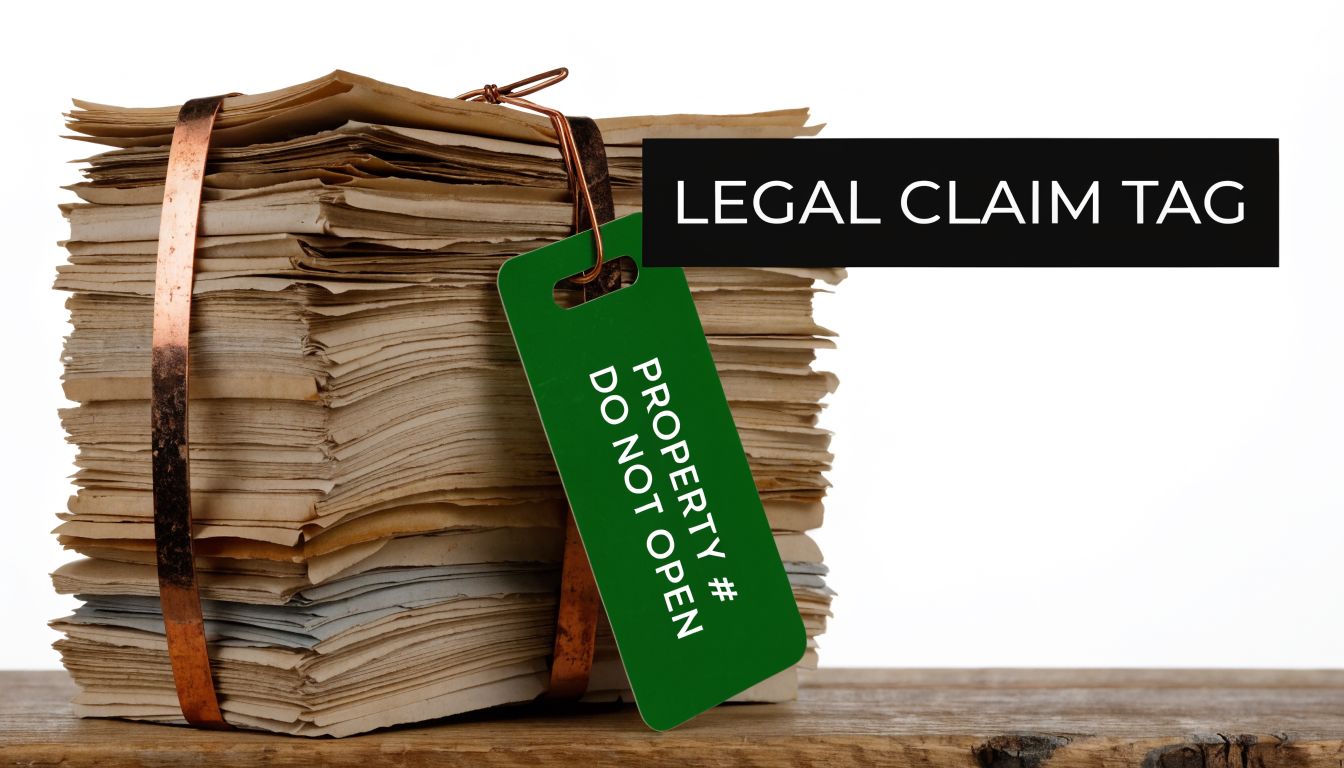
Under Texas Family Code Chapter 157, Subchapter G, child support liens attach to non-exempt real and personal property upon proper notice filing, and the lien covers past-due support plus accrued interest at a 6% statutory rate under §157.265, as summarized by this discussion of Texas child support lien law.
Why this tool has so much force
The word “lien” commonly brings to mind a bank mortgage. The concept is similar. The debt follows the property interest. In child support cases, that creates pressure at the moment the obligor needs a transaction to go through.
That pressure matters in real life:
- A seller can't close cleanly if title shows a lien that must be resolved.
- A vehicle owner can't transfer title freely if the lien is reflected on the title record.
- A person expecting money from a claim or award may find the payment intercepted.
The lien doesn’t just preserve a claim in theory. It interferes with access to value.
Automatic right versus perfected lien
Clients often confuse two different ideas. The law gives the support recipient or enforcing authority a right to a lien when support is unpaid. But that right must still be perfected correctly to bind third parties and give the lien practical effect against property in practice.
That distinction is where strategy begins. A lien that exists in concept but isn't perfected may not stop the transaction you care about. A lien that is properly prepared, filed, and directed at the right asset can force immediate attention.
Here is a helpful overview before the deeper mechanics:
What the lien secures
The debt secured by the lien is not limited to missed base support. It also includes accrued interest. In a case with long-running arrears, interest changes the negotiation range significantly.
That matters for both sides.
| Issue | Why it matters |
|---|---|
| Past-due support | This is the core debt the lien secures |
| Interest under §157.265 | The total owed can be materially higher than the missed monthly payments alone |
| Asset-specific impact | The practical effect depends on whether the asset is real property, a vehicle, an account, or proceeds |
A lien isn't just leverage for a hearing. It's leverage at the closing table, at the bank, and during settlement disbursement.
The Lien Lifecycle Creation Perfection and Priority
The power of a texas child support lien depends less on rhetoric and more on sequence. Lawyers use three words for that sequence: creation, perfection, and priority. If you understand those three stages, you understand why some liens produce payment quickly and others collapse under challenge.
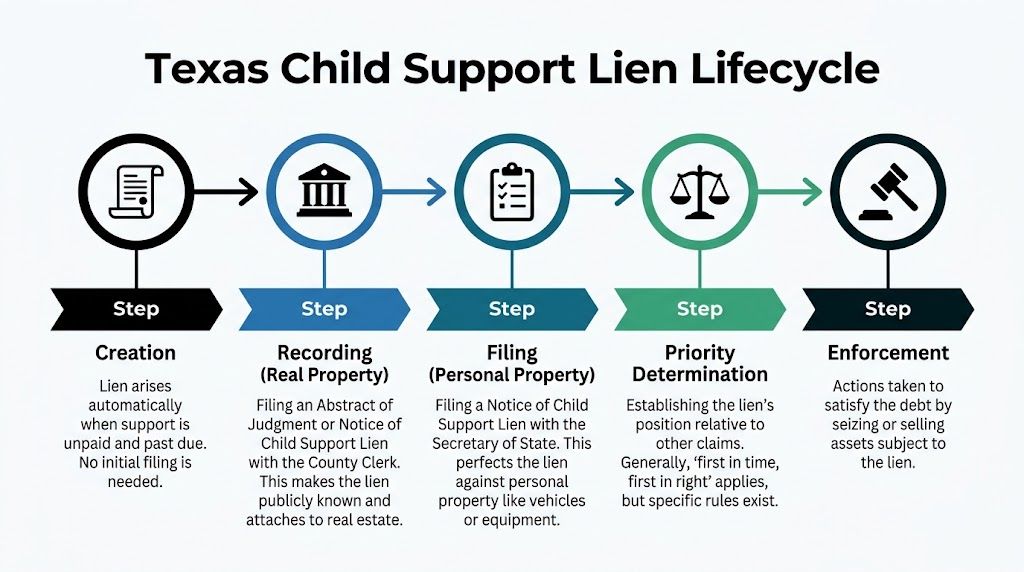
Creation
Creation is the legal beginning of the lien right. Once support is delinquent, the Family Code gives the unpaid support obligation lien consequences. But creation alone doesn't answer the practical question clients usually ask, which is this: will a title company, buyer, lender, insurer, or other third party have to respect it?
Usually, the answer turns on perfection.
Perfection
Perfection is the step that gives the lien real teeth against third parties. Under §157.316(a), perfection occurs by filing an abstract of judgment or lien notice as authorized by §157.314. The filing location can matter. Depending on the property and circumstances, filing may occur with the county clerk in the obligor’s county of residence, the obligee’s county, the county where the order was rendered, or the county where the immovable property is located.
The content of the notice matters just as much as the filing location. Under §157.313, the notice must include specific required elements. If a required element is missing or defective, the lien can be vulnerable.
What must be in the notice
A valid notice isn't casual paperwork. It must be precise.
- Identifying details for the obligor and obligee must be accurate.
- The arrears amount must be stated with interest computation.
- The court and cause number must be included.
- Certification of delinquency must appear as required by statute.
When any of those pieces are sloppy, third-party enforcement becomes harder. In litigation, procedural defects often become the obligor’s first line of attack.
Critical point: A strong lien starts with exact statutory compliance. Near-correct is often not good enough.
Where practitioners go wrong
In practice, the most common failures are simple and expensive. A name is wrong. The arrearage is outdated. The county chosen for filing doesn't match the property problem you're trying to solve. The lien exists, but it doesn't hit the transaction that matters.
That’s why timing and asset mapping matter. If the obligor owns land in one county, lives in another, and is about to close in a third place, the filing strategy can't be improvised.
A practical way to think about perfection is this:
| Step | What you need to ask |
|---|---|
| Identify the asset | Are you targeting real property, a vehicle, an account, or proceeds? |
| Confirm the arrears | Is the amount current and supported by the payment record? |
| Draft the notice | Does it satisfy §157.313 in full? |
| File in the right place | Will the relevant third party actually encounter the lien? |
Priority
Priority determines who gets paid first when multiple claims exist. Under §157.320, the perfected child support lien generally has priority over later-recorded interests, while earlier interests may come ahead of it. For clients, the easiest way to understand priority is “first in line.”
If your lien is perfected before a later creditor records its claim, your position is stronger. If someone else already had a properly recorded interest, that earlier claim may sit ahead of the child support lien as to that property.
This becomes very real in a Houston sale or a Dallas refinance. The title review doesn't care who has the better moral argument. It cares who has the stronger recorded legal position.
Enforcement is downstream from perfection
People often jump to enforcement before they've secured priority. That’s backwards. If perfection is weak, enforcement gets messy. If perfection is solid, many cases resolve without a fight because the transaction itself can't move forward cleanly.
That is what makes liens different from ordinary demands for payment. They don't rely on persuasion. They rely on record notice, legal priority, and the other side’s need to use or transfer an asset.
Enforcing the Lien Against Specific Assets
A lien becomes real when it hits a specific asset the obligor wants to use. Real estate is one category. Vehicles are another. Bank accounts, retirement assets, and insurance proceeds raise different issues. Good enforcement strategy starts by matching the lien to the asset that creates the most immediate advantage.
If you need a broader enforcement overview alongside lien strategy, review how to enforce child support in Texas.
Real property
In a house or land deal, the lien usually works by clouding title. The owner may still hold the property, but a clean sale becomes difficult because buyers and title companies want the lien addressed before closing.
In Houston, this often appears when a parent has ignored support for years but suddenly wants to sell investment property or refinance. In Dallas, it commonly appears when equity has increased and the obligor assumes the closing will generate free cash. A perfected lien can force the support debt into that closing conversation.
The main strategic question is whether the lien has been filed where the title search will catch it. If not, the advantage quickly diminishes.
Vehicles
Vehicles have special perfection rules. Under §157.316(b), a lien on a motor vehicle must be perfected through the title process, not just by county filing. Jackson Walker’s discussion of insurer and lien procedures notes that child support liens extend to insurance settlements and awards under §157.317, and for motor vehicles the lien must be perfected through the Texas DMV by surrendering the title so a new title is issued showing the lien.
That title notation matters because it directly interferes with transfer. A private sale, dealer trade-in, or title cleanup becomes much harder once the lien is on the record the DMV uses.
Financial accounts and retirement assets
Bank accounts and retirement-related assets can create pressure because they are liquid or near-liquid. Under §157.317, liens can attach to non-exempt personal property, and the verified material specifically identifies bank accounts and retirement plans as part of the strategic context in these cases.
But this category has trade-offs.
- Bank accounts can provide a fast advantage, especially if the obligor needs operating cash.
- Retirement assets may require additional procedural work, and distribution issues can become technical.
- The homestead exemption is different, which is why asset classification matters before taking action.
In high-income disputes, these assets often matter more than wages. A parent may keep salary modest on paper while holding substantial value elsewhere. A lien strategy should track where the actual money sits, not where the pleadings assume it sits.
In asset-heavy cases, the smartest enforcement target is usually the asset the obligor needs to move soon, not the asset with the best optics.
Insurance claims and legal settlements
This is one of the strongest pressure points in the statute. Under §157.317, child support liens can reach insurance settlements and awards. In practice, that can matter in auto claims, workers’ compensation contexts, and other settlement-driven recoveries.
San Antonio cases often present this issue cleanly. A parent owes substantial arrears, then a settlement is approaching. The obligor thinks the matter is private and temporary. It isn’t. Once the lien framework is engaged correctly, the expected payout may no longer be freely available.
This type of enforcement works because proceeds are often the first liquid asset in a long-running arrearage case.
What works and what doesn't
Some enforcement choices produce results. Others waste time.
| Approach | Usually works when | Usually fails when |
|---|---|---|
| Real estate lien strategy | There’s a pending sale, refinance, or title issue | The filing never reaches the county that matters |
| Vehicle title lien | The owner needs to sell or trade the vehicle | The lien isn't perfected through the DMV process |
| Bank or retirement targeting | The obligor is asset-rich and income-light | Counsel doesn't understand the account type or release path |
| Insurance intercept approach | A settlement is pending and proceeds are identifiable | The lien work starts after disbursement is already complete |
How to Resolve and Release a Child Support Lien
From the obligor’s side, the biggest mistake is pretending the lien will disappear on its own. It usually won’t. Child support debt is a priority obligation, and lien problems tend to surface at the worst time, like the week of closing or the day settlement funds are supposed to be released.
There are three realistic paths. Pay it. Negotiate a limited release. Or challenge the lien because something about it is wrong.
Paying the debt in full
The cleanest solution is full satisfaction of the arrears and any applicable interest. Once that happens, the next issue is just as important as payment itself: getting the release of lien properly prepared and filed.
I’ve seen obligors pay substantial money and still struggle because no one completed the release step promptly. The debt may be paid, but if the public record still shows a live lien, title problems can remain until the release is recorded where it needs to be recorded.
For that reason, payment should be handled as a two-part task:
- Confirm the payoff amount using a reliable arrearage record.
- Obtain and file the release in every place the lien was perfected.
Partial release under §157.323
A partial release can be the most practical option when one asset needs to move, but the full arrears balance can't be paid immediately. Section 157.323 allows release from particular property while the remaining lien rights stay alive against other property.
This is common in real transactions. A parent needs to sell a vehicle, close a piece of real estate, or access one account. If the sale will generate funds, a negotiated partial release can let the transaction proceed while directing proceeds toward arrears.
That approach works when both sides focus on economics rather than posture.
- For the obligee, a partial release can produce immediate money instead of prolonged standoff.
- For the obligor, it can prevent the loss of a transaction that would otherwise help resolve the debt.
- For counsel, it creates a structured path rather than emergency motion practice right before closing.
Challenging a defective lien
Not every lien is valid. If the notice failed to comply with statutory requirements, if the amount is inaccurate, or if the lien was filed against the wrong property path, challenge may be the correct response.
These challenges usually center on a few recurring issues:
| Possible defect | Why it matters |
|---|---|
| Bad arrears figure | An inflated lien undermines settlement and can affect validity arguments |
| Missing statutory information | A notice that doesn't satisfy §157.313 may be vulnerable |
| Wrong perfection method | Asset-specific rules matter, especially for vehicles |
| Release not filed after payment | The debt may be resolved, but the title problem remains |
The mistake many obligors make is waiting until a deal is collapsing before raising these issues. If you know a sale, refinance, or settlement is coming, audit the lien early.
If the issue is old arrears generally, not just the lien itself, this overview of how to collect back child support in Texas is also useful because release discussions often happen alongside broader arrearage negotiations.
What bankruptcy usually won't solve
Some debt problems can be reshaped in bankruptcy. Child support debt is different. As a practical matter, this is not the category of obligation people usually discharge away. If a lien is tied to child support arrears, the better strategy is usually direct resolution, not avoidance planning.
That is why obligors need a real plan early. Waiting doesn't improve the legal position. It usually just means the lien appears at the exact moment you need the asset most.
Strategic Planning and Advanced Lien Topics
A Houston parent is paid through distributions, bonuses, and a closely held business. Wage withholding reaches part of the income and misses the rest. Meanwhile, a house sale is set for next month, and a bank account is about to receive a large deposit. In that case, a lien is often the tool that changes the settlement posture fastest.
A lien should be chosen for the asset in front of you, not used by reflex. Wage withholding is cleaner in a straight payroll case. Contempt can create immediate court pressure when nonpayment is willful. Liens become more effective when the obligor is self-employed, holds significant nonwage assets, or is about to close a transaction that cannot move forward with title or funds tied up.

When liens outperform wage withholding
Wage withholding depends on a reliable payor and visible compensation. A lien reaches a different problem. It targets value already parked in property, accounts, proceeds, or other non-exempt assets.
That distinction matters in Dallas, Houston, and San Antonio cases involving physicians, executives, contractors, business owners, and parents paid through uneven compensation structures. On paper, the monthly income picture may look limited or delayed. In practice, the collection path may run through real estate, brokerage funds, settlement proceeds, or retirement assets covered by Texas Family Code §157.317.
A well-placed lien also changes timing. If an obligee knows a refinance, sale, or probate distribution is coming, waiting for missed payroll deductions can be a strategic mistake. On the other side, an obligor who sees a transaction coming should review the lien record early, because title companies and financial institutions rarely solve these defects on the eve of closing.
High-income cases after the 2025 cap change
The September 1, 2025 increase in the net resource cap to $11,700 will matter most in high-income support disputes and later enforcement fights. The cap change does not create a lien, but it does affect how support is argued, how deviations under §154.123 are framed, and how arrears disputes develop after entry of the order.
In high-income cases, the fight often shifts from setting support to collecting it. That is especially true where compensation comes from K-1 income, deferred compensation, commissions, performance bonuses, or business distributions. In those files, counsel should be planning for enforcement from the beginning, because a parent with substantial wealth can still present a difficult wage-withholding target.
For obligees, that means tracing where value sits and where it will move next. For obligors, it means understanding that an aggressive arrears claim tied to a flawed accounting can create real title and liquidity problems long before the court resolves the amount.
Procedural mistakes that can ruin a good lien
I see the same strategic error on both sides. They focus on the debt and ignore the paperwork.
A child support lien is only as useful as its preparation and perfection. If the notice omits required statutory information under §157.313, misstates the arrears, or is sent or filed in a way that does not match the asset type, the lien may lose priority or become vulnerable to attack. That problem shows up often in fast-moving cases where someone rushes to file after learning about a closing or payout.
For obligees, the lesson is simple. A rushed lien that is defective can cost collection opportunities and settlement credibility. For obligors, the lesson is just as important. The critical question is not whether a lien was filed, but whether the bank, title company, plan administrator, or other third party will encounter a valid and properly perfected lien.
That issue can decide real outcomes. In a San Antonio real estate sale, a filing defect can delay or derail closing. In a Dallas business-ownership dispute, a bad arrears number can distort negotiations for weeks. In a Houston case involving irregular compensation, the difference between a properly perfected lien and a sloppy one may determine whether funds are frozen or released.
What works for each side
For the obligee, strong lien practice is proactive and asset-specific:
- identify likely assets before arrears grow
- check whether a sale, refinance, lawsuit recovery, or inheritance is pending
- match the perfection method to the property involved
- confirm the arrears figure before serving notice
- use the lien with other remedies when the facts support it
For the obligor, the best response is early damage control backed by records:
- audit the arrears calculation immediately
- compare the lien notice to the Family Code requirements
- ask whether the lien reached the correct asset in the correct way
- pursue payoff, escrow, or partial-release discussions before a transaction becomes urgent
- prepare for the reality that some challenges are amount disputes, while others are validity disputes
The practical point is straightforward. A lien is not just pressure for a hearing. It is a collection device that can freeze a deal, force a payoff conversation, or expose serious defects in the claimant's paperwork.
If counsel is needed, one option is the Texas Child Support Law Office of Bryan Fagan, which handles establishment, modification, enforcement, and defense of Texas child support orders, including high-income and arrearage disputes.
Texas Child Support Lien FAQs
Can a texas child support lien affect a homestead?
Yes. Texas child support lien law is unusually powerful in this area, and homestead issues should never be assumed away without reviewing the statute and the filing history carefully.
Does a lien require a new court order every time?
Not always. Much depends on whether the lien right already exists through delinquency and whether the notice was properly prepared and perfected under the Family Code. The fight is often about validity, amount, or enforcement mechanics, not whether a fresh hearing happened first.
Can Texas enforce support if the parent or property is outside Texas?
Often yes. Interstate enforcement may involve UIFSA procedures. The details depend on where the order was issued, where the parties live, and where the property or income source is located.
Who should handle lien enforcement, the OAG or a private attorney?
The Office of the Attorney General can be involved in support enforcement matters. A private attorney may be more useful when the case involves asset tracing, title issues, high-income disputes, negotiated partial releases, or a fast-moving sale or settlement.
What if the arrears number looks wrong?
Challenge it early. Don't wait until a title company, insurer, or buyer raises the issue at the last minute. Lien disputes are often easier to address before the transaction calendar takes over.
Can a lien matter in a 50/50 custody or modification dispute?
Yes. Those cases often produce disputes about guideline calculations, deviations under §154.123, and what should happen once arrears exist. The lien becomes part of the financial strategy, not just a collection afterthought.
If you're dealing with unpaid support, a pending sale, a title problem, or a dispute over arrears, the Texas Child Support Law Office of Bryan Fagan helps parents across Houston, Dallas, San Antonio, Fort Worth, Austin, and surrounding counties address child support liens, enforcement actions, modifications, and high-income support disputes under the Texas Family Code.