You walk out of court with a signed child support order in your hand, and your first reaction is simple: this can't be right.
Maybe the judge used income figures that didn't reflect reality. Maybe the order doesn't make sense with your possession schedule. Maybe you expected a guideline result and got something very different. Or maybe an associate judge made a ruling so quickly that you barely had time to understand what just happened before the hearing was over.
That moment matters because the wrong next move can cost you the chance to fix the problem.
If you're asking can you appeal a child support order texas, the answer is sometimes yes, but appeal is only one of three serious options. The others are a post-judgment motion, such as a motion for new trial, and a modification. Those are not interchangeable. Each tool solves a different problem, runs on a different timetable, and carries a different cost.
A parent who chooses the wrong tool usually loses time first. Then an advantage. Then money.
Here is the practical way to think about it. If the court made a legal or procedural mistake based on the evidence already presented, an appeal may be the right path. If the ruling just came down and there is still a narrow window to ask the trial court to correct or reconsider it, a post-judgment motion may be the fastest move. If the facts have changed since the order, income, job, custody schedule, or the child's needs, then modification is usually the better remedy.
Practical rule: The first question isn't whether the order feels unfair. The first question is whether the problem is legal error, trial-court error that can still be corrected quickly, or changed circumstances.
In child support cases, strategy beats emotion. A parent who is angry but organized usually does better than a parent who is angry and late. The deadlines are short, the record is limited, and the trial court's paperwork often tells only part of the story. That is why the first days after an unfavorable order are so important.
The Threshold Question Is Your Child Support Order Appealable
Before anyone spends money on an appeal, they need to answer one threshold question: is the order appealable?
Texas appellate courts usually review final judgments or another final appealable order. They generally do not review temporary or interim rulings unless a statute expressly allows it. One Texas family-law discussion of appellate jurisdiction explains that if the order is nonfinal, the appellate court lacks authority and will dismiss the appeal, even if the support ruling may have been wrong on the merits. See this discussion of Texas appellate jurisdiction in family-law cases.
What final means in real life
The easiest analogy is a football game. You don't appeal the score at halftime. You appeal after the game ends.
Family courts work much the same way. If the judge has entered a temporary support ruling while the larger divorce or SAPCR is still pending, that usually isn't the point where an appeal starts. The appellate court wants one finished order that resolves all claims and all parties, unless a narrow exception applies.
That matters because parents often call after a temporary hearing saying the court "already ruled." Sometimes the court did rule, but not in a way that creates immediate appellate jurisdiction.
Orders that often create confusion
Parents usually get tripped up in these situations:
- Temporary orders during a divorce or SAPCR: These often control support in the short term, but they usually aren't immediately appealable.
- Associate judge rulings: These may require a different immediate response before a true appeal is even on the table.
- Partially resolved cases: If support was decided but custody, property, or other claims remain open, the order may still be nonfinal.
- Clerical paperwork that looks complete: A signed document can still be nonfinal if it doesn't dispose of the whole case.
A lot of confusion comes from the difference between a court order being enforceable and being appealable. An order can absolutely affect your paycheck, your arrears balance, and your monthly budget while still not being ready for appellate review.
Why this screening step matters
If the order isn't appealable, filing a notice of appeal doesn't solve the problem. It creates a new one.
The appellate court won't fix a nonfinal case by being sympathetic. Jurisdiction is jurisdiction. If the order isn't final, the appeal gets dismissed. That means more delay while the original support obligation keeps operating.
For that reason, I usually tell clients to review the order through two lenses before discussing appellate arguments:
- Is this a final order?
- Who signed it, a district judge or an associate judge?
Then look at the child support framework itself under the Texas Family Code child support provisions, including guideline support under §154.125 and possible deviations under §154.123. Those sections often reveal whether the complaint is really about a legal error, judicial discretion, or changed facts that belong in a modification case instead.
A bad result does not automatically create an appealable issue. A final order and a preserved legal problem are what create an appealable issue.
Appeal vs Modification vs Post-Judgment Motion Choosing the Right Tool
Most parents don't lose because they had no remedy. They lose because they chose the wrong one.
An appeal attacks error in the original ruling. A post-judgment motion asks the trial court to revisit or correct something quickly after judgment. A modification asks the court to change the order going forward because circumstances are different now. Texas recognizes that distinction in modification practice. The Office of the Attorney General explains that formal review is available for active child support cases, and Texas Family Code §156.401 generally allows modification when there has been a substantial and material change in circumstances, or when an order is at least three years old and the recalculated amount would differ by at least 20% or $100 per month. See the Texas child support modification process through the OAG.
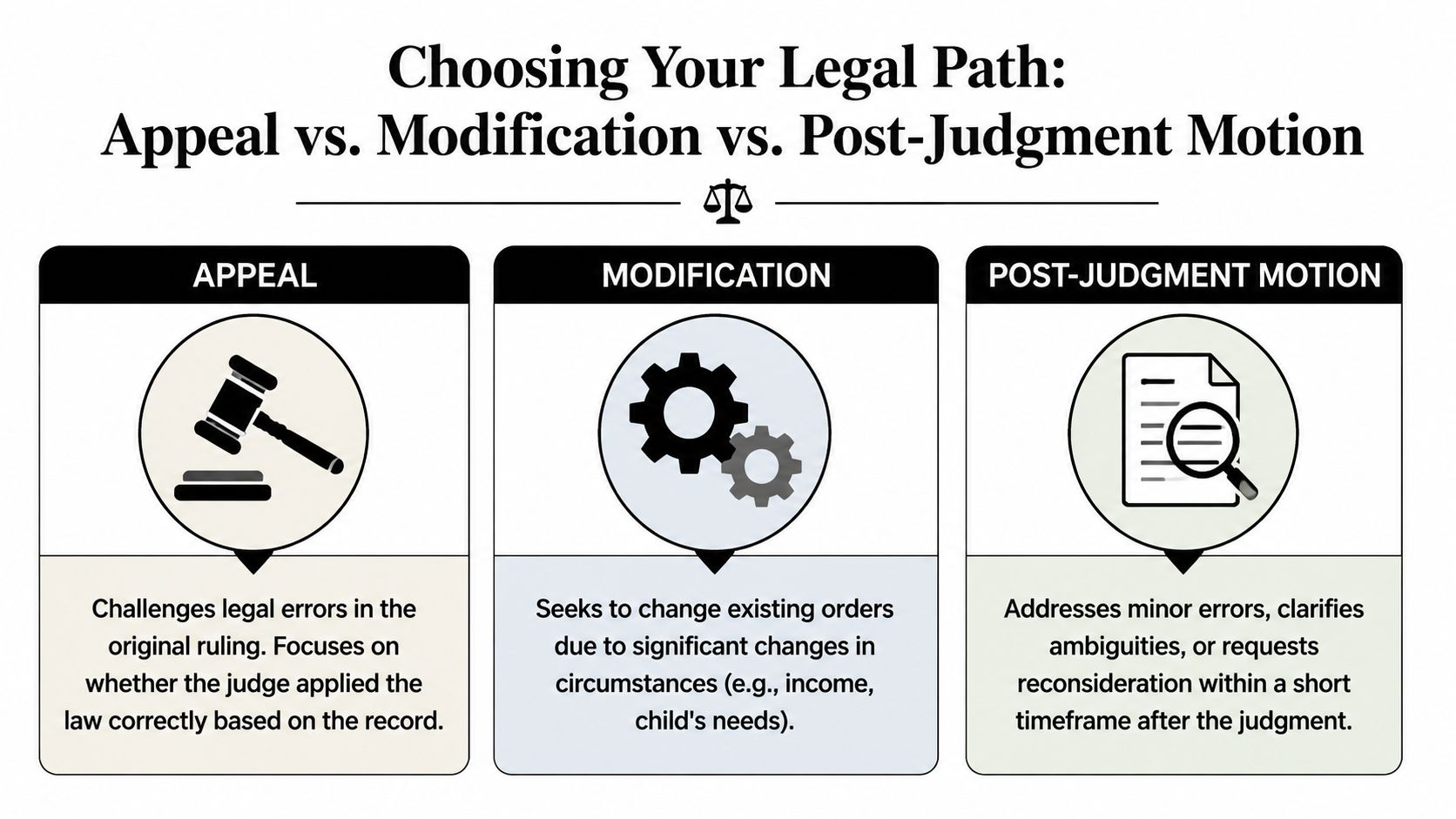
Appeal vs. Motion vs. Modification Which Is Right for You
| Feature | Appeal | Post-Judgment Motion | Modification |
|---|---|---|---|
| Primary purpose | Challenge legal or procedural error in the original order | Ask the trial court to correct, reconsider, or reexamine the judgment | Change support because facts have changed |
| Main focus | Whether the judge applied the law correctly to the existing record | Whether the trial court should revisit the result while it still has power to do so | Current and forward-looking circumstances |
| Evidence | No new evidence on appeal | Depends on the motion and hearing posture | Updated evidence is central |
| Best fit | Misapplied guideline law, incorrect net-resources analysis, preserved procedural error | Fast correction of a recent ruling, ambiguity, or trial-level reconsideration | New job, lost income, changed possession schedule, changed child needs |
| Typical risk | Expensive and narrow | Short deadline, limited usefulness if the legal problem is bigger | Doesn't erase past error in the original order |
When appeal is the right tool
Appeal is like telling a reviewing court, "The trial judge had the wrong rule, used the wrong record, or made a decision outside the law."
That can happen in child support cases when the court:
- Misapplies guideline support under §154.125
- Uses the wrong net resources calculation
- Ignores or misuses deviation factors under §154.123
- Bases a ruling on something not properly in the record
- Commits a procedural error that was preserved
Appeal is not a do-over. It isn't a second trial. It's a review of what already happened.
When a post-judgment motion makes more sense
Sometimes the smartest move is not to rush straight to the court of appeals.
If the order was just signed and there is a clear issue the trial court can still address, a Motion for New Trial or similar post-judgment request may be the practical first step. In some cases, that gives the trial judge a chance to fix a mistake before the parties spend months briefing an appeal. It can also affect appellate deadlines, so timing and wording matter.
Good judgment matters more than reflex. Some rulings are fixable quickly. Others are not.
When modification is the better answer
Modification is often the right answer when the complaint is really this: "The order may have made sense then, but it doesn't fit now."
That includes situations like these:
- Income changed: One parent lost a job, changed compensation structure, or now has more reliable proof of earnings.
- Possession changed: The actual parenting schedule now differs from what the court assumed.
- The child's needs changed: Medical, educational, or other proven support needs are different.
- A dated order now qualifies for review: The order meets the benchmark described above under §156.401.
If that sounds like your case, read about the process to modify child support in Texas. Modification doesn't argue that the original judge got everything wrong. It asks for a legally supportable update.
The biggest mistake I see is a parent trying to use appeal to present new facts. New facts belong in modification, not in the court of appeals.
What works and what usually doesn't
The most effective path is the one that matches the problem.
What usually works:
- Appeal for preserved legal error
- Post-judgment motion for immediate trial-court correction
- Modification for changed circumstances
What usually doesn't:
- Appealing because the result feels unfair without identifying a legal error
- Filing modification when the primary complaint is that the original judge misapplied the law
- Waiting too long while deciding between options
In practice, some parents may use more than one tool at different stages. But they still need a primary strategy. The question isn't which remedy sounds strongest. The question is which remedy fits the facts and the timing.
The Nuts and Bolts of a Texas Child Support Appeal
Texas appeals are procedure-heavy. The parents who do best are the ones who treat the calendar like a weapon, not a suggestion.
One Texas family-law source notes that appellate deadlines are highly time-sensitive. The standard notice-of-appeal deadline is 30 days after the judgment is signed, and that can extend to 90 days if a qualifying post-judgment motion is filed. The same discussion explains that appeals are confined to the existing trial record, which is why the strongest issues are legal or procedural errors already preserved below, such as miscalculating net resources or misapplying guideline percentages. See this explanation of Texas child support appeal steps and deadlines.
Step one starts earlier than many parents think
If an associate judge issued the ruling, your first move may not be a court of appeals filing at all.
A Texas family-law source discussing child support appeals notes that a party generally must first request a de novo hearing if the ruling was by an associate judge, and it notes a three-day deadline to do so after the ruling. That same source states that if this is missed, a Motion for New Trial may still be filed within 30 days, and that appellate courts review whether the trial judge abused discretion or misapplied the law rather than considering new evidence. See this discussion of appealing a child support order in Texas.
That short de novo deadline catches people off guard. Parents often assume they can "deal with it next week." In some cases, next week is too late.
The appellate record is everything
An appeal lives or dies on the record. That usually includes the clerk's record and, when available and necessary, the reporter's record from the hearing or trial.
If a fact wasn't offered into evidence, if an objection wasn't made, or if a complaint wasn't preserved, the appellate court usually won't rescue it later. This is why I tell clients that appeal is a lawyer's file-and-transcript case. The appellate judges examine what the trial court had, not what you wish had been offered.
Key practical points:
- Preserved objections matter: If trial counsel didn't clearly raise the issue, review gets harder.
- Exhibits matter: Income documents, tax records, payroll evidence, and support calculations must be in the record.
- Findings can matter: In some cases, the court's written findings help identify whether the issue is guideline error, deviation, or pure discretion.
Here's a short explainer that helps many parents understand the process before they decide whether to proceed:
The basic sequence
Most Texas child support appeals follow a sequence like this:
Confirm the order and deadline
First determine whether the order is final and whether any post-judgment filing changes the appellate timetable.File the notice of appeal on time
Missing the deadline can end the case before the merits are ever reached.Secure the appellate record
That means the paperwork filed below and the hearing transcript if one exists.Identify the actual appellate issues
Strong appeals focus on legal error, preserved procedural error, or abuse of discretion tied to the record.Draft and file briefs Legal authority and record citations perform the primary work during this phase.
Wait for decision
Sometimes there is oral argument, but many family-law appeals are decided on the briefs and record.
Appeals reward discipline. The strongest brief in the world can't fix an issue that was never preserved or a deadline that was missed.
Strategic Considerations for Complex Child Support Cases
You get the order, read the child support amount twice, and the first reaction is often, “We need to appeal.” In complex cases, that is not always the right move. The better question is whether the judge made a legal error on the record, whether your facts changed after the hearing, or whether the order is tough but still likely to survive review.
That distinction matters most in cases involving high income, equal possession schedules, self-employment, bonuses, restricted stock, or business deductions. These are the cases where parents waste time and money if they pick the wrong tool.
High-income cases and the guideline cap
In high-income cases, the first step is to separate guideline support from any amount above the guidelines based on the child's proven needs. Texas Family Code §154.125 controls the guideline framework, including the $11,700 net monthly resource cap effective September 1, 2025. The cap sets the point where the court stops the standard guideline calculation and asks a different question. Has the party seeking more support proved needs that justify more?
That second question drives the strategy.
If the trial court applied percentages above the cap without a proper proven-needs analysis, that may support an appeal. If the evidence on the child's needs was weak but still admitted, the issue may be closer because trial courts get discretion in this area. If your income dropped after trial, or the bonus structure changed, an appeal usually will not fix that. Modification is usually the cleaner path.
High-income parents also need to be realistic about optics. A complaint that “the amount is too high” rarely carries weight by itself. A complaint that the court skipped the required legal sequence, counted income incorrectly, or awarded extras without evidence is far more useful.
Fifty-fifty custody cases require a strategy, not assumptions
A 50/50 schedule does not eliminate child support in Texas. Judges still look at each parent's net resources, who pays health insurance, who covers recurring school costs, who handles activity expenses, and whether a deviation under §154.123 is justified.
These cases often produce bad appeals because the losing parent focuses on fairness instead of legal error. Appellate courts do not reverse orders because a parent expected equal time to mean equal financial responsibility. They look at whether the trial court used the correct legal standard and whether the evidence supports the decision.
A better strategy is to identify the actual problem. Was income calculated wrong? Did the court ignore evidence about expense allocation? Did the judge make findings that conflict with the possession schedule or the proof at trial? Those points can matter. General frustration does not.
Variable income and business-owner cases are won or lost on the record
Business owners, commission earners, and parents paid through multiple entities often have the strongest emotional reaction to a support order and the weakest appellate posture. The reason is simple. If the financial record at trial was messy, the appellate court usually will not clean it up for you.
In these cases, the practical review usually centers on four questions:
- Was net income calculated under the Family Code using actual admissible evidence?
- Were claimed business deductions legitimate, personal, or poorly documented?
- Did the court rely on bank records, tax returns, payroll documents, and testimony, or on suspicion and rough estimates?
- Does the order show a clear path from the evidence to the support amount?
If the judge chose between two competing versions of the facts, an appeal can be difficult even if the result feels wrong. If the court used the wrong legal method, refused to consider admitted financial records, or made a support finding with no evidentiary support, the case gets stronger.
Choosing among appeal, modification, and acceptance
This is the strategic fork in the road.
Appeal makes sense when the problem is tied to what happened in court. Wrong legal standard. Misapplied guideline cap. Unsupported deviation. Income calculation error preserved in the record.
Modification makes more sense when the order may have been defensible when signed, but life changed soon after. Job loss, compensation changes, major shifts in possession, or new evidence of the child's actual expenses usually point in that direction.
Sometimes the right answer is to accept the order and stop spending money on a weak challenge. I give that advice more often than clients expect, especially where the order falls within the court's discretion and the cost of review would exceed any realistic upside.
In complex child support cases, the winning move is not always to fight harder. It is to choose the procedure that fits the problem.
What to Expect Costs Timelines and Potential Outcomes
A child support appeal is not a fast reset button. It is a separate layer of litigation.
That means more attorney time, record preparation, briefing, and waiting. It also means the order you're challenging often continues to matter while the appeal is pending. Parents need to plan for that reality before they file.
The real trade-offs
Appeals cost more than many parents expect because the work is specialized. The lawyer has to master the trial record, identify preserved issues, research the controlling law, draft a brief, and respond to the other side's arguments. On top of that, there may be reporter and clerk record expenses.
The timing also frustrates people. Appellate courts move on their own schedule. Even a strong issue can take substantial time to resolve, and during that period your budgeting, payroll withholding, and compliance obligations may remain active.
That is why the strategic question matters so much. If the issue is really a changed financial picture, modification may produce a more practical result than waiting on appellate review.
The outcomes parents should actually expect
There are three broad results in an appeal:
| Outcome | What it means in practice |
|---|---|
| Affirmed | The appellate court leaves the order in place |
| Reversed and rendered | The appellate court changes the result and enters the judgment that should have been entered |
| Reversed and remanded | The appellate court sends the case back to the trial court for further proceedings |
Most parents imagine a clean win. Often, even a successful appeal means remand, not final victory. That can mean another hearing, another evidentiary fight, and more cost.
What doesn't change on appeal
Appeal is not the place to bring in new bank records, new tax returns, or a new custody reality that developed after the hearing. The source discussed earlier on Texas child support appeals explains that appellate courts review whether the judge abused discretion or misapplied the law and do not consider new evidence. That is why trial-level choices matter so much, especially in cases that began before an associate judge and may require a fast de novo request.
If your best argument begins with "the judge didn't know what happened afterward," you're probably talking about modification, not appeal.
For many parents, the best use of a consultation is cost-benefit analysis. Not "Can I fight?" but "What result am I likely to get, how long will it take, and is there a better tool?"
Next Steps How a Texas Child Support Attorney Can Help
If you just received an unfavorable support order, the immediate task is diagnosis.
You need to determine whether the problem is legal error, a trial-court issue that can still be addressed quickly, or changed circumstances. That is the fork in the road. Get it wrong and you waste precious time. Get it right and you preserve options.
The urgency is real because child support deadlines in Texas aren't flexible in any practical sense. Waiting to "see how things go" is often the decision that closes doors. By the time a parent decides to act, the best procedural path may already be gone.
A Texas child support attorney helps by doing four things fast:
- Reading the order closely: Is it final, temporary, or tied to an associate judge ruling?
- Matching the facts to the right remedy: Appeal, motion, or modification.
- Auditing the record: What was admitted, objected to, and preserved?
- Building a realistic strategy: Not just whether to challenge the order, but whether the challenge is worth the cost and delay.
If you need help sorting that out, start with a lawyer who handles these cases regularly and can evaluate the order, the record, and the timing immediately. A focused Texas child support attorney can tell you very quickly whether you're looking at an appeal problem, a modification problem, or a problem that may be better solved by accepting the order and planning your next move strategically.
Frequently Asked Questions About Texas Child Support Appeals
Can I appeal an Office of the Attorney General child support order
Sometimes, but the answer depends on what kind of ruling you received and where it sits procedurally.
If the matter went through a process involving an associate judge or an administrative path that requires a trial-court step first, you may need to pursue that immediate remedy before a standard appeal is available. The label on the paperwork matters less than the procedural posture. The key questions are whether there is a final appealable order and whether a de novo request or post-judgment motion must come first.
Do I still have to pay child support while the appeal is pending
In many situations, yes, the existing order remains in effect unless the court grants relief that changes enforcement or suspends the obligation in some legally recognized way.
Parents make a major mistake when they assume filing an appeal automatically stops support. It usually doesn't. If support is withheld from wages, the withholding often continues unless another order changes that. You need a direct case-specific analysis before making any payment decision during an appeal.
What happens if I win the appeal
Winning does not always mean the support order vanishes.
Sometimes the appellate court affirms nothing and sends the case back for a new hearing or further proceedings. Sometimes it directs a different result. But in family-law appeals, a successful outcome often means more litigation in the trial court, not a clean and immediate end.
What if I missed the deadline
That is often the hardest consultation.
If the appellate deadline passed, options may narrow dramatically. If the ruling came from an associate judge, a missed de novo deadline can be especially damaging. Depending on the timeline and facts, there may still be a post-judgment or modification path, but the loss of one remedy does not automatically create another.
Can I appeal because the judge believed the other parent instead of me
Usually not by framing it that way alone.
Appeals are not designed to re-weigh credibility because one side thinks the judge chose the wrong witness. The better appellate arguments focus on legal error, lack of evidentiary support within the governing framework, preserved procedural problems, or an abuse of discretion shown by the record.
If my income changed right after the order, should I appeal
Usually that points toward modification rather than appeal.
An appeal looks backward at whether the original ruling was legally correct on the evidence the court had. A sudden change in earnings after the order is a new fact. New facts usually belong in a modification case.
Is it ever smarter to accept the order
Yes.
If the amount in dispute is limited, the record is weak, the deadlines are compromised, or the facts are already changing, accepting the order and preparing a stronger modification case can be the smarter move. Good legal advice isn't always "fight." Sometimes it is "preserve your resources, comply now, and attack this in the proper forum."
If you're weighing whether to appeal, move for a new trial, or file to modify, the most important step is getting a fast, candid review of the order and the timeline. The Texas Child Support Law Office of Bryan Fagan helps Texas parents evaluate child support orders, identify the right procedural path, and act before strict deadlines close off viable options.