You’ve probably had this thought already: “Why can’t I just send the money straight to the other parent?” It feels faster. It feels cooperative. It may even feel more respectful than sending money through a state system.
In Texas, that instinct gets parents into trouble.
If you’re asking can you pay child support directly to parent texas, the practical answer is this: you usually shouldn’t, and in most court-ordered cases you need to pay through the official system, not off the books. A direct payment may feel like payment. In court, it can turn into a proof problem, an arrears problem, and an enforcement problem.
Texas family courts care less about what you meant and more about what you can prove. That’s why payment method matters so much. The law is built around recordkeeping, not trust.
The Tempting Mistake of Direct Child Support Payments
Parents make direct payments for understandable reasons. You want to keep things simple. The other parent says, “Just Venmo me.” You’re between jobs and agree to cover groceries instead. Or you hand over cash after a weekend exchange because it seems easier than dealing with paperwork.
That’s the mistake.
Child support in Texas is not just a private arrangement between two parents. It’s a court-ordered obligation. Once a judge signs that order, you don’t get to rewrite the payment system by mutual convenience. If you pay the wrong way, you may still owe the same support on paper.
Practical rule: If your order says pay through the State Disbursement Unit, then paying the other parent directly is not a shortcut. It’s a documentation gamble.
The problem gets worse when the relationship changes. Parents who cooperate today may fight next year. Memories change. Text messages disappear. Cash leaves no clean trail. What started as “we’re handling it ourselves” can end with one parent claiming nonpayment and the other scrambling to reconstruct years of transactions.
Texas law gives you a clean, safe method for a reason. Use it. If you ignore it, you may end up arguing that your real payments should count while the official record says you paid nothing.
That is a bad place to stand in a Texas courtroom.
The Official Channel Why Texas Mandates the State Disbursement Unit
Texas does not leave child support payment tracking to trust, memory, or screenshots. It uses a state-run payment record.
Under Texas Family Code § 154.004(a), a court must order child support to be paid through the state disbursement unit under Chapter 234 unless the law allows another method. That statute is the reason your order usually names the State Disbursement Unit, or SDU, instead of telling you to send money straight to the other parent.
What the SDU does
The SDU receives the payment, credits the right case, records the date and amount, and maintains the ledger that courts and the Texas Attorney General rely on. If wage withholding is in place, the SDU is the endpoint that ties the employer’s payment to your child support account. If a dispute shows up later, that ledger becomes the starting point.
That is the whole point of the system. Texas built an evidence record into the payment process.
The legal framework matters here. Texas Family Code § 234.001 requires the Title IV-D agency to establish and operate the state disbursement unit for support payments. Texas Family Code § 234.009 addresses the recordkeeping function of that unit. Put those statutes together with § 154.004, and the message is plain. Texas wants one official payment trail, in one place, tied to one case record.
Why the SDU carries legal weight
Courts trust records that were created in the ordinary course of the state system. They trust those records far more than a parent’s claim that money changed hands informally.
That distinction becomes serious in an enforcement case. The Texas Supreme Court’s decision in Ochsner v. Ochsner left room for a parent to prove certain direct payments should count. It did not weaken the SDU requirement, and it did not make side payments a smart practice. It confirmed the opposite practical lesson. If you pay outside the official channel, you may spend years later trying to prove each payment one by one.
Here is the difference that matters:
| Payment method | What carries weight fast |
|---|---|
| Through SDU | State payment record tied to the case |
| Direct app transfer or cash | Private evidence that may be challenged |
| Paying rent, groceries, or other bills | Usually no automatic credit unless the order or court allows it |
If you want the nuts-and-bolts process, this guide on child support payment in Texas explains how the payment system works in practice.
Why Texas insists on one channel
The SDU answers the questions judges care about without a side fight over proof:
- Who paid
- When the payment was received
- How much was paid
- Which case got the money
Direct payments blur every one of those points. Venmo descriptions are sloppy. Cash is worse. Payments for clothes, school costs, or rent often mix support with voluntary spending, which creates an avoidable argument over credit.
My advice is simple. Read your order and follow it exactly. If it says pay through the SDU, use the SDU every time. If you want a different arrangement, change the order first. Do not build your child support record on convenience. In Texas, the official ledger usually wins.
The High Cost of Going Off the Record Risks of Direct Payments
You hand the other parent money every month for years. Then an enforcement petition lands on your doorstep claiming you are behind. Your answer is, “I already paid.” The court’s first question is simpler: “Can you prove it?”
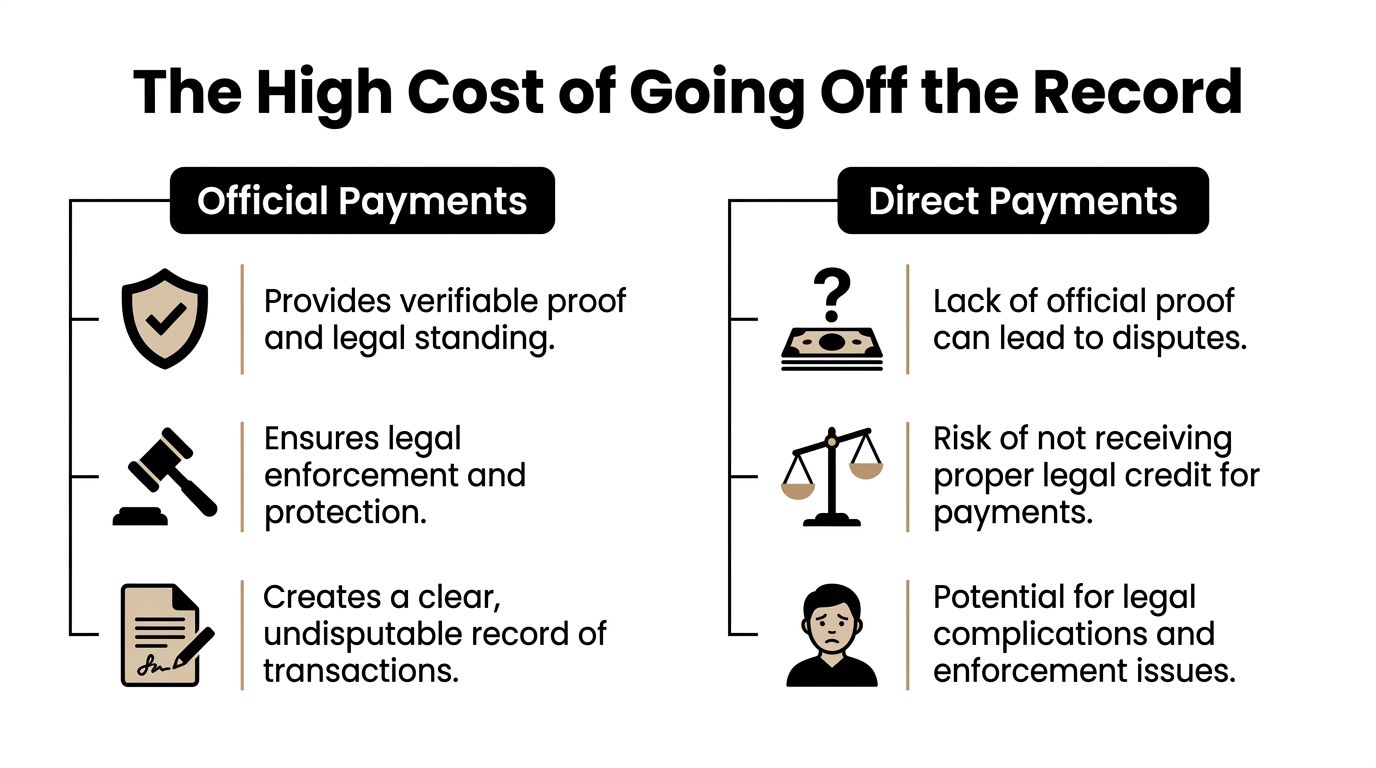
The legal problem is not payment alone. It is provable payment.
In Texas, direct child support payments are dangerous because they create a proof fight you did not need to have. The order usually requires payment through the State Disbursement Unit. If you pay outside that system, you step outside the clean record the court expects.
That is where Ochsner v. Ochsner matters. The Texas Supreme Court rejected the old hardline view that direct payments could never count. A parent may receive credit for off-the-books payments if that parent proves them as an affirmative defense under the evidence standard the court applies. See the discussion of that ruling in Onda Family Law’s summary of Ochsner.
Read that case correctly. Ochsner gave paying parents a possible defense. It did not turn direct payment into a good plan. It did not rewrite your order. It did not make Venmo, cash, Zelle, rent payments, or grocery runs equivalent to an SDU record.
That distinction decides real cases.
| Feature | State Disbursement Unit (SDU) | Direct Payment to Parent |
|---|---|---|
| Proof of payment | Official state record | You must assemble and authenticate your own proof |
| Enforcement defense | Usually straightforward | Often turns into a credibility dispute |
| Risk payment is treated as a gift or separate expense | Low | Much higher |
| Compliance with most Texas orders | Yes | Often no |
What goes wrong in court
Enforcement hearings move fast. Judges want a ledger. If the Attorney General’s record shows missed payments, you start in a hole. Then you have to dig out with bank statements, screenshots, receipts, text messages, and testimony.
Some evidence helps. A clear transfer labeled “May 2024 child support” is better than a payment memo that says “for kids.” Cash is the worst choice. Payments for rent, school supplies, clothes, or extracurriculars are also risky because they often look like voluntary support for extra needs, not court-ordered child support.
Texas courts can enter a money judgment for arrears, add interest where allowed, issue income withholding, suspend licenses, and impose other collection remedies. If the case gets far enough, the consequences start looking like the ones described in this guide on what happens if child support is not paid. None of that is theoretical. I see parents spend more proving old direct payments than they would have spent simply following the order.
The expensive misconception about “we had an agreement”
Private side deals fail all the time. One parent says, “Just send it straight to me.” The other parent agrees. Months later, the relationship changes, a new spouse gets involved, or money gets tight. The informal arrangement suddenly disappears, and the case returns to the written order.
The written order usually wins.
Under the Texas Family Code, child support duties and enforcement rights are creatures of the order and the statute, not casual text-message agreements. If you want a different method, change the order. Do not rely on cooperation staying friendly for the next five or ten years.
If you already paid directly, do this now
Do not panic. Get organized.
Pull every bank record, transfer history, cashier’s check, money order stub, text, email, and acknowledgment from the other parent. Build a month-by-month timeline that matches each payment to the amount due under the order. Separate true child support payments from gifts and extra expenses. If you paid rent or utilities instead of sending support, flag those items for a lawyer review before assuming you will receive credit.
Then fix the process now. Start paying exactly the way the order requires unless and until the court signs a modification.
A video overview may help if you’re dealing with an arrears or proof issue already.
My advice
Do not treat direct child support payments as harmless shortcuts. In Texas, they are evidence problems waiting to become enforcement problems.
If you already went off the record, your job is to document every dollar and get back into compliance immediately. If you have not started yet, use the SDU and leave yourself a record the court can trust.
Calculating Child Support The Guideline Formula and the 2026 Cap
A lot of support fights start with a simple misunderstanding. The paying parent thinks the number is flexible because the parents have been “working it out.” It is not. In Texas, the court starts with the guideline formula, and the math drives the order unless someone proves a reason to depart from it.
Texas Family Code §154.125 sets the guideline framework. The court calculates the obligor’s net monthly resources, then applies the statutory percentage for the number of children before the court. If a parent earns more than the cap, the guideline percentage applies up to that ceiling, and any amount above it requires proof of the child’s proven needs under §154.123.
The guideline framework
The percentages are straightforward. For one child before the court, the guideline is 20% of net monthly resources under §154.125. The percentage rises as the number of children before the court increases.
The arguments usually center on the inputs, not the multiplication. Lawyers fight about what belongs in net resources, whether a parent is intentionally unemployed or underemployed, and whether the evidence supports a deviation under §154.123. If you get those issues wrong, the final number is wrong.
Texas Family Code §154.062 defines net resources broadly. Wages, salary, commissions, overtime, self-employment income, rental income, severance pay, retirement income, unemployment benefits, and other compensation can all matter. Then the statute allows specific deductions. That is why do-it-yourself calculations often miss the mark.
A practical example
Use a clean example. If a parent has $6,000 in net monthly resources and one child is before the court, the guideline amount under §154.125 is 20%, or $1,200 per month.
If the parent’s net monthly resources exceed the statutory cap, the court does not continue to apply the percentage without limit. The judge applies the guideline to the capped amount first. A higher award requires evidence that the child has proven needs beyond the guideline amount under §154.123.
That distinction matters in real cases. High-income parents often make extra direct transfers for tuition, activities, travel, or housing and later argue those payments should count as support. That argument is dangerous. Texas courts separate court-ordered child support from voluntary extras, and sloppy records make that fight harder than it should be.
The September 2025 cap update
For cases affected on or after September 1, 2025, the net-resources cap increases to $11,700 per month, as noted earlier in the article’s cited Texas child support materials. That change will affect guideline calculations heading into 2026, especially for higher-income cases.
Do the math carefully. With one child before the court, 20% of the updated cap produces a maximum guideline amount of $2,340 per month before any proven-needs analysis under §154.123. The cap matters because it sets the baseline. It does not prevent a higher award if the evidence justifies one.
This is also where experienced counsel earns their fee. A high-income case is not just a worksheet exercise. You need to frame what counts as net resources, challenge inflated “needs” claims when appropriate, and build a record the trial court can defend on appeal.
Why accurate calculation and accurate payment records belong together
The amount in the order and the payment trail have to match. If they do not, enforcement gets ugly fast.
Ochsner v. Ochsner is a reminder that Texas courts treat support obligations as creatures of the order and the statute, not informal family bookkeeping. The lesson for clients is simple. Once the court signs an amount, pay that amount through the channel the order requires and keep your proof clean.
Three disputes show up again and again:
- The parent pays the correct amount directly to the other parent. The official ledger still shows a missed payment.
- The parent sends more than the ordered amount. The extra money is later characterized as a gift or reimbursement, not child support.
- The parents agree to a different number without modifying the order. The signed order remains enforceable as written.
Texas law gives you a formula for setting support. The order gives you the legal obligation. The payment record proves compliance. Treat all three as one system, or you invite an arrears case you should have avoided.
Getting Credit for Payments Already Made The Affirmative Defense
You paid the other parent directly for months, then an enforcement notice arrives showing arrears. That is the scenario that catches parents off guard in Texas. The court does not start with your memory or your good intentions. It starts with the order, the official payment record, and the Texas Family Code.
If you already made direct payments, your job is to prove them with precision. In an enforcement case, payment can be raised as an affirmative defense under Texas Family Code § 157.008. If some of the payments were made before a support order existed, § 154.009 may allow the court to credit those amounts in limited circumstances. The hard truth is simple. Credit is never automatic.

What the court wants to see
Judges do not want a vague claim that you “helped out” or “paid all the time.” They want proof tied to the support obligation month by month.
Bring the strongest records you have:
- Cancelled checks showing the amount, date, and endorsement
- Bank statements matching each transfer to the receiving account
- Payment app records that clearly identify both parties, the amount, and the date
- Signed receipts that specifically say the payment was for child support
- Texts or emails confirming the purpose of the payment
- A sworn statement or testimony from the other parent if that parent admits the payments were support
Cash is where these cases fall apart. If you handed over cash without a signed receipt, expect a fight.
Ochsner is the warning
Texas appellate courts have made the point repeatedly. Child support is controlled by the order and the statutes, not by side deals and informal bookkeeping. Ochsner v. Ochsner is part of that larger lesson. If you want credit, you need evidence that the payment satisfied the legal duty in the order, not just evidence that money changed hands.
That distinction matters. Money for school clothes, rent, birthday gifts, field trips, or a car payment may help your child, but it may not count as child support.
How to present the defense the right way
File with discipline. Sloppy presentations lose credit that could have been saved.
A sound approach usually includes:
- Build a payment ledger. List every claimed payment by date, amount, method, and the monthly obligation it was meant to satisfy.
- Attach proof behind every line item. Judges should be able to move from your spreadsheet to the bank record or receipt in seconds.
- Plead the correct defense or request. In an enforcement action, raise payment as an affirmative defense under § 157.008. In other situations, ask the court to confirm the proper credit based on the procedural posture of your case.
- Separate support from extras. Do not mix gifts, reimbursements, or voluntary add-ons into the same total.
- Prepare for a withholding fix after the hearing. If your recordkeeping has already caused trouble, clean it up with a formal payment method such as Texas child support wage garnishment through income withholding.
One strong exhibit binder beats a long explanation.
Pre-order payments are different
Pre-order payments are treated differently from payments made after a signed order. Under § 154.009, a court can credit support previously provided before the order, but that issue is fact-specific and often contested. The parent asking for credit still has the burden to prove the amounts and their purpose.
As noted earlier in the article, one Texas family law discussion explains that courts may consider documented informal payments and that practitioners often address the issue through a motion seeking credit for those payments. Use that point correctly. It is a reminder to document and plead carefully, not a promise that every direct payment will be credited.
My recommendation if you already paid direct
Do three things immediately. Reconstruct the ledger. Gather every piece of proof. Get in front of the issue before the arrears number hardens into a judgment.
Texas judges can grant credit. They also deny it every day when the payer shows up with a stack of incomplete records and a story. If you want the affirmative defense to work, treat it like an accounting case backed by statute. That is how you turn off-the-books payments into admissible proof instead of expensive arrears.
Formalizing Your Payments Income Withholding and SDU Options
Once a Texas child support order is signed, your job is simple. Pay through a method that creates an official record every time.
Texas law gives you two safe lanes. Use income withholding under Chapter 158 of the Texas Family Code, or send the payment through the State Disbursement Unit tied to your case. Those methods match how Texas enforces support, tracks arrears, and credits payments. They also fit the warning from Ochsner v. Ochsner that side arrangements create proof problems and invite litigation.
Income withholding should be your first choice
If you receive wages from an employer, use withholding. That is the cleanest system in Texas.
The withholding order goes to the employer. The employer deducts the ordered amount and sends it through the official processing channel. You get a payment record without having to build one yourself. If a dispute comes later, you are not relying on memory, text messages, or the other parent’s honesty.
That is why I tell clients to stop resisting withholding. It protects the paying parent as much as it protects the child.
SDU payments are the right answer for self-employed parents and irregular income
Self-employed parents, business owners, gig workers, and independent contractors still need the same paper trail. The difference is who pushes the payment.
If payroll withholding is not available, pay the SDU directly using an approved method tied to your case number. The state record matters. A bank transfer to the other parent may feel faster, but it creates the same problem discussed earlier in this article. You paid money. You may still be shown as unpaid under the order.
For a practical explanation of how withholding works and what happens with employer-based collection, review this guide on Texas child support wage garnishment through income withholding.
Set this up correctly now
Use one system and stick to it.
- W-2 employee: get the withholding order in place and confirm your employer is sending payments correctly.
- Self-employed or contract income: schedule SDU payments on fixed dates every month.
- Variable income: pay early, keep receipts, and match every payment to the case number exactly.
- Any recent direct payments to the other parent: do not assume they count. Keep paying through official channels while your lawyer addresses past-credit issues separately.
My advice is blunt because the risk is real. Convenience causes arrears cases. Official records prevent them.
The safest child support payment in Texas is the one the court can verify from its own file.
When to Modify Your Order vs Making Informal Agreements
Your ex texts, “Just send $300 this month. We’ll fix it later.” You do it. Six months later, you are in court being told you still owe the full ordered amount.
That is how arrears cases start.
If the problem is that the order no longer fits your life, stop making side deals and file a modification. Texas courts enforce the signed order, not the private arrangement you made to get through a rough month. Under Texas Family Code Chapter 156, modification is the tool for a material and substantial change in circumstances. An informal agreement is only a future lawsuit waiting to happen.
When modification is the right move
File to modify when the facts changed in a way the current order does not reflect, such as:
- Your income dropped or increased in a meaningful way
- The child is now living with you more of the time
- Health insurance, cash medical support, or uncovered medical cost arrangements changed
- A prior guideline deviation under Texas Family Code § 154.123 no longer makes sense
- The current support amount should be recalculated under the updated cap that takes effect in September 2025
The 2025 cap matters in higher-income cases. If your case will be decided after that update takes effect, the guideline analysis may look different than it did when your current order was signed. That is another reason to fix the order formally instead of improvising by text.
Informal agreements create two separate problems
First, they do not change the legal amount due. If your order says one amount and you pay another, the unpaid difference can still be treated as arrears until a judge signs a new order.
Second, informal agreements are usually vague. Parents often agree to “help with expenses instead” or “catch up later,” but they never define dates, amounts, or whether those payments satisfy child support. That ambiguity is poison in an enforcement case.
Use a modification case to put the new terms in writing, get them signed, and make them enforceable.
What I recommend
Act fast. Do not wait for months of underpayments to pile up.
If the amount needs to change, file a petition to modify and keep paying under the existing order as closely as you can until the court signs a new one. If the other parent is willing to agree, turn that agreement into a signed modified order. If the other parent is not willing, set the case for hearing and let the judge decide it.
A text-message agreement feels easy. A court order protects you.
Frequently Asked Questions About Texas Child Support Payments
Can I pay child support directly if the other parent agrees
Usually, no. Not safely. If your order requires payment through the SDU, private agreement doesn’t override the order. You need the order changed if you want a different method.
If I paid cash, will the court give me credit
Maybe, but cash is the worst form of proof. You’ll need strong supporting evidence, such as signed receipts or admissions from the other parent. Without that, you’re asking the court to trust memory over the official record.
Can I pay for rent, clothes, or school expenses instead of support
Not unless your order allows that or the court later credits those payments. Paying household or child-related expenses may help your child, but that does not automatically satisfy a support obligation.
What if my employer is already withholding support
Then leave it alone unless the court orders otherwise. Wage withholding is one of the safest methods because it routes money through the official system and reduces proof disputes.
What should I do if I already made direct payments
Start organizing records immediately. Build a month-by-month payment history and prepare to file the appropriate motion or assert payment as a defense if enforcement is pending.
Does the September 2025 cap update matter in my case
It may. If your case involves higher income and will be decided after the update takes effect, the $11,700 net monthly resource cap effective September 1, 2025 can affect the guideline analysis under §154.125, with possible deviation arguments under §154.123.
If you need clear answers about paying support correctly, fixing past direct payments, defending an enforcement action, or modifying an outdated order, Texas Child Support Law Office of Bryan Fagan helps parents across Texas build a practical court strategy based on the Texas Family Code, real payment records, and the facts that matter in front of a judge.