Your child support order made sense when it was signed. Then life changed.
Maybe your income dropped after a layoff. Maybe your compensation went up and the other parent is asking for more. Maybe the child now needs different medical care, tutoring, therapy, or a different possession schedule. In practice, most parents who search modify child support texas aren’t trying to start a fight. They’re trying to get the order to match reality before arrears build up or the current amount becomes unworkable.
Texas law gives you a structured way to do that. Under Texas Family Code §156.401, there are two legal paths to modify child support: a material and substantial change in circumstances or the three-year review rule. Those paths sound simple on paper, but hearings are usually decided by details such as dates, income proof, guideline math, and whether the judge believes the change is real and lasting.
The strongest cases are built backward from the hearing. You don't begin with outrage or a rough estimate. You begin with the right legal standard, the right documents, and a support calculation that can survive scrutiny. If you're trying to understand when a change qualifies as a substantial change in circumstances under Texas law, that distinction matters early because it affects every filing and every argument that follows.
Is It Time to Modify Your Texas Child Support Order?
A common scenario looks like this. A parent has been paying the same amount for years. The order was entered when they had stable employment, predictable pay, and a standard possession schedule. Now the facts are different. The child spends more time in one home. Insurance costs changed. A commission structure disappeared. The old order still exists, but it no longer fits the family.
Texas law recognizes that problem. Texas Family Code §156.401 allows a court to modify support in two situations: when there has been a material and substantial change in circumstances, or when the three-year review rule applies. Under that three-year rule, modification may be available if the current order is at least three years old and a guideline recalculation would change the monthly amount by at least 20% or $100, as summarized in this discussion of Texas child support modification standards.
What usually brings parents to court
Some changes are obvious. Job loss is one. A major raise is another. A child’s needs can also shift in ways that affect support, especially when medical or educational expenses become more significant than they were when the order was signed.
Other cases are less obvious. A parent may have moved from salary to self-employment. A possession schedule may function very differently from what the order says. Or one parent may have informally accepted a lower amount for months, only to learn that the original order is still enforceable until a judge signs a new one.
Practical rule: A side agreement between parents doesn’t modify a court order. Until a new order is signed, the existing one controls.
The question that matters first
Before filing, ask one question: Which legal path fits your facts better?
If your order is old enough and the guideline math clearly changes, the three-year rule may be the cleaner route. If the timing doesn't work but your facts have changed, a material-and-substantial-change claim may be stronger. The right choice isn't academic. It shapes the evidence you need, the arguments you make, and the weaknesses the other side will try to expose.
Grounds for Modification The Two Legal Pathways in Texas
The court doesn't modify support because a parent feels squeezed or frustrated. The court modifies support when the facts fit a legal standard. In Texas, that usually means choosing one of two pathways and proving it with documents.
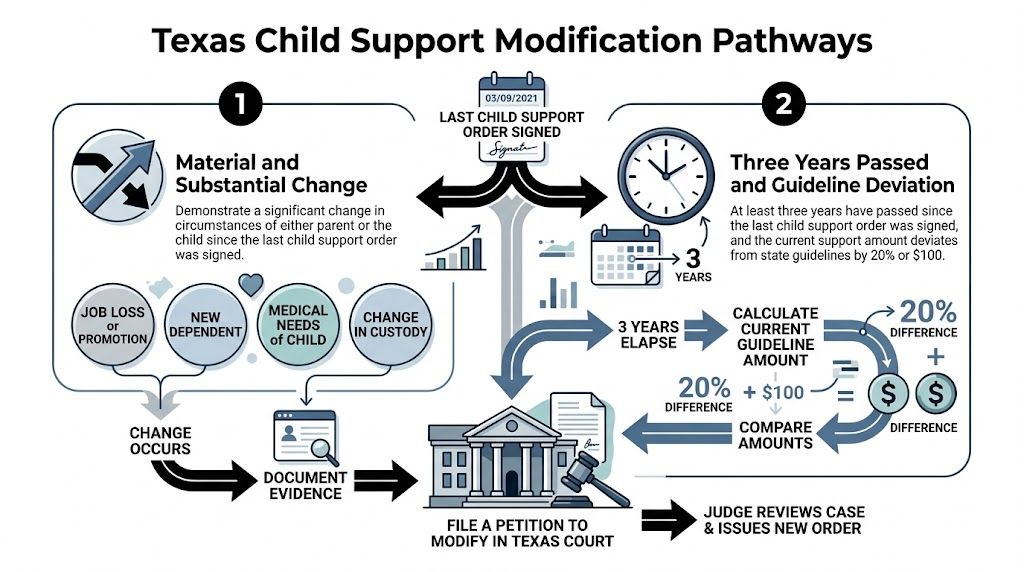
Material and substantial change
This is the broader pathway. It's also the one parties misuse most often.
A material and substantial change in circumstances requires a real comparison between conditions when the last order was signed and conditions now. Courts want contemporaneous proof. They don't want broad statements like "business is down" or "the schedule changed." They want records showing what changed, when it changed, and why it matters.
As summarized in this guide on modifying a child support order in Texas, qualifying changes can include significant income shifts, custody changes, or disability determinations. The same source also notes a point that matters in many hearings: voluntary unemployment or intentional income reduction usually fails, because courts expect good-faith efforts to maintain earning capacity.
What usually works
Strong material-change cases often include a before-and-after record:
- Income proof from both periods: Pay stubs, tax returns, profit and loss statements, or employment letters that show what the court relied on before and what the parent earns now.
- Custody proof: Calendars, school records, exchange logs, or other records showing a real change in where the child lives and who bears daily expenses.
- Child-need proof: Medical records, invoices, insurance changes, or school documentation tying new expenses to the child’s present needs.
What usually fails
Some arguments look compelling to a parent but don't persuade a judge.
| Argument | Court concern |
|---|---|
| "I took a lower-paying job." | Was the reduction voluntary? |
| "My business had a slow month." | Is the decline temporary or ongoing? |
| "We already agreed to a new amount." | Where is the signed court order? |
| "I have the child more often now." | What records prove the actual schedule? |
If you're self-employed, expect closer scrutiny. Courts often want a longer view of earnings, not a single lean month. If you changed jobs by choice, the other side may argue underemployment. If that argument sticks, the court can focus on earning capacity instead of actual current pay.
Bring records that tell a timeline. Judges don't modify orders on impressions alone.
The three-year review rule
The second pathway is narrower but often cleaner. Texas allows modification when three years have passed since the order was established or last modified and a new guideline calculation would differ by at least 20% or $100 per month, as described in this step-by-step discussion of modifying child support in Texas.
This path is useful because it doesn't depend on proving a dramatic life event. It depends on dates and math. If the timeline qualifies and the guideline amount moves enough, the court has a statutory basis to consider modification.
Choosing the right path strategically
Parents sometimes assume the three-year rule is always easier. Not always.
Use this comparison:
- Use material change when the facts are recent, substantial, and well documented, but the last order isn't old enough for the three-year route.
- Use the three-year rule when the date requirement is met and the guideline recalculation is straightforward.
- Use caution with weak overlap cases where the order is old but the math is marginal and the life change is poorly documented. Those are the cases judges deny because neither theory is presented cleanly.
A practical example helps. If your income changed in a way that clearly alters guideline support and the order is already old enough, the three-year route may avoid fights over whether the change was "substantial." If your order is newer but the child’s needs changed significantly, waiting for three years may be a mistake.
Calculating Guideline Support Under the New 2026 Rules
Most modification cases turn on math after they turn on eligibility. If you can't show the court a credible guideline calculation, your case stays abstract. Courts decide support by applying the Family Code to actual net resources, not by reacting to what feels fair.
Start with net monthly resources
Under Texas Family Code §154.125, guideline child support is based on the obligor’s net monthly resources. In a modification case, that means the court will examine current income carefully, especially if compensation is irregular or self-employment income is involved.
For a practical walkthrough, review this explanation of how to calculate child support in Texas. In court, the issue is rarely just gross pay. The issue is what the judge accepts as net resources after reviewing the evidence.
The guideline percentages that matter
For many modification hearings, the first percentages to know are the core guideline rates tied to the cap:
| Number of children before the court | Guideline percentage |
|---|---|
| One child | 20% |
| Two children | 25% |
| Three children | 30% |
Those percentages matter most when the paying parent's income approaches or exceeds the statutory cap. They also matter when you're testing whether the three-year rule supports filing.
The September 1, 2025 cap change
One of the most important recent changes is the increase in the net monthly resources cap from $9,200 to $11,700, effective September 1, 2025, under Texas Family Code §154.125. That update directly affects high-income modifications, as outlined in this summary of the Texas child support cap increase effective September 1, 2025.
The example from that source is worth understanding because judges and lawyers use this kind of simple cap-based comparison in hearings:
| Scenario | Calculation | Monthly support for two children |
|---|---|---|
| Pre-2025 cap | $9,200 × 25% | $2,300 |
| Post-2025 cap | $11,700 × 25% | $2,925 |
That is a $625 monthly increase under the updated cap for a two-child case at the cap level.
Why that matters in modification cases
If you're the parent paying support and your prior order was calculated under the old cap, a post-September 1, 2025 recalculation can produce a materially different result even when your income pattern hasn't changed much. If you're the parent receiving support, the cap change may create a stronger basis to revisit an older high-income order.
This doesn't mean every high-income case automatically increases. It means the ceiling used for guideline calculations has moved. The practical effect depends on where the obligor's proven net resources fall, whether there are other child support obligations, and whether a deviation argument is supported.
The hearing usually turns on one question: what number can you prove, not what number can you argue.
When courts depart from the guideline amount
Guidelines are the starting point, not the end of the analysis. Under Texas Family Code §154.123, courts may deviate from the guideline amount when applying the straight formula would be unjust or inappropriate.
Common deviation issues include:
- Possession realities: A parent may have far more day-to-day expenses than the standard order suggests.
- Medical support: Ongoing healthcare costs can shift the practical burden even where base support follows the guideline.
- High-income child needs: In some cases, the dispute isn't whether the cap applies, but whether the child’s proven needs justify a different figure.
- Existing obligations and arrears: Judges often want a complete picture, especially when withholding, reimbursement, or past-due amounts interact with current support.
Real-world calculation trade-offs
Parents often want a quick answer. Courts want a supported one.
If you're salaried, calculation is usually more straightforward. If you're paid by bonus, commission, contract income, or business draws, expect disputes over averaging and documentation. If you own a business, the court may look past a single tax line and examine whether claimed business expenses reflect actual personal benefit.
That matters because weak math invites judicial skepticism. A clean spreadsheet backed by tax returns and pay records usually carries more weight than a verbal estimate delivered from the witness stand.
A practical hearing checklist
Before you ask the court to recalculate support, have these ready:
- The last child support order. The judge must compare the old order to current facts.
- Current income records. Pay stubs, tax returns, business records, or compensation summaries.
- Insurance and child-related cost proof. Especially if medical support or reimbursements are disputed.
- A proposed calculation. Show your math clearly.
- A proposed order. Judges are more receptive when the requested relief is reduced to workable paperwork.
Navigating the Court Process Step by Step
A good modification case can still fail if the procedure is sloppy. Texas courts expect a clean filing, proper service, organized financial proof, and a request that matches the evidence. If one of those pieces is missing, the hearing can stall or the judge can deny relief without much patience.

Step one file in the right court
Most modifications must be filed in the court with continuing jurisdiction over the child support order. Start by pulling the existing order and confirming the cause number, the county, and the exact terms currently in effect.
Your petition should state the legal basis for modification and the relief requested. Be precise. If you're relying on a material and substantial change, identify the change. If you're relying on the three-year route, the dates and recalculation basis should be apparent from the filing.
Step two get the other parent served
A modification doesn't become retroactively effective just because you meant to file earlier or discussed it informally. Formal service matters.
That means the other parent must be properly served unless service is waived in a legally valid manner. Don't treat this as a technical nuisance. In support cases, service affects influence, timing, and what relief the court can grant.
Step three gather proof before the hearing date appears
Many parents file first and organize later. That's backward.
The best practice is to build your proof immediately after filing. That usually includes income records, prior tax returns, proof of insurance cost, daycare or child-related expense records, possession calendars, and any records showing a real shift in circumstances since the last order.
A lawyer may use formal discovery if the other side won't disclose records voluntarily. The Texas Child Support Law Office of Bryan Fagan handles these modification issues through filing, discovery, mediation, and hearings for parents dealing with guideline disputes, underemployment allegations, and 50/50 custody questions.
Step four prepare for the underemployment fight
One of the most common defenses in a downward modification case is this: "You could earn more than you're claiming."
Under Texas Family Code §154.066, courts can impute income based on earning potential in underemployment cases. As discussed in this analysis of Texas underemployment findings in child support modification disputes, parents who want to counter that argument should present evidence of involuntary circumstances such as market downturns or health issues, supported by expert testimony on industry salaries, asset affidavits, and longitudinal income records.
That means "I lost business" usually isn't enough by itself. Strong rebuttal evidence often includes:
- Employment market proof: Job search records, industry postings, recruiter communications, or expert evidence about salary ranges.
- Medical support for work limits: Records that connect a health condition to actual earning restrictions.
- Income history over time: Records showing the decline wasn't engineered for litigation.
- Asset evidence: If the other side claims you can liquidate assets or are hiding resources, address it directly.
A judge is more likely to believe a parent who anticipated the underemployment argument and answered it with records.
A short overview of the hearing process can help frame what comes next.
Step five mediation and final hearing
Many courts expect mediation before a contested final hearing. A good mediation position starts with the same thing a good hearing position starts with: a reliable calculation and proof that you can defend under questioning.
If the case doesn't settle, expect the judge to focus on a few core topics:
| Hearing issue | What the court usually wants |
|---|---|
| Legal basis | Why modification is allowed under the Family Code |
| Income | Clean documentation, not estimates |
| Child-related costs | Records, invoices, insurance proof |
| Requested amount | Guideline math or a deviation argument tied to §154.123 |
| Credibility | Consistency between testimony and documents |
Step six get the signed order and withholding in place
Winning the hearing isn't the end. The modified order must be signed, entered, and implemented. If wage withholding applies, make sure the withholding order reflects the new amount. A verbal ruling that never becomes an enforceable written order creates avoidable problems fast.
Advanced Topics Retroactive Support and 50/50 Custody
The hardest modification disputes usually involve timing and possession. Parents often assume fairness alone will carry those issues. It won't. Courts want proof, and they want the legal theory tied closely to the facts.
Retroactive modification starts later than most parents think
One of the most expensive mistakes in a support case is waiting. A parent loses income, struggles for months, and assumes the court will backdate relief to the date the problem began. That usually isn't how modification works.
In practice, timing often turns on filing and service. If you're dealing with this issue, it's worth reviewing how retroactive child support works in Texas, because parents frequently confuse retroactive support concepts with retroactive modification relief.
The strategic lesson is simple. If the existing order no longer matches reality, act promptly. Delay gives the arrearage more time to grow and makes settlement harder.
Equal possession doesn't automatically mean zero support
Parents with a true shared schedule are often surprised by this. Even when possession is close to equal, the court may still order support.
As discussed in this overview of Texas child support modification issues involving 50/50 custody, courts often deny zero-dollar orders when incomes are unequal, require proof that costs are equalized, and may favor proportional sharing over a zero-support model. That source also notes that 50/50 arrangements surged 22% in Texas divorces, and 40% involved support disputes over uneven soft costs.
What judges actually look for in 50/50 cases
Judges usually focus less on the label "50/50" and more on the money flow behind it.
Relevant proof often includes:
- Actual possession evidence: Calendars and records showing the schedule is equal in practice, not just on paper.
- Expense allocation: Who pays school costs, extracurricular expenses, clothing, activities, therapy, and transportation.
- Medical support structure: Which parent provides insurance, who advances out-of-pocket care, and how reimbursements are handled.
- Income imbalance: If one parent earns substantially more, the court may conclude equal time doesn't equal equal financial capacity.
Shared time and equal cost are not the same thing. Courts know that, and your evidence needs to reflect it.
Using §154.123 effectively in possession-heavy cases
Texas Family Code §154.123 takes on significance. In a shared-possession case, guideline support may be the starting point, but the court may consider deviation factors when a straight guideline result doesn't reflect the child’s actual circumstances.
The strongest 50/50 modification arguments usually don't demand "zero because time is equal." They show the court a practical framework for allocating support, insurance, and recurring child expenses in a way that fits the actual schedule and the parents' respective resources.
Common Questions About Texas Child Support Modification
How long does a modification case take
That depends on whether the case is agreed or contested, how quickly service is completed, and how complicated the income issues are. A straightforward agreed modification usually moves much faster than a case involving self-employment income, underemployment claims, or a dispute over possession.
Can we just agree to a new amount without going to court
You can agree in principle, but the enforceable amount remains the one in the signed order until a judge signs the modification. That's why informal payment changes create trouble. One parent thinks the issue is resolved. The court record says otherwise.
What if I lost my job and can't pay the current amount
File promptly and document the loss thoroughly. If the other side claims you're intentionally underemployed, you'll need evidence showing the job loss or income reduction was involuntary and that you're making good-faith efforts to maintain earnings.
Does 50/50 custody eliminate child support
Usually not automatically. Courts often still examine income differences, medical support, and who is paying major child-related costs. Equal possession is important, but it isn't the only financial fact the court considers.
What documents should I bring to my hearing
Bring the current order, recent pay records or business records, tax returns if relevant, proof of insurance costs, records of child-related expenses, and any documentation supporting your modification ground. If your case involves custody changes, bring calendars or logs that show the actual schedule.
Can the court use earning capacity instead of actual income
Yes. In the right case, the court can impute income if it believes a parent is intentionally unemployed or underemployed. That's why unsupported claims of reduced earnings are risky, especially when the parent changed jobs voluntarily or has assets the court may consider.
What happens after the judge grants the modification
The new order must be signed and entered. If wage withholding applies, the withholding paperwork should also be updated to reflect the modified amount. Until the paperwork catches up, administrative problems can continue even after a favorable ruling.
Should I file through the OAG or directly in court
That depends on the facts. Simpler uncontested cases may fit an administrative review. Cases involving deviations, high-income disputes, underemployment arguments, or contested 50/50 issues usually require closer court-focused preparation because those details often need active judicial decision-making.
If your current order no longer fits your income, your parenting schedule, or your child’s needs, the next move should be a strategy decision, not a guess. The Texas Child Support Law Office of Bryan Fagan represents parents in modification cases involving guideline recalculations, high-income support under §154.125, deviation arguments under §154.123, underemployment disputes, and 50/50 custody issues across Texas.