You filed for divorce, custody, paternity, or modification, and the bills didn't pause just because the case started. One household is buying groceries, paying rent, covering school expenses, and keeping the lights on while the other parent may still be deciding whether to contribute voluntarily. That gap is where temporary child support orders matter.
In Texas, the temporary orders hearing is often the first time a judge sees your financial reality on paper and hears your explanation under oath. Clients sometimes think of it as a short-term hearing that just gets them through the next few months. That's a mistake. In practice, temporary child support can shape negotiation advantages, set expectations, and create a status quo that influences how the rest of the case unfolds, especially in high-income or shared-possession disputes.
Understanding Temporary Orders and Why They Matter in Your Case
A temporary child support order is the court's way of creating financial stability for a child while the case is pending. It gives structure where there was uncertainty. If support has stopped, or if it was never being paid consistently, this is the tool that puts a binding number in place before final orders are signed.

Texas courts don't issue these orders in a vacuum. They can only issue temporary child support when there's already a pending SAPCR, meaning a Suit Affecting the Parent-Child Relationship, such as a divorce, custody, modification, or paternity case, as explained by McClure Law Group's discussion of temporary child support in Texas. That procedural point matters. If no qualifying case is on file, there is no temporary child support hearing to request.
Why timing matters
Parents usually ask the same practical question first: how fast can support start?
The answer depends on how quickly the case is filed, how quickly the motion for temporary orders is presented, and how prepared you are when the hearing date arrives. The parent who files early and comes to court with organized financial proof usually has a stronger chance of framing the first support number in the case.
Practical rule: Temporary orders are not paperwork for later. They are often the first meaningful opportunity to define what the judge sees as reasonable support.
Why temporary orders influence the final case
Judges care about stability for children. If a temporary arrangement works, the court may be less interested in changing it without a good reason. That doesn't mean temporary support automatically becomes final support. It does mean the temporary hearing can establish a pattern.
A weak showing at temporary orders creates problems that are harder to fix later. A strong showing does the opposite. It sets a baseline, documents need, and forces the other side to respond to evidence instead of general claims.
Consider the strategic difference between these two positions:
- Unprepared parent: Brings rough estimates, no pay records, no child expense summary, and asks the judge to "be fair."
- Prepared parent: Brings pay stubs, tax returns, health insurance proof, childcare costs, and a clear proposed order tied to Texas guideline support.
One of those presentations gives the court a usable record. The other leaves room for the judge to default to whatever limited evidence is available.
The Legal Foundation for Temporary Child Support in Texas
Texas temporary child support rests on a mix of procedural authority and child support standards in the Texas Family Code. In a divorce case, temporary orders commonly arise under the court's temporary-order authority. In SAPCR cases involving parent-child issues directly, the court also has authority to enter temporary orders while the suit is pending. The practical point is simple: once the parent-child case is properly before the court, the judge can enter interim orders to protect the child's welfare and keep the case stable until final orders are entered.
The legal standard driving these rulings is the best interest of the child. For financial issues, that standard isn't abstract. Judges look at what the child needs, what each parent earns or can earn, and who is paying the recurring child-related expenses while the case is pending.
Guideline support is the starting point
Texas courts generally begin with the guideline framework found in Texas Family Code §154.125. The Texas State Law Library notes that temporary child support is designed to provide stability while the case is pending, that it requires an active SAPCR, and that courts rely on the child's best interest and the parents' financial circumstances when setting support in temporary orders. The same resource identifies the baseline guideline percentages as 20% of net monthly income for one child, 25% for two, 30% for three, 35% for four, and 40% for five or more children in the Texas State Law Library guide on temporary orders.
That guideline structure matters because it gives the court a recognized starting point. It also gives lawyers a predictable framework for preparing evidence and proposing numbers.
If you want a broader statutory overview, this breakdown of Texas Family Code child support provisions is a useful companion to the Code sections most often argued at temporary orders.
Deviation is possible, but it must be grounded in evidence
Guidelines are a starting point, not the end of the analysis. Under Texas Family Code §154.123, a court can deviate from guideline support when the facts justify it. That's where many temporary hearings are won or lost.
A parent asking for more or less than guideline support needs to show why. The court is not likely to make a thoughtful deviation based on frustration, suspicion, or broad statements that the other parent "has money." The court needs admissible facts.
Judges don't reward vague narratives. They reward clear records.
What the court is really evaluating
At a temporary hearing, the legal question is often narrower than clients expect. The judge usually isn't deciding every long-term issue in the case. The judge is deciding what support order will hold things together fairly and lawfully while the case is pending.
That means these questions carry real weight:
- What are the paying parent's net resources under the Code?
- What child-related expenses are already being paid, and by whom?
- Is guideline support appropriate, or is there a legally supportable reason to deviate under §154.123?
- What arrangement best protects the child's stability until the final hearing or settlement?
Those are the questions your evidence has to answer.
How to Obtain or Contest a Temporary Child Support Order
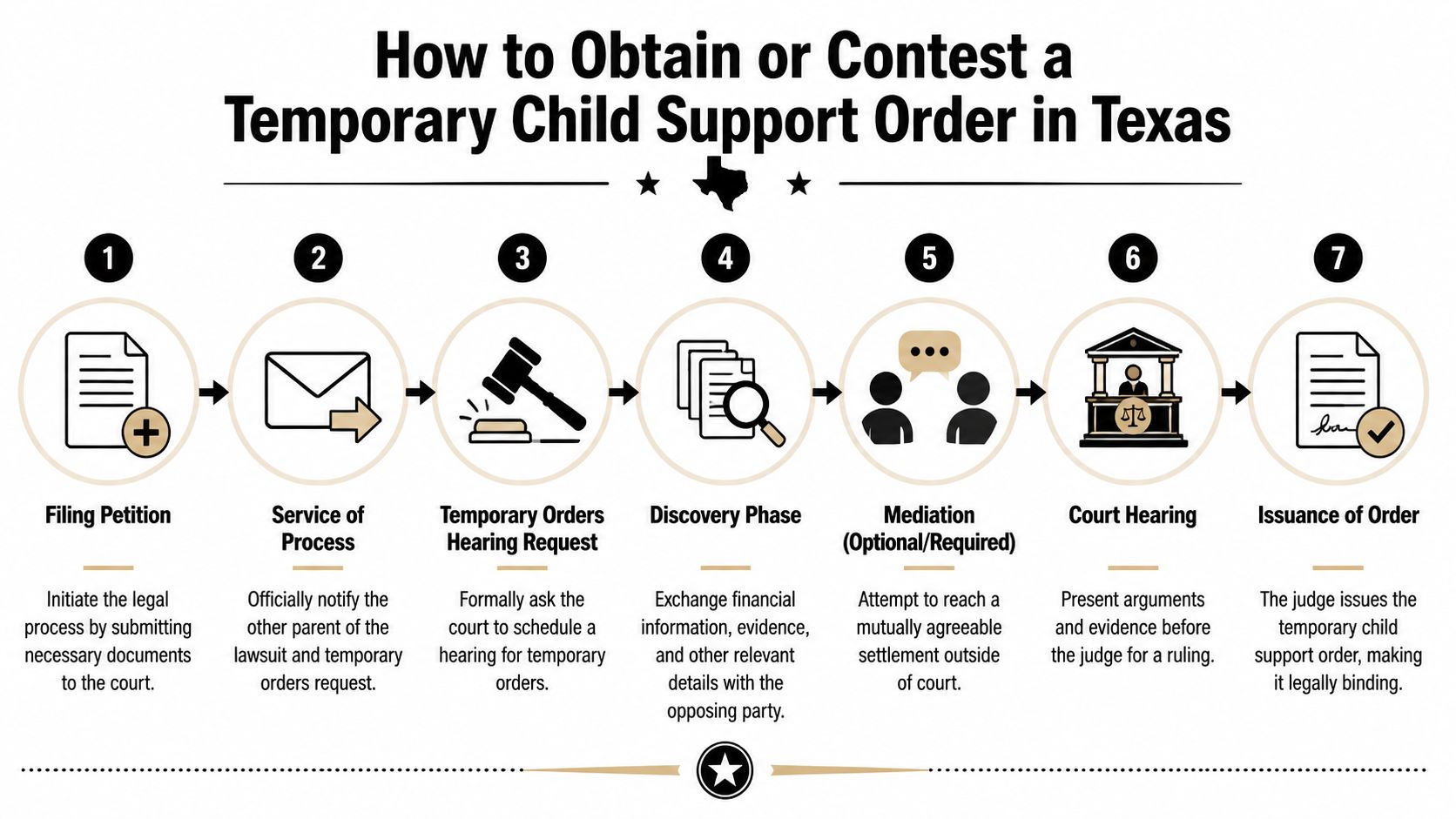
Temporary child support doesn't appear automatically when a case is filed. Someone has to ask for it, put the issue before the court, and support the request with evidence. If you're seeking support, speed and preparation matter. If you're contesting the requested amount, detail matters just as much.
Step one starts with the underlying case
You need a pending family law case involving the child. That may be a divorce with children, a SAPCR, a paternity case, or a modification. Once that suit is on file, the requesting party files a Motion for Temporary Orders asking the court to set support and any related temporary relief.
In practice, that motion should do more than say "order child support." It should identify what relief you're asking for, what possession arrangement is being proposed, who is paying medical coverage, and why the requested amount is appropriate.
Service and notice are not optional
After filing, the other parent must receive proper notice. If the other side hasn't been served correctly, or if the hearing notice doesn't satisfy the applicable rules and local practice, your hearing can be delayed or your request can be denied for that setting.
That is one reason rushed filings without a coordinated service plan often backfire. Urgency helps only if procedure is handled correctly.
TROs and temporary orders are not the same thing
Parents under stress often hear "emergency order" and assume that means money can start immediately. That's not how it works.
TexasLawHelp explains that a TRO lasts only 14 days or until the temporary-orders hearing, whichever is sooner, and that a TRO cannot include child support or custody orders, while temporary orders can include child support, as stated in TexasLawHelp's guide to temporary orders and TROs.
That distinction matters in real life:
- Use a TRO when you need immediate restraint related to safety, property, or conduct.
- Use temporary orders when you need enforceable child support, custody provisions, and interim family management rules.
If your plan is "we'll get a TRO and that will make support start," the plan is incomplete.
What to bring to the hearing
The strongest temporary child support presentations are document-driven. A parent who walks in with organized financial proof gives the judge something usable. A parent who relies on memory usually creates avoidable doubt.
Bring the documents that prove income and child-related expense allocation. Depending on the facts, that often includes:
- Income records: Recent pay stubs, W-2s, tax returns, profit-and-loss records if self-employed, and any commission or bonus documents.
- Insurance proof: Evidence showing who carries the child's health or dental coverage and what that cost is.
- Childcare documents: Invoices, payment logs, or provider statements if work-related childcare is being paid.
- Expense summary: A clean list of recurring child expenses. Housing, food, school-related needs, and transportation are often part of the practical discussion even when not every expense is separately reimbursed.
If income is disputed, you may also need bank records, affidavits, business documents, or subpoenaed records. Cases involving cash income, self-employment, or inconsistent reporting require more preparation, not less.
How to request a strong temporary amount
Don't ask the court for a number without showing the path to that number. The better approach is to present:
- the legal basis for support,
- the evidence of income,
- the applicable guideline calculation under §154.125,
- any requested deviation under §154.123, and
- the proposed order language.
That last part matters. Judges and associate judges appreciate parties who make the requested relief easy to sign if the evidence supports it.
How to contest the request effectively
If you're on the receiving end of a temporary child support request, the wrong move is to show up angry and underprepared. The right move is to challenge the inputs.
You may contest:
- Income assumptions: If the other side inflated your pay, omitted business expenses in a self-employment case, or ignored recent employment changes.
- Possession facts: If the proposed parenting schedule doesn't reflect reality.
- Medical or childcare claims: If the expense is inaccurate, duplicated, or not being paid by the requesting parent.
- Deviation arguments: If the request goes beyond guideline support without evidence tied to §154.123.
A well-defended case doesn't necessarily seek the lowest number. It seeks the correct number under the evidence.
Mediation can resolve temporary issues
Many courts encourage or require mediation before a contested hearing. That's often useful if both sides have exchanged enough financial information to make realistic proposals. Temporary mediation tends to work best when each side has documents, not just positions.
For parents looking for focused support in preparation, one option is Texas Child Support Law Office of Bryan Fagan, which handles child support establishment, modification, enforcement, and income disputes under the Texas Family Code.
Calculating Temporary Support The Texas Guideline Formula
Temporary child support in Texas usually begins with net resources, not gross pay. That distinction is where many mistakes happen. Parents look at salary alone and assume the support number should flow directly from it. The court doesn't work that way.
Under Texas Family Code §154.062, the court looks to a parent's net resources. Then, under §154.125, the court applies the guideline percentage based on the number of children before the court.
The guideline percentages
The baseline percentages are straightforward once net resources are established.
| Number of Children | Percentage of Net Resources |
|---|---|
| One child | 20% |
| Two children | 25% |
| Three children | 30% |
| Four children | 35% |
| Five or more children | 40% |
These percentages come from the temporary-orders guidance summarized by the Texas State Law Library in the source cited earlier.
For a practical walk-through of the same framework, this guide to calculating child support in Texas is helpful when you're organizing documents for the hearing.
What the court examines in a temporary calculation
The temporary calculation is evidence-driven. The court considers each parent's income, the possession arrangement, and who is paying health care and childcare expenses. The temporary award is meant to stabilize housing, food, clothing, healthcare, school-related costs, and other basic needs during litigation, and courts may review income statements, proof of expenses, affidavits, and declarations, as described in The Jimenez Law Firm's explanation of temporary child support orders.
That means a temporary order is not a guess. It is an interim calculation based on the evidence the court has at the hearing.
A real-world example without inflated assumptions
Take a parent who earns regular W-2 wages and is paid consistently. The court won't stop at annual salary. It will work through the parent's net monthly resources under the Family Code framework, then apply the percentage for the number of children.
A clean presentation at hearing usually follows this order:
- Start with income proof: Pay stubs, year-to-date earnings, and tax documents.
- Show allowable deductions: The Code governs what counts toward net resources and what reduces them.
- Identify the child count before the court: The percentage changes depending on whether support is being set for one child, two children, and so on.
- Address health coverage and childcare: If one parent is paying these items, that fact may affect the temporary support analysis and related temporary relief.
The best support calculation is the one the judge can verify quickly from the documents in the file and the exhibits in hand.
What works in court and what doesn't
What works is precision. If you're asking the court to use a specific net-resource figure, bring the records that support it. If you're claiming the other parent is understating income, identify the inconsistency with documents.
What doesn't work is giving the court unsupported round numbers. "He makes good money" is not a calculation. "She can afford more" is not a statutory argument. Temporary child support orders texas hearings move quickly, and judges often make decisions based on whichever side presented the cleaner and more credible financial record.
The upcoming cap issue you need to watch
For higher-income cases, the guideline-cap conversation matters. Existing consumer guidance often doesn't explain these disputes well, even though they are common in contested cases. TexasLawHelp materials note this gap and specifically identify the updated $11,700 net-resource cap effective September 1, 2025, along with deviation issues under Texas Family Code §154.123, in TexasLawHelp's temporary orders packet information.
If your case extends into that time frame, or you're preparing strategy around a higher-income temporary hearing, you should account for that change as part of your calculation and negotiation posture.
Special Issues in Temporary Child Support Calculations
The difficult temporary child support hearings are rarely about a parent with a simple paycheck and no dispute over possession. The harder cases involve high income, shared parenting schedules, bonuses, self-employment, reimbursement fights, and disagreement over what the child needs during the case.

High-income cases above the guideline cap
When a parent's net resources exceed the applicable cap, the hearing becomes more technical. The court still starts with the guideline framework, but the dispute often shifts to whether additional support is justified by the child's proven needs under Texas Family Code §154.126.
That phrase matters. Proven needs are not luxury preferences dressed up as child support. They require evidence. If you want more than the capped-guideline amount supports, bring records that tie the request to the child, not the parents' conflict.
Strong evidence in these cases often includes:
- Actual recurring child expenses: school costs, therapies, childcare, and similar documented items
- Reliable income proof: especially if compensation includes distributions, deferred compensation, or irregular pay
- A clear theory of deviation: if you're also invoking §154.123, explain exactly why guideline support would be unjust or inappropriate
The September 2025 cap change matters
The same TexasLawHelp materials noted above identify an updated $11,700 net-resource cap effective September 1, 2025. In a pending or newly filed case that spans that period, the timing can affect settlement posture and hearing preparation.
That doesn't mean every higher-income case turns into a cap fight. It does mean lawyers and parents need to be precise about which legal framework applies on the relevant hearing date and what evidence supports any amount above the baseline guideline analysis.
A 50 50 schedule does not erase support
One of the most common misconceptions is that equal possession means no child support. Texas law doesn't create an automatic zero-support rule for a 50/50 schedule.
Courts still examine income, actual possession, who pays health insurance, who pays childcare, and whether one home is carrying more of the child's day-to-day cost. In many shared-possession disputes, the true dispute is not whether support exists. It is how the court should calculate it fairly in light of the schedule and each parent's resources.
Shared parenting time and child support are related issues, but they are not interchangeable.
A parent with expanded time should still come prepared with income records and proof of expense allocation. Without that record, the court may adopt a number that doesn't reflect the practical economics of the arrangement.
Medical and dental support are separate issues
Parents also overlook Texas Family Code §154.181 and §154.182, which address medical and dental support. Those obligations are not automatically folded into the base child support number in a way that solves every dispute.
If one parent is paying the child's insurance premium, present proof of that. If the parties historically split unreimbursed medical expenses, make sure the temporary order says how those expenses will be handled going forward. Leaving it vague invites post-hearing conflict.
This short video helps illustrate why the details in support cases matter when the numbers are being challenged:
Disputed income requires a paper trail
The biggest gap in many temporary hearings is proof. If the other parent is self-employed, paid partly in cash, or controls business records, don't assume the judge will infer hidden income just because the lifestyle looks inconsistent with the tax return.
Build the record. Use discovery. Request bank statements, profit and loss statements, invoices, contracts, and business account records where appropriate. Temporary hearings move quickly, but a disputed-income case still turns on documents, not suspicion.
After the Hearing Enforcement Modification and Next Steps
Once the judge signs a temporary child support order, it is binding. It is not a suggestion, and it is not something either parent can rewrite by text message. If support is ordered, it must be paid as ordered until the court changes it or the final orders replace it.

Enforcement starts earlier than many parents expect
Most temporary child support orders are set up for enforcement through income withholding. That means the court can sign a withholding order directing the paying parent's employer to send support through the proper channel rather than relying on informal direct transfers.
If payment problems begin, act quickly. Waiting usually makes the record worse and the arrearage larger. This guide on enforcing child support in Texas outlines the enforcement tools commonly used when a parent falls behind.
The size of Texas's child support system helps explain why these temporary orders matter so much in practice. The Texas Office of the Attorney General's Child Support Division administers about 1.5 million child support cases and Texas collected $4.2 billion in child support in 2018, according to MBH Texas Law's child support statistics summary. Temporary orders are the front end of a system built for long-term enforcement, collection, and later modification disputes.
Modification before final orders
Temporary orders can be changed before the final hearing if circumstances shift enough to justify a new temporary ruling. Job loss, a significant change in possession, newly discovered income evidence, or a major change in the child's needs can all become relevant depending on the facts.
But don't assume the court will revisit the order just because one side is unhappy with the first result. Courts expect a concrete reason and updated evidence.
Use the temporary period strategically
The weeks or months after the temporary hearing should be productive. If you're receiving support, keep records and monitor compliance. If you're paying support, pay exactly as ordered and preserve proof. If the number is likely to be disputed again at final trial, use this period to gather the documents you did not have the first time.
A good temporary order gives you a platform. It does not finish the case. It gives you structure for mediation, an advantage for settlement, and a clearer roadmap for the final hearing.
Frequently Asked Questions on Texas Temporary Child Support
Can parents agree to temporary child support without a contested hearing
Yes, if both sides exchange enough financial information to make a real agreement. The agreement should still be reduced to a written temporary order and signed by the court. Verbal side deals create enforcement problems and usually fall apart when possession or expense-sharing becomes disputed.
What if the other parent is self-employed or hiding income
Treat it like an evidence case, because that's what it is. Ask for business records, bank statements, tax returns, invoices, and payment records through discovery. If the income picture is incomplete at the temporary stage, focus on presenting the strongest available record and preserving the issue for further discovery before mediation or final trial.
A judge can work with imperfect evidence. A judge can't work with missing effort.
How long does a temporary child support order stay in effect
Usually until the final order replaces it, unless the court modifies the temporary order sooner. That means the amount set at the temporary stage can control the practical financial reality of the case for a substantial period. That's why the hearing deserves final-trial-level preparation, even though it happens earlier.
Will the temporary amount become the final child support amount
Not automatically. Final support can change if the evidence develops differently, the parties settle on different terms, or the court reaches a different conclusion at trial. Still, temporary numbers often influence the final outcome because they create a working status quo and shape the negotiation range.
Can I ask for child support through a TRO
No. A TRO and a temporary support order serve different purposes. A TRO can address immediate restraint issues, but it cannot set child support. To obtain enforceable support, you need temporary orders entered in the pending case.
What should I do before my temporary orders hearing
Organize your financial records, child-related expenses, proposed possession terms, and any proof about insurance or childcare. If income is disputed, identify exactly what records are missing and how you plan to prove the issue. The parent who presents a clean, documented, legally grounded request usually has the stronger hearing.
If you're preparing for a temporary orders hearing or dealing with a disputed support amount, Texas Child Support Law Office of Bryan Fagan helps Texas parents establish, modify, enforce, and defend child support orders under the Texas Family Code, including high-income cases, 50/50 custody disputes, wage withholding issues, and contested net-resource calculations.