You find out about the order after the damage starts. Your employer tells you a wage withholding order arrived. Money disappears from your paycheck. A bank account gets frozen. You receive notice that a license problem is coming next. That's often the first real notice a parent gets that a default judgment child support texas case has already moved forward without them.
A default judgment means the court entered orders because one side didn't answer or didn't appear. In family law, that can mean current child support, medical support, retroactive support, withholding from earnings, and arrears issues all got decided while only one side was in the room.
If that just happened to you, the most important point is simple. You may still have options, but your options depend on timing. In Texas, the wrong remedy filed at the wrong time can cost you the right one. The legal answer isn't just “file something.” It's choosing the correct procedural vehicle, building the right evidence, and moving fast enough to keep the court from treating the order as final and enforceable.
A Court Order You Never Saw Coming
Texas courts see enough default cases that this isn't some rare procedural fluke. The Texas Judicial Branch FY 2021 Annual Statistical Report shows that more than 20% of cases resulted in a default judgment, and divorce cases made up 38% of roughly 305,000 new or new post-judgment family cases, while another 30% involved Title IV-D child support suits. In plain terms, Texas family courts handle these cases constantly, and defaults materially shape outcomes.
That matters if you just discovered a support order entered against you. Courts, the Office of the Attorney General, and private parties all operate in a system where default judgments are familiar. The system moves quickly once a response deadline passes.
Why clients are usually shocked
Most parents don't ignore a case because they made a strategic decision to give up. Usually, one of these happened:
- Service failed in practice: Papers went to an old address, another adult accepted them, or the parent didn't understand what had been delivered.
- The paperwork was misunderstood: A parent thought talking to the other side was enough, or assumed a hearing notice would come before anything important happened.
- Life got in the way: Work travel, military issues, illness, transportation problems, or a family emergency kept the parent from responding properly.
None of that changes the urgency now. Once a judge signs the order, the issue becomes procedural. The court entered a valid-looking judgment, and you need to decide how to attack it.
Practical rule: The first question isn't whether the order is unfair. The first question is when it was signed and whether service was valid.
What needs immediate attention
If you call my office after learning about a default, I want four things right away:
- The signed order
- The petition and citation
- The return of service
- Any notice showing when you first learned of the judgment
Those documents usually tell you whether you're looking at a motion for new trial, a restricted appeal, or a bill of review. They also show what the court ordered, which is critical because many parents focus only on monthly support and miss medical support, withholding, and arrears language built into the same judgment.
What Is a Default Judgment in a Texas Child Support Case
A Texas child support case usually starts as a SAPCR (Suit Affecting the Parent-Child Relationship), a divorce with children, or an Attorney General case to establish or enforce support. One party files. The other party must be formally served unless service is waived in a legally valid way. After service, the responding party must file an answer under the Texas Rules of Civil Procedure.
If that answer never gets filed, the petitioner can ask the court to proceed by default. But a default is not automatic, and it isn't supposed to be a rubber stamp.
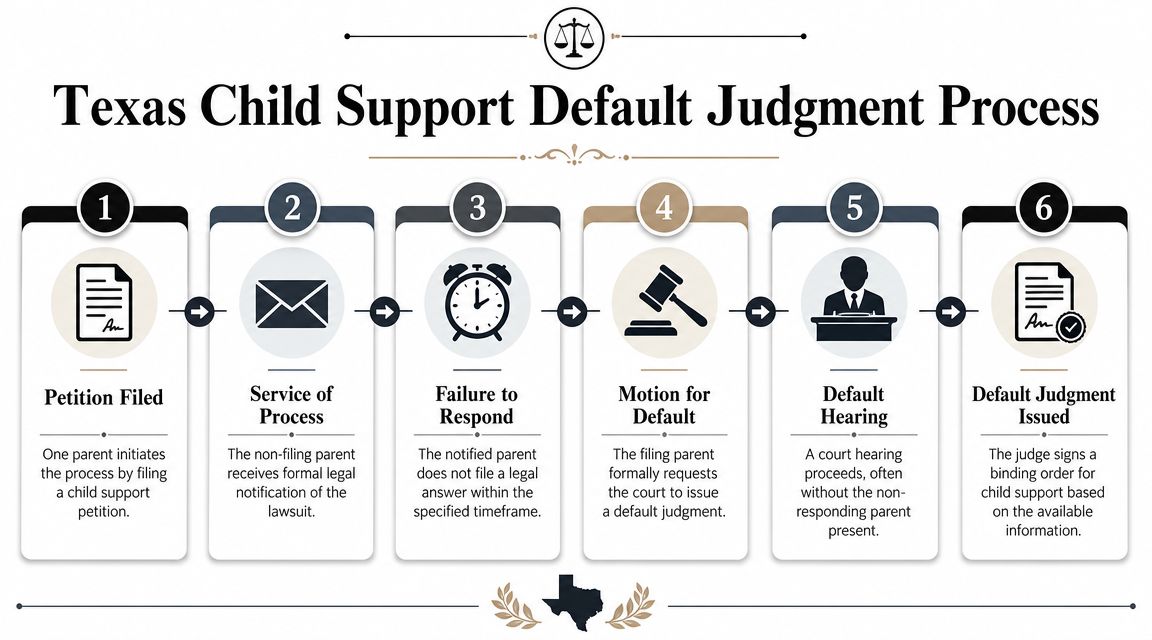
The procedural path to default
The basic sequence looks like this:
- Petition filed
- Service of process completed
- No answer filed by the deadline
- Petitioner requests default
- Court holds a prove-up hearing
- Judge signs an order if the evidence supports it
Service matters because due process matters. In family cases, a parent can't lose rights or take on support obligations without proper notice. Texas procedure requires strict compliance with service rules. If service was defective, that often changes the entire strategy.
The prove-up hearing still matters
Even in a default, the petitioner must present enough evidence for the court to grant child support and related relief. As noted in this Texas default judgment discussion, the court may render support based solely on the evidence presented by the appearing parent, but the petitioner still has to bring records supporting the request, including items like a final decree, wage withholding order, and information supporting the support calculation.
The missing parent loses the chance to challenge the evidence at that hearing, but the judge still needs a record that supports what gets ordered.
That point gets missed constantly. Parents often assume that if they didn't show up, the judge could sign any number requested. That's not how it should work. In a child support default, the court still has to apply the Family Code and base support on evidence.
The Family Code still controls the result
For guideline support, courts look first to Texas Family Code §154.125, which sets the presumptive percentage of the obligor's net monthly resources. If the court is considering a deviation from guideline support, §154.123 governs the factors that may justify a different number. Medical support and cash medical support issues are addressed elsewhere in Chapter 154. In a divorce or SAPCR, the support terms must also fit the pleadings and the evidence offered.
What doesn't work is assuming the problem fixes itself. Filing nothing, calling the other parent, or waiting for payroll to “sort it out” doesn't challenge the judgment. The court only sees formal pleadings, evidence, and deadlines.
The Immediate Consequences of a Default Child Support Order
Once the judge signs the order, the case shifts from “I missed a hearing” to “I now have an enforceable judgment.” That changes everything. Child support orders in Texas don't remain dormant in a file. They get enforced.
Wage withholding starts fast
In many default cases, the support order is paired with an Order Withholding from Earnings for Child Support. That means the employer gets the order and deducts support directly from pay. The parent often notices only after a reduced paycheck lands.
This is one reason default orders are so disruptive. The case may have moved from filing to signed order without the respondent understanding what was happening, but enforcement begins in the tangible world through payroll systems, not legal theory.
Arrears can become the larger problem
A default order may include current support and past-due amounts. Once arrears are reduced to judgment or otherwise fixed in the order, they become harder to unwind than many parents expect. Even if future support is later modified, that doesn't automatically erase amounts already due.
The enforcement machine behind these cases is substantial. The Texas Child Support Division administers about 1.5 million cases, and unpaid child support in Texas totals approximately $19 billion, with arrears accruing 6% interest, according to this Texas child support statistics summary. The same source notes that nationally, only 45.9% of custodial parents received the full amount owed.
That explains the posture you see in enforcement. Texas uses withholding, intercepts, liens, and license-related remedies because the system is built to collect. If you want a practical overview of enforcement pressure after nonpayment, this guide on what happens if child support is not paid is a useful starting point.
A short video can help frame the enforcement risk:
What enforcement usually looks like
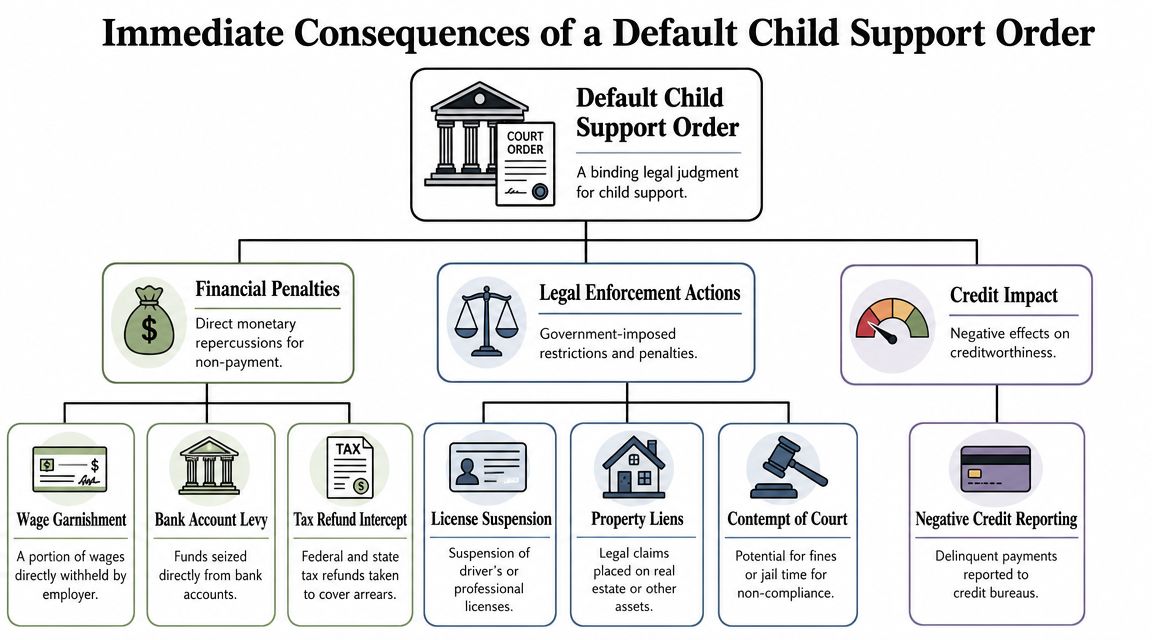
Common consequences include:
- Income withholding: Employers send part of your wages toward current support and arrears.
- License pressure: Driver's licenses and some professional licenses can become a tool for enforcement.
- Property and account issues: Liens and account restraint measures can follow unpaid support.
- Contempt exposure: If the order remains unpaid, enforcement can escalate into court proceedings with serious consequences.
If you discovered the default only because money was taken from your paycheck, you're already behind procedurally. That doesn't mean relief is impossible. It means every day matters.
What works and what doesn't
What works is targeted action. Get the signed order, freeze the timeline, and match your facts to the correct remedy. If withholding has begun, your lawyer may also need to address temporary practical issues while the challenge to the judgment moves forward.
What doesn't work is treating enforcement as the main problem. Enforcement is only the symptom. A key question is whether the underlying default can still be attacked, and by which procedure.
How Texas Courts Calculate Child Support in a Default
Even when one parent doesn't appear, a Texas court still has to calculate support under the Family Code. The judge cannot pick a number at random. In most cases, the starting point is Texas Family Code §154.125, the guideline child support statute.

The guideline framework
Guideline support is based on the obligor's net monthly resources. For example:
- One child: 20% under §154.125
- Two children: 25% under §154.125
- Three children: 30% under §154.125
- Four children: 35% under §154.125
- Five children: 40% under §154.125
If there are other children the obligor has a duty to support, the percentage can change under the multiple-family adjustment tables. Courts may also deviate from guidelines under §154.123 if the facts justify it.
For a detailed discussion of the underlying math, see this explanation of how Texas courts calculate net resources.
What happens when income is unclear
Default hearings often involve incomplete income proof. If the respondent isn't present and hasn't provided pay records, the court may rely on the petitioner's evidence. In some situations, courts may use minimum-wage assumptions when the obligor's income is unknown. That's one reason defaults can produce support amounts that don't reflect reality.
A practical example helps. Suppose the petitioner brings recent pay records showing one level of income, but the respondent recently changed jobs or had variable earnings. If the absent parent isn't there with tax returns, pay stubs, or employer records, the court may calculate support from the evidence it has, not the income picture the respondent wishes the court had seen.
Important: A bad number entered at default doesn't fix itself later. You either attack the judgment in time or seek modification going forward, and those are very different tools.
High-income cases and the 2025 cap
For higher earners, guideline support doesn't apply without limit. The author's brief requires reference to the updated cap, so here's the practical point: effective September 1, 2025, the net monthly resource cap used in guideline calculations is $11,700. In higher-income cases, courts still start with the cap for guideline analysis, then address whether additional support is justified under the Family Code based on the child's proven needs.
That matters in default settings because high-income respondents are especially vulnerable to incomplete records. If the petitioner presents partial compensation evidence, bonus information, or a skewed picture of available resources, the absent parent loses the chance to push the court back to the correct net-resource analysis and deviation factors.
The prove-up record matters more than people think
A support order entered by default should still rest on evidence. That includes:
- Income proof: Pay stubs, tax returns, employer records, or competent testimony
- Medical support information: Health insurance availability and cost
- Retroactive support facts: Dates, prior non-support allegations, and requested relief
- Deviation facts: If someone asks the court to move away from guidelines under §154.123
What works in court is a clean record tied to statutory sections. What fails is unsupported guessing.
Your Legal Remedies to Fight a Default Judgment
This is the decision point. Once a default order is signed, you don't file whatever form sounds closest. You choose the remedy that fits the timeline and the defect. The standard 30-day deadline for a motion to set aside a default judgment is noted by TexasLawHelp's discussion of setting aside a default judgment. After that, the analysis usually turns to restricted appeal or bill of review, depending on the facts.
Comparing remedies for a default judgment in Texas
| Remedy | Deadline | Key Requirement (Simplified) | Best For… |
|---|---|---|---|
| Motion for New Trial | Within 30 days of the signed judgment | You must show a legally sufficient reason to reopen the case and act promptly | Cases where you learned quickly and can explain the failure to answer or appear |
| Restricted Appeal | After the trial deadline passes, but still within the restricted-appeal window | You did not participate in the hearing or timely file post-judgment motions, and error must appear on the face of the record | Clear service defects or other record-based problems |
| Bill of Review | After ordinary deadlines have expired | You must meet a much higher equitable burden, often tied to lack of notice, fraud, or official mistake | Last-resort cases discovered too late for the other remedies |
If you want a broader overview of appellate options in support cases, see can you appeal a child support order in Texas.
Motion for new trial
If you're still within 30 days of the signed judgment, this is usually the first remedy to evaluate. In practice, lawyers and courts may refer to this as a motion for new trial or a motion to set aside the default.
The classic standard comes from Craddock. Simplified, you generally need to show:
- Your failure to answer or appear wasn't intentional or the result of conscious indifference.
- You have a meritorious defense.
- Granting a new trial won't cause undue delay or injure the other side.
What a meritorious defense looks like in child support
A “meritorious defense” doesn't mean proving you'll ultimately win everything. It means showing that reopening the case matters because there is a real issue to litigate. In a support case, examples may include:
- Incorrect income used for guideline support under §154.125
- A valid basis to deviate under §154.123
- Improper retroactive support allegations
- Medical support terms that don't fit the facts
- Parenting-time facts that affect a requested deviation
- Service or notice problems
What works here is detail. Judges want affidavits, payroll records, tax records, message logs, address history, and any proof explaining why you missed the case and why the result may be wrong.
Restricted appeal
A restricted appeal is narrower. It's not a redo of the whole case because the result feels harsh. It's for nonparticipating parties when error appears on the face of the record.
In default child support cases, the most common restricted-appeal issue is service. If the clerk's file, return, citation, or pleadings show a defect, a restricted appeal may be the right path. The court reviewing the case looks at the official record, not new evidence developed later.
When restricted appeal is strong
Restricted appeal tends to be stronger when:
- The return of service is facially defective
- The judgment grants relief not supported by the live pleadings
- A required procedural step is missing from the record
- The respondent never participated in the hearing and didn't file a timely post-judgment motion
Restricted appeal is often attractive because it focuses on objective defects. But it's also unforgiving. If the error doesn't appear in the record itself, this may not be your vehicle.
The right question for restricted appeal is not “Was the outcome unfair?” It is “Can the appellate court see the legal defect in the record without hearing new evidence?”
Bill of review
A bill of review is the remedy people ask about after too much time has passed. It exists, but it is not easy.
This is an equitable proceeding filed in the trial court to set aside a final judgment after the normal deadlines have expired. The burden is high. The required showing depends on the facts, especially whether the problem was lack of service or some other form of prevented participation, but this is not a casual filing. Courts expect detailed proof.
When bill of review becomes necessary
Bill of review usually enters the conversation when:
- The parent discovered the judgment long after entry
- Wage withholding or enforcement revealed the case
- The file raises serious notice concerns
- Other deadlines are gone
What doesn't work is filing a bill of review with general claims that the order is unfair, support is too high, or the other parent lied. Those allegations may matter, but the remedy requires a structured legal showing tied to why you were prevented from presenting your case.
Which remedy should you choose
Use this practical screen:
- Within 30 days: start by evaluating a motion for new trial.
- Past that, with a record-based defect and no participation: examine restricted appeal.
- Past ordinary deadlines and the problem is fundamental notice or another qualifying equity issue: consider bill of review.
The deadlines and standards overlap in ways that trap self-represented litigants. I've seen parents waste critical time filing the wrong paper, then discover the correct remedy expired while they were waiting for a hearing on the wrong one.
Practical Next Steps and When to Hire an Attorney
If you've just learned a default child support order exists, don't spend the next week researching in circles. Start building the record immediately.
If you're the parent hit with the default
Take these steps in order:
- Get the file: Obtain the signed order, petition, citation, return of service, and docket sheet from the clerk.
- Mark the dates: Write down the date the order was signed and the date you first learned about it.
- Save proof of notice problems: Keep envelope scans, screenshots, employer notices, withholding notices, address records, and anything showing when notice reached you.
- Gather financial records: Bring pay stubs, tax returns, benefit records, insurance cost information, and proof of any other children you support.
- Document your defense: If guideline support was calculated wrong under §154.125, or a deviation issue exists under §154.123, collect the proof now.
If you're hiring counsel, choose someone who handles Texas child support and post-judgment procedure regularly. One option is the Texas Child Support Law Office of Bryan Fagan, which handles establishment, modification, enforcement, and defense of support orders under the Texas Family Code. The key is finding a lawyer who can identify the correct procedural remedy quickly, not someone who treats this as a routine hearing reset.
If you're the parent who obtained the default
You also need a strategy. A default judgment can be challenged, and if the other parent files a timely motion, restricted appeal, or bill of review, you may be back in court. Preserve your proof.
Keep:
- Service records
- Income evidence used at prove-up
- Medical support documents
- Draft orders and withholding paperwork
- Any communication showing the other parent knew about the case
When legal help stops being optional
Self-representation is especially risky when the issue is no longer “what should support be?” but “which procedural vehicle can still reopen a final judgment?” That's an appellate and post-judgment question wrapped inside a family-law problem.
If your wages are already being withheld, if you were never properly served, or if you learned about the case close to a filing deadline, this is the point to get a lawyer involved immediately.
Frequently Asked Questions About Default Child Support Orders
Can I just modify the child support order instead of fighting the default?
Sometimes, but that only changes future obligations if the court grants a modification. It usually doesn't erase arrears that built up under the existing order. If the underlying issue is lack of service or a defective default, modification is often the wrong first move.
If I was never served, does that matter more than whether the support amount is wrong?
Yes. Service defects can be outcome-determinative because due process comes before support math. If you were not properly served, that often points toward a procedural attack on the judgment itself rather than a simple request to change the amount.
Does a 50/50 possession schedule automatically mean no child support?
No. Texas doesn't automatically cancel support because possession time is equal or close to equal. Courts still begin with the statutory framework, especially §154.125, and may consider deviation factors under §154.123 if the facts justify a different amount.
Can the court order child support at a default hearing without my pay stubs?
Yes, if the petitioner offers other competent evidence and the court accepts it. That's one reason defaults are dangerous. The judge may proceed using the record available at the hearing, and your absence means you aren't there to challenge outdated, incomplete, or one-sided income proof.
Does talking to the other parent or the Attorney General count as filing an answer?
No. A phone call, text message, or informal conversation doesn't replace a filed answer. The court file controls.
If I missed the hearing because of work or an emergency, can I still win?
Possibly. In a timely motion for new trial, the explanation for your failure to answer or appear matters a great deal. The court will want specifics, not general statements. Supporting documents help.
Can child support in a default include medical support too?
Yes. Texas support orders commonly address not only monthly support but also medical support or health-insurance obligations. That's why you need to read the full order, not just the paragraph with the monthly payment.
Is guideline support always the final number?
No. §154.125 creates the guideline starting point. §154.123 allows deviation when the facts support it. But if you weren't present at the default hearing, you lost the chance to present those deviation facts at the time the order was entered.
If you've discovered a default child support order and need to know whether a motion for new trial, restricted appeal, or bill of review still fits your case, contact Texas Child Support Law Office of Bryan Fagan. The firm represents parents across Texas in child support establishment, modification, enforcement, and post-judgment challenges, including cases involving wage withholding, arrears, disputed service, and income calculation issues under the Texas Family Code.