Your ex misses one payment. Then another. Rent is still due, school costs don't wait, and the child support order that looked clear on paper suddenly feels useless in real life.
It isn't useless. In Texas, a child support order is a court order, and courts can enforce it.
Texas gives parents real enforcement tools. The Office of the Attorney General Child Support Division is the primary enforcement agency, and it offers free services that include wage garnishment, bank account levies, tax refund interception, and license suspensions under Texas Family Code Chapters 157, 158, and 159. Nationally, 48.9% of the 12.9 million custodial parents in 2018 had a child support agreement, and 88% of those agreements were formal court orders, which underscores how often enforcement depends on a clear legal order in place (Hembree Bell on enforcing child support payments in Texas).
For a parent trying to figure out what happens if child support is not paid, the first question usually isn't whether Texas law has remedies. It does. The key question is which remedy to use first, and how aggressive your strategy needs to be.
When Your Ex-Spouse Stops Paying Child Support
Most parents land here the same way. The order was signed. Payments may have started. Then excuses replaced transfers. A job change, a “mix-up,” a promise to catch up next month. Meanwhile, the child still needs groceries, housing, transportation, and medical care.

A missed payment doesn't automatically mean you should sprint into court the next morning. But it does mean you need to start treating the case like an enforcement matter, not a co-parenting misunderstanding.
What the order means
A Texas child support order is enforceable through the court system and, in many cases, through OAG administrative tools. If the order includes monthly child support, medical support, dental support, or reimbursement obligations, those terms matter. Judges expect compliance with the written order, not a side deal made over text.
Practical rule: Enforce the order you have, not the arrangement the other parent says is “fair” now.
That distinction matters because enforcement cases are won on details. Which payment was due. On what date. In what amount. Through what payment channel. What remains unpaid.
The shift from frustration to effective power
Parents often assume they have to “wait until it gets bad enough.” That isn't the right lens. The better perspective focuses on obtaining an advantage. Texas law gives you several ways to force payment or create consequences for continued nonpayment.
That influence can include:
- Income withholding: Payments can be taken directly from wages under Chapter 158.
- Contempt remedies: Courts can use contempt powers under Chapter 157 when nonpayment is willful.
- Interstate enforcement: If the other parent moved, Chapter 159 may still allow enforcement across state lines.
- Administrative pressure: The OAG can use tools private parties can't use on their own, including passport-related enforcement and tax refund interception.
The point isn't punishment for its own sake. The point is getting support flowing again and reducing the chance that arrears keep growing.
Your Two Paths to Enforcement OAG vs Private Attorney
This is the first strategic choice in most Texas enforcement cases. You can use the Office of the Attorney General, or you can file a private enforcement action through your own attorney.
Both paths can work. They don't work equally well in every case.
Texas law allows a parent to file a private motion for enforcement without going through the OAG, and courts can order wage withholding, license suspensions, property liens, and contempt proceedings under Chapter 157. Private actions can also reach remedies such as liens on bank accounts and retirement plans through QDRO-related relief available since September 1, 2021 (YouTube discussion of Texas child support enforcement options).
When to use the OAG
The OAG is often the right starting point when the case is straightforward.
If the other parent is a regular W-2 employee, has a known employer, and there isn't much dispute about what is owed, the OAG's free services can be practical. Wage withholding is often the cleanest tool in that setting because the payment process becomes less dependent on promises.
The OAG also makes sense when:
- Cost is the main concern: Its services are free.
- You need administrative enforcement: The agency can use government enforcement tools that private lawyers can't independently trigger.
- You already have a payment history through the state system: That often simplifies proof and tracking.
- The case is mostly collection, not investigation: There isn't much need to dig for hidden income or unravel business records.
What the OAG does well
A state agency is built for volume. That has a downside, but it also has an upside. If your case fits the standard pattern, the system can be efficient enough.
The strongest OAG cases usually share these features:
| Case feature | OAG fit |
|---|---|
| Known employer | Strong |
| Regular payroll | Strong |
| Clear payment record | Strong |
| Need for tax intercept or passport-related enforcement | Strong |
| Complex hidden income issues | Weak |
| High-asset enforcement with a specific court strategy | Weak |
When to hire a private attorney
Private enforcement is usually the better choice when the case requires precision, speed, or pressure beyond standard administrative action.
That includes situations where the other parent is self-employed, owns a business, works for cash, changes jobs frequently, transfers assets, or has income that doesn't show up neatly on payroll records. It also includes cases where arrears are large enough that delay becomes expensive.
A private attorney can draft the pleadings to specifically address the violations and request relief that fits the facts. That matters because Texas judges want specificity. If you're seeking contempt, lien relief, a money judgment, attorney's fees, and wage withholding, the motion needs to be drafted with care.
The harder the income is to trace, the less useful a one-size-fits-all enforcement approach becomes.
What private enforcement does better
A private case gives you control over litigation strategy.
That can mean:
- Filing immediately: You're not waiting in an agency queue.
- Using discovery: Bank records, business records, tax returns, and other financial documents can become central.
- Targeting assets: Property liens and retirement-related enforcement may matter more than wage withholding.
- Building a contempt case: If the nonpayment is willful, the court can impose serious consequences.
- Seeking fees: In the right case, attorney's fees may become part of the relief requested.
If you're comparing firms, one option Texas parents use is the Texas Child Support Law Office of Bryan Fagan, which handles establishment, modification, enforcement, arrears, high-income disputes, and related child support litigation under the Texas Family Code.
The main trade-off
The trade-off isn't just free versus paid. It's standardized process versus customized litigation.
If the case is simple and the payer is easy to reach through payroll, start by considering the OAG. If the case involves evasive conduct, significant arrears, business income, retirement assets, or urgent court action, private enforcement is usually the more effective path.
A lot of parents try the OAG first, then move to private counsel when the case stalls. That's a reasonable sequence in many cases. But if the facts already show complexity, starting with a private enforcement strategy may save time and reduce avoidable delay.
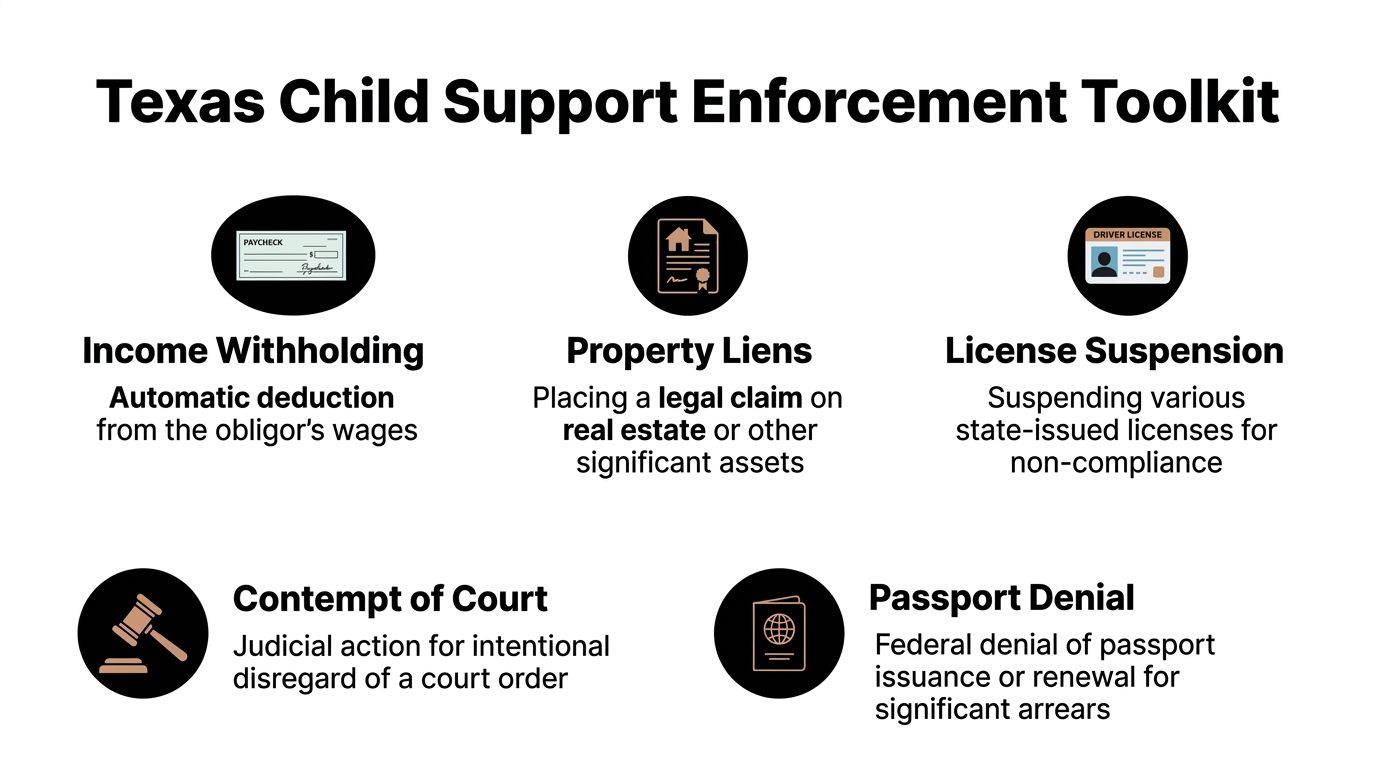
The Texas Child Support Enforcement Toolkit
Texas gives courts and the OAG several enforcement tools. The right tool depends on the payer's income source, assets, and pattern of noncompliance. A smart enforcement plan doesn't throw every remedy at the wall. It matches the remedy to the problem.
Income withholding under Chapter 158
Income withholding is usually the first and most effective enforcement tool when the obligor has a regular employer. Under Texas Family Code Chapter 158, the court can order withholding from wages, and employer compliance is mandatory.
This works best when the other parent draws a paycheck from an identifiable employer. Once withholding is in place, payments route through the state disbursement unit, which creates a cleaner record and reduces the chance of disputes over whether payment was made.
Use income withholding when:
- The parent is employed on payroll
- You need ongoing reliability
- You want a trackable payment record
- The problem is nonpayment, not hidden income
If the obligor is self-employed or controls when and how money is paid out, withholding loses force quickly.
Child support liens and property claims
A child support lien can attach to certain property interests. This remedy becomes more useful when wages aren't the best target.
If the nonpaying parent owns nonexempt assets, has funds in accounts, or has property that may be sold or refinanced, lien strategy can create pressure and preserve collectability. In the right case, the goal isn't immediate cash that day. The goal is making sure the debt follows the asset.
License suspension
Texas can suspend certain licenses for child support noncompliance. This includes a driver's license and, depending on the facts, a professional license.
License suspension isn't ideal for every case. If the person is already unstable financially, taking away a license can sometimes reduce short-term ability to earn. But for a parent who can pay and won't, license pressure can be effective.
Strategic point: Use license remedies when nonpayment is a choice, not when the case turns on tracing difficult income.
Tax refund interception and other government remedies
The OAG has tools that private litigants don't control directly. Those include tax refund interception, passport-related enforcement, credit reporting, and seizure of certain funds such as lottery winnings, as described in the Texas enforcement framework discussed earlier.
These remedies matter because they reach money streams and privileges that ordinary motion practice does not.
Contempt of court under Chapter 157
Contempt is the remedy people think of first, and for good reason. When a parent had the ability to comply and willfully failed to do so, a court can use civil or criminal contempt powers under Chapter 157.
Contempt is powerful, but it has to be pleaded correctly. Judges won't jail someone just because arrears exist. You have to prove the order, the missed obligations, and the failure to comply with the required level of detail.
Contempt may lead to:
- A coercive order to pay
- Fines
- Jail time
- Community supervision in appropriate cases
- Additional compliance terms
Interstate enforcement under Chapter 159
If the other parent left Texas, that doesn't end your case. Texas adopted the Uniform Interstate Family Support Act through Chapter 159, which allows enforcement against nonresident obligors.
Interstate cases require more procedural discipline. Jurisdiction, registration, and communication between states all matter. But the move itself is not a defense to a Texas child support order.
Retirement enforcement through QDRO-related relief
Since September 1, 2021, Texas Family Code §157.501 allows direct enforcement against retirement plans through qualified domestic relations order procedures in appropriate cases. This is not the first tool used in an ordinary missed-payment case, but it can be important when substantial arrears exist and retirement assets are one of the few reachable sources.
Which tools work best
Different tools fit different facts.
| Enforcement tool | Best use case | Limitation |
|---|---|---|
| Income withholding | W-2 employee with known employer | Less effective for self-employment |
| Lien | Asset-heavy obligor | Collection may not be immediate |
| License suspension | Willful nonpayer needing pressure | Can backfire if income is already unstable |
| Contempt | Strong proof of intentional nonpayment | Requires careful pleading and proof |
| Interstate enforcement | Parent moved out of Texas | Procedure can be slower |
| Retirement enforcement | Large arrears with retirement assets | Usually a more advanced remedy |
Filing a Motion for Enforcement The Legal Process
Private enforcement succeeds or fails on preparation. The motion has to be specific, the other side has to be properly served, and the evidence has to line up with the relief requested.
Courts require specificity in a Motion for Enforcement. Available remedies include wage withholding, liens, license suspensions, and contempt, and Chapter 158 requires employer compliance within 14 days when withholding is ordered. The same source notes that anecdotal attorney reports suggest up to 70% of pro se motions are dismissed for vagueness, which is why details matter so much (Coldwell Bowes on enforcing child support payments in Texas).
If you're considering filing a motion for contempt of court, think of the case as a proof exercise, not a story-telling exercise.
Step one is building the record
Start with documents, not arguments.
You want the paper trail that shows:
- The signed order: The court has to know exactly what obligation existed.
- The payment history: A certified record from the Texas Child Support Disbursement Unit is often central.
- Your supporting records: Bank statements, portal records, payroll records, receipts, and prior communications can help.
- Dates and amounts: Each alleged violation should be tied to a due date and amount due.
Parents often know the other side “hasn't paid in months.” That isn't enough for pleading. The court needs the missed obligations broken out with precision.
What the motion must say
A proper motion identifies each violated provision and tells the court what remedy you're seeking.
That may include requests to:
- Confirm arrears
- Reduce arrears to judgment
- Award interest on unpaid support
- Order income withholding
- Impose lien-related relief
- Find contempt for willful violations
- Award attorney's fees under §157.167
A vague motion invites objections and delay. A detailed motion gives the judge something enforceable to sign.
Judges don't enforce broad complaints. They enforce specific orders against specific violations.
Service matters
After filing, the other parent must be served correctly. This is not a formality. If service is defective, the hearing can unravel even if the arrears are obvious.
In contempt cases, service issues become even more sensitive because liberty interests may be involved. If incarceration is possible, courts expect the process to be handled carefully.
The hearing
At the hearing, the court will usually focus on a short list of issues.
| Hearing issue | What the court wants |
|---|---|
| Was there a valid order? | Signed order with clear terms |
| What was due? | Dates and amounts |
| What was unpaid? | Payment record and proof |
| Was nonpayment willful? | Facts showing ability and failure to pay |
| What remedy fits? | Practical relief tied to evidence |
If the respondent claims inability to pay, the facts behind that claim matter. A job loss may support a modification request. It does not erase missed obligations that were already due.
Later in the process, this overview can help some parents visualize what a court hearing looks like in practice.
What the court can order
A successful enforcement case may result in several layers of relief at once.
Common outcomes include:
- Arrears confirmed as a money judgment
- Simple interest at 6% annually on back support
- Income withholding
- Attorney's fees under §157.167
- Contempt findings
- Compliance conditions going forward
Under Texas Family Code §157.167, attorney's fees are often part of the strategy, not an afterthought. If the other parent's noncompliance forced litigation, fee recovery may be available.
Where many self-filed cases fail
The most common weakness in self-filed enforcement cases isn't lack of frustration. It's lack of precision.
Parents often file motions that say the other parent “failed to pay support” without listing every missed payment by date and amount. They attach screenshots but not certified records. They ask for contempt without tying the request to the exact violated terms. Those defects can sink a strong case.
If you want to know how to enforce child support in texas through private court action, this is the answer in practical terms: specific pleading, proper service, certified records, and a remedy plan that fits the facts.
Advanced Strategies for Complex and High-Income Cases
Some enforcement cases stop being simple the moment you look at the income. The parent owns a business. Deposits don't match the pay stubs. Personal expenses run through company accounts. Money moves, but not in a way that makes collection easy.

For those cases, standard enforcement tools often need help. According to the verified data, Texas child support arrears averaged over $1.2 billion statewide in 2024, and self-employment complicated 25-30% of cases, with enforcement timelines exceeding 12-18 months versus 3-6 months for waged employees. The same source states that firms handling complex income disputes can achieve up to 40% faster resolutions via motions for forensic audits (Travis County support enforcement information).
Parents dealing with these issues often need a more specific strategy than standard withholding alone. That's especially true in cases involving business ownership or unusually high earnings, which is why many also look closely at high-income child support in Texas.
Hidden income changes the case
A self-employed obligor can look broke on paper and solvent in real life.
In those cases, counsel often focuses on:
- Bank records
- Business account transfers
- Tax returns
- Profit and loss statements
- Personal expenses paid by a business
- Lifestyle evidence inconsistent with claimed income
The objective is to show the court what resources exist, not just what the obligor chooses to label as wages.
Discovery and forensic work
Formal discovery becomes much more important in a complex case. Requests for production, interrogatories, subpoenas, and depositions may all matter.
In the right case, a forensic accountant can help trace money movement, identify disguised income, or separate legitimate business expenses from personal spending. That kind of work is expensive, so it needs to be proportionate to the arrears and the likely collectible value of the case. But when the other parent has income and is obscuring it, this may be the only path to a meaningful result.
A high-income enforcement case is rarely won by taking the pay stub at face value.
Guideline support, deviations, and the 2025 cap
When support is being calculated, modified, or defended alongside enforcement, the guideline framework still matters. Texas courts look to §154.125 for guideline child support and may depart from the guideline result under §154.123 when the facts justify a deviation.
For higher earners, the author's brief requires reference to the $11,700 net monthly resource cap effective September 1, 2025 when discussing guideline calculations. In practice, that cap matters most when lawyers are evaluating whether the original order was calculated correctly, whether a modification issue is mixed into the enforcement dispute, and whether the child has needs that may support a deviation above guideline levels.
A practical example helps. If a parent has net monthly resources above the cap, the court generally begins with the guideline framework up to the cap, then considers whether proven circumstances support deviation. In a pure enforcement case, the court is enforcing the signed order. But in many real disputes, the obligor responds to enforcement by claiming the order should have been lower. That argument usually belongs in a modification case, not as a defense to already accrued support.
Retirement plans and nontraditional assets
If wages are unreliable and liquid accounts are sparse, retirement assets may become part of the plan. Under §157.501, QDRO-related relief can allow direct enforcement against retirement plans in appropriate cases.
That isn't a routine first move. It's an advanced collection strategy for advanced arrears cases.
Frequently Asked Questions About Texas Child Support Enforcement
Parents usually ask the same hard questions once enforcement becomes real. The answers depend on the order, the payment record, and whether you're enforcing basic support, medical support, or a shared-possession arrangement.
A common issue in 50/50 custody cases is that support looks small or uneven, so one parent assumes enforcement isn't worth it. But the verified data shows that 50/50 orders reduce enforcement filings by 35%, while unreimbursed medical arrears hit $500 million annually in Texas. The same source states that courts may allow deviations under §154.123 for high earners, and that legislative changes expanded retroactive enforcement to 4 years pre-filing in shared-custody arrangements (Walters Gilbreath on how child support orders are enforced).
Can I collect interest on unpaid child support
Yes. Texas law allows 6% annual interest on unpaid child support arrears.
That matters because waiting doesn't freeze the debt. Support that should have been paid months or years ago can continue to grow. In a private enforcement case, confirming arrears and interest as a money judgment is often a core part of the requested relief.
What if the other parent moved out of Texas
A move doesn't wipe out the order.
Texas adopted the Uniform Interstate Family Support Act in Chapter 159, which allows enforcement against nonresident obligors. Depending on the facts, Texas can work with the other state to register and enforce the order there.
The practical problem is usually not authority. It's procedure. Interstate cases require patience, accurate paperwork, and a clean copy of the existing order.
How do I enforce support in a 50 50 custody case
A 50/50 schedule doesn't mean there is nothing to enforce.
These cases often involve:
- Medical support obligations
- Uninsured medical reimbursements
- Retroactive support issues
- Deviated support orders for high-income parents
- Arrears from prior periods when the payment terms were different
If your order requires reimbursement for medical expenses, enforce that written obligation the same way you would enforce monthly support. Keep receipts, proof of payment, written requests for reimbursement, and the exact language of the order.
Can the court put the other parent in jail for not paying
Yes, in the right case. A Texas court can use civil or criminal contempt for willful nonpayment.
But jail isn't automatic. The moving party has to prove the violation properly, and the pleadings must be specific. Courts take contempt seriously, which is why a loosely drafted motion often underperforms.
Should I file enforcement or modification
They solve different problems.
File enforcement when the other parent violated the current order. File modification when a material change means the order should be changed going forward. Parents often confuse the two.
If the obligor lost a job and wants the amount reduced, the correct path is usually modification. If the obligor stopped paying the existing order, the correct path is enforcement. A later modification generally doesn't erase support that already accrued before the filing date.
If your ex has stopped paying support, waiting usually makes the record messier and the arrears harder to collect. The Texas Child Support Law Office of Bryan Fagan helps parents across Texas enforce child support orders, address arrears, evaluate OAG versus private enforcement strategy, and prepare court-ready cases involving wage withholding, medical support, high-income disputes, and complex income issues under the Texas Family Code.