You may be dealing with this right now. Your child lives with you in Texas, the other parent moved to another state, and the support question has turned into a jurisdiction problem before anyone even gets to dollars.
That’s where most interstate cases go off track. Parents focus on fairness first, but the court focuses on authority first. If you file in the wrong place, fail to register an existing order properly, or misunderstand which state controls modification, you lose time and advantage.
For child support when parents live in different states texas, the right strategy starts with two questions. Which court has authority to act, and is this an establishment case, an enforcement case, or a modification case? Once those are answered correctly, the Texas Family Code and UIFSA framework become much more manageable.
Navigating Your Interstate Child Support Case in Texas
If your co-parent now lives in Colorado, Florida, California, or anywhere else outside Texas, your case is still workable. It just requires more discipline than an in-state child support case.
Texas courts regularly handle interstate support matters. The legal framework comes from the Uniform Interstate Family Support Act, usually called UIFSA, along with the Texas Family Code provisions governing support, income withholding, enforcement, and modification. In practice, the interstate issue changes procedure more than it changes the core purpose. The court still wants a valid order, enforceable payment terms, and a structure that protects the child.
Three situations come up most often:
- No order exists yet. One parent needs Texas to establish paternity or establish support.
- An order already exists elsewhere. The Texas parent needs to register it here for enforcement.
- The order needs to change. A parent assumes Texas can modify it, but continuing jurisdiction may still belong to another state.
Practical rule: In an interstate case, the first real decision isn’t “how much support should be paid?” It’s “what court has the power to decide that question?”
Texas-specific law matters because Texas calculates support differently from most states. It also matters because once a valid order is entered, the state that controls that order often keeps control over future modifications.
Parents who understand that early usually make better filing decisions, maintain their advantage, and avoid expensive procedural mistakes.
The Foundation of Interstate Support Jurisdiction Under UIFSA
A parent in Dallas files first because the child lives here. The other parent lives in Georgia and says Texas has no authority to set support. That argument wins more often than it should, not because it is always legally correct, but because many interstate cases are filed before anyone confirms which state has jurisdiction and which order, if any, controls.
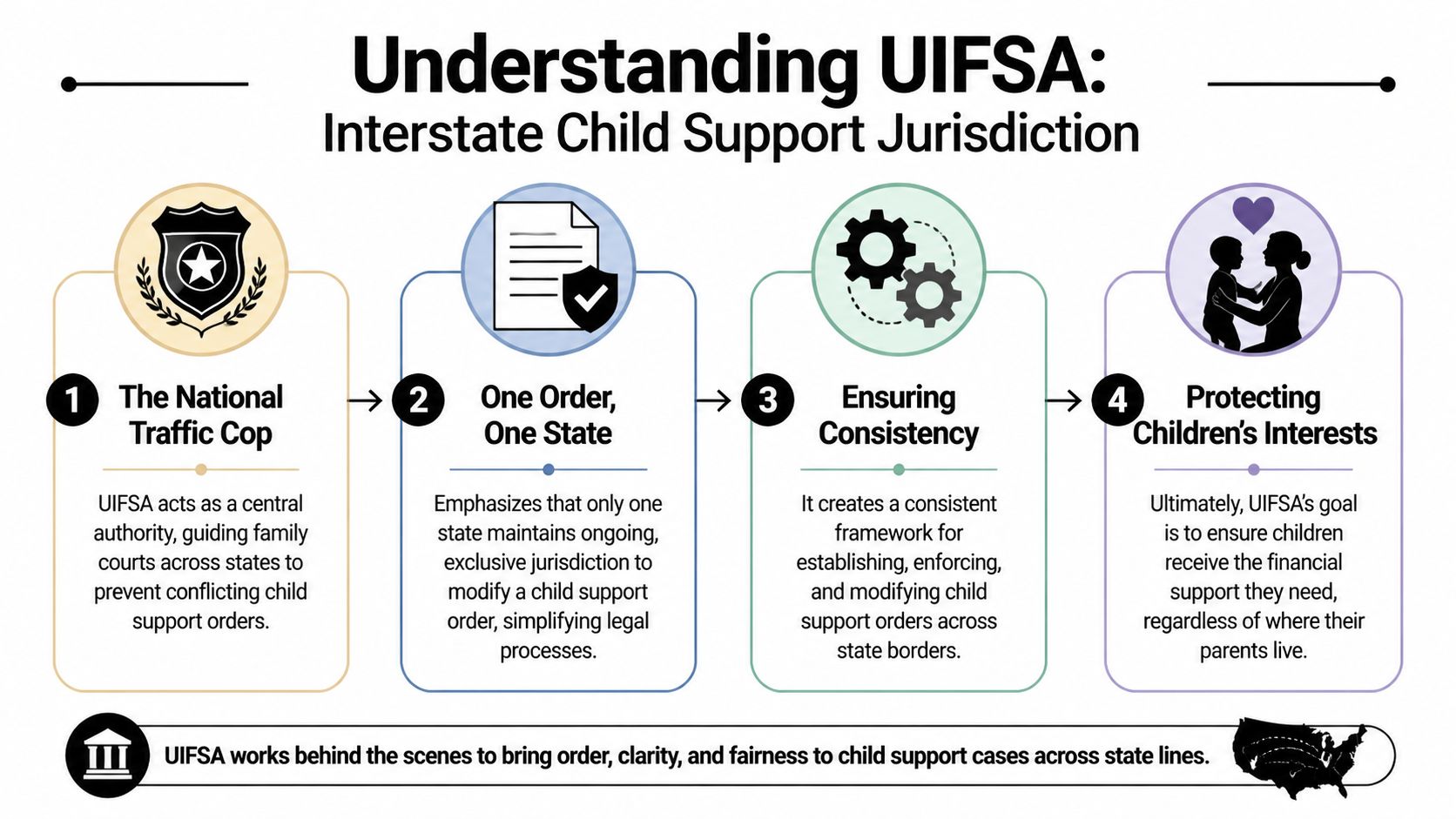
UIFSA exists to stop that problem. Texas adopted UIFSA in Chapter 159 of the Texas Family Code. The statute is designed to prevent multiple states from issuing competing support orders and to identify one controlling order when more than one order exists. TexasLawHelp gives a useful general overview of that framework in its article on interstate child support and UIFSA.
The controlling order decides who keeps power over the case
The term that matters most at the start is continuing, exclusive jurisdiction, or CEJ. Under Chapter 159, the state that issued a valid child support order usually keeps the power to modify that order while the child, the obligor, or the obligee still lives there, unless the statutory conditions for transfer are met.
That point is not academic. It affects where future modification fights happen, what court hears evidence, and which state’s support law frames the dispute. In an interstate case, the first order often shapes the next several years of litigation.
Texas parents should pay close attention to that because Texas does not calculate support the way many other states do. Texas relies on a percentage-of-net-resources model under Texas Family Code § 154.125, subject to the statutory net resource cap, and courts can depart from guideline support under § 154.123 when the facts justify it. If Texas becomes the issuing state, those Texas standards can matter immediately and later, especially in higher-income cases.
The Texas statutes that matter first
A serious jurisdiction review usually starts with the Texas statutes, not general internet summaries.
Key provisions include:
- Texas Family Code Chapter 159. Texas’s UIFSA chapter. It governs interstate jurisdiction, registration, enforcement, and modification.
- § 159.201. Texas’s long-arm jurisdiction provision. It lists the circumstances that allow a Texas court to exercise personal jurisdiction over a nonresident in a support case.
- § 154.001. Authority for a court to order child support.
- § 154.062. Definition of net resources, which is the foundation of Texas support calculations.
- § 154.123. Factors that can support a deviation from guideline child support.
- § 154.125. Texas guideline percentages and the net resource framework used in most cases.
Those statutes work together. Chapter 159 answers whether Texas can act against the out-of-state parent. Chapter 154 answers how Texas will calculate support if it can.
Personal jurisdiction is usually the first pressure point
Parents often confuse subject matter authority with personal jurisdiction. Texas courts hear child support cases every day. The harder question is whether a Texas court can bind the out-of-state parent to a new support order.
Section 159.201 lays out several ways Texas may get personal jurisdiction over a nonresident. Common examples include a parent being personally served in Texas, living with the child in Texas, providing prenatal expenses or support in Texas, directing the child to reside here, or engaging in conduct that caused the child to be conceived in Texas. The facts matter. A weak jurisdiction theory can cost months.
For example, if a mother and child have lived in Houston for two years, that fact alone does not automatically give Texas personal jurisdiction over a father who has never lived in Texas, was never served here, and has no qualifying contacts under § 159.201. In that situation, filing in Texas without a clear UIFSA basis may invite a dismissal. If the father previously lived with the child in Texas or agreed to the child’s relocation here under facts that fit Chapter 159, the analysis changes.
Strategy matters more in interstate cases
In a pure Texas case, filing in the child’s county is often straightforward. In an interstate case, filing first only helps if Texas has authority to issue an enforceable order.
I usually look at four questions before recommending where to file:
- Is there already a valid child support order somewhere else?
- Does Texas have personal jurisdiction over the out-of-state parent under § 159.201?
- Which state will likely keep CEJ after the initial order is entered?
- Would Texas’s net-resources model under §§ 154.123 and 154.125 help or hurt this client compared to the other state’s approach?
That last question is where strategy becomes very Texas-specific. A parent dealing with variable compensation, self-employment income, or high earnings may see a very different result under Texas’s net-resources and guideline framework than under another state’s formula. The right forum can affect both the initial support number and the standard applied in a later modification.
If no order exists and Texas has a sound jurisdictional basis, it often makes sense to evaluate whether filing here gives the client a better long-term position. If you need a starting point on procedure, this guide on how to file for child support in Texas helps explain the filing mechanics. Procedure alone does not solve the interstate problem, but it does show where the Texas process begins.
What usually goes wrong
The common mistakes are predictable. A parent assumes the child’s residence alone gives Texas full power. Another parent assumes the first state to hear about the dispute automatically controls. Both assumptions are wrong often enough to be expensive.
The better approach is a front-loaded review of residence history, prior orders, paternity status, service options, and each parent’s connection to Texas. In interstate support cases, jurisdiction is not a technical sideshow. It is the case plan.
Establishing a New Order or Registering an Existing One
A mother moves to Harris County with her child after a breakup. The father stays in Louisiana, sends money sporadically, and insists Texas cannot order support because he never moved here. A different case starts with the opposite problem. An Oklahoma order already exists, arrears are growing, and the parent in Texas wants wage withholding to start now. Those cases do not use the same procedure, and treating them as if they do wastes time.
Texas courts handle interstate support under Chapter 159 of the Texas Family Code, which adopts UIFSA. The first strategic decision is simple. Decide whether Texas should issue a new support order under Chapter 159, Subchapter B, or whether Texas should register and enforce an existing order under Subchapter F.

When no child support order exists yet
If no state has entered a support order, Texas may be the right place to file, but only if the jurisdictional facts support it. In practice, that means confirming both the proper Texas court and a valid basis for personal jurisdiction over the out-of-state parent under Tex. Fam. Code § 159.201.
That statute matters because Texas cannot order a nonresident parent to pay support based only on the child living here. The court needs a recognized basis such as personal service in Texas, the parent’s consent, the parent having resided with the child in Texas, the parent having provided prenatal expenses or support in Texas, or acts or directives by that parent that caused the child to reside here. The exact facts control the filing strategy.
A common example is relocation. If the parents agreed the child would move to Texas and the out-of-state parent continued involvement tied to Texas, those facts may support jurisdiction. If the other parent has never lived here, was never served here, and has no qualifying Texas contacts under § 159.201, filing in Texas may invite a dismissal and give the other side a head start.
Procedure still matters. A parent starting the case can review the filing steps in this guide on filing for child support in Texas. The strategy question comes first. Filing mechanics only help after the forum decision is sound.
When another state already issued the order
If a valid support order already exists from another state, Texas usually does not calculate a new obligation from scratch. Texas first requires registration of that order under Tex. Fam. Code §§ 159.601 through 159.614 before a Texas court can enforce it.
Registration is more than attaching a foreign order to a pleading. The filing party needs the order itself, often a certified copy, a sworn statement of arrears if past-due support is claimed, identifying information for the obligor, and enough detail for service to work. Sloppy packets cause avoidable continuances. In a contested case, they also give the other side room to argue that notice was defective or the arrearage amount cannot be verified.
The strategic benefit of registration is speed and continuity. The Texas court can use the existing order rather than relitigating support from the beginning. The strategic limitation is just as important. Registration does not let a Texas court rewrite the support terms solely because Texas would have calculated support differently under §§ 154.123 or 154.125. That distinction matters in interstate cases because Texas’s percentage-of-income model can produce a materially different result than the issuing state’s formula.
The challenge period and the real dispute
After registration, the contest usually shifts to notice, validity, payment history, or identity. Under Tex. Fam. Code § 159.605, the nonregistering party must timely contest the registered order or risk confirmation by operation of law.
In real cases, the dispute is rarely about abstract UIFSA concepts. It is usually about records. Has the obligor been credited for direct payments? Is the arrears ledger accurate? Was the order the controlling order? Was service sent to an address the parent had not used in years?
Those are fixable problems if the file is built correctly from the start.
Common trouble spots include:
- incomplete payment histories that ignore direct transfers or payments made through another state disbursement unit
- missing certified copies of the controlling order and later modifications
- stale employer information that delays withholding
- objections framed as custody complaints, even though registration and enforcement are narrower issues
Here is a useful overview before getting into the hearing phase:
What helps in a contested registration case
A strong interstate file is organized before the first hearing setting. That means certified orders, a clean arrears calculation, proof of the obligor’s last known address, and records showing where payments were supposed to go and where they were received.
I also separate issues early. If the other parent tries to turn a registration case into an argument about possession or old grievances, the court usually gains little from that detour. The immediate question is whether Texas should confirm the registered order and enforce it.
Use this checklist:
- Get certified copies of the original order and every modification.
- Match the payment ledger against bank records, state disbursement records, and any claimed direct payments.
- Confirm the controlling order before alleging arrears.
- Prepare service evidence as carefully as the support evidence.
- Decide whether the immediate goal is enforcement only, enforcement plus withholding, or later modification after registration is complete.
A complete registration packet does two things. It shortens the procedural fight, and it preserves the client’s position for enforcement or modification later. In interstate support cases, that early discipline usually saves more money than any argument made at the hearing.
How Texas Calculates Child Support for Interstate Cases
A parent lives in Houston. The other parent moved to Colorado and now gets paid through salary, quarterly bonuses, and a side business. The first serious fight is usually not whether support should be paid. It is how Texas will count income, where the guideline number starts, and whether anyone has enough proof to push the amount above or below that number.
Texas gives you a different framework than many other states. Texas uses a percentage-of-income model focused on the obligor’s net resources, not a combined-income model. In an interstate case, that difference shapes strategy early. A parent who expects the court to compare both households the way another state would can misjudge settlement value by a wide margin.
The guideline structure under Texas Family Code
The starting point is Tex. Fam. Code § 154.062, which defines net resources. The court then applies the guideline percentages in § 154.125.
For one child, the guideline is 20 percent of net resources. For two, 25 percent. For three, 30 percent. For four, 35 percent. For five or more, 40 percent.
| Number of Children | Percentage of Net Resources |
|---|---|
| 1 | 20% |
| 2 | 25% |
| 3 | 30% |
| 4 | 35% |
| 5 or more | 40% |
If you need the mechanics of the math, this explanation of how to calculate child support in Texas follows the same framework Texas courts use.
The practical question is what counts as net resources. Wages count. Salary, commissions, overtime, bonuses, self-employment income, rental income, severance, retirement income, and other recurring sources may count too, depending on the facts and the proof. Interstate cases often turn on incomplete records, especially when the paying parent works in one state, lives in another, and receives part of the income through a business entity.
The cap matters, but it is not the end of the analysis
Under § 154.125, guideline support is calculated on the obligor’s monthly net resources up to the statutory cap. For cases filed after the current adjustment takes effect, practitioners should confirm the cap in force on the date the court signs the order, because Texas updates that number over time.
Here is the strategic point. In a high-income case, the cap often sets the presumptive guideline amount, but it does not automatically end the discussion.
Assume the obligor’s monthly net resources exceed the applicable cap. For one child, the court applies 20 percent to the capped amount for the presumptive guideline figure. For two children, it applies 25 percent. That gives both sides a clean starting number. It does not answer whether the final order should stay there.
Above-cap cases are won with proof under § 154.123
Tex. Fam. Code § 154.123 gives the court room to vary from the guidelines when the evidence supports a different result. In higher-income interstate cases, the key issue is usually the child’s proven needs, not the paying parent’s earnings by themselves.
That distinction matters. A parent does not get a higher order just by showing the other parent earns a large income in another state. The court needs evidence tying the requested amount to the child.
Useful proof usually includes:
- itemized childcare costs tied to work or school schedules
- uninsured medical, dental, counseling, or therapy expenses
- tuition, tutoring, or special educational services
- transportation costs created by the child’s needs, not just the parents’ conflict
- records showing the child’s established and reasonable living expenses
I tell clients the same thing in these cases. Build the file as if the judge has never met your child and will decide the issue from paper first, testimony second.
Interstate income disputes usually center on classification and credibility
Interstate support cases get technical fast because income is rarely a simple W-2 number. A parent may receive base pay from an employer in Oklahoma, bonuses from a parent company in Illinois, and distributions from an LLC formed in Texas. Texas courts still have to decide what qualifies as net resources under § 154.062 and whether the claimed deductions are proper.
That is where case strategy matters.
If you represent the parent seeking support, get the tax returns, pay stubs, profit and loss statements, bank records, and business account records early. If the income is irregular, use a longer earnings history to show the court a fair monthly average. If you represent the paying parent, separate true business expenses from personal spending run through the company. Judges see that issue often, and weak expense claims usually fail under scrutiny.
A common example helps. Suppose a parent argues that only the $8,000 monthly salary should count, while the other parent shows an additional $4,000 monthly average from commissions and rental income. In Texas, that dispute can change the guideline amount substantially because the percentages apply directly to net resources. In an income-shares state, the argument might shift toward both parents’ combined earnings. In Texas, the fight is more focused and often more document-heavy.
Shared possession does not cancel support
Parents in interstate cases often assume a 50/50 schedule ends child support. Texas law does not create a simple automatic rule like that.
Courts may still order support when possession time is equal or close to equal. The court can consider income disparity, who pays health insurance, who covers daycare, and whether a guideline result should be adjusted under § 154.123. In practice, some cases resolve through an offset approach during negotiation. Others do not, especially when one parent earns much more or pays fewer direct child-related expenses.
The label on the parenting schedule matters less than the numbers and the evidence behind them.
Enforcing Child Support Payments Across State Lines
A parent gets a Texas registration order, assumes collection will start, and then learns the paying parent has switched jobs in another state. That is the point where enforcement strategy matters. A registered order gives Texas real enforcement power, but results still depend on choosing the remedy that fits the obligor’s income source and assets.
Once Texas registers the controlling support order, Texas can enforce it under UIFSA and Texas enforcement procedures. In practice, wage withholding usually produces the fastest results because it reaches payroll before the money disappears. If the obligor is a regular W-2 employee, start there and move quickly.

Income withholding is usually the first move
Texas law strongly favors income withholding as an enforcement tool. After registration, withholding can be directed to the obligor’s employer, and the employer must honor it. If the parent changes jobs, the case does not go back to zero. The practical task is finding the new payroll source and getting the withholding paperwork to the right employer fast.
That speed matters in interstate cases. Parents who move often sometimes assume distance makes collection harder. It can slow the file down if no one is actively tracking employment, but registration plus withholding usually gives Texas a direct path to collect.
If missed payments are already piling up, this guide on how to enforce child support in Texas gives a useful overview of the process.
Enforcement gets harder when income is not tied to payroll
A salaried employee and a self-employed parent are two different cases.
If the obligor is paid through a business, receives commissions, works as an independent contractor, or shifts money among entities, withholding may only solve part of the problem. Texas courts can still enforce the order, but the case usually needs tighter proof and more aggressive discovery. I treat those files as evidence cases first and collection cases second. If you cannot show where the money is going, the court cannot target it effectively.
The most effective private enforcement work usually focuses on four jobs:
- identifying the current employer or payor quickly
- organizing the payment ledger and prior orders for an arrearage claim
- issuing discovery aimed at business records, bank records, and contract income
- presenting a specific proposed order for arrears, withholding, judgment, and compliance terms
If the other parent is skilled at hiding money, passive enforcement often moves too slowly.
Texas offers more than one collection tool
Withholding is the workhorse, but it is not the only remedy. Depending on the facts, Texas courts may enforce support through contempt, arrearage judgments, liens, and other collection procedures authorized by the Family Code. The right choice depends on what the obligor owns and how the obligor gets paid.
For example, contempt may be effective when the order is clear, the payment history is clean, and the failure to pay is willful. A judgment for arrears may be more useful when the immediate goal is to fix the debt amount and pursue collection against property or accounts. License-related remedies can add pressure in the right case, but they do not replace a plan to locate income.
Timing affects what can be recovered
Enforcement and delay are closely tied. If an order already exists, each missed payment can become part of an arrearage claim. If no order exists yet, the parent seeking support may lose ground by waiting. Texas does allow retroactive child support in some cases, but it does not automatically reach back as far as some parents assume. That makes early filing a strategic decision, not just an administrative one.
Texas’s child support model also changes the settlement pressure in interstate enforcement. Because Texas uses a percentage-of-net-resources approach, disputes often turn on proving actual income rather than arguing over both households’ combined earnings. In a strong enforcement case, that can help the parent seeking support. In a concealed-income case, it can also make the fight more document intensive.
Modifying an Existing Interstate Child Support Order
A parent moves to Texas, the child has lived here for two years, and the old support amount no longer fits reality. Many parents assume a Texas court can readily update the order. In a large share of interstate cases, that assumption is wrong.
Modification turns on jurisdiction first, math second. Under UIFSA, the issuing state usually keeps continuing, exclusive jurisdiction over child support as long as the child, the obligor, or the obligee still lives there, or the parties have not properly shifted jurisdiction by consent. Texas can often enforce a registered out-of-state order. That does not give Texas automatic power to rewrite it.
If Texas can modify the order
If Texas issued the original support order and continuing, exclusive jurisdiction remains here, the modification case usually belongs in a Texas court. The legal standard is not general unfairness. The parent seeking a change must show a basis recognized under Texas law, usually a material and substantial change in circumstances. See Tex. Fam. Code § 156.401.
That showing often comes from facts such as a meaningful increase or decrease in income, a major change in the child’s medical or educational needs, or a shift in the parenting schedule that affects actual support needs. Proof matters. Pay records, tax returns, health insurance costs, childcare expenses, and evidence of the child’s needs usually decide whether the court sees a real change or just a temporary disruption.
If Texas has modification authority, Texas support standards also matter in a very practical way. Texas does not use the income-shares model many other states use. Texas starts with the obligor’s net resources and applies the guideline percentages in § 154.125, then considers whether a deviation is justified under § 154.123. In an interstate modification, that can create a strategic advantage or disadvantage depending on the obligor’s income and the facts.
For example, if the paying parent now earns much more than before, the case may turn on how Texas applies the statutory net-resources framework and whether the child has proven needs above the guideline amount. If the paying parent’s income dropped, the fight is often less about both households’ combined finances and more about proving actual net resources with credible records.
If another state still controls modification
If another state issued the support order and one of the parties still lives there, that state usually keeps the power to modify. Texas can still be useful. A Texas court may register the order for enforcement. But the amount itself often must be changed in the issuing state.
That distinction affects strategy immediately. Filing the wrong action in Texas can waste months while arrears continue to accrue under the existing order. I usually tell clients to answer three questions before spending money on a modification fight: Who issued the order? Where does each parent live now? Did all parties leave the issuing state, or has anyone filed a written consent that allows another state to take over?
A common example shows the problem clearly. Suppose an Oklahoma court entered support, the mother and child later moved to Dallas, and the father still lives in Oklahoma. Texas may help enforce the Oklahoma order after registration. Texas usually cannot change the amount while Oklahoma still has continuing, exclusive jurisdiction.
When jurisdiction shifts to a new state
Jurisdiction can shift, but only after the statutory requirements are met. If the child, obligor, and obligee have all left the issuing state, a new state may be able to modify the order if it has personal jurisdiction and the UIFSA registration and notice requirements are satisfied. In practice, move dates, prior filings, and service history often control the outcome.
Here is the practical framework:
| Situation | Likely result |
|---|---|
| Texas issued the order and a party still lives in Texas | Texas usually keeps modification authority |
| Another state issued the order and a party still lives there | The issuing state usually keeps modification authority |
| Everyone has left the issuing state | Another state may be able to modify after proper registration and jurisdictional proof |
Texas-specific support rules still shape the modification fight
Even in an interstate case, Texas law can change the pressure points if Texas is the modifying forum. Section 154.125 gives the guideline percentages. Section 154.123 gives the court room to deviate when the facts justify it. Those provisions matter most in higher-income cases and in cases involving unusual expenses, because Texas does not automatically treat support the same way an income-shares state would.
That creates real trade-offs. A parent seeking more support may prefer Texas if the evidence shows specific needs that support a deviation under § 154.123. A paying parent may prefer a tighter guideline analysis if the other side cannot prove needs above the guideline framework. The forum decision is often outcome-sensitive, not just procedural.
Delay is expensive
Parents often wait too long to file. That is a mistake.
If income drops, the existing order usually stays in force until a court changes it. If the child’s needs increase, the lower order usually stays in place until someone asks for relief in the correct state. Texas courts can modify support prospectively based on the governing statute and facts proved to the court, but waiting usually increases arrears, litigation cost, and settlement pressure.
In interstate modification work, the first job is choosing the right court. The second is building a clean financial record under the law that court will apply.
Common Questions on Interstate Child Support in Texas
A parent lives in Houston. The other parent moved to Georgia two years ago. Support was ordered in Colorado, income has changed, and nobody agrees on which court should act next. That is a normal interstate case in Texas. The right first move depends on whether you need to establish, enforce, or modify, because those are different proceedings with different jurisdiction rules and different strategic risks.
| Question | Answer |
|---|---|
| Can Texas order child support if the other parent lives in another state? | Yes, if Texas has jurisdiction to do it. In a new case, the court must have personal jurisdiction over the out-of-state parent under UIFSA, now codified in Chapter 159 of the Texas Family Code. The facts matter. A parent who lived with the child in Texas, conceived the child in Texas, or directed support-related conduct toward Texas may be subject to a Texas order. |
| If another state already has an order, can Texas enforce it? | Usually yes, after registration in Texas under Chapter 159. Registration lets a Texas court use Texas enforcement tools such as income withholding and contempt remedies if the statute allows them. Enforcement does not give Texas automatic power to rewrite the amount. |
| Can Texas change an order from another state? | Sometimes, but only if the UIFSA modification rules are satisfied. In many cases, the issuing state keeps continuing, exclusive jurisdiction while a party or the child still lives there. Before filing, confirm where each parent lives, where the child lives, and whether the issuing state has lost control of the order. Filing in the wrong state wastes time and increases arrears exposure. |
| Does Texas use both parents’ income to calculate support? | Texas uses its own guideline structure. Section 154.125 applies a percentage to the obligor’s net resources, rather than using the income-shares model common in other states. That difference can materially change settlement value in an interstate case, especially when one parent expects the court to compare both households equally. |
| What if the paying parent earns money in several states? | The court still has to determine net resources under Texas law if Texas is calculating support. That can include wages, bonuses, self-employment income, commissions, and other recurring income streams traced across employers and states. The real fight is often proof. Payroll records, tax returns, 1099s, business records, and bank deposits usually matter more than broad accusations. In higher-income cases, § 154.125 and deviation arguments under § 154.123 often drive the result. |
| Does equal custody eliminate support in Texas? | No. Texas does not use a simple equal-time rule that cancels support. A court can still order support after examining net resources, the child’s proven needs, and any facts that support a deviation under § 154.123. |
| Can the other parent block registration of an existing order just by refusing to cooperate? | No. A difficult parent can delay service, hide employment, or force extra hearings, but those problems usually affect cost and timing, not whether registration can happen. Good address history, payment records, and a clean copy of the existing order usually shorten that fight. |
| What should I bring to the first meeting with counsel? | Bring every signed order, the payment ledger, wage withholding notices, tax returns, recent pay stubs, 1099s, health insurance information, daycare records, and a timeline showing where each parent and the child lived. In interstate cases, the residence timeline often decides jurisdiction before anyone argues about money. |
Texas gives parents a very different strategic frame than many other states. If Texas is the forum setting support, § 154.125 creates a guideline starting point tied to net resources, and § 154.123 gives the court room to depart from that number when the evidence supports it. That can help the parent seeking more support in a case involving private school, extraordinary medical needs, or a high earner. It can also help the paying parent if the other side cannot prove needs beyond the guideline analysis.
Interstate support cases usually turn on two things first: who has jurisdiction, and who has the better financial records.
When you need a legal strategy for child support when parents live in different states texas, the Texas Child Support Law Office of Bryan Fagan helps parents establish, enforce, modify, and defend support orders under the Texas Family Code. If your case involves UIFSA, an out-of-state parent, high-income support, wage withholding, or a fight over which state controls the order, their team can help you build a court-ready plan.