One day the support case looks straightforward. Then someone learns the father has another child, or another full household, and the numbers no longer feel predictable.
That moment hits both sides hard. A parent receiving support worries the new family will cut into money their child already depends on. The parent paying support worries the opposite problem, that separate orders will stack until monthly obligations stop making sense. In Texas, both concerns are real, but neither is answered by guesswork.
Texas does not let courts multiply 20% over and over for each household. It uses a structured multi-family formula under Texas Family Code §§154.128 and 154.129 to account for legally established duties to children in more than one home. The purpose is practical. Courts try to support all children without pushing the obligor into an impossible payment structure.
That's why child support when father has multiple families texas cases often turn on details that people miss at the beginning. Which children are before the court. Which prior duties are legally established. Whether there is already an order. Whether the parent has a true 50/50 arrangement in another case. Whether income is high enough for the September 1, 2025 net-resource cap to matter.
A case like this usually gets better when the math gets clearer. The law is technical, but it isn't random. If you understand the baseline guideline system, the multi-family credit method, and the procedure for modification or enforcement, you can usually predict the pressure points before the hearing instead of reacting after the order is signed.
Navigating the Shock of a Second Family
A common first meeting starts with some version of this: “I just found out he has another child,” or “I already pay support in one case and now there's a new petition.” The legal issue arrives wrapped in financial fear.
For the parent receiving support, the concern is immediate. Will the new child reduce the amount available for the child already under an order? For the parent paying, the fear is often just as sharp. Will the court treat each case in isolation and set support at full guideline percentages every time? Texas law is built to avoid that result, but only if the right facts are proved and the correct statute is used.
What usually goes wrong first
Most mistakes happen before anyone reaches a courtroom. Parents rely on informal arrangements, assume a new baby automatically changes an old order, or use online calculators meant for a single household. None of that is reliable in a multi-family case.
The court looks for legal duties, not informal payments made out of goodwill. It also won't rewrite a prior order because someone's circumstances changed in real life. A judge needs a proper pleading, evidence, and a record that ties the numbers back to the Texas Family Code.
Practical rule: If there's already a signed order, don't change the amount on your own. File to modify it.
The problem is emotional, but the solution is procedural
These cases often feel personal because they are personal. Still, the path forward is usually mechanical:
- Identify every legally recognized child support duty. Existing orders matter. Informal support usually does not.
- Separate current frustration from legal relevance. A new relationship may matter. A new legal obligation matters more.
- Build the income record carefully. Pay records, prior orders, health insurance costs, and possession orders shape the result.
- Decide whether you need establishment, modification, or enforcement. Those are different proceedings with different proof.
When clients understand that framework, the panic usually settles. The court isn't improvising. It's applying a formula, then deciding whether any deviation under §154.123 is justified.
The Foundation of Texas Guideline Child Support
Before the multi-family adjustment makes sense, the baseline rules have to be right. Texas starts with monthly net resources and then applies guideline percentages. If the net-resource figure is wrong, every later calculation is wrong too.
Net resources come first
Under Texas Family Code §154.062, the court works from net monthly resources rather than gross pay. In practice, that means the court considers income and then applies the deductions allowed by statute. In many cases, lawyers focus less on broad theory and more on the paper trail: pay stubs, tax-related deductions, union dues if applicable, and the cost of health insurance for the child.
That's why income disputes often matter more than parents expect. A support fight may look like a parenting dispute on the surface, but the outcome often turns on whether the court accepts one net-resource calculation over another. If you need a refresher on the general framework, this overview of Texas child support guidelines explained is a useful starting point.
The standard guideline percentages
For a single household, Texas applies the guideline percentages in §154.125. The verified guideline percentages and the updated cap are summarized by this discussion of the Texas child support cap. Effective September 1, 2025, guideline calculations are capped at $11,700 in monthly net resources, up from $9,200. Under that cap, the maximum guideline support amounts are tied to the standard percentages.
| Number of Children | Percentage of Net Resources | Maximum Monthly Support |
|---|---|---|
| 1 | 20% | $2,340 |
| 2 | 25% | $2,925 |
| 3 | 30% | $3,510 |
| 4 | 35% | $4,095 |
| 5 or more | 40% | $4,680 |
Those numbers are the presumptive guideline starting point. They aren't the end of every case, but they are where the analysis begins.
Why the cap matters
The $11,700 cap matters most in high-income cases, but it affects strategy in ordinary cases too. Once parties understand there is a presumptive ceiling for guideline calculations, they start asking the right follow-up question. Is this a straight guideline case, or is someone asking the court to go above the presumptive amount based on proven needs under §154.123?
Courts use the guidelines as the default. Anyone asking for more or less needs a record that explains why the guideline result would be unjust or inappropriate.
That distinction matters because many parents treat the cap as either irrelevant or absolute. It is neither. It controls the guideline calculation, but the court can still consider whether the child has proven additional needs in the right case.
The Multi-Family Adjustment How Texas Calculates Support
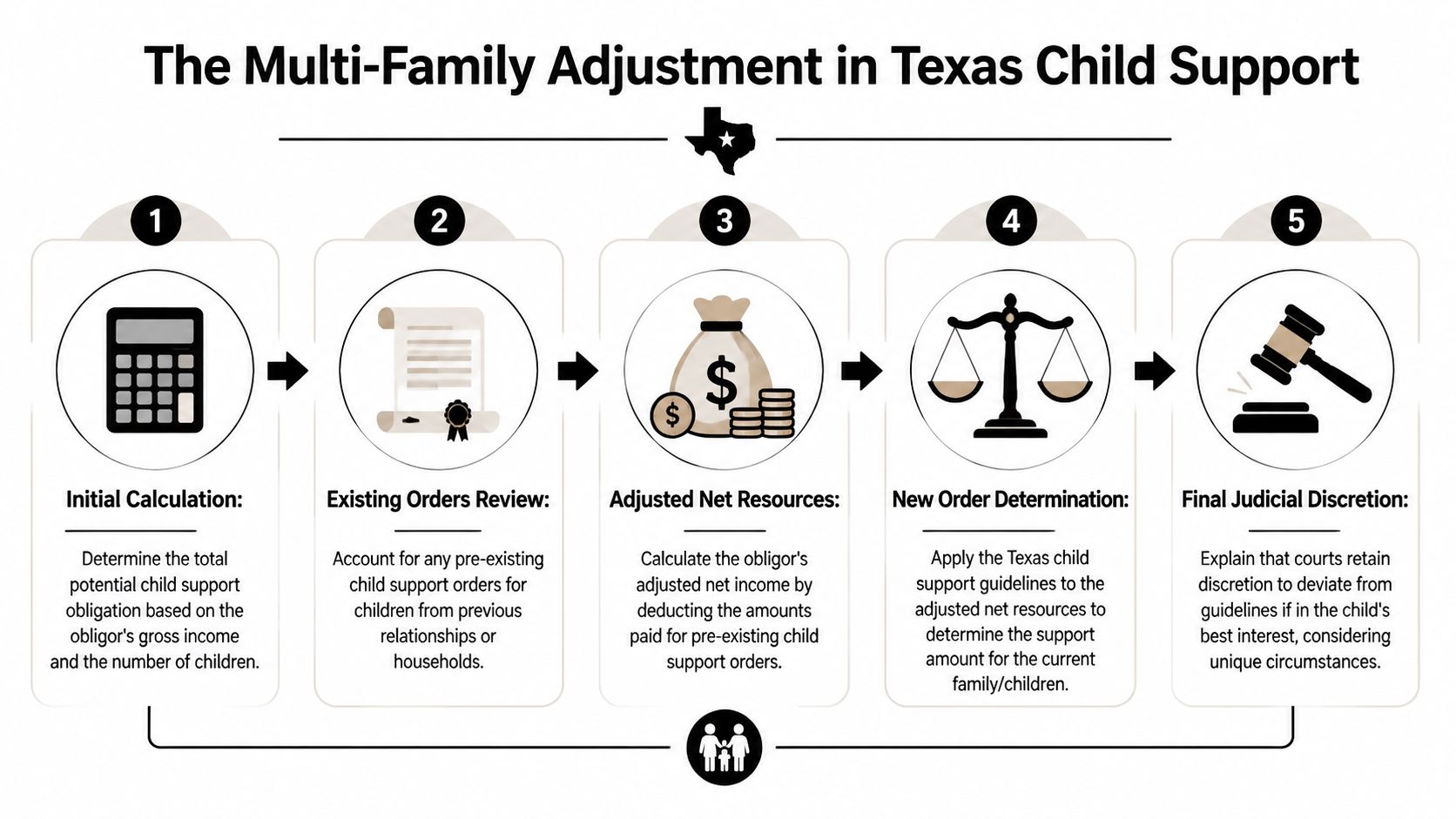
When a father has children in more than one household, Texas does not repeat the single-family formula separately for each case. The law uses a credit method under §154.128, supported by the adjusted tables in §154.129.
The idea behind the formula
Think of the support obligation as one pie tied to available net resources. Texas first asks what the pie would look like if all legally supported children lived in one home. Then it allocates credit for the children in other households so the obligor isn't charged as if each case existed in a vacuum.
The core method is stated clearly in this explanation of calculating child support in multiple orders in Texas. Step 1: compute hypothetical support as if all children lived together. Step 2: determine the per-child amount, generate a credit for prior household children, subtract that credit from net resources, and then apply the standard percentage to the adjusted amount for the children in the current case.
The two-step method in plain English
Here is what that means in practice:
Count the total number of children subject to legal support duties.
This includes the children before the court and the children in prior legally established households.Calculate hypothetical support as one family.
Use the standard percentage that matches the total number of children.Find the per-child amount.
Divide the hypothetical total by the total number of children.Create the credit for children in prior households.
Multiply the per-child amount by the number of children not before the court.Adjust net resources and calculate the current support.
Subtract the credit from the obligor's net resources, then apply the ordinary percentage for the number of children in the current case.
If you want a more detailed discussion of how courts frame income before the formula is applied, this resource on how Texas courts calculate net resources helps tie the income side to the support side.
Why this usually surprises parents
Parents often assume fairness means each household gets the same percentage. That isn't how the statute works. The court is not trying to assign a standalone percentage to each family without regard to the others. It is trying to account for all legally recognized children in a way the statute permits.
A simple example from the verified data shows why. With $5,000 in net resources, 2 prior children, and 1 current child, the hypothetical support for 3 total children is 30%, or $1,500. That creates a $500 per-child amount. The credit for the 2 prior children is $1,000, leaving $4,000 in adjusted net resources. Support for the 1 current child is then 20% of $4,000, which is $800. The verified source also gives a separate example with $5,000 net resources, 2 prior children, and 1 current child using the credit method to reach $750 when the hypothetical support is 25% = $1,250, based on that source's scenario framing. In actual court, the exact number depends on the specific child count and procedural posture supported by the evidence and the table applied. The lesson is the same. Multi-family math is statutory, not intuitive.
A parent doesn't receive the multi-family adjustment by saying, “I help another child.” The parent gets it by proving a legal duty the court can recognize.
What the court still controls
Even in a guideline case, judges still retain discretion under §154.123. The formula is the starting point, not a blindfold. If the evidence shows the presumptive amount would be unjust or inappropriate, the court can deviate, but it must do so based on the statute and the record.
That matters because lawyers sometimes argue these cases as if the table alone decides everything. It doesn't. The table matters. The proof matters just as much.
Real-World Scenarios Calculating Support with Multiple Families
A parent sits down for a support consult and says, “I have a child from my first relationship, two children at home now, and we split time 50/50 with one of them. What am I going to pay?” That is the right question. Multi-family support cases in Texas turn on math, proof, and the order in which the court applies the statutes.

Online summaries often stop at the table. Real cases do not. The harder questions usually involve the multi-family adjustment under Texas Family Code §154.128, the guideline tables in §154.129, the net-resource cap, and whether a shared-possession order changes the numbers before anyone reaches a final monthly figure.
One prior child and one current child
Start with a common setup. The obligor already has one child subject to a prior legal duty of support and is now in a new case involving one current child.
The court does not treat those obligations as separate silos. It applies the multi-family framework by looking at the total number of children for whom the parent owes a legal duty, then uses the adjusted table to reach the percentage for the child or children before the court. In practice, that usually reduces the support amount below what the parent would pay if the current court ignored the first child entirely.
The key word is legal. A child counts for this analysis if there is an enforceable duty the court can recognize, such as a prior order or established parentage.
A worked example under the 2025 cap
High-income cases are where clients most often miscalculate support. They assume the cap ends the analysis. It does not.
As explained in this 2025 Texas guideline discussion, net monthly resources are capped at $11,700 effective September 1, 2025 for guideline calculations. In a multi-family case, the court still applies the §154.128 adjustment within that capped framework.
Consider the example many lawyers see. Net monthly resources are $11,700. There are 3 total children tied to legal duties, made up of 2 prior children and 1 current child before the court. The hypothetical support for 3 children is 30%, which equals $3,510. The credit for the 2 prior children is $2,340. That leaves $9,360 in adjusted net resources. Support for the 1 current child is then 20% of $9,360, or $1,872.
That number surprises people. Many expect a straight 20% of the full cap. Texas does not calculate it that way once other legally recognized children are part of the picture.
Where 50/50 custody changes the discussion
Shared custody adds another layer. Parents often assume a 50/50 schedule means no child support anywhere. Texas courts do not use that shortcut.
If one household has a true shared-possession arrangement and another household has a standard support claim, counsel usually needs to calculate the shared-custody obligation first, then examine how that legal duty affects the multi-family adjustment in the pending case. The court will want the actual order, not a verbal description of the schedule. If the paperwork shows equal possession but one parent still pays support under the existing order, that obligation can affect the current calculation.
This is one reason two parents with the same income can leave court with different numbers. The result depends on which children are before the court, which duties are already reduced to orders, and whether a shared arrangement is documented well enough to be used in the math.
Proof problems decide a lot of hearings
Many multi-family disputes are lost on evidence, not theory. A parent claims support obligations in another home. The other side argues the obligation is informal, exaggerated, or already terminated. The judge then has to decide whether the claimed credit belongs in the worksheet at all.
The records that usually carry the hearing are:
- Prior child support orders
- Paternity orders or other proof establishing a legal duty
- Recent pay stubs and tax records used to calculate net resources
- Proof of health insurance or cash medical support
- Possession orders for any claimed 50/50 arrangement
Missing one of those documents can change the result fast.
A practical way to analyze a multi-family file
In my experience, these cases go better when the file is mapped before anyone argues fairness. Start with the children who are before the court. Add every other child tied to a legally enforceable duty. Identify which orders are active, which children are covered by informal support only, whether any parent is claiming a shared-possession setup, and whether income exceeds the guideline cap.
Then run the numbers carefully. After that, ask whether the presumptive result should stand or whether a deviation argument under §154.123 makes sense. That second step is where strategy comes in. A parent seeking less than the guideline amount needs proof. A parent seeking more than the capped guideline amount also needs proof, especially if claiming proven needs above the presumptive support amount under §154.130.
In multi-family cases, the best argument usually starts with a clean worksheet and certified orders.
Later in the case, this video gives a useful visual overview of how support disputes often play out in practice:
What works and what fails
What works is disciplined preparation. Courts respond to accurate income calculations, organized exhibits, and a clear explanation of how §§154.128, 154.129, 154.123, and 154.130 fit together in that specific file.
What fails is a general claim that “I have other kids to support” without orders, adjudications, or admissible financial records. Judges hear that argument often. They reduce support only when the law and the evidence support the reduction.
Some parents also need help reviewing payroll records, calculating net resources, preparing a modification, or organizing hearing exhibits. That is the type of work firms such as Texas Child Support Law Office of Bryan Fagan handle in Texas support litigation and modification practice.
Special Considerations and Complex Scenarios
The hardest cases are usually not about the table. They're about whether the table applies cleanly at all.

Shared custody does not erase the multi-family analysis
Parents often assume a 50/50 schedule means there is no child support issue anywhere. That is not always true. In multiple-family cases, the shared arrangement in one household can still affect support in another.
Verified data states that in 50/50 custody cases with multiple families, Texas courts first offset mutual obligations before applying the §154.128 multi-family adjustment. If a father has 50/50 custody of children with one parent and owes support for a child with another parent in sole custody, the current order can still receive a credit for the children in the shared-custody household, typically reducing the percentage from 20% to around 17.5% of net resources, as discussed in this article on multiple families and Texas child support. The key proof issue is the court order establishing the 50/50 arrangement.
That last point is where many litigants stumble. A claimed informal schedule is not the same thing as an enforceable possession order.
Informal support usually won't help
A father may tell the court he pays rent for another child's mother, buys groceries, or covers school costs in another household. Those facts may matter emotionally, but they do not automatically create a statutory credit.
The court wants proof of a court-ordered or legally established duty. Informal generosity is not the same as a legal support obligation under the Family Code. That distinction frustrates many parents, but it is central to how judges keep the formula consistent.
Imputed income and manipulated earnings
Some obligors try to lower support by changing jobs, working fewer hours, or presenting a reduced current income after years of higher earnings. In those cases, the legal fight becomes one of credibility and earning capacity.
Under the Family Code, courts can examine whether a parent is voluntarily unemployed or underemployed. A multi-family credit can reduce a valid obligation, but it does not excuse a parent from an income finding the court considers artificial or incomplete.
Courts are more receptive to documented income changes than to unexplained ones. If earnings dropped, show why with records, not conclusions.
Medical and dental support are separate issues
Parents sometimes focus so heavily on monthly cash support that they forget medical and dental support are separate obligations. A negotiated or litigated result may look manageable on the cash side but become far heavier once health coverage and reimbursement duties are added.
That matters in settlement discussions. Before agreeing to numbers, ask:
- Who carries the child's health insurance
- How uninsured expenses are allocated
- Whether the support amount assumed a specific insurance cost
- Whether the order language clearly states reimbursement procedures
These details don't make the headline, but they often drive post-order conflict more than the base support amount does.
Modifying and Enforcing Your Child Support Order
A child support order doesn't update itself. If a parent has a new legal duty to support another child, or if the existing amount no longer matches the statutory framework, the fix is a modification case, not a private agreement.
When modification makes sense
Under Texas Family Code §156.401, a court may modify support when there has been a material and substantial change in circumstances. A new legal obligation to support another child commonly fits that standard.
The important part is timing and procedure. The prior order stays in force until a judge changes it. A parent who starts paying less because a new child was born risks creating arrears while believing he is acting fairly.
What the process usually looks like
A support modification usually follows a straightforward sequence:
File the petition
The pleading should identify the current order and the change that justifies recalculation.Serve the other party properly
If service is defective, the case can stall or unravel.Gather the right documents
Pay records, prior orders, proof of health insurance cost, tax-related records, and any possession orders tied to another household matter.Prepare the calculation theory before the hearing
Don't walk in expecting the judge to build your case from scratch.Present a clean record
The court needs evidence of income, legal duties to other children, and any basis for deviation under §154.123.
If you are preparing that process now, this guide on how to modify child support in Texas is a practical companion to the statute.
Enforcement is its own case
When support has not been paid, the receiving parent may need enforcement rather than modification. Courts can enforce existing obligations through wage withholding and other remedies authorized by Texas law. Enforcement can also become more complicated when the obligor responds by claiming another family should reduce the amount.
That response may matter prospectively in a modification case, but it does not erase unpaid support already owed under an existing order. Arrears remain serious, and they should be addressed with the exact order language and payment history in hand.
What usually helps at hearing
The strongest modification and enforcement presentations are organized, not dramatic. Judges usually respond better to:
- A payment history that is easy to read
- Copies of every existing support order
- A chart showing which children are before the court and which are not
- A net-resource calculation tied to the Family Code
- Focused testimony that matches the exhibits
That approach keeps the hearing on law and proof instead of frustration.
Frequently Asked Questions About Texas Multi-Family Child Support
Does informal support for another child reduce my child support?
Usually no. Texas multi-family adjustments are tied to court-ordered or legally established duties, not side payments, gifts, or voluntary help. If the father says he supports another child but cannot prove a legal duty, the court may refuse the adjustment.
What does a father need to prove to get the multi-family credit?
He needs evidence the court can recognize. That commonly means a prior support order, an adjudication of parentage, or another legally sufficient basis showing the duty exists. If the issue involves shared custody in another case, the possession order matters too.
Can the court give more than the guideline amount in a high-income case?
Yes. The guideline calculation is the starting point. In the right case, a parent can ask the court to go above the presumptive amount by proving the child's needs under §154.123 and related provisions. The stronger argument is usually specific and document-based, not general lifestyle language.
Does a new child automatically reduce an older order?
No. A new child may justify a modification, but the old amount remains enforceable until the court changes it. This is one of the biggest traps in child support when father has multiple families texas cases. People assume life events update court orders. They don't.
How does 50/50 custody with one parent affect support for another parent?
It can matter significantly, but only if the arrangement is legally established and proved. In verified examples, Texas courts first offset mutual obligations in the shared-custody case and then apply the multi-family adjustment to the other support case. Without a court order showing the 50/50 structure, that argument is much harder to win.
Can a parent argue the obligor is hiding income while also claiming another family credit?
Yes. Those issues often travel together. One side may argue for the credit based on other children, while the other side argues the income figure is understated. The court can address both. A valid multi-family credit does not require the court to accept a weak income presentation.
What happens to arrears in a multi-family case?
Arrears do not disappear because another child was later born or another order was later entered. The court may modify support prospectively if the legal standard is met, but unpaid amounts under the existing order still matter and can still be enforced.
Should I rely on an online calculator?
Not in a multi-family case unless you know the calculator accounts for §§154.128 and 154.129, the current cap, and any custody offsets that apply. Single-household calculators often mislead parents because they don't account for prior legal duties, capped resources, or deviation issues.
If you're dealing with competing child support obligations, a pending modification, or a dispute over whether another child should count in the calculation, Texas Child Support Law Office of Bryan Fagan works with Texas parents on establishing, modifying, enforcing, and defending support orders under the Texas Family Code. A focused case review can identify whether the issue is income, proof of another legal duty, application of the multi-family tables, or a deviation argument the court needs to hear clearly.