A lot of parents land here in the same moment. One parent has taken a job in another state, remarried, joined the military, or left Texas after a breakup. The first question is usually blunt: does child support still have to be paid if a parent moves out of Texas?
Yes. And if you're dealing with child support if parent moves out of texas, the main issues aren't whether the order survives. It does. The main issues are which court can change it, how interstate enforcement works, and whether the move gives you grounds to seek a modification.
Texas law is direct on the basics. Child support is governed by Texas Family Code Chapter 154, modifications are addressed in Chapter 156, and relocation disputes often intersect with conservatorship rules in Chapter 153. In practice, that means a move can change strategy, deadlines, travel costs, and evidence. It usually does not erase the order you already have.
Your Texas Child Support Order Follows You Everywhere
A father accepts a job in Georgia and assumes Texas can no longer do much about the support order. A mother relocates with the child to New Mexico and assumes support should be recalculated there right away. Both assumptions cause expensive problems.
If a Texas court signed the support order, the order remains in force after a parent crosses state lines. Texas adopted UIFSA in Texas Family Code Chapter 159, and the point is simple: relocation does not cancel child support. The monthly amount stays due until a court signs a new order.

That rule matters whether the parent who moved is the one paying support or the one receiving it. The practical effect is different depending on who left Texas, but the order itself does not disappear. If you need a broader overview of Texas child support when parents live in different states, start there. Then focus on the order you already have, because that document controls until a court changes it.
What Texas law requires
Start with Texas Family Code § 154.001. It authorizes a court to order either or both parents to support a child. § 154.125 sets out guideline child support, and § 154.123 lists reasons a court may depart from the guideline amount.
Those statutes lead to two practical rules.
- The duty to pay comes from the court order
- A parent cannot change the amount by private decision
That is where people get into trouble. A move may increase airfare, change parenting time, reduce overtime, or affect housing costs. Those facts may support a later modification request. They do not authorize a parent to pay less this month because the move felt justified.
Texas courts also treat support and possession as separate issues. If visitation is being denied, the remedy is enforcement or modification of the possession order. It is not a support strike.
Common mistakes after a move
The same bad patterns show up in interstate cases:
- Stopping payments until custody or visitation is sorted out
- Making side payments in cash, by app, or directly to a landlord instead of paying through the ordered channel
- Assuming another state must enter a new order before anyone can enforce the Texas order
- Waiting months to file for modification while arrears continue to accumulate
I tell clients the same thing in both roles. Paying parents need to act before arrears build. Receiving parents need to keep clean records and move quickly when payments stop.
Texas has real enforcement tools, including income withholding, license-related remedies, liens, and interstate enforcement procedures under Chapter 159. The Texas Attorney General's child support program explains how support collection and enforcement continue even when a parent lives elsewhere.
What works better
Use the order. Use the records. Use the court process.
If you are the paying parent, keep paying under the current order unless and until a judge signs a modification. If the move changed income, travel costs, or the child's living arrangement, document that change and file promptly.
If you are the receiving parent, gather the signed order, payment history, employer information, and the other parent's current address as soon as you learn about the move. Interstate cases are easier to enforce when the paperwork is organized from the start.
The short version is straightforward. Texas support orders travel well. Parents do not get a fresh start on child support just because they changed states.
Understanding Jurisdiction Which Court Decides Your Case
The hardest interstate question isn't enforcement. It's jurisdiction.
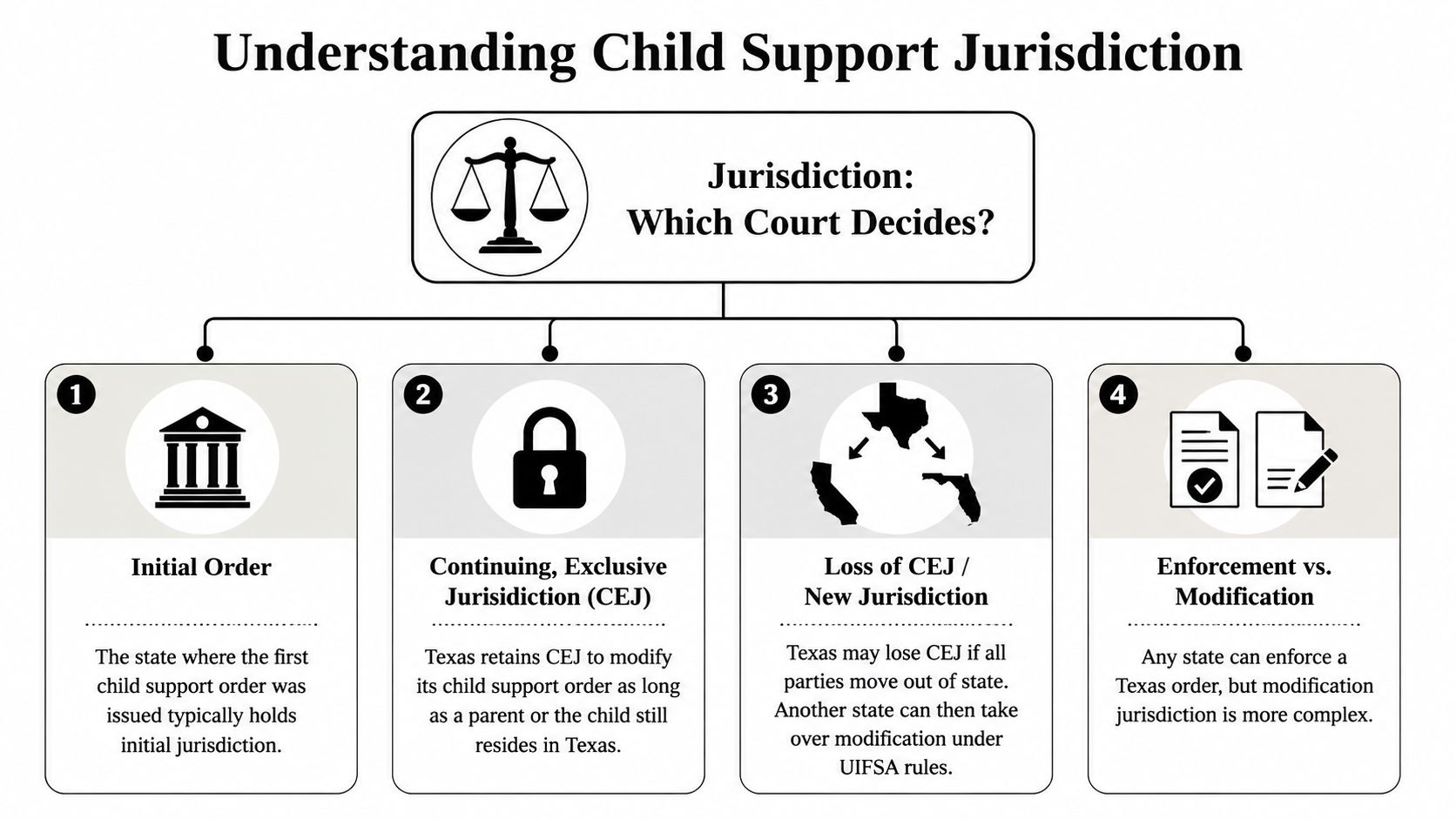
Parents often ask whether Texas still controls the case after everyone has scattered to different states. The answer turns on continuing, exclusive jurisdiction, often shortened to CEJ. Under UIFSA and Texas practice, the court that issued the support order usually keeps the power to modify it unless specific facts shift that authority elsewhere.
Texas usually keeps modification power longer than parents expect
If a Texas court signed the original support order, Texas often remains the proper court for modification even after one parent leaves. That's why parents should separate two ideas that get confused constantly:
| Issue | General rule |
|---|---|
| Enforcement | Another state can often help enforce a Texas order |
| Modification | Texas usually keeps authority until jurisdiction shifts under UIFSA rules |
The verified authority on this point is clear. The state where the child becomes domiciled, typically after 6 months, can gain modification jurisdiction, but only if certain conditions are met, such as both parents and the child no longer residing in Texas. Until then, the original Texas court can still modify the order even if one parent lives elsewhere, as explained by Walters Gilbreath on out-of-state child support enforcement and jurisdiction.
That means parents often make a bad filing decision. They assume, "I live in another state now, so I should file there." Sometimes that's wrong, and the case gets delayed while everyone argues about which court has authority.
For a broader discussion of interstate issues, see child support when parents live in different states in Texas.
The six-month point matters, but it isn't the whole rule
The child's residence in a new state is important. So is whether either parent still lives in Texas. Those facts work together.
A useful way to think about it is this:
- If a parent or the child still resides in Texas, Texas often retains continuing, exclusive jurisdiction to modify.
- If everyone has left Texas, the analysis changes.
- If the child has become domiciled in the new state, that state may become the modification forum under UIFSA if the other required conditions are also met.
A new driver's license and a moving truck don't transfer jurisdiction by themselves.
How this plays out in real cases
Consider two common patterns.
Pattern one: Mother and child move to Georgia, but father still lives in Harris County. Texas generally remains the place to seek support modification because Texas still has a live connection to the case through a parent.
Pattern two: Mother and child move to Tennessee, father moves to Arizona, and nobody remains in Texas. At that point, Texas may lose continuing, exclusive jurisdiction, and another state may become the proper place to seek modification.
This is why Texas Family Code Chapter 159, which contains Texas's UIFSA provisions, matters so much. You cannot treat an interstate modification like a local family case and expect it to go smoothly.
What to check before filing
Before anyone files anything, confirm these facts:
- Who currently lives in Texas
- Where the child has been living
- Whether the move was temporary or permanent
- Which court signed the last controlling order
- Whether you're asking for enforcement, modification, or both
A lot of wasted attorney's fees come from skipping that analysis. Jurisdiction isn't a side issue. It determines whether your case can move at all.
Enforcing a Texas Child Support Order Across State Lines
When the paying parent moves and stops paying, enforcement usually becomes more practical than theoretical. You need a collection path that works in the other state.
Under UIFSA, a Texas support order can be registered in the new state where the parent relocated. Once registered, the receiving state can use its own enforcement machinery, including wage garnishment, tax refund seizure, and driver's license suspension, without re-litigating the underlying support obligation, as explained by Verner Brumley on interstate enforcement of child support orders.
If you need a procedural overview on Texas enforcement tools generally, review how to enforce child support in Texas.
Registration opens the door to local enforcement
Registration is often the key move because it allows the new state to treat the Texas order as one it can act on for enforcement purposes.
In practical terms, that can mean:
- Income withholding from the out-of-state employer
- Interception of eligible tax refunds
- Suspension of a driver's license
- Other state-level enforcement measures available once the order is registered
Parents sometimes think they must start from scratch in the new state. They don't. The goal is usually to activate enforcement, not to prove the original case again.
What enforcement usually looks like in sequence
Most interstate enforcement files follow a predictable pattern:
Confirm the controlling order
Get the signed order and any later modifications.Establish the arrears record
Use official payment records where possible.Identify the new state and current employer
Good address information shortens the process.Register the order or work through the appropriate agency route
UIFSA takes on the primary responsibility.Push for collection tools that match the facts
Wage withholding is often the cleanest route when the parent has regular employment.
Here is a short explainer on how these interstate cases function in practice:
Enforcement and modification are not the same case
This distinction matters in court and in strategy.
If the order says the parent owes support and they aren't paying, that's an enforcement problem. If the parent believes the amount should change because income, custody, or expenses have changed, that's a modification problem.
Courts don't treat nonpayment as an informal request for a lower amount.
That matters because the paying parent can still rack up arrears while waiting to file a modification. The receiving parent can enforce the existing amount while the other side argues for a future change.
What gets parents in trouble
A few recurring mistakes make interstate enforcement harder than it needs to be:
- Relying on verbal agreements. If the parents agreed to a lower amount after the move, but no court signed it, the original order still controls.
- Failing to document where the parent moved. Enforcement gets slower when nobody has an employer, address, or reliable service information.
- Treating missed travel reimbursement and missed support as the same issue. They're related, but not identical.
- Waiting too long. Delay usually means larger arrears and a more defensive other side.
An interstate case is still a court case. The parent who brings records, payment data, and a clean timeline usually has an advantage.
How to Modify Child Support When a Parent Lives Out of State
A parent takes a job in Colorado, the other parent stays in Texas, and both assume the child support amount will adjust on its own because the circumstances obviously changed. It will not. Until a court signs a new order, the old amount remains enforceable.
Texas modification cases usually turn on Texas Family Code § 156.401, which allows modification when there has been a material and substantial change in circumstances. An out-of-state move often qualifies because it can affect income, health insurance, childcare, possession time, or transportation costs tied to visitation. The move is the reason to file. It is not the modification itself.

For a focused look at the Texas process, see how to modify child support in Texas.
File in the right court, then prove the change
If Texas keeps continuing, exclusive jurisdiction over support, the modification usually belongs in the Texas court that controls the existing order. That jurisdiction question matters more in interstate cases than many parents realize, because filing in the wrong state wastes time and money. Texas Family Code Chapter 159, the Texas version of UIFSA, controls when Texas keeps authority and when another state may modify instead.
The mechanics are familiar, even if the other parent now lives elsewhere:
- File a petition to modify the support order
- Serve the out-of-state parent correctly
- Exchange current financial records
- Set the case for hearing, or reduce an agreement to writing
- Present evidence of the changed circumstances and the requested amount
- Get a signed order
Service deserves real attention. In interstate cases, bad service is one of the fastest ways to create delay, extra expense, and a hearing date that disappears.
The support amount still starts with Texas guidelines
Texas courts still begin with guideline support under Texas Family Code § 154.125 if Texas is the modifying state. The standard percentages remain the starting point:
| Number of Children | Percentage of Net Resources |
|---|---|
| 1 | 20% |
| 2 | 25% |
| 3 | 30% |
| 4 | 35% |
| 5 or more | 40% |
The applicable net resource cap also matters in higher-income cases. Under § 154.125, the court starts with guideline support up to the statutory cap, then evaluates whether additional support is justified under § 154.123 based on the child's proven needs and other statutory factors. In practice, that means broad claims about rising costs are weak evidence. Judges want pay stubs, tax returns, insurance costs, daycare records, and proof of actual expenses tied to the child.
Relocation changes the facts, not the legal burden
A move can affect the modification analysis in several ways.
If the paying parent relocates and earns more, the receiving parent may have a strong basis to seek an increase. If the paying parent relocates and claims lower income, the court will look closely at whether that reduction was voluntary, temporary, or made in good faith. Texas courts are rarely impressed by a parent who chooses a lower-paying path and then asks the child to absorb the loss.
Travel expense is another common flashpoint. A parent who moves farther away often asks the court to lower support because visitation now costs more. Sometimes that argument has some force. Often it does not, especially when that same parent chose the move and shifted the transportation burden onto the other household. The court can consider those facts under § 154.123 when deciding whether to deviate from the guideline amount.
Modification strategy changes depending on who moved
Interstate cases stop being generic at this point.
If the parent receiving support moved with the child, the support issue may be tied to changes in school, childcare, medical coverage, and the day-to-day cost structure for the child. If the paying parent moved alone, the dispute often centers on income, travel allocation, and whether the move was a legitimate reason to revisit support at all. The facts are different, and the persuasive evidence is different.
I tell clients to build the case around documents, not frustration. The best modification file usually includes current income records, prior tax returns, health insurance costs, daycare invoices, travel receipts, school calendars, and a clean timeline showing what changed and when it changed.
Deviation cases require specific proof
Not every case ends at the guideline number. Texas Family Code § 154.123 allows the court to depart from guidelines when the facts justify it, including travel burdens, the parents' financial resources, special needs, or the child's actual needs.
That cuts both ways. A parent asking for reduced support because interstate travel became expensive may have a weak position if the move was voluntary and the child's needs did not decrease. A parent asking for more support because the move increased costs still has to prove those costs with credible records.
A brief factual point here. The Texas Child Support Law Office of Bryan Fagan handles interstate establishment, modification, and enforcement matters, which reflects how often these cases turn on jurisdiction and proof rather than on broad fairness arguments alone.
Asymmetrical Impacts Who Moves Matters
Relocation cases are not symmetrical. The legal effect changes depending on which parent moved.
That distinction gets missed in generic articles, but it matters in almost every serious interstate case. The move affects conservatorship, travel expense, enforcement pressure, and the credibility of a later modification request.
When the parent with the child moves
If the parent with the right to designate the child's residence wants to move out of Texas, support doesn't exist in a vacuum. The move may collide with a geographic restriction in the existing order and with conservatorship rules under Texas Family Code Chapter 153, including the policy statement in § 153.001.
Under the verified material, when parents share joint conservatorship and one parent violates a geographic restriction by relocating without authorization, the consequences can include contempt findings, loss of primary conservatorship, and mandatory return orders, as discussed by Hannah Law on relocation and geographic restrictions in Texas.
That changes the support analysis in two ways.
First, a parent who moved without permission may walk into court already on the defensive. Second, even if the move is eventually allowed, the court may assign a substantial share of the new transportation burden to the parent who created it.
When the paying parent moves
If the non-custodial or paying parent leaves Texas, the case usually centers on enforcement and proof of changed finances.
A lower-paying job in another state doesn't automatically reduce support. The parent still needs a formal modification order. Courts often look at whether the move was reasonable, whether the new income is stable, and whether the parent voluntarily reduced earnings.
That creates a very different litigation posture from the custodial-parent move. The paying parent is usually asking the court for relief while trying to avoid arrears at the same time.
Side-by-side practical differences
| Situation | Main legal pressure point | Common court concern |
|---|---|---|
| Custodial parent moves | Geographic restriction, possession, travel allocation | Whether the move disrupts the child's relationship with the other parent |
| Paying parent moves | Enforcement, income proof, modification request | Whether the parent is using the move to reduce support without court approval |
If you're planning a move, file before the move hurts your credibility. If the other parent already moved, act before the facts harden against you.
What doesn't change in either scenario
The verified source makes one point that parents need to hear clearly: the relocation itself does not automatically modify the support obligation. Only a court can do that through a formal modification proceeding.
So even though the strategic issues are different depending on who moved, the same bottom-line rule applies. The existing amount remains in place until a judge signs something new.
Your Action Plan for Interstate Child Support Issues
Interstate child support problems get easier when you stop treating them as one issue. They are usually three separate tracks: order review, jurisdiction review, and proof gathering.
If you're the parent moving, start with your current orders. Read every page for support terms, conservatorship language, geographic restrictions, notice requirements, and payment instructions. A parent who moves first and reads later usually loses an advantage.
If you're the parent moving out of Texas
Build a file before you leave.
- Pull the controlling orders. You need the most recent signed documents, not just memory of what happened in court.
- Document the reason for the move. Job offer, family support, military orders, or housing changes all need paper behind them.
- Create a realistic post-move budget. Courts respond better to specifics than general claims that life got more expensive.
- Map out parenting logistics. Flights, driving time, school schedules, exchange locations, and who will pay for travel often become central.
- Decide whether you need modification immediately. If your income changes, don't wait for arrears to pile up.
If you're the parent staying in Texas
Your job is different. You're preserving enforcement options and preparing for a likely dispute about possession or money.
- Get a clean payment history. Missed and partial payments need to be organized.
- Save communication about the move. Dates matter.
- Record new child-related costs. Travel, school disruption, childcare changes, and medical issues may become relevant.
- Keep possession records. Actual time exercised can matter, especially when the other side claims the schedule changed.
- Separate emotion from proof. Judges hear relocation anger every week. They decide cases on documents.
What to bring to the first attorney meeting
Bring the material that shortens analysis:
- All signed orders
- Payment records
- Addresses and employer information
- Recent pay information for both parents if available
- Messages or notices about the move
- A timeline with major dates
A productive consultation usually turns on those documents. Without them, a lawyer can discuss possibilities. With them, a lawyer can discuss strategy.
Parents also do better when they decide early what they want. Some want enforcement only. Some want reduced support. Some need a relocation fight, a possession rewrite, and a support modification all at once. Those are different cases, even when they come from the same move.
Frequently Asked Questions About Interstate Child Support
Can I stop paying child support if the other parent moved without telling me
No. Support and possession are treated separately. If the other parent violated the order, you may have enforcement or modification remedies, but you can't unilaterally stop paying because of the move.
If I moved to another state with lower wages, will Texas automatically lower my support
No. You must seek a formal modification. Until a court signs a new order, the current amount remains due. The court will usually want reliable proof of the income change and the reason it occurred.
What if the other parent moved to another country
The same first step applies. Start with the existing Texas order and confirm whether Texas still has jurisdiction over modification. International enforcement can be more complicated than interstate enforcement, but the move itself doesn't cancel the order.
Does 50 50 possession erase child support after an out-of-state move
Not necessarily. Texas doesn't use a simple rule that equal time always means no support. The court still looks at net resources, the actual parenting schedule, and whether deviation from guidelines is justified under Texas Family Code § 154.123.
Can the new state change my Texas order just because my child has lived there for six months
Not by itself. The six-month domicile point can matter for jurisdiction, but it works together with the larger UIFSA analysis about whether Texas still has continuing, exclusive jurisdiction.
Texas Child Support Guideline Percentages
| Number of Children | Percentage of Net Resources |
|---|---|
| 1 | 20% |
| 2 | 25% |
| 3 | 30% |
| 4 | 35% |
| 5 or more | 40% |
If you're dealing with child support if parent moves out of texas, the safest move is usually early legal analysis before the arrears, travel disputes, and jurisdiction fights all collide. The court can solve these problems. But it can only solve the problems you properly put in front of it.
If you're facing an interstate support problem, Texas Child Support Law Office of Bryan Fagan helps Texas parents establish, modify, enforce, and defend child support orders, including cases involving relocation, high-income guideline disputes, wage withholding, arrears, and contested jurisdiction issues across Houston, Dallas, Austin, San Antonio, Fort Worth, and surrounding counties.