Your paycheck is about to get hit, or your child support still isn’t arriving, and you need a straight answer. In Texas, wage garnishment for child support texas cases isn’t some rare enforcement tactic. It’s the standard tool courts use to keep support moving.
If you’re the parent receiving support, you need to know how to get withholding in place fast and how to force action when it fails. If you’re the parent paying support, you need to know what can legally be withheld, when to challenge bad numbers, and when to file a modification before arrears pile up. Texas law provides both structure and advantage. Use it correctly.
The Legal Foundation of Texas Child Support Garnishment
Texas treats child support differently from ordinary debt. That matters.
For most consumer debts, Texas protects wages from garnishment. But child support is one of the clear exceptions under Texas law. In practice, that means courts and the Office of the Attorney General can reach earnings through an Income Withholding Order, usually called an IWO, and they do it routinely.

Why Texas uses withholding first
If you’re expecting checks to arrive voluntarily every month, you’re relying on the weakest enforcement model available. Texas doesn’t rely on trust when a child support order exists. It relies on payroll deduction.
Over 80% of all collections in cases enforced by the Texas Attorney General’s Child Support Division come through wage withholding, according to the Texas OAG employer income withholding information. That tells you exactly how the system is built. Wage withholding is the backbone.
Under Chapter 158 of the Texas Family Code, courts can order income withholding for support. In real life, that means support is taken from earnings before the paying parent gets the money. It removes delay, excuses, and selective payment behavior.
Practical rule: If there’s a valid support order, assume withholding should be in place unless the court has specifically found good cause not to require it.
What the Family Code says
You should know the key sections because judges and lawyers use them constantly:
- §154.125 sets the guideline framework for child support.
- §154.123 governs deviations from the guidelines when the standard amount would be unjust or inappropriate.
- Chapter 158 addresses income withholding for support.
- §158.107 requires notice of employment changes, which becomes critical if the obligor switches jobs.
Texas courts also work within federal garnishment limits under the Consumer Credit Protection Act. The verified cap is 50% of disposable earnings if the obligor supports another spouse or child, or 60% if not, as described in the earlier-cited Texas OAG material. Disposable earnings means pay left after legally required deductions.
What this means in court
Judges don’t view wage withholding as punishment. They view it as compliance infrastructure.
If you’re the paying parent, don’t waste time arguing that withholding is unfair because you intended to pay directly. That argument usually goes nowhere. Texas law assumes structured withholding protects the child and reduces enforcement fights.
If you’re the receiving parent, don’t accept informal promises in place of an enforceable withholding setup. A text saying “I’ll send it Friday” isn’t security. A signed order served on payroll is.
A real-world example
A father in Dallas has a regular W-2 job and a child support order. He says he’ll pay manually because he doesn’t want payroll involved. The court still includes withholding because the law favors reliable collection. If he misses payments, the employer can be directed to deduct support directly.
A self-employed parent is different. There may be no employer to serve. In that situation, you need a different enforcement strategy. But where wages exist, withholding is usually the fastest and cleanest route.
Child support enforcement works best when it stops being personal and starts being automatic.
Calculating Guideline Child Support and Withholding Amounts
Most fights over wage garnishment aren’t really about garnishment. They’re about the underlying support number.
Texas starts with monthly net resources, then applies the guideline percentages in §154.125. If the case is unusual, the court can depart from the guideline amount under §154.123. That’s the framework.
How Texas courts approach the math
For a standard case, the judge looks at the obligor’s net monthly resources under §154.062 and applies the guideline percentage tied to the number of children before the court.
Use that in the right order:
- Determine average monthly net resources.
- Apply the guideline percentage.
- Check the statutory cap on net resources.
- Decide whether facts justify a deviation under §154.123.
Many parents make expensive mistakes in this process. They argue from gross pay, not net resources. Or they assume a high income automatically means unlimited guideline support. It doesn’t.
The current cap and the 2025 change
Texas law currently applies the guideline calculation to the first $9,200 of average monthly net resources, with maximum guideline support of $1,840 for one child, $2,300 for two, $2,760 for three, $3,220 for four, and $3,680 for five or more, as summarized in this discussion of Texas child support guidelines for 2025.
That same source states the net resource cap will update to $11,700 effective September 1, 2025. If you’re negotiating or setting a case now that will still matter after that date, plan for it.
Texas Guideline Child Support Calculations Effective Sep. 1, 2025
| Number of Children | Percentage of Net Resources | Maximum Guideline Support |
|---|---|---|
| 1 | 20% | $2,340 |
| 2 | 25% | $2,925 |
| 3 | 30% | $3,510 |
| 4 | 35% | $4,095 |
| 5 or more | 40% | $4,680 |
These amounts reflect the stated $11,700 cap effective September 1, 2025 and the guideline percentages in §154.125.
A practical calculation example
Say a parent’s average monthly net resources are $6,000 and one child is before the court. Under §154.125, the presumptive guideline amount is 20%, so support would be $1,200.
Now change the facts. The parent’s net resources are $12,500 monthly in a case involving two children. Before September 1, 2025, the guideline analysis applies to the first $9,200. On and after September 1, 2025, the guideline analysis applies to the first $11,700. That difference can materially change withholding.
For a deeper walk-through of net resource calculations, review this guide on how to calculate child support in Texas.
When courts go above or below the guidelines
The guidelines are the starting point, not the finish line.
A judge can deviate under §154.123 if the child’s proven needs or the case facts justify it. That happens in high-income cases, unusual medical or educational situations, and some shared-possession disputes. But don’t walk into court saying, “I make more, so I should pay more,” or “we split time, so I should pay less,” without evidence tied to the statute.
Use specifics:
- Child-focused proof: Show actual needs, not lifestyle arguments.
- Income proof: Bring reliable records. Inconsistent documents get punished.
- Possession facts: If you claim a shared arrangement changes fairness, be ready to prove the schedule and the actual expense split.
Courts don’t reward vague fairness arguments. They reward documented numbers tied to the Family Code.
How to Initiate an Income Withholding Order in Texas
If support has been ordered, withholding should usually follow. If it hasn’t, fix that immediately.
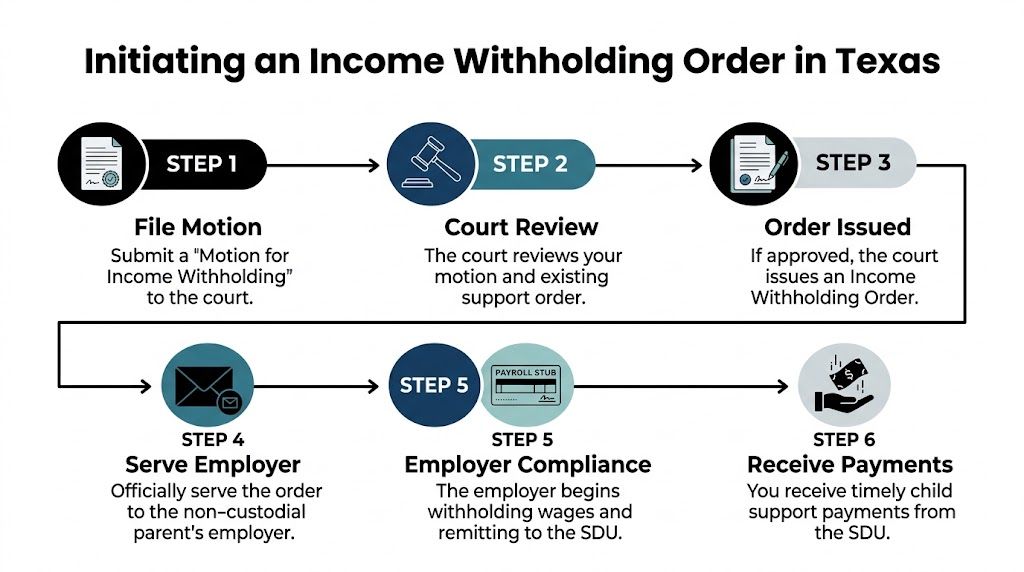
The process starts in court, not with the employer. Payroll won’t act because you called. Payroll acts because it received a valid order.
The order starts with the case
Texas practice is straightforward here. The filing of a petition for a child support order typically includes an Income Withholding Order unless good cause is shown or the parents agree otherwise. The court signs the OMB-approved IWO form, and that signed form is then filed and served on the employer, as explained in this overview of wage garnishments and income withholding.
That means your first question should be simple. Do I already have a signed child support order and a valid withholding order attached to it?
If the answer is no, start there.
The practical sequence
The cleanest way to think about it is as a file-serve-enforce chain.
Get the support order in place
If no final order exists, file the petition and obtain support terms first.Use the correct IWO form
Don’t improvise. A noncompliant form can stall the process.File the signed order with the clerk
If it isn’t properly filed, enforcement gets messy fast.Serve the employer correctly
Use the employer’s correct legal name and payroll address.Monitor the first remittance
Don’t assume the employer got it right.
What parents get wrong
I see the same mistakes repeatedly.
- Wrong employer identity: Parents list the store location, not the actual employing entity.
- Old payroll address: The order gets mailed to a place that can’t process it.
- Bad form version: The employer rejects it because the paperwork isn’t the proper OMB-approved IWO.
- No follow-up: Weeks pass, and nobody checks whether deductions started.
Those are avoidable errors. Fixing them early matters more than arguing later about who caused delay.
If the order needs to be updated
A child ages out. Support is modified. Arrears are added. Employment changes. Each of those events may require an amended withholding order.
Don’t assume the employer will figure out a changed amount from a separate court order. Employers need the withholding instructions in a form they can process. If the support terms change, update the withholding paperwork too.
The best filing mindset
Treat an IWO like a payroll instrument, not a courtroom speech. Precision wins.
If you want money to move, give payroll exactly what payroll needs. Correct party name. Correct amount. Correct form. Correct service.
Employer Obligations and Compliance with a Texas IWO
Once an employer receives a valid Income Withholding Order, this stops being optional. The employer isn’t mediating between parents. The employer is following a legal directive.
What the employer must do
The employer must begin withholding according to the order and remit the money as directed. In Texas practice, the payment is typically sent to the proper child support disbursement channel rather than handed informally from one parent to another through payroll.
An employer also has to treat the withholding amount as a priority deduction within the legal limits that apply to support withholding.
The withholding limits that matter
Federal law matters here.
Under the Consumer Credit Protection Act, verified data states that garnishment for child support may be capped at 50% of disposable earnings if the obligor supports another spouse or child, or 60% if not. Disposable earnings means what remains after legally required deductions. Those limits protect against over-withholding, but they do not eliminate the employer’s duty to withhold the ordered amount up to the lawful ceiling.
This is one reason support garnishment often blocks other lower-priority collection efforts. In Texas, wages are generally not open to garnishment for ordinary consumer debt anyway, which puts child support in a protected lane.
What both parents should watch
Use this checklist.
- For the receiving parent: Confirm the employer implemented the order and sent funds correctly.
- For the paying parent: Verify payroll used the right amount, especially after a modification.
- For either parent: Compare the court order to the pay stub and the payment record. Don’t assume all three match.
If the employer fails to comply, the court can compel compliance. That’s one reason it helps to understand broader enforcement options, including those discussed in this guide on how to enforce child support in Texas.
The practical takeaway
If payroll has a valid IWO and still doesn’t withhold correctly, that’s not a minor clerical issue. It can create arrears, overpayment disputes, and enforcement hearings that should never have been necessary. Catch mistakes early.
Enforcing Arrears and Contesting Garnishment Orders
When current withholding isn’t enough, you need escalation. When the withholding amount is wrong, you need a challenge backed by evidence. Those are different moves, and parents confuse them all the time.

If you’re owed back support
Arrears cases require more than sending another demand text.
Verified data confirms that in Texas the OAG can pursue additional withholding up to 65% of disposable earnings if arrears are over 12 weeks past due, and can also seek remedies such as tax refund intercepts and license suspensions, as outlined in this discussion of whether wages can be garnished for child support in Texas.
That gives you a practical roadmap.
Strong enforcement options
- Motion for enforcement: Ask the court to confirm arrears and enforce the order.
- Amended withholding: Increase withholding to cover current support and back support within legal limits.
- License pressure: Suspension risk often changes behavior fast.
- Intercepts and liens: Useful when wages alone won’t solve the problem.
If the obligor keeps dodging payment, filing a motion for contempt of court may be the right next step.
If you’re the parent being garnished
Don’t challenge garnishment because you dislike it. Challenge it because the numbers or legal basis are wrong.
Valid grounds may include:
- Bad arrears math: The payment history is inaccurate.
- Outdated order amount: A modification occurred, but payroll is still using the old figure.
- Identity or paternity issue: Rare, but serious if the order doesn’t legally bind the person being garnished.
- Income cap issue: In a guideline dispute, the court may have used the wrong net resource analysis.
- Support overlap problem: A child aged out or the order should have been amended.
Bring records. Judges don’t fix unsupported complaints.
Self-employment and gig work are different
Traditional wage withholding breaks down when there’s no ordinary employer. That’s why these cases become expensive and frustrating.
A parent driving for app-based platforms, working contract jobs, or operating a cash-heavy business can make income withholding far less effective. In those cases, you often have to move toward liens, contempt, or asset-focused enforcement after arrears become clear.
The biggest mistake in a gig-work case is waiting for payroll enforcement to solve a payroll-free problem.
What the court wants to see
Whether you’re enforcing or contesting, the court wants organized proof.
Use a file that includes:
| Issue | Best evidence |
|---|---|
| Missed payments | Payment ledger, SDU history, bank records |
| Wrong withholding amount | Current order, prior order, pay stubs |
| Arrears dispute | Full payment history, receipts, direct payment proof |
| Job change | Employer info, notices, hiring records |
| Modification basis | Income records, tax returns, business records |
A short explanation helps, but documents decide these hearings.
A useful visual on enforcement pressure
This short video gives context for how enforcement disputes often unfold in practice.
My advice on strategy
If you’re owed arrears, move early. Delay gives the other parent time to switch jobs, hide income, or build a defense around confusion.
If you’re facing incorrect withholding, don’t stop paying and hope to sort it out later. File to correct it, document every payment, and ask for a prompt hearing. Passive parents lose these cases.
When You Must Hire a Texas Child Support Attorney
A parent walks into my office after payroll starts taking too much from each check, the arrears balance looks inflated, and the other side is threatening contempt. At that point, this is no longer an administrative problem. It is a Texas Family Code case with real financial and legal exposure.

Hire counsel as soon as the dispute involves more than correcting a simple payroll error. Chapters 154 and 158 set the framework, but the outcome usually turns on proof, timing, and whether someone knows how Texas judges evaluate income records, arrears claims, and withholding limits.
High-income and above-guideline disputes
These cases need a lawyer early.
Once monthly net resources reach the guideline cap, the fight shifts from formula to evidence under Texas Family Code §154.125 and potential above-guideline support under §154.123. In 2025, the adjusted cap matters even more because a small percentage fight can mean a large monthly difference for a high earner. If one parent receives bonuses, RSUs, K-1 income, deferred compensation, or irregular commissions, the paper trail has to be built correctly and explained clearly.
Judges do not award extra support because one parent earns a lot. They want proof of the child’s proven needs, and they want the numbers tied to records.
Self-employed, business-owner, and gig-income cases
A standard withholding case is straightforward. A self-employment case is not.
If the paying parent runs income through an LLC, mixes personal and business spending, gets paid through apps, or deals heavily in cash, you need subpoena strategy, bank-record analysis, and a position on what counts as net resources under §154.062. I also look for expense inflation, retained earnings arguments, and sudden income drops that appear right before court. Those patterns show up often in real cases.
Gig-economy disputes are especially messy because there may be no stable employer to serve and no reliable paystub history. You need a lawyer who knows how to prove actual earning capacity and push the court beyond the fiction that a missing W-2 means missing income.
Arrears, contempt, and license-risk cases
Hire a lawyer immediately if the other side is alleging serious arrears or asking for contempt.
Contempt can bring fines, attorney’s fees, and jail exposure. A bad hearing can also leave you with a confirmed arrears judgment that keeps collecting interest and drives more aggressive enforcement later. If you made direct payments, paid cash, covered rent, or sent support outside the state disbursement unit, those facts do not prove themselves. They must be documented and presented correctly.
This is also where withholding mistakes become expensive. If payroll has been taking the wrong amount for months, you need a fast correction strategy and a clear payment reconstruction.
Interstate, relocation, and job-transition disputes
Cross-state enforcement raises a different set of problems. UIFSA issues, registration of foreign orders, and employer changes create delays and mistakes that unrepresented parents usually do not catch until money is already gone.
The same is true when someone changes jobs repeatedly or moves between payroll work and contract work. Texas law imposes reporting duties, but enforcement often lags behind reality. A lawyer can press for updated withholding, modification, or a different collection method before the case drifts into a larger arrears fight.
Cases that justify paying for legal help
Pay for counsel if any of these apply:
- your income is above the guideline cap or includes bonuses, equity compensation, or business income
- the other parent is asking for above-guideline support based on the child’s proven needs
- you are self-employed, paid in cash, or earning through gig platforms
- arrears are large, old, or based on a payment history you dispute
- contempt, license suspension, or other aggressive enforcement is on the table
- the order involves another state, a recent move, or repeated job changes
- payroll is withholding the wrong amount and the mistake is not being fixed quickly
The Texas Child Support Law Office of Bryan Fagan handles establishment, modification, enforcement, and defense of Texas child support orders, including high-income disputes and withholding issues under the Texas Family Code.
If the case can change your monthly cash flow, increase arrears, threaten contempt, or turn a high-income dispute into a long-term overpayment problem, hire the lawyer. Waiting usually costs more.
Frequently Asked Questions on Texas Child Support Garnishment
Parents usually ask the same practical questions right before court or right after payroll starts withholding. Here are the answers you need.
FAQ
| Question | Answer |
|---|---|
| Can Texas garnish wages for ordinary credit card debt the same way it does for child support? | No. Texas generally prohibits wage garnishment for most ordinary debts. Child support is one of the main exceptions, which is why withholding for support carries unusual force. |
| Is income withholding automatic in Texas child support cases? | Usually yes. Texas practice includes an Income Withholding Order with the child support order unless good cause is shown or the parents validly agree otherwise in a way the court accepts. |
| What if the paying parent changes jobs? | That’s a common failure point. Texas Family Code §158.107 requires the obligor to report employment changes, and TexasLawHelp notes that job changes and gig work often create gaps that traditional withholding can’t immediately solve, which may force the receiving parent to pursue liens or contempt actions through the court process described in TexasLawHelp’s article on income withholding for support orders. |
| Does wage garnishment work against gig workers or self-employed parents? | Not reliably in the same way. A standard IWO depends on a conventional employer. If the parent is self-employed or earning through app-based or contract work, enforcement often shifts toward contempt, liens, or other collection remedies once nonpayment is established. |
| Can I stop paying child support if I’m being denied visitation? | No. Support and possession are separate issues. You must address visitation violations through the court, not by withholding support. |
| What if payroll is taking the wrong amount? | Act immediately. Compare the withholding to the signed order and your pay records. If the amount is wrong because of an outdated order, arrears mistake, or modification issue, file to correct it. Don’t simply stop payment. |
| Can the court order more than the guideline amount? | Yes, in some cases. Under §154.123, a court may deviate from the guideline amount if the facts justify it, especially where the child’s proven needs support a different figure. |
| What happens when a child ages out? | The support terms may need to be updated, and the withholding order may need amendment. Don’t assume payroll will reduce withholding automatically. Get the court paperwork corrected. |
| Should I rely on the Office of the Attorney General alone for enforcement? | Sometimes that works. Sometimes it’s too slow or too general for a complicated case. If the case involves high income, self-employment, large arrears, or a contested hearing, private counsel is often the smarter move. |
Get ahead of the problem. In child support cases, delay is expensive for both sides.
If you need a strategy for wage withholding, arrears enforcement, modification, or defending against the wrong garnishment amount, contact Texas Child Support Law Office of Bryan Fagan. The firm represents parents across Texas in child support cases involving guideline calculations, §154.123 deviations, withholding orders, self-employment disputes, and courtroom enforcement under the Texas Family Code.