You may be dealing with this right now. Your paycheck changed, your child’s expenses changed, or the existing order no longer fits the custody schedule you’re living under. In Texas, that doesn’t mean the court will automatically update support. It means you need a legally supportable reason, clean financial proof, and a strategy that fits how judges evaluate modification requests.
A strong child support adjustment texas case is never just about saying life is different now. It’s about showing the court exactly what changed, why the current order no longer works under the Texas Family Code, and why the adjustment still serves the child’s best interest. That last point matters more than many parents expect. Courts do not treat support as a fairness contest between adults. They treat it as a child-focused obligation governed by Texas Family Code §§ 154.123, 154.125, and 156.401.
When Can You Request a Child Support Adjustment?
Texas law gives you two main paths to request a modification. The first is a material and substantial change in circumstances under Texas Family Code §156.401. The second is the three-year review rule, which applies when enough time has passed and the guideline amount would now be materially different.
If you walk into court without fitting one of those gateways, your case starts in a hole.

Material and substantial change in circumstances
Texas courts modify child support orders when there's a material and substantial change in circumstances or through a three-year review if the new guideline amount differs by at least 20% or $100 from the current order, and the parent asking for relief must prove the need by a preponderance of the evidence under Texas Family Code §156.401 and §154.123, as discussed in Bryan Fagan's discussion of Texas child support deviation factors.
That legal phrase sounds broad because it is. But judges don’t apply it loosely. They compare the circumstances at the time of the last order with the circumstances now.
Common examples include:
- Income changed in a meaningful way: A parent lost a job, took a lower-paying position involuntarily, received a major promotion, or now receives bonuses or other compensation that materially affects net resources.
- The child’s costs shifted: Health insurance premiums changed, the child developed medical needs, or education-related expenses became more significant.
- The parenting schedule changed: One parent now has more overnights than the prior order assumed, or the child primarily lives with a different parent than before.
- Another support-related fact changed: Medical support, dental support, or the actual structure of who pays recurring child expenses no longer matches the order.
A weak modification claim usually sounds like this: “Things are tighter than they used to be.” A stronger claim sounds like this: “At the time of the last order, Father earned W-2 wages from one employer. He was later laid off, his replacement income is lower, and his current net resources are documented by pay records, tax returns, and benefits statements.”
Practical rule: Judges decide modification cases with documents, not frustration.
If your income dropped because you chose to work less, changed careers voluntarily, or left stable employment without a strong explanation, expect skepticism. Texas courts often ask whether the income reduction was voluntary and whether reducing support would still protect the child’s needs.
For a fuller breakdown of this threshold issue, see this explanation of substantial change in circumstances in Texas support cases.
The three-year review rule
The second path is cleaner. If three years have passed since the last order was rendered or modified, and applying the current guidelines would change support by at least 20% or $100 per month, you may qualify for a modification under the statutory review framework.
This route matters because not every parent has a dramatic event to point to. Sometimes the order is old, the financial numbers are different, and the guideline amount no longer matches the current facts.
That said, parents often misunderstand this rule in two ways:
- It’s not automatic. You still have to file.
- You still need proof. The court needs reliable current income and expense evidence to calculate the new figure.
What tends to work and what usually fails
A workable case usually includes current, organized evidence and a clear explanation of why the old order no longer tracks the law or the child’s needs.
What helps:
- Recent income proof: Pay stubs, tax returns, and records showing how you’re paid.
- Child expense records: Insurance costs, childcare invoices, and medical records where relevant.
- Possession evidence: Calendars, logs, or communications showing the schedule has materially changed.
What hurts:
- Informal estimates: “I think I make less now” is not evidence.
- Unverified side agreements: Courts care about the signed order, not the arrangement you temporarily accepted.
- Minimal income fluctuation: Small changes often won’t justify the cost and effort of litigation.
Courts don’t modify support because an order feels outdated. They modify it because the evidence satisfies a legal standard.
If you’re deciding whether to file, ask a disciplined question: can you prove a statutory basis for modification with documents that will hold up under oath? If the answer is yes, you may have a real case. If the answer is “probably,” more preparation is usually needed before filing.
Calculating Child Support in Texas Under the New Cap
Most modification disputes eventually come down to math. Not rough math. Texas Family Code §154.125 math.
The central issue in many 2026 cases is the updated cap on monthly net resources. Effective September 1, 2025, the Texas child support cap increased from $9,200 to $11,700, and for one child the guideline amount at the cap increased from $1,840 to $2,340, as explained in this discussion of the Texas child support cap increase. For higher earners, that change can materially affect whether filing a modification makes sense.
Start with net monthly resources
Texas does not begin with gross pay and stop there. The court looks at net monthly resources. In practice, that means gathering all income that should count, then applying the deductions the statute allows.
In a standard case, the calculation usually involves:
- Employment income: Wages, salary, and other compensation paid.
- Variable income: Bonuses, commissions, or self-employment earnings if supported by records.
- Allowable deductions: Taxes and health insurance for the child are often central parts of the calculation.
Such circumstances often lead to complications. A parent focuses on take-home pay from one paycheck, while the other parent points to tax returns, bonus history, or business deposits that suggest a different picture. Courts want a consistent, documented resource calculation.
For readers tracking the cap change in more detail, this breakdown of the $11,700 cap is useful background.
The guideline percentages
Once net monthly resources are established, the statutory guideline percentages apply up to the cap.
| Texas Standard Child Support Guidelines | |
|---|---|
| Number of Children Before the Court | Percentage of Net Resources |
| 1 child | 20% |
| 2 children | 25% |
| 3 children | 30% |
| 4 children | 35% |
| 5 or more children | 40% |
Those percentages come directly from the guideline structure described in the verified statutory summary tied to Texas Family Code §154.125.
A practical example under the new cap
A simple example shows why the cap matters.
If a parent has one child before the court and exactly $11,700 in monthly net resources, the guideline amount is 20%, which produces $2,340 in monthly child support. Under the prior $9,200 cap, that same one-child obligation would have been $1,840.
That difference is significant in a modification case involving a higher-income obligor. It can also affect related planning around wage withholding, arrears exposure, and whether a negotiated resolution makes more sense than a contested hearing.
Where the numbers get contested
The statute gives a framework. The fight is often over the inputs.
Three recurring disputes show up in practice:
Bonuses and irregular compensation
Parents often disagree about whether bonuses are occasional, guaranteed, or expected. If the compensation is recurring and documented, courts may treat it as part of the support analysis.
Self-employment income
Business owners often have more complicated records. The court may look past a simplified claim of “the business had a bad year” and focus on tax returns, business deductions, and whether personal expenses are running through the company.
Insurance and child-specific deductions
Parents sometimes overstate deductions or subtract expenses that the statute doesn’t treat the same way. The more complicated the payroll and benefits structure, the more carefully the numbers need to be prepared.
Bottom line: In a child support adjustment texas case, the parent with the cleaner paper trail usually has the more persuasive calculation.
When courts move off the guideline number
Guidelines matter, but they are not the end of the inquiry in every case. Under Texas Family Code §154.123, courts may deviate when the guideline amount would be unjust or inappropriate. That issue appears most often in higher-income cases, unusual medical or educational expense cases, and some shared-possession cases.
The mistake I see often is assuming that “high income” automatically means “higher child support than the guideline cap.” It doesn’t. A court generally needs proof tied to the child’s actual needs. If you want support above the guideline framework, you need evidence that is specific, documented, and connected to the child, not just the parents’ lifestyle dispute.
A useful way to think about this is:
- Guideline case: establish net resources, apply the percentage, and confirm the amount.
- Deviation case: prove why the guideline result is unjust or why the child’s proven needs require a different amount.
That distinction drives strategy. If your case is really a guideline case, keep it clean and straightforward. If your case is a deviation case, build it like one from the start.
The Modification Process from Filing to Final Order
Knowing that you qualify is only the opening move. The process itself decides many outcomes. Parents lose solid cases because they file too early, miss service, show up with incomplete records, or assume the judge will sort out the details for them.
This visual gives the sequence at a glance.
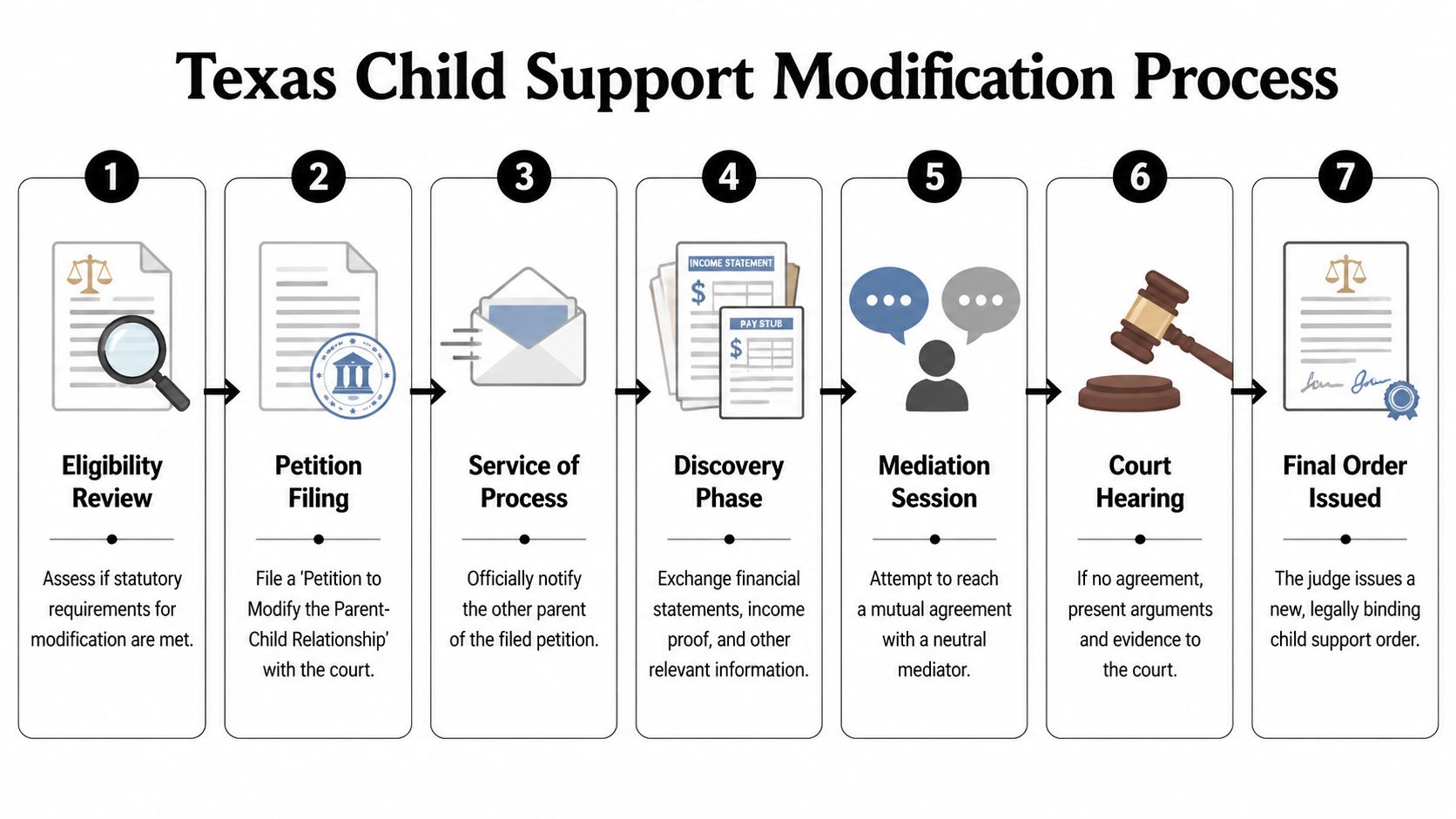
The modification process under Texas Family Code §156.401 requires filing a petition, service, and then negotiation or a court hearing, and Office of the Attorney General data discussed by Cuccia Wilson indicates about 60-70% of cases in the Child Support Review Process reach agreement without court, while litigated cases depend heavily on strong evidence because inadequate documentation is a leading reason for denial, as summarized in their guide to modifying a child support order in Texas.
Step one starts on paper, not in the hallway
The case usually begins with a petition to modify the parent-child relationship filed in the proper court. If the Office of the Attorney General is involved, some parents also use the review process through that agency, but many contested cases still end up in court.
Before filing, gather the documents that will support your position. In many cases that means pay stubs, tax returns, health insurance proof, childcare records, and any records showing an actual change in the possession arrangement.
If you want a practical overview of the procedural roadmap, this guide on how to modify child support in Texas lays out the filing path clearly.
Service is not a technicality
Once you file, the other parent must be formally served unless service is properly waived. Parents who skip this or handle it casually create delay and, sometimes, fatal problems for timing.
That matters for another reason. In many cases, the date of service affects how far back relief can realistically reach. Waiting to file often means waiting to start the clock.
Filing the case is important. Completing service is what turns the case into an enforceable court process.
Temporary stability while the case is pending
Some modification cases move quickly. Others don’t. If support, medical coverage, or payment logistics need attention before a final hearing, temporary orders may be necessary.
Not every case needs them. But when cash flow is unstable, when a parent changed jobs, or when the current arrangement is creating immediate pressure, temporary relief can keep the problem from growing while the case is pending.
Discovery wins contested cases
If the parents disagree about income, the next stage usually involves discovery. This is the formal exchange of information and documents. In practical terms, it means neither side gets to hide behind vague claims for long.
Documents commonly requested include:
- Income records: Pay stubs, tax returns, bonus documents, and employer records.
- Business records: Profit and loss statements, bank statements, general ledgers, and expense documentation in self-employment cases.
- Child expense records: Insurance premiums, childcare costs, therapy invoices, and educational expenses when relevant.
Parents often underestimate how much discovery shapes the case. A confident claim about “reduced income” loses force if deposits, retained earnings, or payroll history suggest otherwise.
A short video can help clarify how these cases move through court and negotiation.
Negotiation and mediation
A large share of cases resolve without a final trial. That doesn’t happen because the law is vague. It happens because once both sides exchange real documents, the likely court outcome becomes easier to see.
Mediation is often the point where posturing ends. If one side came in with inflated assumptions about income or unsupported claims about the child’s needs, those weak points usually surface there.
Good mediation prep includes:
- A clear proposed calculation: Don’t attend with only objections. Bring your number and the math behind it.
- A document set you can hand across the table: Judges are not present in mediation. The documents still matter.
- A realistic view of risk: If your evidence is thin, settlement may protect you better than a hearing.
Final hearing and the order that controls
If no agreement is reached, the court hears evidence and signs a new order if modification is warranted. The judge will usually compare the facts at the time of the prior order to the current facts, evaluate credibility, and decide whether the statutory standard was met.
The final order needs to address more than the monthly amount. It should also clearly state wage withholding, medical support, and any other support-related terms that affect enforcement. Ambiguity creates future litigation.
What works at hearing is rarely dramatic. It’s organized. The parent who presents reliable records, a coherent calculation, and a legally grounded request usually performs better than the parent who relies on broad claims about fairness.
Advanced Strategies for Complex and Disputed Cases
Some cases aren’t really about whether support should change. They’re about whether the court can trust the numbers and whether the requested change aligns with the child’s best interest. Those cases require tighter proof and more selective arguments.

A verified summary tied to McClure Law Group states that in complex income disputes, modifications succeed in 65% of cases using forensic accountant reports versus 25% without, that courts often impute income at 75% of prior earnings in voluntary unemployment disputes, and that those reduction requests face an 80% denial rate when the court finds the employment change undercuts the child’s interests, as discussed in their article on underemployment and denied modification requests.
Self-employment and business income
Business-owner cases often fail because the parent treats the case like a tax return review, while the court is trying to determine actual support-paying ability. Those are related questions, but they are not identical.
If income runs through a business, the court may scrutinize:
- personal expenses paid by the company
- depreciation or write-offs that reduce taxable income but don’t tell the full story about available resources
- irregular owner draws versus actual business cash flow
In those cases, a forensic accountant can be decisive. The numbers above show why. Judges are more receptive when an expert organizes the financial picture into something credible and testable.
Underemployment and imputed income
Many obligors misjudge the court’s approach. A parent may believe the income reduction was reasonable. The court may still ask a different question: can this parent earn more, and would reducing support shift too much of the burden onto the child?
Under Texas Family Code §154.066, courts can consider earning potential rather than current reported income in the right case. Bad faith isn’t always the only issue. Practical earning capacity matters.
A voluntary income drop is not the same thing as a court-recognized inability to pay.
If you lost income involuntarily, document the job loss, the search for replacement work, the efforts to maintain comparable earnings, and any barriers that are real and provable. If you changed jobs by choice, expect a harder road.
High-income cases and support above the guidelines
When income exceeds the cap, the fight often shifts from “what is the percentage?” to “what are the child’s proven needs?” Under Texas Family Code §154.123, a court may deviate from the guideline amount if the statutory factors justify it.
That requires precision. A parent asking for more support should connect claimed expenses directly to the child. General arguments about lifestyle usually don’t carry much weight. Specific records tied to tuition, therapy, tutoring, recurring activity costs, or unusual medical needs are stronger.
A parent resisting an upward deviation should avoid arguing only from income level. The better argument is often that the guideline amount already meets the child’s proven needs unless the evidence shows otherwise.
50 50 possession does not eliminate child support
Shared possession is one of the most misunderstood parts of a modification case. A near-equal schedule may support a deviation analysis, but it does not automatically erase support. Texas courts still focus on resources, actual child expenses, and whether a departure from the guideline figure would be just under §154.123.
This is one area where clean records matter more than rhetoric. If you’re claiming equal time, bring actual calendars, exchanges, school records, and communications that support the claim. Loose descriptions of “we basically split time” often fall apart under scrutiny.
The strategic question in disputed cases
Not every issue should be litigated with equal force. Some cases call for aggressive discovery and expert analysis. Others should be narrowed to one or two decisive disputes and resolved.
One practical option for parents who want structured guidance on calculation strategy, documentation, and court preparation is Texas Child Support Law Office of Bryan Fagan, which handles modification, enforcement, high-income disputes, and support calculations under the Texas Family Code.
The strongest strategy usually comes from asking three questions early:
- What fact will the judge most likely doubt?
- What document or witness resolves that doubt?
- Does the requested change still look child-centered when all the evidence is on the table?
If you answer those questions before filing, your case is usually stronger.
Frequently Asked Questions About Texas Child Support Adjustments
A parent loses a job in October, keeps paying the old amount for a few months, and waits until January to file because an informal agreement seemed possible. In court, that delay often matters. Texas judges can grant relief, but they usually will not rewrite support for months before the modification case was properly served.
Can child support be modified retroactively?
Usually only from the point allowed by the modification rules, which is often tied to service of the petition. As explained in Coker Legal’s discussion of modifying Texas child support orders, waiting to file can cost real money. A parent who qualifies for a reduction but delays may still owe the higher amount for that gap period.
The practical rule is simple. File promptly if the facts support modification.
What if the other parent won’t provide income documents?
Use formal discovery early. Pay stubs, tax returns, bank statements, profit and loss records, general ledgers, and payroll records often decide whether the court trusts the income story being presented.
If a parent refuses to produce records, the court can compel production and, in the right case, impose sanctions. Judges hear claims of hidden income all the time. They are far more persuaded by subpoenaed bank deposits, business records, and inconsistent tax filings than by suspicion alone.
If the amount at issue depends on disputed income, bring documents that can be admitted into evidence and explained clearly. Courts rarely reduce or increase support based on estimates that cannot be tested.
Does my new spouse’s income affect child support?
Usually, no. Texas child support is based on the parents’ resources, not a new spouse’s paycheck. The main question remains what the obligor earns or can earn under the facts of the case.
A remarriage can still affect how a judge views claimed expenses. If a parent says monthly obligations prevent payment, but household bills are being shared, the court may look harder at whether the claimed financial strain is overstated. That issue comes up often in reduction requests.
Can we just agree to a lower or higher amount ourselves?
You can make an informal agreement, but the signed court order still controls until a judge signs a new one. If the ordered amount is not paid, arrears can build, and enforcement can follow even if both parents acted on a handshake deal for months.
I regularly warn clients about this because it is a common mistake. Parents may cooperate well for a while, then one disagreement over possession, medical costs, or school expenses turns the case into an enforcement problem. If you want the change to stick, reduce it to a written order and get it signed.
How does the new $11,700 net resource cap affect a modification case after September 1, 2025?
It changes the ceiling used for guideline support calculations under Texas Family Code §154.125. For cases filed or adjusted under the new cap, guideline support is calculated against net resources up to $11,700 per month, unless the court finds a basis to go above guideline support based on the child’s proven needs.
That creates two practical effects. First, some parents paying support under older assumptions may have a real reason to review whether the current order still tracks the statute. Second, high-income cases will still draw close judicial scrutiny. A judge may apply the cap for the guideline amount, but any request above that amount usually requires credible evidence of the child’s actual needs, not general claims that the other parent earns a lot.
What should I bring to a consultation about modifying support?
Bring the current order, your recent pay records, tax returns, health insurance costs, childcare expenses, and any proof of a material change in circumstances. If you are self-employed, bring source records, not just a summary prepared for litigation.
Good modification cases are built from documents, dates, and a clear theory. A stack of incomplete screenshots usually does not get the job done.
Can a court deny a reduction even if I earn less now?
Yes. A lower income number does not end the analysis. Courts may deny a reduction if the income drop looks voluntary, temporary, poorly documented, or inconsistent with the child’s best interest under §156.401 and the broader child-focused analysis reflected in Texas support law.
This comes up often with commission earners, business owners, and parents who changed jobs shortly before filing. Judges are alert to strategic underemployment. If the court believes the parent still has earning capacity, access to business funds, or assets that undercut the claimed hardship, the requested reduction may be denied.
If you’re considering a child support adjustment texas case, the most useful first step is a focused review of your current order, your present financial records, and whether your facts fit Texas Family Code §§ 154.123, 154.125, 154.066, and 156.401. Texas Child Support Law Office of Bryan Fagan works with parents across Texas on modification strategy, contested income calculations, enforcement exposure, and court preparation so you can move forward with a case built on proof instead of assumptions.