You open the mail, see the Attorney General’s seal, and your stomach drops. The notice says you owe child support arrears. Maybe you missed payments after a job change. Maybe support was never properly set and the other parent is now asking for retroactive support. Maybe you have a 50/50 schedule and thought that meant no support was due. Texas doesn’t reward assumptions.
If you’re dealing with back child support texas issues, act fast. Waiting makes the problem more expensive, harder to prove, and easier for the other side to lock into a judgment. The law is technical, but the practical advice is simple. Figure out whether you’re facing unpaid periodic support, retroactive support, or a confirmed arrears judgment. Those are not the same thing, and treating them like they are is how parents lose in court.
Texas courts follow the Family Code, not fairness as you personally define it. Judges look at the order, the payment record, the obligor’s historical net resources, and whether the child’s needs justify a deviation. If you’re a paying parent, your job is to challenge bad numbers before they become a judgment. If you’re a receiving parent, your job is to document the obligation and push enforcement before records disappear.
Understanding Your Notice of Unpaid Child Support
Most parents don’t call a lawyer after the first missed payment. They call after the notice arrives. By then, the issue has usually moved beyond a private dispute between parents.
In Texas, the Office of the Attorney General handles a massive enforcement workload. It managed over 410,000 child support cases in a recent December snapshot involving parents who owed more than $5,000 in court-ordered arrears, and the agency requested over $390 million for child support enforcement in the next fiscal year, a $25 million increase, according to this report on Texas child support enforcement: https://www.youtube.com/watch?v=yuIqlvJte_o. That tells you exactly how seriously the state treats nonpayment.
What the notice usually means
A notice from the OAG usually means one of three things:
- You missed ordered payments. There is already a valid order, and the state’s records show nonpayment.
- The other parent is pursuing retroactive support. There may not have been a prior support order for the full period claimed.
- Someone is trying to confirm arrears into a judgment. That’s a major shift because once arrears are confirmed, your room to argue shrinks.
A missed payment is bad. A confirmed arrearage judgment is worse. Before confirmation, you may still be fighting over credits, dates, service, or income history. After confirmation, the debt is fixed and enforceable.
Know the players
Three actors matter in these cases.
| Party | What they do |
|---|---|
| The court | Determines what is owed and signs enforceable orders |
| The OAG | Tracks, enforces, and litigates support obligations |
| The other parent | May seek enforcement, retroactive support, or private settlement |
The other parent and the OAG are not interchangeable. Sometimes the OAG pushes a case based on its own records even when the parents have made informal side arrangements. Informal arrangements are dangerous because judges enforce court orders, not handshake deals.
Practical rule: If your order says one thing and your text messages say another, the order wins unless you get the court to change it.
The first mistake to avoid
Don’t ignore the notice. Don’t assume you’ll “explain it to the judge later.” And don’t send partial money without first figuring out how the case is being framed.
If you’re the paying parent, pull every order, every payment record, and every proof of insurance or direct support you’ve provided. If you’re the receiving parent, gather the payment history, communication records, and the filing date history. The early paperwork decides most of the fight.
How Texas Courts Calculate Back Child Support
Texas courts don’t guess at back support. They apply the Family Code. The key starting point is Texas Family Code §154.125, and the income definitions come from §154.061 and §154.062.
Retroactive child support is based on the noncustodial parent’s historical net monthly resources, not today’s income if the unpaid period happened years ago. For one child, the guideline amount is 20% of net resources, as explained in this discussion of retroactive child support under Texas Family Code §154.125: https://www.bryanfagan.com/2024/06/how-retroactive-child-support-is-determined-in-texas-courts/.
The court rebuilds the past
That’s the part many parents miss. In a back child support texas case, the judge often has to reconstruct what the obligor earned during the unpaid period.
That means collecting old:
- Pay stubs
- Tax returns
- W-2s or similar wage records
- Business records for self-employment
- Proof of health insurance premiums for the child
- Evidence of union dues or other allowed deductions
If you need a clearer breakdown of what counts toward net resources, review this guide on Texas net resource calculations: https://txchildsupport.net/how-texas-courts-calculate-net-resources/
A practical example
Assume a parent owed support for one child during a period when the court finds the parent had qualifying net monthly resources each month. Under §154.125, the court applies the 20% guideline to that net figure for each month owed.
The logic looks like this:
- Determine the month at issue.
- Determine the parent’s net monthly resources for that month under §154.061-.062.
- Apply the guideline percentage.
- Repeat for each month in the unpaid period.
- Add the monthly amounts together.
- Add statutory interest.
That final step matters. Arrears accrue 6% annual interest, which increases the amount over time, as noted in the same Bryan Fagan discussion linked above.
Courts care less about your memory than your documents. If your numbers aren’t backed by records, the judge may accept the more credible reconstruction.
The four year issue
Texas courts typically limit retroactive support to a period of several years before filing, unless the facts justify going further. The main exception is when the obligor knew of the duty and intentionally avoided payment or evaded the obligation.
That exception is where these cases get ugly. If the receiving parent can show the obligor knew about the child, knew support should be paid, and dodged responsibility, the court may look beyond the normal period. If you’re defending that claim, your evidence needs to be specific. General statements like “I didn’t know what to do” usually won’t help much.
Why precision changes outcomes
Back support fights often turn on disputed income. A salaried employee is easier to analyze. A parent paid through commissions, oilfield contract work, cash-heavy business activity, or irregular bonuses creates a harder case.
Use a disciplined checklist before hearing:
| Issue | Why it matters |
|---|---|
| Correct dates | A wrong start date can inflate the total owed |
| Proper deductions | Net resources, not gross pay, control |
| Employment gaps | Temporary unemployment may affect the calculation |
| Health insurance evidence | Child coverage can alter net resource analysis |
If you’re the parent seeking support, file promptly and preserve records. If you’re the parent defending the claim, don’t let the court use a rough estimate when precise records exist.
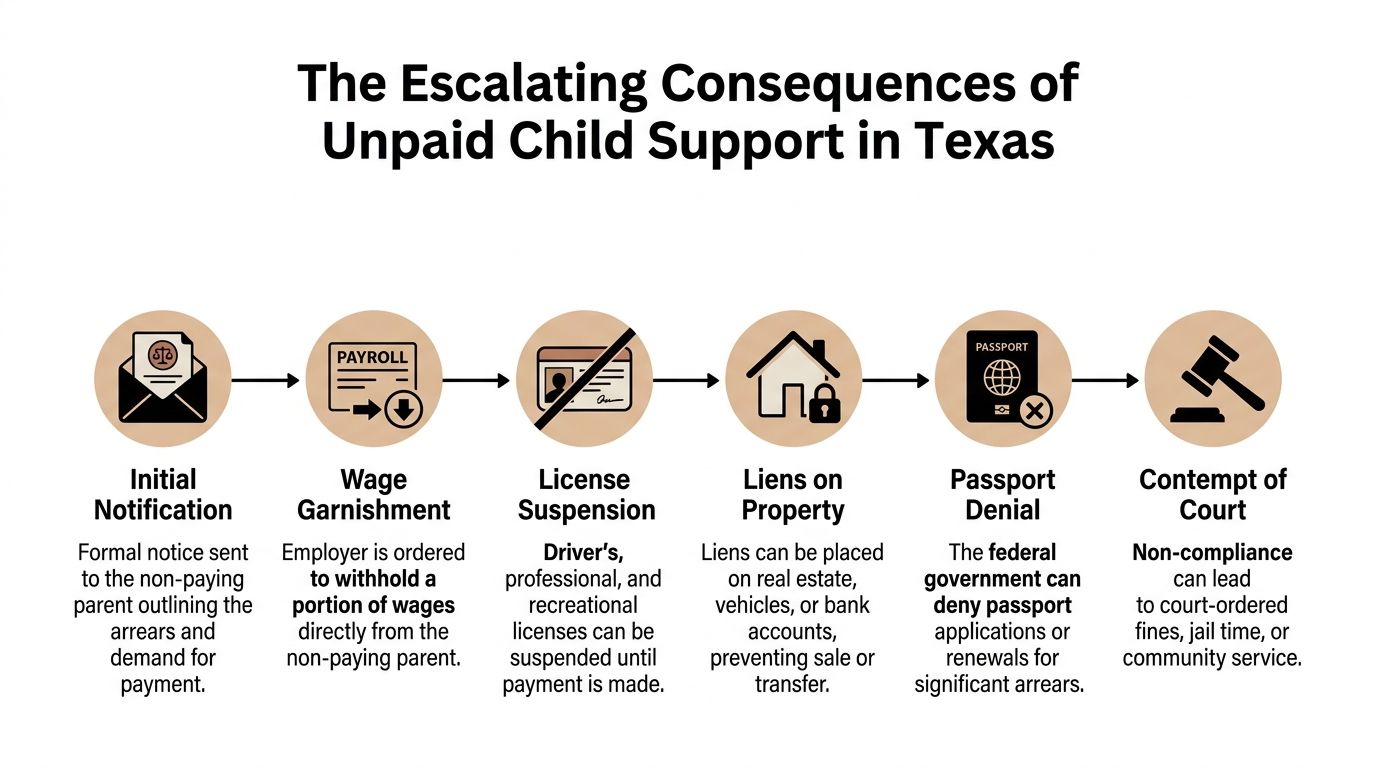
The Escalating Consequences of Unpaid Child Support
Texas starts with collection tools and moves toward punishment if collection doesn’t work. The system is designed to increase pressure until the obligor pays, negotiates, or appears in court.
The first broad lesson is simple. Unpaid support does not stay unresolved. It invites enforcement.
Wage withholding usually comes first
In many cases, wage withholding is the first serious enforcement tool. An employer receives an order and must withhold support from the employee’s pay.
Under the verified background provided, withholding can reach 50% to 65% of disposable earnings in arrears situations, depending on the circumstances tied to the enforcement framework described in the provided Texas child support materials. For the parent who falls behind, that means the case moves out of private negotiation and into payroll control.
This is why parents with irregular income often get blindsided. They think they can catch up later, then payroll starts deducting support and arrears while they’re already behind on everything else.
Then come restrictions on your life
Texas can suspend licenses for nonpayment. That includes a driver’s license, but it can also hit occupational and recreational licenses.
That matters because license suspension can quickly compel payment. A suspended license can affect your commute, your work, and your ability to keep earning. Parents often wait until this point to seek help, which is late.
Liens are another pressure point. The state can target property interests, including vehicles or real property. Once a lien in place, selling or refinancing becomes more difficult.
For a broader overview of common enforcement outcomes when support isn’t paid, this Texas child support resource is useful: https://txchildsupport.net/what-happens-if-child-support-is-not-paid/
Federal intercepts and passport consequences
When arrears grow, federal enforcement tools come into play. Texas can pursue tax refund intercepts and passport-related consequences under the enforcement structure described in the materials provided.
That means your refund may never reach your account. It also means travel plans can become collateral damage in a child support case. Parents who ignore state notices often discover the federal piece only after money is already taken or a passport problem appears.
A short explainer on enforcement pressure points appears below.
Contempt is where the case becomes dangerous
The most serious escalation is contempt of court. This happens when the court finds that a parent violated a prior support order and has the ability to comply or failed to follow the order as required.
Possible consequences can include:
- Court appearances under threat of sanctions
- A commitment order for jail time
- Additional fees and tighter payment directives
- Strict purge conditions tied to release
A contempt case is not the time to improvise. You need to know exactly what order is alleged to have been violated, what payments are claimed missing, and whether the motion pleads the required details.
The worst position in family court is being unprepared in an enforcement hearing where the judge believes you ignored a direct order.
The sequence matters
Not every case follows the exact same path, but the pattern is predictable:
| Stage | Typical effect on the paying parent |
|---|---|
| Notice | Warning and demand to address arrears |
| Withholding | Direct paycheck deductions begin |
| Suspensions or liens | Daily life and assets get constrained |
| Federal enforcement | Refunds and travel consequences appear |
| Contempt proceedings | Court-imposed punishment becomes real |
If you’re the receiving parent, use this sequence strategically. Start enforcement before the obligor disappears into job changes or cash work. If you’re the paying parent, don’t wait for stage four or five. The best time to fix an arrears case is before contempt is on the docket.
Navigating High-Income and 50/50 Custody Arrears
The hardest back child support texas cases aren’t the simple W-2 cases. They’re the ones with high earnings, business income, uneven compensation, and shared parenting schedules that people wrongly assume cancel support.

The major strategic change is the updated guideline cap. Effective September 1, 2025, Texas child support guidelines cap at $11,700 in net monthly resources, up from $9,200, and that change affects support calculations in cases spanning periods before and after the effective date, according to this explanation of the 2025 Texas child support guideline update: https://www.thetexasattorney.com/blogs/how-is-child-support-calculated-in-texas-2025-guidelines-explained/.
What the new cap changes
For guideline support, the court applies the statutory percentage to the first $11,700 of net monthly resources in covered cases after that effective date. For one child, that produces a guideline figure of $2,340. For two children, $2,925. For three, $3,510. Those numbers come directly from the verified data tied to the updated cap.
High-income cases don’t stop at the cap
Some parents think the cap protects them from higher support. It doesn’t. Under Texas Family Code §154.123, the court can go above the guideline amount if the evidence shows the child’s proven needs justify more.
That usually means the court wants evidence, not lifestyle slogans. If someone claims the child needs support above guideline, they should be prepared to prove actual expenses tied to the child.
Examples can include:
- Private school tuition
- Special educational costs
- Documented medical needs
- Specific extracurricular expenses tied to the child
The court doesn’t just reward the other parent because you earn a lot. But if the child’s proven needs exceed the basic guideline framework, the judge has room to deviate.
In a high-income case, the fight is rarely about whether the parent earns well. The fight is about what counts as net resources and what the child needs.
The 50/50 mistake
Shared custody does not automatically erase child support. Texas can still order support in a 50/50 arrangement, often by comparing incomes and applying an offset-style analysis in practice when the facts support it.
Arrears can still build in these cases if:
- one parent was ordered to pay and didn’t,
- the schedule changed informally but the order didn’t,
- income changed and no one filed to modify,
- one side assumed equal time meant equal legal responsibility.
That last mistake is common and expensive.
Timing controls influence
A confirmed arrears judgment cannot be reduced because the law changed later. The verified data is clear on that point. Courts cannot reduce a confirmed arrears judgment, and that debt continues accruing 6% annual interest under the cited materials tied to the 2025 cap source above.
That creates a sharp strategic divide.
| If you are | Best move |
|---|---|
| Behind on support | Seek modification for future support before more arrears accrue |
| Owed support | Confirm the amount and push enforcement before the other side rewrites the facts |
For high earners, every deduction and every income category matters. For 50/50 parents, every overnight schedule and prior order matters. Don’t walk into court saying “we split time equally” as if that settles anything. It doesn’t.
Proactive Strategies for Resolving Child Support Debt
Avoidance is the worst strategy in a child support arrears case. It hands the timeline to the other side and lets interest, enforcement, and procedural defaults do the damage for them.

Texas law treats child support debt as unusually durable. According to the verified data, parents can negotiate arrears payment plans with the OAG, but the debt is non-dischargeable, survives bankruptcy, and has no statute of limitations under the framework described here: https://www.bryanfagan.com/2025/12/what-happens-if-i-cant-afford-my-texas-child-support-payments/
If you owe support
Your goal is not to make the case disappear. Your goal is to control damage before enforcement gets harsher.
Take these steps in order:
Audit the number claimed
Compare the payment record against your bank statements, employer withholding records, and any direct payments.Read the last signed order
Many parents defend based on the arrangement they lived under, not the order that still controls.Separate future support from old debt
A modification can change future support if the legal standard is met. It does not wipe out confirmed past-due amounts.Negotiate a payment structure early
Structured plans can reduce pressure from wage garnishment or license suspension, even though the debt itself remains.Prepare for a confirmation hearing
If arrears are being confirmed, challenge bad math, wrong dates, missing credits, and service issues before judgment.
For parents who need practical collection and enforcement information from the receiving side, this Texas child support resource addresses how to collect back support: https://txchildsupport.net/how-to-collect-back-child-support/
If you are owed support
Stop relying on promises. File and prove the numbers.
Your focus should be:
- Payment history
- The signed order
- Proof of nonpayment
- Any evidence of evasion
- A clean arrears calculation
If retroactive support is part of the case, build the income history carefully. If enforcement is part of the case, make your pleadings precise. Sloppy requests create delay.
What a good negotiation looks like
A useful negotiation isn’t vague. It looks like this:
| Issue | What should be nailed down |
|---|---|
| Total arrears claimed | The number both sides are using |
| Payment frequency | How often payments will be made |
| Method of payment | Wage withholding, registry, or approved channel |
| Enforcement hold | Whether certain actions pause if payments stay current |
Courts can approve structured settlements that reduce pressure. They cannot forgive confirmed arrears because someone asks nicely.
If you can still negotiate, do it before the case becomes a contempt fight. Your negotiating position weakens once the judge is deciding whether you disobeyed a prior order.
When legal counsel changes the result
An arrears case is one of the few family law problems where paperwork can beat a compelling story. That’s why legal review matters early.
One option for parents handling arrears, modifications, and support enforcement is the Texas Child Support Law Office of Bryan Fagan, which handles support establishment, modification, enforcement, high-income disputes, and net resource analysis under the Texas Family Code. You still need to compare counsel, but you should work with someone who understands support math, pleading requirements, and enforcement defenses.
If you wait until your hearing is next week, your lawyer spends time triaging. If you move early, your lawyer can build a strategy.
Key Questions on Texas Child Support Arrears
Parents usually ask the same questions, and the answers are often blunt. That’s a good thing. Clarity saves money.
Fast answers that matter
You can't fix an arrears case by making assumptions about what seems fair. You fix it by matching facts to the order and the Family Code.
Below is a practical FAQ that addresses the questions I hear most often.
Frequently Asked Questions
| Question | Answer |
|---|---|
| What is the difference between back child support and arrears in Texas? | People use the terms interchangeably, but the legal posture matters. “Back child support” may refer to unpaid ordered support or retroactive support sought for an earlier period. “Arrears” usually refers to support that is already past due under an order, and in many cases the next dispute is whether those arrears will be confirmed into a judgment. |
| Can a Texas court order retroactive child support if there was no prior order? | Yes. Texas courts can order retroactive child support under Texas Family Code §154.125. The court looks at historical net resources during the period at issue and applies the guideline percentages, subject to the legal limits and exceptions discussed earlier. |
| How far back can the court go? | Texas courts typically look back up to a period of several years before filing in retroactive support cases, but that limit can extend if the facts show the obligor knew about the duty and intentionally avoided paying. If that issue is in your case, evidence matters more than argument. |
| Does 50/50 custody mean no child support is owed? | No. Equal possession does not automatically eliminate support. A court can still order support based on the parties’ incomes, the existing order, and the child’s needs. Informal equal-time arrangements do not rewrite the court’s order. |
| Can a judge erase confirmed child support arrears? | No. A court cannot forgive a confirmed arrears judgment because the paying parent later faces hardship. The better route is to attack inaccurate calculations before confirmation and seek modification of future support when legally appropriate. |
| Can I lower what I owe because my income dropped? | You may be able to modify future support if you meet the legal standard for modification. That does not automatically reduce already accrued support. This is one of the biggest misconceptions in child support court. |
| What if I paid the other parent directly? | Bring proof. Direct payments can become a credit dispute. Some judges will consider reliable proof. Some direct-payment situations create messy record problems because the official registry does not reflect what happened. If you paid in cash and kept no records, you created a serious problem for yourself. |
| Will bankruptcy clear child support debt? | No. Child support debt is not discharged in bankruptcy under the verified legal framework provided for Texas arrears cases. Treat the debt as enduring and address it directly. |
| Can I go to jail for unpaid child support in Texas? | Yes, if the court finds contempt in an enforcement action. Jail is usually part of the enforcement endgame, not the opening move, but once a contempt proceeding is filed the risk becomes real. |
| Should I wait until the Attorney General contacts me again? | No. If you know support is unpaid or a dispute exists, get the order, the payment history, and the income records now. Delay helps the side with cleaner paperwork. |
| What should I bring to a child support arrears hearing? | Bring the signed order, proof of all payments, employer withholding records, tax records if income is disputed, proof of insurance payments for the child if relevant, and a clean timeline. If service or notice is an issue, bring the documents that prove it. |
| When should I hire a lawyer? | Immediately if the other side is seeking retroactive support, confirming arrears, alleging contempt, or disputing income in a high-earner or 50/50 case. Those are the cases where procedural mistakes get expensive fast. |
The bottom line is simple. If you owe support, don’t let a bad number become a judgment. If you’re owed support, don’t let delay destroy your proof. Texas child support law rewards organized parents and punishes passive ones.
If you need practical help with a back child support texas case, Texas Child Support Law Office of Bryan Fagan works with parents across Texas on support establishment, arrears disputes, modification, enforcement, high-income calculations, and 50/50 custody support issues. The right next step is a strategy review based on your order, your payment history, and the exact procedural posture of your case.