If you are preparing for a Texas child support case, you will hear attorneys and judges refer to "the cap." This is shorthand for a crucial number that shapes nearly every high-income case: the statutory cap on a parent's net monthly resources.
Effective September 1, 2025, that cap will be $11,700. This figure is not a limit on how much child support can be ordered. Instead, it is the maximum amount of a parent’s income that the standard guideline percentage will apply to. Understanding this distinction is the first step in preparing a winning strategy for court.
What the $11,700 Cap Really Means for Your Case
There is a common and costly myth that the $11,700 cap acts as a hard ceiling on child support payments. That is incorrect. The cap’s purpose is to create a consistent and predictable starting point for the court, especially when one parent earns a significant income.
Think of it as the foundation for the calculation. A judge first determines the guideline child support amount based on the paying parent's net resources, but only up to the $11,700 limit. The result of this first step is called the presumptive child support.
Under Texas Family Code §154.125(b), this presumptive amount is assumed to be in the child's best interest. However, this is a "rebuttable presumption," meaning you have the right to present evidence showing why a different amount (either higher or lower) would be more appropriate for your child.
How the Presumptive Guideline is Calculated
The process starts with applying a simple percentage to the paying parent’s net monthly resources, as spelled out in Texas Family Code §154.125. For one child, the guideline is 20% of net resources.
Here is how the cap changes the calculation:
- If Net Resources are Below the Cap: A parent with $8,000 in net monthly resources has their presumptive support calculated directly from that income. For one child, the obligation is 20% of $8,000, which is $1,600 per month.
- If Net Resources are At or Above the Cap: A parent earning $15,000 a month has their presumptive support calculated using the cap. The starting obligation is 20% of $11,700, or $2,340 for one child.
This initial figure gives everyone—the parents, attorneys, and the judge—a solid, legally defined number to work from. The real negotiation begins when discussing whether the child's specific needs justify going beyond this amount.
Texas Guideline Cap Impact on Presumptive Child Support
| Metric | Previous Cap (2019-2025) | New Cap (Effective Sept. 1, 2025) |
|---|---|---|
| Net Resource Cap | $9,200 | $11,700 |
| Max Presumptive Support (1 Child @ 20%) | $1,840 | $2,340 |
| Max Presumptive Support (2 Children @ 25%) | $2,300 | $2,925 |
| Max Presumptive Support (3 Children @ 30%) | $2,760 | $3,510 |
The new cap directly increases the baseline, or "presumptive," child support obligation for high-earning parents. This adjustment ensures the guideline support amount keeps pace with the actual cost of raising children.
Moving Beyond the Presumptive Amount
While the cap sets a predictable floor, it is not the end of the story. A judge is fully empowered to order child support above the presumptive guideline amount under Texas Family Code §154.123.
This occurs when a parent provides evidence of the child’s "proven needs." If you can document that your child’s lifestyle and expenses—such as private school tuition, competitive sports, specialized medical care, or tutoring—require more than the guideline amount, the court has the discretion to order additional support. This vital mechanism ensures the final order is tailored to the child's actual best interests, not just a one-size-fits-all formula.
How to Calculate Your Monthly Net Resources
Everything in a Texas child support case comes down to one number: your monthly net resources. This isn't just your take-home pay. It's a specific figure calculated using a formula straight from the Texas Family Code §154.062. If you get this number wrong, every other calculation that follows will be wrong, too.
Getting a firm grip on this calculation is the single best way to prepare for court. It is the foundation of your entire child support order.
What Income Gets Included?
First, the court must determine your total gross income. Think of this as a wide net that catches money from every possible source before a single deduction is taken.
The law is written to be incredibly broad. It is not just about your 9-to-5 salary. The court will absolutely look at:
- Wages and salary, which covers everything from your base pay to commissions, overtime, tips, and bonuses.
- Self-employment income, calculated as your gross business revenue minus ordinary and necessary business expenses.
- Investment income, like interest you earn, dividends from stocks, and any royalty payments.
- Rental income after you have subtracted the costs of operating the property.
- Other income sources such as retirement benefits, pensions, trust income, and even unemployment benefits are all on the table.
Simply put, if it is money flowing to you, the court will count it. This all-encompassing approach is designed to get a true picture of your financial ability to support your children.
What Gets Deducted from Your Gross Income?
Once the court has your gross income total, it applies a very specific, limited list of deductions to find your net resources. This is a huge point of confusion. You cannot deduct personal living expenses like your car payment, rent, or credit card bills.
Under §154.062, the only deductions allowed are:
- Federal income taxes (calculated for a single person claiming one deduction)
- State income taxes (not applicable in Texas)
- Social Security (FICA) taxes
- Union dues
- The amount you pay for the child's health and dental insurance premiums
A Crucial Point: The court does not use the actual amount of tax you pay. Instead, they use standardized tax charts. This prevents anyone from attempting to lower their child support by asking their employer to withhold extra taxes from their paycheck.
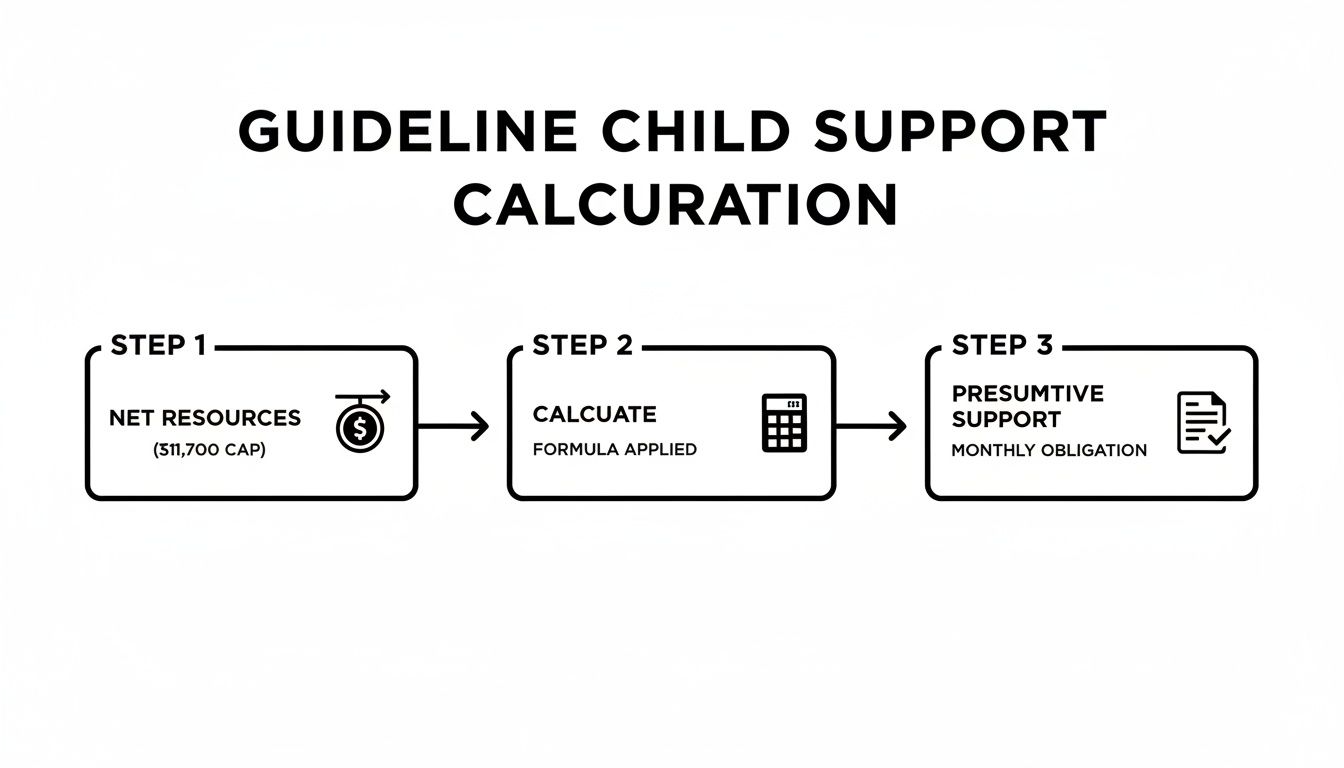
This flowchart gives you a great visual of how the court moves from gross income to the final child support amount.
Let's Walk Through an Example
Seeing the numbers in action makes the process clearer. Let's imagine a parent named Alex who has a standard salaried job and one child.
- Find Gross Monthly Income: Alex earns a salary of $14,000 per month.
- Calculate Allowable Deductions (per §154.062):
- Federal Income Tax (from standardized chart): $2,200
- FICA Taxes (Social Security & Medicare): $1,071
- Health Insurance for the Child: $300
- Union Dues: $50
- Total the Monthly Deductions: $2,200 + $1,071 + $300 + $50 = $3,621
- Calculate Net Monthly Resources: $14,000 (Gross) – $3,621 (Deductions) = $10,379
Alex’s official net monthly resources for child support purposes are $10,379. This amount is below the new $11,700 statutory cap effective September 1, 2025. Because Alex is under the cap, the court will apply the standard child support percentage (20% for one child) directly to that $10,379 figure, resulting in a presumptive obligation of $2,075.80.
To dive deeper into the specifics, you can read more about how Texas courts calculate net resources in our comprehensive guide. Nailing this calculation from the very beginning helps you avoid costly mistakes and ensures your entire case is built on a solid, accurate financial footing.
Seeing the Guideline Percentages in Action

It is one thing to read about the law, but it is another to see how it plays out in a courtroom. Let's walk through a few common scenarios to see how a judge takes the guideline percentages from Texas Family Code §154.125 and applies them to real families with real numbers.
Breaking down the math this way takes the guesswork out of the process and shows you what to expect.
Example 1: The Standard Calculation (Income Below the Cap)
Let's start with a straightforward case. Imagine a paying parent, Jordan, who has $7,500 in net monthly resources. This income is well under the $11,700 statutory cap effective September 1, 2025.
Because Jordan's income is below the cap, the calculation is simple. The court applies the standard percentage directly to the full amount.
- For 1 Child (20%): $7,500 x 0.20 = $1,500 per month
- For 2 Children (25%): $7,500 x 0.25 = $1,875 per month
- For 3 Children (30%): $7,500 x 0.30 = $2,250 per month
This is the most common child support calculation you will see in Texas. It's a direct application of the law with no complicated variables.
Example 2: The High-Income Earner (Income Above the Cap)
Now, let's look at Taylor, a high-income earner with $20,000 in net monthly resources. Since this is over the $11,700 cap, the judge starts the calculation differently.
First, the court applies the guideline percentages only to the capped portion of the income to find the "presumptive" support amount.
- For 1 Child (20%): $11,700 x 0.20 = $2,340 per month
- For 2 Children (25%): $11,700 x 0.25 = $2,925 per month
- For 3 Children (30%): $11,700 x 0.30 = $3,510 per month
Important Takeaway: This presumptive amount is just the starting line. A judge can—and often will—order additional support above this baseline if the receiving parent proves the child has needs that require it. The court can tap into Taylor's remaining income ($8,300) to cover those proven expenses.
Example 3: The 50/50 Possession Schedule (Offset Method)
Finally, let's tackle a very common setup: a 50/50 possession schedule. Here, both parents, Chris and Pat, share custody of their one child equally. In these cases, Texas judges often use an "offset" calculation.
Here’s a breakdown of how it works with their different incomes:
Calculate Each Parent's Theoretical Obligation: First, the court determines what each parent would pay if they were the non-custodial parent.
- Chris’s Net Resources: $10,000/month. The guideline amount for one child (20%) is $2,000.
- Pat’s Net Resources: $6,000/month. The guideline amount for one child (20%) is $1,200.
Find the Difference (The "Offset"): Next, the court subtracts the smaller obligation from the larger one.
- $2,000 (Chris's Obligation) – $1,200 (Pat's Obligation) = $800
Determine the Final Order: The higher-earning parent pays the difference. The final order will require Chris to pay Pat $800 per month in child support.
This offset approach ensures that both parents contribute financially based on their ability to pay, even when they share physical custody. These examples make it clear why accurate income reporting is so critical for a fair outcome. For a deeper dive into the rules, check out our guide on Texas child support guidelines explained.
Arguing for Support Above or Below the Guidelines
Think of the Texas child support guidelines as a starting point, not a final destination. The law recognizes that a formula cannot account for every family's unique circumstances. While the calculation provides a presumptive amount, a judge has the power to adjust it up or down.
This is where legal strategy comes in. Under Texas Family Code §154.123, the court can order a different amount if the evidence shows the guideline calculation would be "unjust or inappropriate." The statute gives the judge a specific list of factors to weigh, opening the door for a skilled attorney to argue for a more suitable outcome.
Building a Case for Support Above the Guidelines
If you're the custodial parent, convincing a judge to order support above the standard amount hinges on one thing: proving the child's actual needs. This is not about funding a parent's lifestyle; it is about documenting the real-world costs of maintaining the child's established quality of life.
A successful argument is built on concrete evidence. You must show the judge exactly what the child requires. This often includes:
- Educational Costs: Private school tuition, specialized tutoring for a learning disability, or fees for advanced academic programs. You will need invoices and enrollment contracts to back it up.
- Extraordinary Medical Needs: This covers expenses that insurance does not, like ongoing therapy, specialized medical equipment, or costly treatments for a chronic condition.
- High-Level Extracurriculars: If a child is a competitive athlete, a gifted musician, or involved in other serious enrichment activities, the receipts for coaching, travel, and equipment can justify a deviation.
A judge is far more likely to grant a deviation for a specific, documented need than a vague request for more cash. Presenting a $1,500 monthly invoice for the child's special needs school is far more powerful than simply stating you need more money.
Arguing for a Downward Deviation
On the flip side, the parent paying support (the obligor) can also argue that the guideline amount is unfairly high. Simply having a large mortgage or car payment will not suffice. The reason must be tied to fairness and the specific factors the law recognizes in §154.123.
Common arguments for a downward deviation include:
- Covering Major Expenses Directly: If the paying parent already covers the child’s health insurance premiums or pays for significant travel costs for visitation, a judge may lower the monthly support to avoid "double-dipping."
- Duty to Support Other Children: When a parent has a legal obligation to support children from another relationship, the court can consider the total financial burden when setting the amount for the current case.
- Significantly More Possession Time: If you have the child for much more time than a standard possession order outlines, you are already bearing more of the direct costs. A judge might reduce the support payment to reflect that reality.
The Procedural Steps in Court
Whether you are seeking an increase or a decrease, the court process is methodical.
- Filing: It begins when one parent files a petition asking the court to set child support.
- Service: The other parent is formally "served" with the lawsuit and must file a formal response.
- Discovery: Both sides enter the "discovery" phase, where you formally exchange financial information—tax returns, pay stubs, bank statements, and detailed expense records.
- Hearing: The final hearing is where your attorney presents the evidence and makes a case to the judge, explaining exactly why the factors in §154.123 justify moving away from the standard guideline amount. After hearing from both sides, the judge makes a final decision, which becomes a binding court order.
Changing or Enforcing Your Child Support Order

Once a judge signs a child support order, it brings stability. But life does not stand still. The Texas Family Code acknowledges this reality, giving parents two key legal tools for when things change: modification and enforcement.
Whether your income has shifted dramatically or you're trying to collect support that is long overdue, you have options. It is about knowing the right procedural steps to take, especially with the new $11,700 net resource cap set to take effect on September 1, 2025.
How to Modify Your Child Support Order
To get a judge to modify an existing order, you must prove there has been a “material and substantial change in circumstances” since the last order was put in place. This legal standard, laid out in Texas Family Code §156.401, prevents the courts from being bogged down with endless minor adjustments.
What counts as "material and substantial"? Think big, significant life events. Classic examples include:
- A major income shift for the paying parent. This could be a promotion that vaults their income past the new $11,700 cap, or it could be an involuntary job loss.
- The child's needs have fundamentally changed. A new medical diagnosis with expensive treatments or a child aging out of costly daycare could qualify.
- The custody schedule has been altered. If one parent moves and the other assumes nearly all day-to-day care, the support order will likely need revisiting.
- The three-year rule. If it has been at least three years since your last order, and a new calculation shows the payment would change by 20% or $100, you likely have grounds for modification under §156.401(a)(2).
Crucial Insight: The new $11,700 cap does not automatically change your current child support order. You must file a formal Petition to Modify and prove a material and substantial change to get the new cap and guidelines applied.
For a complete walkthrough of this process, check out our guide on how to modify child support in Texas.
Enforcing an Order and Collecting Unpaid Support
When a parent stops paying court-ordered child support, that debt accumulates into arrears. The receiving parent can go back to court to force collection. Texas courts have powerful tools at their disposal. The procedural steps begin with filing a Motion for Enforcement.
If the judge finds the parent has failed to pay, the most common enforcement methods include:
- Wage Garnishment: A court orders the paying parent's employer to automatically withhold child support from their paycheck.
- Property Liens: A lien can be placed on the non-paying parent's assets, like a house or land, preventing them from selling or refinancing until the debt is cleared.
- License Suspension: Judges can order the suspension of a driver's license, professional licenses, and even recreational licenses for hunting and fishing.
- Jail Time: For willful non-payment, a judge can order jail time for contempt of court.
The Texas Child Support Cap: Your Questions Answered
When you're dealing with Texas child support, it is easy to get tangled up in legal terms and shifting numbers. To help cut through the confusion, here are straight-to-the-point answers for the most common questions we receive.
Does the new $11,700 cap automatically change my current support order?
No, it does not. A court order is set in stone until someone takes legal action to change it. If you want the new cap to apply to your case, one of the parents must file a Petition to Modify the Parent-Child Relationship. To succeed, you must show the court there has been a "material and substantial change in circumstances" since your last order, as required by Texas Family Code §156.401. The legislature increasing the cap can serve as this change, especially if it has been over three years since your last order.
How is child support handled if we have a 50/50 possession schedule?
While the Texas Family Code does not outline a special formula for these cases, judges typically use the "offset" calculation. The goal is to ensure both parents contribute based on their income. Here is the breakdown:
- The court calculates what each parent would pay in child support if they were the non-custodial parent.
- The smaller number is subtracted from the larger one.
- The parent with the higher income pays the difference—the "offset"—to the other parent.
For example, if Parent A's guideline obligation is $2,000 a month and Parent B's is $1,200, the court would order Parent A to pay Parent B $800 per month.
What happens if my income is inconsistent?
If you work in a field based on commissions, bonuses, or seasonal projects, a judge will average your income over a longer period—usually the last one or two years—to find your true average monthly net resources. To prepare for court, you must be your own bookkeeper. Start gathering your tax returns (with all schedules), 1099s, K-1s, commission reports, and business profit-and-loss statements. The responsibility falls on you to paint a clear financial picture for the judge.
Can a judge order less than the guideline amount?
Yes. The amount calculated using the state guidelines (Texas Family Code §154.125) is a legal "presumption." A judge can go lower if the paying parent proves that sticking to the guideline amount would be "unjust or inappropriate" under the circumstances, per §154.123. Valid reasons include:
- The paying parent already covers major costs, like 100% of the child's health insurance or significant travel expenses for visitation.
- The parent has a legal duty to support other children who are not part of the case.
- The parent has possession of the child for significantly more time than a standard order requires, meaning they already cover more day-to-day costs.
A judge will not lower support for personal debts like a high car payment. The decision is always centered on the child's best interests and the specific factors the law allows.
Whether you're setting up your first child support order, looking to modify it based on the new $11,700 cap, or trying to enforce late payments, you need a solid understanding of the law and a clear strategy. The Law Office of Bryan Fagan is committed to helping Texas parents navigate these challenges with authority and confidence. If you’re ready to protect your rights and your child's future, reach out to us.
Schedule Your Consultation with the Law Office of Bryan Fagan