You are covering the child's bills, the order has not kept up, and the gap is no longer small. In that position, the right question is not whether the arrangement feels unfair. The question is whether Texas law gives the court a reason to modify the existing order and whether the numbers support a larger obligation.
That analysis starts with the current facts, the prior order, and the guideline framework in the Texas Family Code. For many parents, the September 1, 2025 increase in the net resource cap to $11,700 changes the value of a modification case in a very real way, because the guideline ceiling for new or modified orders rises with it. If the last order was set under the older cap, that matters.
Good modification cases are built, not guessed at. Income records, proof of the child's increased needs, and a clear timeline of what changed usually decide whether a request gains traction. If you are still evaluating whether the facts qualify, this explanation of what counts as a substantial change in circumstances in Texas child support cases is a useful starting point.
The sections below focus on the questions that matter in practice: when you can ask, what evidence to gather, how courts apply guideline support under Texas Family Code Chapter 154, and how the new $11,700 cap affects strategy for cases filed or modified after September 1, 2025.
When Can You Ask for an Increase in Child Support?
A Texas court won't raise child support because life feels tighter. You need a legal basis to modify the existing order. Under Texas Family Code § 156.401, parents usually pursue an increase through one of two paths.
Texas guidance recognizes these two main routes: a material and substantial change in circumstances, or a review after three years if the guideline amount would differ by at least 20% or $100 from the current order, as explained by TexasLawHelp's article on changing a child support order.
Material and substantial change
This is the ground I see most often in practice. The court looks at what has changed since the last order was signed, not whether your current arrangement feels unfair in the abstract.
Common examples include:
- Income changed: The paying parent got a raise, changed jobs, or now has a stronger earning picture than when the order was entered.
- The child's needs changed: Medical treatment, therapy, tutoring, or other recurring expenses now exist where they didn't before.
- The parenting schedule changed: If the child is spending materially more time in one home, the financial burden may no longer match the old order.
For a deeper look at what courts treat as enough of a shift, review this guide on substantial change in circumstances in Texas child support cases.
Practical rule: Courts modify orders based on evidence tied to the prior order and the current facts. They don't modify based on frustration alone.
The three-year review option
The second route is more mechanical. If enough time has passed, the question becomes whether the guideline amount is now far enough from the current order to justify a change under the statutory benchmark.
That route matters when income has increased but the facts don't produce a dramatic story. A straightforward recalculation may still support relief if the difference crosses the legal threshold described above.
What usually doesn't work
Some parents wait and hope informal discussions fix the problem. Others ask the other parent to "just pay more" without filing anything. That can produce temporary cooperation, but it usually doesn't create an enforceable change.
What works is a focused request built around the statute, the current numbers, and documents that show the existing order no longer fits the child's circumstances.
Building Your Case with Strong Evidence
A modification case is won on paper before it's argued in court. Texas Family Code § 156.401 gives the legal standard, but your documents are what make the standard real.
One parent says, "My child's costs have gone up." Another parent walks in with pharmacy receipts, invoices from a specialist, insurance explanations of benefits, school billing statements, and a comparison to what existed when the prior order was signed. The second parent usually has the stronger case.
Three examples judges understand
A child develops ongoing medical needs. That can justify more support, but only if you can show the need is real, recurring, and connected to actual cost. Bring provider records, billing statements, receipts, and any proof of what insurance does and doesn't cover.
The paying parent gets promoted. That can matter, but don't rely on rumor or social media. Use discovery to obtain pay stubs, tax returns, employment records, bonus information, and bank records where appropriate.
The possession schedule changed in practice. If your child now lives with you more often than the prior order contemplated, judges want specifics. Calendars, school pickup records, messages confirming exchanges, and attendance records can all help establish the actual pattern.
What to gather before filing
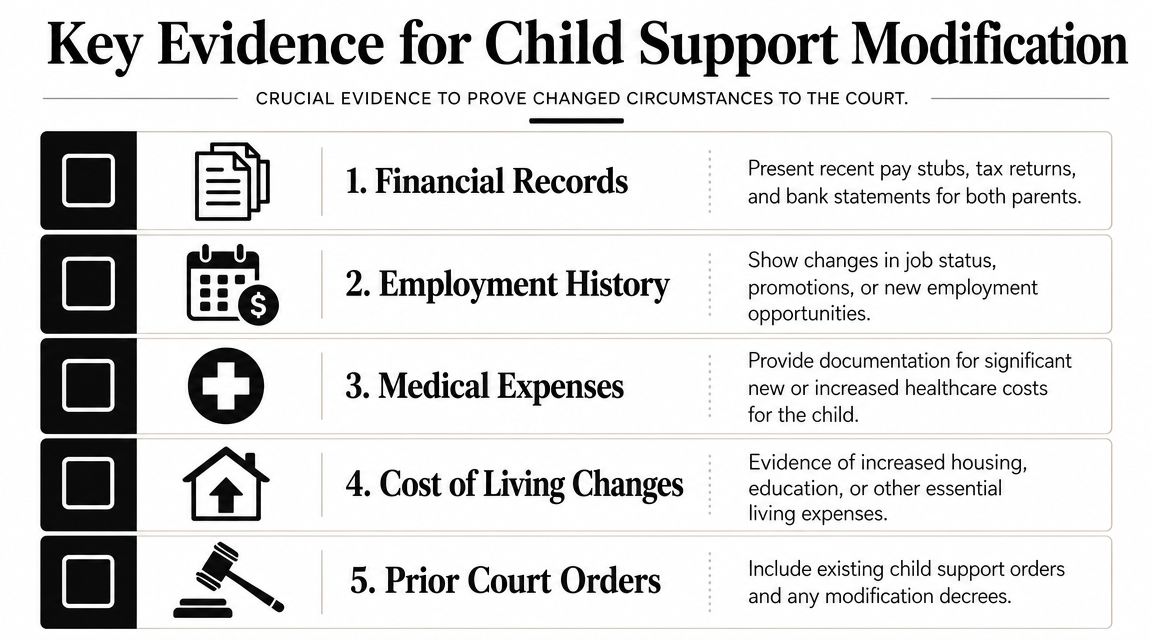
Use a simple evidence file. Separate it into categories so your lawyer, mediator, or judge can follow it quickly.
- Income records: Recent pay stubs, tax returns, W-2s or 1099s, business records if self-employment is involved, and proof of benefits or bonuses.
- Child-related expenses: Medical bills, therapy invoices, prescription receipts, tuition statements, tutoring bills, and childcare records.
- Prior orders: The current support order, any prior modification orders, and any written agreement that was signed into an order.
- Schedule proof: Calendars, school records, exchange logs, and messages that show where the child has been living.
- Employment changes: Offer letters, termination letters, promotion notices, or records showing a parent changed jobs.
If you're preparing the proof yourself, this checklist on evidence needed for a Texas child support case is a practical starting point.
Bring the judge organized proof, not a stack of unsorted paper. The parent who can explain the timeline cleanly usually gets heard more clearly.
A mistake that weakens good cases
Many parents lead with household hardship alone. That matters emotionally, but modification cases are usually stronger when they center on the child's needs, the other parent's resources, and how circumstances differ from the time of the last order.
That doesn't mean your budget is irrelevant. It means the court is more persuaded by targeted evidence than by a general statement that everything costs more now.
How Texas Calculates and Caps Child Support
A parent earning well above the guideline ceiling can look "rich on paper" and still trigger the wrong argument in court. In Texas, support is not calculated as a flat share of all income. The court starts with monthly net resources, applies the guideline percentages in Texas Family Code § 154.125, and then asks a second question in higher-income cases: does the child have proven needs that justify more under § 154.123?
That distinction matters more after September 1, 2025. For new or modified orders signed on or after that date, the monthly net resource cap is $11,700. If you are asking to increase support, your target number should be built around that cap from the start.
Guideline percentages under Texas Family Code § 154.125
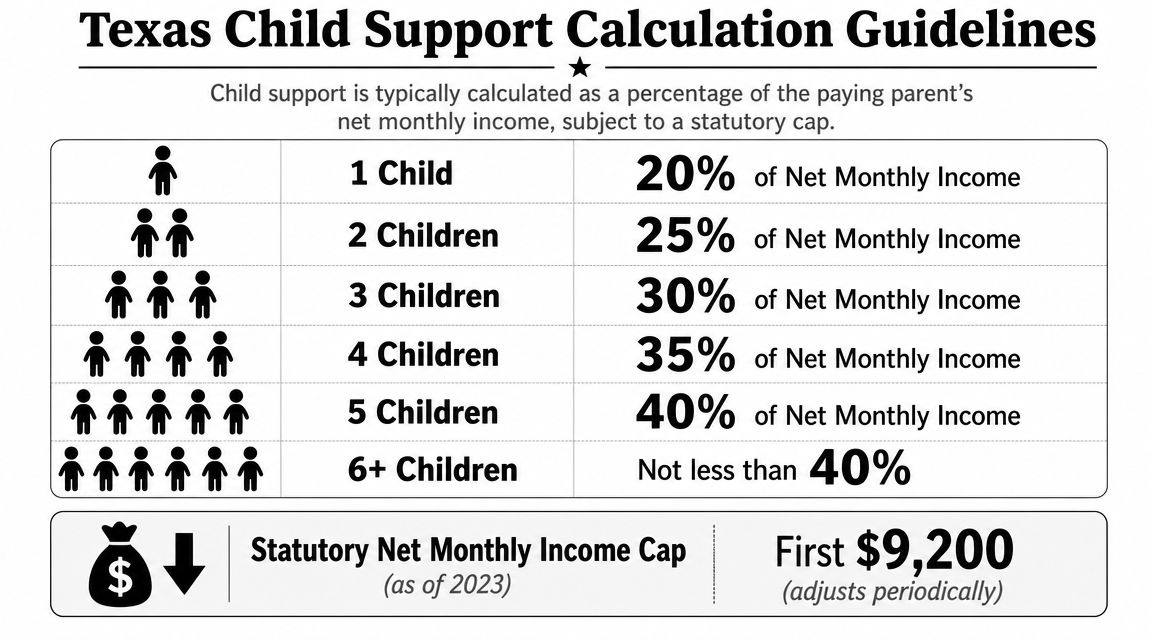
The standard percentages are:
| Number of Children | Percentage of Net Resources |
|---|---|
| 1 child | 20% |
| 2 children | 25% |
| 3 children | 30% |
| 4 children | 35% |
| 5 children | 40% |
Texas courts calculate support from net resources, not gross pay. That usually includes wages, salary, commissions, overtime, bonuses, self-employment income, rental income, and some benefits, minus the deductions allowed by the Family Code. In practice, the support fight is often less about the percentage and more about what should be counted before the percentage is applied.
What the 2025 cap changes in real numbers
The cap used to stop at $9,200 in monthly net resources. For orders entered or modified on or after September 1, 2025, the cap rises to $11,700.
That changes the guideline number immediately in upper-income cases.
For one child, 20% of $11,700 is $2,340 per month. Under the old cap, 20% of $9,200 was $1,840. For two children, 25% of $11,700 is $2,925, compared with $2,300 under the prior cap.
Those are not small differences. If the payor's net resources meet or exceed the new ceiling, the updated cap should be part of your modification strategy, your settlement position, and your proposed order.
Above-cap cases under Texas Family Code § 154.123
Parents often assume a high earner automatically owes support based on all income above $11,700. Texas law does not work that way. The guideline amount on the capped resources is the starting point. To get more, the party asking for additional support must prove the child's proven needs.
That is where good cases are won or lost.
A court may consider expenses tied to the child, including:
- Ongoing medical or therapeutic treatment
- Special education support, tutoring, or learning intervention
- Recurring costs for a disability or developmental need
- Childcare or supervision costs tied to the parents' circumstances
- Other established expenses shown to be reasonable and for the child
The key trade-off is straightforward. If you stay at the guideline level, the math is cleaner and the hearing is usually shorter. If you ask for above-guideline support, the upside can be significant, but you need disciplined proof and a judge who sees the expense as a real need of the child, not a lifestyle upgrade for the household.
Where calculation disputes usually happen
In modification cases, I usually see disputes fall into three buckets.
First, net resources are contested. This is common with self-employed parents, business owners, people paid in irregular draws, or parents who receive stock compensation, bonuses, or cash benefits through a company.
Second, the date matters. If your modification will be decided under the post-September 1, 2025 framework, the $11,700 cap should be used in the guideline analysis. That can change the value of the case even before anyone argues about above-guideline needs.
Third, parties confuse "ability to pay" with "legal basis to order more." A judge can consider a parent's resources, but above-cap support still turns on proof of the child's proven needs under § 154.123.
If you want a practical roadmap for how these calculations fit into the court process, review this guide to a Texas motion to modify child support.
A salaried employee with clean payroll records usually presents a straightforward guideline calculation. A parent who controls a business, mixes personal and company spending, or gets paid unpredictably creates a very different case. Then the support hearing becomes a proof problem first and a math problem second.
Filing Your Motion to Modify Child Support
Once your evidence is organized and your requested amount is grounded in the Texas Family Code, the next step is procedure. Child support doesn't increase because you sent a demand letter or reached an off-the-record understanding. It increases when a judge signs a new order.

Step one through step three
Start by filing a petition to modify the parent-child relationship in the court with continuing jurisdiction over your order. The pleading identifies the current order, the child, the parties, and the legal basis for the increase.
After filing, the other parent must be formally served unless service is waived in a legally valid way. Service matters because it starts the case properly and protects enforceability later.
Then the information exchange begins. Some cases involve informal disclosure. Others require formal discovery, especially when income is disputed or incomplete. This guide to a motion to modify child support in Texas gives a useful overview of that process.
A short overview can help visualize the sequence:
Mediation and contested hearings
Many courts expect mediation before a final hearing. That's often productive in support cases because once the income documents are on the table, the range of reasonable outcomes narrows.
If the case doesn't settle, the judge hears evidence. That usually includes testimony about the last order, the alleged change in circumstances, income, and the child's current needs. Exhibits matter. So does organization.
What the judge signs, and when the new amount begins
If the court grants the modification, the judge signs a new order setting the support amount, medical support terms, and any related provisions that need revision. Until that signed order exists, the old order remains in effect.
File first, then push the case forward. Waiting to "see if things improve" usually delays the only date that matters, which is the date your modification case is properly underway.
What helps at this stage
- A clean proposed order: Judges appreciate language that's ready to sign and matches the relief requested.
- Accurate income backup: If your numbers don't match your exhibits, the court notices.
- Clear requests beyond monthly support: Medical support, dental coverage, and uninsured expense allocation often belong in the same modification.
The Texas Child Support Law Office of Bryan Fagan handles modification and high-income support disputes under the Texas Family Code, including cases involving contested net resource calculations and § 154.123 deviation issues.
Advanced Strategies and When to Hire an Attorney
A common Texas scenario looks like this. The paying parent's income has climbed, the child is older and more expensive to support, and the other parent assumes the September 1, 2025 increase in the net resource cap will raise support automatically. It will not.
The cap increase from $9,200 to $11,700 matters, but it matters strategically, not automatically. A court still needs a live modification case and a legal basis to change the order under the Texas Family Code. In practice, that means proving a material and substantial change under § 156.401, or meeting the statutory review standard if it applies to your facts. The higher cap can increase the guideline ceiling once the case is properly before the court. By itself, it does not reopen old orders.
That distinction changes how I would prepare the case.
Strategy issues that matter
Use the modification to fix the whole support structure, not just the monthly number. If the current order is unclear about medical support, dental coverage, reimbursement deadlines, or uninsured expense percentages, clean that up now. Leaving vague language in place usually creates the next dispute.
The 2025 cap also creates a sharper divide between routine cases and cases that may justify support above the guideline amount calculated on capped net resources. If the obligor's net resources exceed $11,700 per month after September 1, 2025, guideline support under § 154.125 is still calculated only up to that cap unless the court has a basis to go higher. To ask for more, the evidence has to shift from income alone to the child's proven needs and the factors the court may consider under § 154.123. That is where many modification requests get weaker than clients expect.
Timing affects money. A modified amount usually does not reach back indefinitely, and courts often focus on the date the modification request was filed and what relief was requested. Delay can cost months of increased support that might otherwise have been available.
When an attorney usually pays for the cost
Some modification cases are paperwork problems. Others are evidence problems.
Hire counsel sooner if any of these apply:
- The other parent is self-employed or paid irregularly. Business deductions, retained earnings, reimbursements, bonuses, and contract income can distort net-resource calculations under Chapter 154.
- Your case may involve support above the $11,700 cap. These cases require disciplined proof of the child's needs, not just proof that the other parent earns more.
- Records are being withheld. Formal discovery, subpoenas, and enforcement of disclosure deadlines often decide the case before the hearing does.
- The existing order is badly drafted. A modification is the chance to correct unclear insurance terms, reimbursement language, and related support provisions before they cause enforcement trouble.
- The other side is already lawyering up for a fight. At that point, speed matters less than precision.
There is a real trade-off here. If the case is fully agreed, income is easy to document, and the order only needs a clean update, handling it efficiently may be reasonable. If income is disputed, cash flow is hard to trace, or you are asking the court to move beyond a guideline calculation tied to the new $11,700 cap, a lawyer often saves money by narrowing the issues, framing the evidence correctly, and avoiding a weak presentation that leaves support too low for years.
Frequently Asked Questions About Texas Child Support Increases
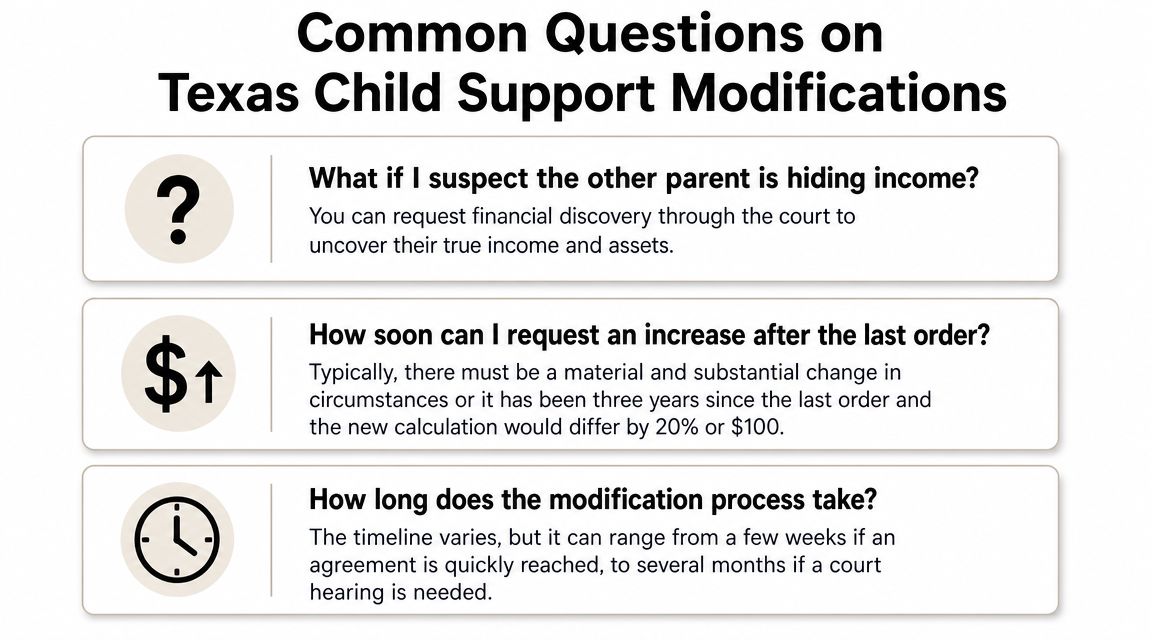
What if I think the other parent is hiding income?
Use the court process. In a contested modification, you can request financial records through discovery. That may include employment records, tax documents, business records, and other materials relevant to income.
If the parent is intentionally underemployed, the court may look beyond surface-level claims. These cases depend heavily on document gathering and cross-examination.
Can we agree to an increase without a fight?
Yes. Parents can often resolve a modification by agreement, but the agreement still needs to be reduced to a written order and signed by the court. Until that happens, the existing order still controls.
An agreed order is often the cleanest outcome because it reduces delay and narrows the chance of future enforcement problems.
How long does a modification take?
It depends on the county, the court's docket, whether financial records are complete, and whether the other parent contests the request. Agreed cases can move much faster than litigated ones.
Cases involving hidden income, business ownership, or above-guideline requests usually take longer because they require more evidence and more court involvement.
What if my child is close to adulthood?
Don't assume that means modification is pointless. If support should be increased and the legal standard is met, the court can still address the issue while the order remains modifiable. Timing matters, though, so waiting can shrink the practical benefit of filing.
How soon can I ask for an increase?
If you can prove a material and substantial change, you may not need to wait for the passage of time alone. If you're relying on the time-based route, use the statutory standard discussed earlier and compare the current order to the guideline result.
A lot of parents wait too long because they think the facts need to be extreme. They don't. They need to be provable.
If you're weighing whether to file, the smartest next step is a case-specific review of your order, the current income picture, and the proof you can put in front of a Texas judge. The Texas Child Support Law Office of Bryan Fagan helps parents analyze modification options, calculate guideline support under the Texas Family Code, and prepare cases for agreement, mediation, or court.