You may be reading this after getting served with a petition, opening a notice from the Attorney General, or realizing that the support amount in your current order no longer fits real life. That moment is stressful because child support cases feel financial, legal, and personal all at once.
The right lawyer doesn't just argue about numbers. The right lawyer protects the structure of your case, the credibility of your evidence, and the stability your child will live with after the hearing ends. Finding the best child support lawyer in Texas requires focusing less on flashy promises and more on who can read the Texas Family Code closely, organize proof fast, and make sound decisions under pressure.
Navigating Your Texas Child Support Case with Confidence
Texas child support cases move through a system that is large, procedural, and unforgiving when a parent shows up unprepared. Texas has one of the largest child support systems in the country. Based on 2018 data, the state collected $4.2 billion in child support, the highest total in the nation, and the Texas Attorney General's Child Support Division later reported a record $4.8 billion in collections during state fiscal year 2020, according to Texas child support collection reporting discussed here.

What your case is really about
Most parents think the issue is simple. One side wants more support, the other wants a lower amount, and the judge picks a number. That isn't how strong cases are built in Texas.
A child support case usually turns on a narrower set of questions:
- What counts as net resources under Texas Family Code §154.062
- Whether the guideline amount applies under §154.125
- Whether facts justify a deviation under §154.123
- Whether the court should enter, modify, or enforce an order under the proper procedural rules
That is why lawyer selection matters. The lawyer isn't there just to speak for you. The lawyer's job is to make sure your income, the other parent's income, health insurance obligations, reimbursement issues, and child-specific needs are all presented in a way the court can use.
Why experience in Texas child support matters
A good family lawyer may handle divorce generally. The best child support lawyer in Texas knows how support issues behave inside larger disputes involving custody, temporary orders, self-employment income, arrears, and enforcement pressure from the Attorney General's office.
Practical rule: If a lawyer can't explain guideline support, deviations, and enforcement procedure in plain English during a consultation, that problem won't improve in court.
Some parents can manage a straightforward administrative matter on their own. Many can't. If you're unsure where your situation falls, this guide on whether you need a lawyer for child support in Texas is a useful starting point.
The Texas Family Code is the rulebook. Your lawyer's value is knowing which section controls your issue, what proof the judge will expect, and when settlement helps more than courtroom combat.
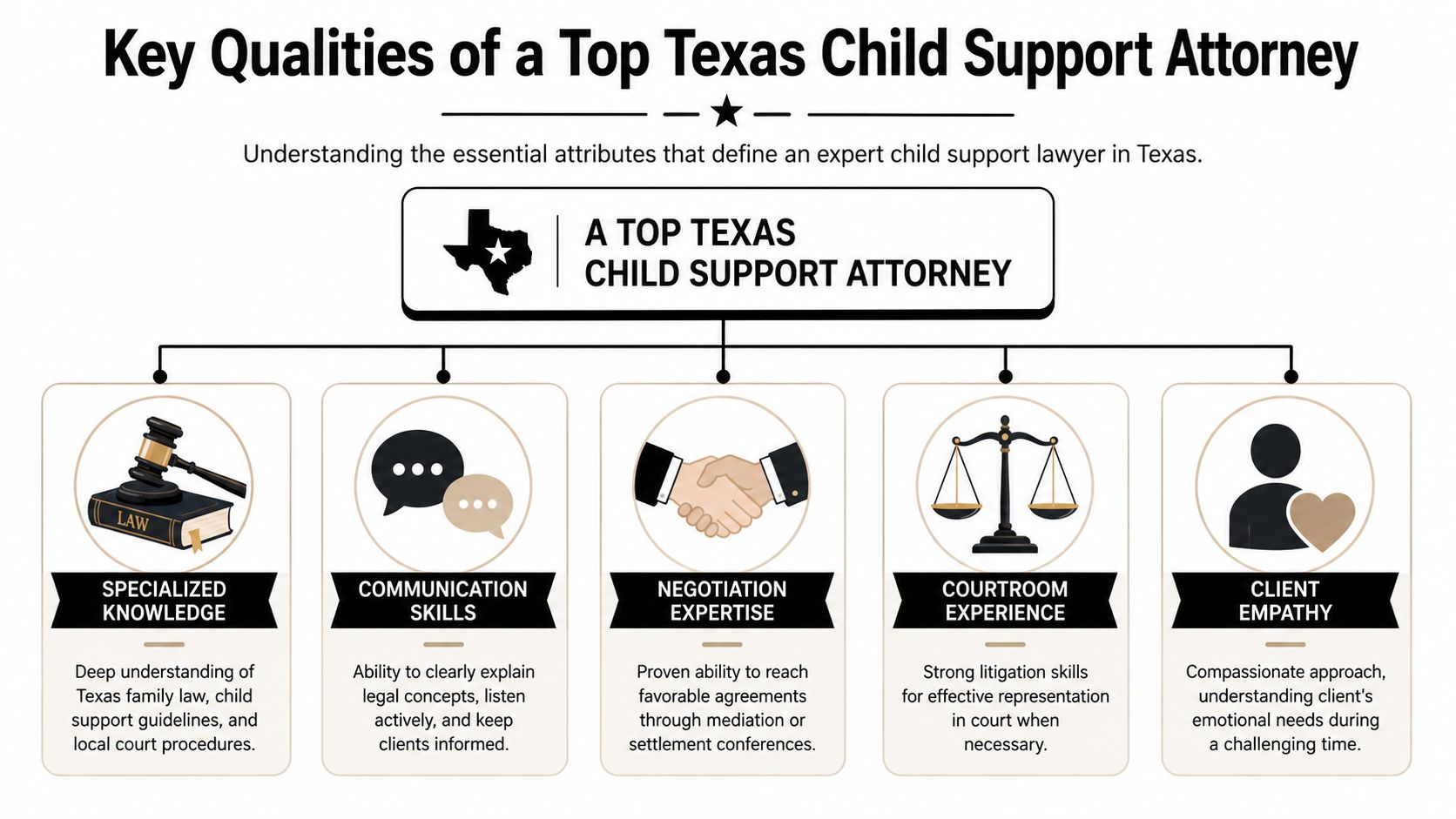
Key Qualities of a Top Texas Child Support Attorney
The phrase best child support lawyer in Texas gets used loosely. In practice, the best fit is the lawyer who can calculate accurately, negotiate credibly, and try the case cleanly if settlement fails.
They know the math and the statute
Child support in Texas starts with net resources under §154.062, then moves to the guideline structure in §154.125, and sometimes to a deviation analysis under §154.123. Lawyers who don't work in this area regularly often talk in broad terms and skip the details that change outcomes.
That becomes even more important in higher-income cases. Texas child support practice becomes technically sensitive in high-income matters because guideline support is tied to the obligor's net resources, and recent Texas Family Code updates raise the cap to $11,700 per month effective September 1, 2025, as discussed in this analysis of Texas child support practice and the updated cap. In those cases, a careful lawyer verifies each income source, deductions, medical-support obligation, and any possible basis for deviation under §154.123 before offering or challenging a number.
A strong attorney should be able to answer questions like these without hesitation:
- Income identification: What counts if the parent is self-employed, paid irregularly, or receives non-salary compensation?
- Deduction review: Which deductions reduce net resources, and which ones don't?
- Deviation analysis: What facts would justify moving away from guideline support?
A short explainer can help you see how lawyers discuss these issues in real life:
They can settle and they can try the case
Some lawyers are good in mediation but weak at hearings. Others posture about trial and miss reasonable settlement opportunities. The best child support lawyer in Texas does both well.
A credible settlement position usually comes from trial readiness. Opposing counsel makes better offers when they know your lawyer can prove the numbers in court.
Ask how the lawyer handles temporary hearings, contested modifications, and enforcement actions involving contempt. In child support work, courtroom skill isn't abstract. It affects whether financial records get admitted, whether weak testimony gets exposed, and whether a vague proposed order gets corrected before signature.
They communicate like a professional
Communication isn't about friendliness alone. It is about whether the lawyer can tell you, clearly and early, what matters and what doesn't.
Look for these signs:
- Direct case assessment: They identify strengths and weak spots instead of promising an easy win.
- Clear staffing model: They tell you who answers routine questions, who drafts pleadings, and who appears in court.
- Order review discipline: They treat the written order as seriously as the hearing itself.
They show judgment, not just aggression
The best lawyers don't fight over every issue. They choose where to press, where to concede, and where to demand documentation before discussing settlement. That judgment saves money and preserves credibility with the court.
Your Consultation a Strategic Interview
Your consultation shouldn't feel like a sales presentation. It should feel like a pressure test. You're deciding who will manage facts that affect your child, your paycheck, and your credibility before a judge.
Bring documents that let the lawyer think
If you arrive with only a summary of what happened, you'll get general advice. If you bring documents, you'll get strategy.
Bring what you have, especially:
- Income proof: recent pay records, tax returns, profit and loss records if self-employed, and any bonus or commission documentation
- Health coverage records: proof of who carries the child and what the premium responsibility looks like
- Current court papers: prior orders, petitions, motions, notices of hearing, and any Attorney General paperwork
- Child expense information: out-of-pocket medical, school-related, and other recurring needs tied to the child
- Payment history: records of support paid, missed, reimbursed, or disputed
If you're gathering records now, this guide on evidence needed for a Texas child support case will help you avoid showing up with half the file.
Ask questions that reveal actual skill
A strong consultation question forces the attorney to explain method, not marketing. You want to hear how the lawyer thinks, what proof they prioritize, and whether they know the Family Code sections that control your issue.
| Category | Question to Ask |
|---|---|
| Guideline calculation | How do you calculate net resources under §154.062 in a case like mine? |
| High-income issues | If income exceeds the guideline cap, how do you analyze support and possible arguments under §154.123? |
| Self-employment | How do you handle a parent who owns a business, takes deductions, or mixes personal and business spending? |
| Hidden income concerns | What discovery tools do you use when reported income doesn't match lifestyle? |
| 50/50 possession | How do you approach support issues when parenting time is close to equal but incomes are very different? |
| Modification | What facts do you look for when deciding whether a modification request is strong enough to file? |
| Enforcement | If support hasn't been paid, when do you seek wage withholding, liens, or contempt relief? |
| Hearings | Who will actually appear with me in court, and how do you prepare clients to testify? |
| Settlement | What terms do you insist on putting in writing so an agreement can be enforced later? |
| Communication | How quickly should I expect updates, and who is my point of contact between hearings? |
Listen for the right kind of answers
The lawyer doesn't need to tell you that your case is perfect. In fact, you should be cautious if they do. Better answers sound like this: what documents are missing, what assumptions need testing, what the opposing side is likely to argue, and what order language must be nailed down.
Bring the lawyer facts, not conclusions. "He hides money" is a conclusion. Bank statements, business records, and inconsistent affidavits are facts.
The consultation is your chance to learn whether the lawyer sees only the dispute or sees the proof structure underneath it. The second type is the one you want.
How the Best Lawyers Handle Your Case from Start to Finish
The strongest Texas child support cases usually follow a disciplined workflow. A strong Texas child-support strategy often starts by assembling complete financial records, calculating guideline support from net resources, testing whether a deviation is justified, and then using negotiation, modification, or enforcement tools depending on the posture of the case. Texas child-support attorneys commonly handle establishment, modification, enforcement, income disputes, arrears, wage garnishment, liens, and contempt, with the Attorney General's Office also playing a central enforcement role, as summarized in this discussion of Texas child support case strategy.
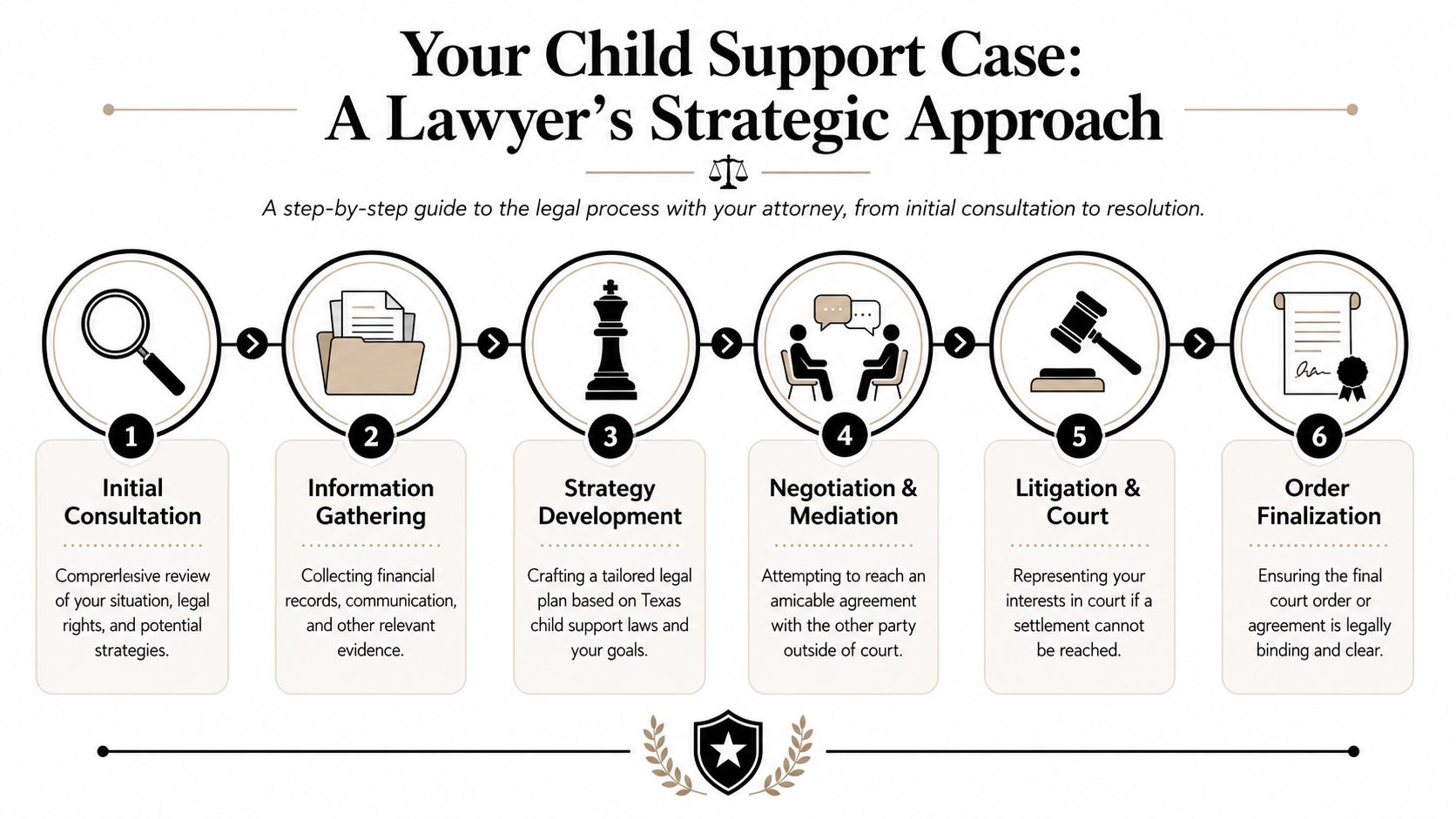
Stage one involves fact control
The case begins with pleadings. That may mean filing an original suit, a modification, or an enforcement action. It may also mean responding quickly after service if the other parent filed first.
Then the essential work begins. Your lawyer gathers income records, prior orders, insurance information, communication history, and any proof that the reported financial picture is incomplete. In a contested case, discovery matters because unsupported accusations don't carry much weight.
A practical example helps. If one parent receives a salary plus irregular commissions, the lawyer shouldn't rely on a single recent pay stub. The lawyer should compare multiple records, tax documents, and payment history to build a more reliable view of net resources under §154.062.
Stage two focuses on the right support number
Once the financial record is organized, the lawyer applies the guideline framework in §154.125. That is the starting point, not always the end point.
A weaker lawyer stops at the worksheet. A better lawyer asks whether there are facts supporting departure under §154.123, such as unusual child-specific needs, payment of health-related expenses, or other relevant circumstances recognized by the court.
Here is what often works in practice:
- Clean financial summaries: Judges need understandable exhibits, not a pile of unsorted records.
- Targeted deviation arguments: Courts respond better to concrete child-related facts than broad fairness complaints.
- Order drafting discipline: Winning the hearing means little if the final order is vague or internally inconsistent.
Stage three is where negotiation gets tested
Most cases don't resolve because one side suddenly changes personality. They resolve because one side presents a number backed by statute, records, and credible risk for trial.
A lawyer may negotiate through informal exchanges, a settlement conference, or mediation. If the case settles, the best lawyers still stay alert. They make sure the agreed language covers support amount, wage withholding, medical support, reimbursement procedures, start dates, and enforcement clarity.
One practical option parents sometimes consider is working with a firm focused on Texas child support litigation and negotiation, such as Texas Child Support Law Office of Bryan Fagan, particularly when the dispute involves high-income calculations, enforcement issues, or modification strategy.
The order controls the future fight. If the wording is sloppy, enforcement gets harder and conflict returns faster.
Stage four is hearing and order enforcement
If settlement fails, the case moves to temporary orders, a contested hearing, or final trial depending on the posture of the dispute. Your lawyer prepares witnesses, organizes exhibits, anticipates objections, and narrows the issues so the court can rule clearly.
After the judge rules, the work isn't over. The written order must match the ruling. If support goes unpaid later, the same case may turn into enforcement involving income withholding, liens, or contempt requests. That is why the best child support lawyer in Texas isn't just a hearing lawyer. The best one builds a case that can be enforced after the courtroom empties.
Understanding the Timeline and Costs of Your Case
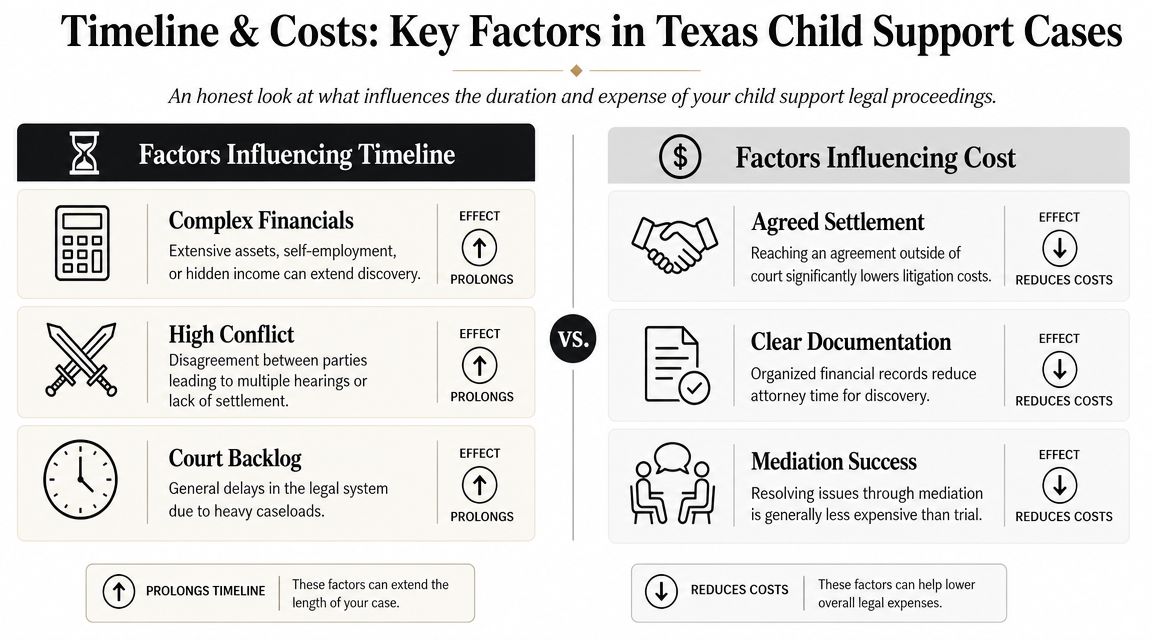
Parents usually ask two questions first. How long will this take, and what will it cost? The honest answer is that both depend less on the label of the case and more on the behavior of the people inside it.
What makes a case move faster or slower
Simple cases move when documents are complete, income is easy to verify, and both sides are realistic. Cases slow down when one parent is self-employed, records are incomplete, hearings are reset, or the dispute expands beyond support into possession, reimbursement, or enforcement.
Court scheduling also matters. Even a prepared lawyer can't force an immediate hearing date when the docket is crowded. What the lawyer can do is file correctly, prepare the evidence early, and avoid preventable delays.
A useful way to think about timeline is this:
- Faster cases: clear payroll income, prompt document exchange, narrow legal issues
- Slower cases: disputed earnings, missing records, repeated discovery fights, contested hearing practice
What drives legal fees
Most child support lawyers bill through a retainer and hourly work against that retainer. That means your total cost usually rises or falls with the amount of lawyer time needed to gather records, draft pleadings, respond to the other side, prepare for hearings, and revise orders.
The biggest cost drivers are usually:
- Complex financial proof: business ownership, cash income, or unreliable records take time to unwind
- Conflict level: constant emergency calls, hostile exchanges, and avoidable disputes cost money
- Litigation intensity: mediation and negotiated orders usually cost less than repeated courtroom appearances
- Document quality: organized records reduce attorney review time
For a more detailed breakdown of how lawyers structure fees and what influences the final bill, review this guide on Texas child support lawyer cost considerations.
What good clients do to control cost
You can't control everything, but you can control waste. Send organized documents. Answer your lawyer's questions directly. Don't use legal time to vent about every insult in a text thread unless it actually affects the issue before the court.
Good preparation lowers cost better than last-minute urgency. The client who organizes records early usually buys less attorney cleanup later.
The best child support lawyer in Texas won't always be the cheapest. But the wrong lawyer often becomes the most expensive because poor preparation leads to repeated hearings, preventable disputes, and bad orders that have to be fixed later.
Frequently Asked Texas Child Support Questions
How is child support usually calculated in Texas
Texas courts generally start with the obligor's net resources under §154.062 and then apply the guideline framework in §154.125. That guideline figure is the starting point the court reviews before deciding whether facts justify a different result under §154.123.
Can a judge order something different from guideline support
Yes. §154.123 allows the court to consider whether guideline support would be unjust or inappropriate under the facts of the case. The key is proof. Judges don't depart from guidelines because one parent says the amount feels unfair. They look for specific evidence tied to the child's needs, the parents' resources, and other relevant circumstances recognized by the statute.
What if the other parent is self-employed or understating income
That issue usually requires a more aggressive document review and, in many cases, formal discovery. A good lawyer compares tax filings, bank records, business activity, expense claims, and lifestyle evidence rather than accepting a bare assertion of income. These cases often turn on credibility and documentation, not just a worksheet.
Can child support be changed after the order is signed
Yes, but the parent seeking change must usually show a legal basis for modification under Texas law. In practice, that often means proving a material and substantial change in circumstances. The court will expect current financial records and a clear explanation of what changed since the existing order.
Does a 50 50 possession schedule eliminate child support
No. Equal or near-equal parenting time does not automatically eliminate support. Courts still examine income, net resources, health insurance responsibility, and whether a guideline or non-guideline result is appropriate under the Family Code.
What happens if support isn't paid
Enforcement can include income withholding and other collection tools, and in serious cases a court may consider contempt remedies if the statutory requirements are met. Enforcement cases are technical. The motion, payment record, and requested relief all need to line up carefully with the order already in place.
Should I hire a lawyer if the Attorney General is involved
Often, yes. The Attorney General plays an important enforcement role, but that office does not act as your personal attorney. If income is disputed, arrears are contested, or order language needs close review, your own lawyer protects your interests directly.
If you're preparing for a child support hearing, considering a modification, or dealing with unpaid support, Texas Child Support Law Office of Bryan Fagan works with parents across Texas on establishment, modification, enforcement, and contested income issues under the Texas Family Code. A focused consultation can clarify the likely pressure points in your case, what documents matter most, and what strategy fits your facts.