You're probably here because something just landed on your desk or in your inbox. Maybe it was a notice from the Office of the Attorney General. Maybe your co-parent filed to modify support. Maybe you've been paying based on a number that never seemed right, and now you're wondering whether it's too late to fix it.
That instinct matters. In Texas child support cases, timing is often the difference between a clean result and an expensive mess. I've seen parents wait because they thought the issue was “just math.” Then they learn the hard way that child support isn't simple math. It's a legal calculation built on defined income rules, filing standards, evidentiary burdens, and procedural deadlines.
If you're asking when should I hire a child support lawyer Texas, my answer is direct. Hire one as soon as your case involves disputed income, modification timing, enforcement risk, or anything outside a straightforward agreed order. If the other side is already moving, you're already behind.
Is a Child Support Lawyer Necessary in Texas?
Not in every case. In some cases, both parents exchange accurate financial information, agree on guideline support, and sign a clean order. Those cases exist.
Most of the time, that isn't what walks into court.
A Texas child support case becomes lawyer territory the moment one of three things happens. First, the numbers are disputed. Second, someone wants to change an existing order. Third, enforcement or contempt gets mentioned. At that point, you're no longer dealing with paperwork. You're dealing with legal standards, admissible proof, and court orders that can follow you for years.
Parents often make the same mistake. They treat hiring counsel as a sign of hostility. It isn't. It's a strategic decision about protecting your child, your income, and your position in court. The judge will sign an order whether you understand the calculation or not.
Practical rule: If you'd be upset living with the wrong support amount for years, don't walk into the hearing unrepresented.
Texas law gives courts a framework for guideline support, but the details matter. Courts look to the Texas Family Code, including §154.125 for guideline percentages and §154.123 when deviation issues matter. Those statutes sound straightforward until you apply them to self-employment income, bonuses, health insurance disputes, overtime, split expenses, or an outdated prior order.
If you need a starting point for evaluating counsel, review what a Texas child support lawyer handles in contested and high-stakes cases. Then look carefully at your own facts. If there's conflict, complexity, or risk, the smart move is to hire a lawyer early, not after the damage is done.
The Foundation of Texas Child Support Calculations
A parent walks into court focused on salary. The court focuses on net resources. That gap decides a lot of Texas child support cases.
Texas does not calculate support from take-home pay by guesswork or from whatever number appears on a pay stub. The court starts with the statutory framework in Texas Family Code § 154.062, which defines resources, and then applies the guideline percentages in § 154.125. If the facts justify a different result, the court can consider deviation factors under § 154.123.
That sequence matters. A lawyer who gets involved early can shape the record before the wrong income number hardens into a court order.

The three building blocks
Texas child support calculations usually rise or fall on three questions.
What counts as resources?
Wages count. Salary counts. Commissions, overtime, bonuses, self-employment income, rental income, severance, retirement income, and other sources may count too under § 154.062.What deductions are allowed?
The court does not stop at gross earnings. It applies the deductions the Family Code allows to reach net resources.What percentage applies?
After net resources are set, the court applies the guideline percentage under § 154.125, subject to the statutory cap and any proven reason to deviate.
That is why two parents with similar gross income can receive different orders. One may have irregular bonus income. Another may pay the child's health insurance. Another may be understating business income or overstating deductions. If those facts are not presented cleanly, the court can reach the wrong number for completely avoidable reasons.
If you want the mechanics, review how Texas courts calculate net resources for child support. Then apply that framework to your own records, not to assumptions.
Guideline percentages are only the starting point
The guideline chart sounds simple on paper. It is not simple in a contested case.
Under § 154.125, the court applies a percentage tied to the number of children before the court. But that percentage only means anything after net resources are calculated correctly and the cap issue is handled correctly. If income is high, variable, seasonal, or tied to a closely held business, the fight is rarely about the percentage itself. The fight is about the number the percentage gets applied to.
That is also where timing becomes strategy, not administration.
Texas adjusted the cap on monthly net resources used for guideline support. If your case was filed near the effective date of that change, or if you are considering a modification now, the timing can affect the support analysis in a real way. For a parent with income above the cap, a delay of months can matter. So can filing too early, before you can prove the right income pattern or a material and substantial change.
Real life does not fit neatly into a payroll stub
A W-2 employee with fixed pay is the easy version. Many parents do not have easy facts.
The common trouble spots are predictable. Self-employed parents run personal expenses through a business. Commission earners have strong and weak quarters. Oilfield, medical, sales, and contract workers may receive incentive pay that spikes one month and disappears the next. Some parents receive restricted stock, deferred compensation, or recurring reimbursements. Others change jobs right before a hearing.
Those are not side issues. They go directly to the child support number.
A court needs admissible proof, credible records, and a lawful method of calculation. If you wait to hire counsel until after the other side has framed the income story, you are already behind.
The smart focus is the input, not the headline number
Clients often fixate on the monthly amount. I focus on the inputs because that is where cases are won.
If the net-resources number is inflated, guideline support starts too high. If it is understated, the child may be shortchanged and the receiving parent may spend years chasing a correction. If the case also involves a future modification, bad math today can become bad baseline evidence later.
Texas child support law is not mysterious. It is technical. And in a technical case, timing matters. Hire a lawyer before the hearing if any part of your income is irregular, if you earn above the cap, or if you are preparing to argue that circumstances changed enough to justify a new order.
Six Scenarios That Signal You Need a Lawyer Immediately
You get served on a Tuesday. Your ex says your bonus, side work, and company truck allowance should all count as income. You think a recent drop in overtime should lower support. The hearing is in two weeks. If that sounds familiar, hire a lawyer now, not after the other side files the first affidavit.

1. You are self-employed or your income changes month to month
These cases go sideways fast.
Texas child support turns on proof, not guesses. If you own a business, earn commissions, get bonuses, work by contract, or receive irregular incentive pay, the court has to sort real income from paper income. That means bank records, profit and loss statements, tax returns, 1099s, business ledgers, and evidence showing whether personal expenses are being paid through the business.
Judges see plenty of claims that income is lower than it looks. They also see the opposite. A parent may have one unusually strong quarter and the other side tries to use it as a permanent earning baseline. A lawyer's job is to frame the right averaging period, challenge inflated assumptions, and keep the order tied to admissible evidence.
2. You want a modification and the timing is not obvious
Do not file just because life feels tighter.
In Texas, a child support order is modified under Texas Family Code § 156.401 if circumstances have materially and substantially changed, or if the statutory time-and-amount threshold is met. In plain English, the court wants a real legal trigger, not a rough month or a temporary setback.
That timing question is strategic. A short-term drop in overtime often makes a weak modification case. A permanent job loss, a shift from salary to commission, a major increase in the other parent's income, or a new medical expense affecting the child may support one. The same facts can win or lose depending on when you file and how you document the change.
3. You are facing enforcement, arrears, or contempt
Treat this as urgent.
If the other side filed an enforcement action, asked for a money judgment, or requested contempt, you are no longer dealing with a routine calculation dispute. You are dealing with missed-payment allegations, defenses, payment records, and possibly jail exposure. Under TexasLawHelp's explanation of the right to a lawyer in family law cases, an indigent person may have a right to counsel in a civil contempt case when incarceration is possible.
Contempt cases are won or lost on preparation. Waiting for the hearing date is a bad plan.
You need payment histories, proof of direct support, proof of inability to pay if that defense applies, and a lawyer who knows how to challenge a defective enforcement pleading.
Here's a useful overview of how these disputes play out in practice:
4. Your income is above the guideline cap
At this point, many parents make expensive mistakes.
Texas uses guideline child support up to a statutory cap on monthly net resources, and the cap is adjusted over time under Texas Family Code § 154.125. Once earnings push above that limit, the fight usually shifts from simple percentage math to evidence about the child's proven needs and whether any upward deviation is justified under Texas Family Code § 154.123.
That changes the value of legal counsel. If you pay support, you need to block inflated wish lists dressed up as needs. If you receive support, you need organized proof of actual expenses tied to the child. High-income cases are not hard because they are dramatic. They are hard because the legal standard changes.
5. The case involves retroactive child support
Retroactive support disputes punish sloppy records.
The court may award retroactive child support under Texas Family Code § 154.131, but the result often turns on notice, delay, prior support provided, and each party's credibility. One parent says there was no help. The other says money was paid informally, bills were covered directly, or paternity and notice were delayed.
A self-represented parent usually shows up with text messages and broad claims. That is rarely enough. You need a lawyer when the timeline is disputed, cash payments were made, or the other side is asking the court to reach far back without clean proof.
6. You have a true 50/50 schedule or something close to it
Equal time does not automatically erase child support in Texas.
Texas does not have a simple formula that says no support is owed when parents split time evenly. Courts still look at incomes, the structure of the possession order, who pays health insurance, and what arrangement serves the child's best interest. The misconception causes bad settlements every year because one parent assumes equal days means equal financial responsibility under the law.
Get legal advice before you sign. A lawyer can tell you whether the proposed order follows the Family Code, whether an offset approach is being used correctly, and whether the numbers reflect the actual parenting schedule.
The pattern in all six scenarios is the same. A legal trigger has to match the facts, and timing decides the advantage. If one of these situations applies to you, waiting usually makes the case harder and more expensive.
Decoding Net Resources How Your Paycheck Becomes a Support Order
The hardest part of many Texas child support cases is not the percentage. It's the number underneath it.
Under Texas Family Code §154.062, courts look to a parent's resources, then subtract the deductions the law allows. That sounds clean until real pay structures get involved. Salary is easy. Mixed income usually isn't.
A child support lawyer becomes most valuable when the case turns on net resource calculation, because support is not based on gross pay alone. Texas courts start with gross income, subtract allowable deductions, and then apply the percentage tied to the number of children supported. Disputes over income classification, deductions, or parenting-time allocations are strong signs that counsel is needed, as explained in Bastine Law Group's discussion of child support calculation issues in Texas.
What lawyers look for in the numbers
When I review a file, I'm not just checking the pay stub. I'm looking for these pressure points:
- Income classification problems. Bonuses, commissions, contract income, side work, and business draws often get presented in a misleading way.
- Deduction mistakes. Parents sometimes assume every payroll deduction reduces support. It doesn't.
- Insurance confusion. Health insurance for the child can materially affect the guideline number, but only if the proof is clear and the allocation is accurate.
- Inconsistent reporting. Tax returns, bank statements, and testimony need to line up.
If your case includes any of those issues, read this breakdown of how Texas courts calculate net resources before you walk into court.
A practical example
Start with gross monthly income. Then remove only the deductions Texas law recognizes. The result is net monthly resources. After that, the court applies the guideline percentage from §154.125, unless someone proves a reason for a different result under §154.123.
That's the legal path. The fight is usually over what belongs in the first step and what comes out in the second.
Courts don't reward rough estimates. They reward records that match the Family Code.
Where parents get burned
Self-employed parents often under-document expenses and overstate deductions. Receiving parents often assume lifestyle proves income without bringing the records needed to back that up. Both errors hurt.
The problem gets worse when one party relies on gross income because it seems easier. It isn't. If the order is built on the wrong figure, you may spend months trying to modify or enforce a number that was flawed on day one.
The Attorney's Role From Strategy Session to Courtroom
You lose child support cases before the hearing starts. It happens when a parent files too early, asks for the wrong relief, or walks in with a real financial problem that does not yet meet Texas's legal trigger for action.
A lawyer's first job is strategy. The question is not whether you are frustrated. The question is whether your facts support establishment, modification, or enforcement under the Texas Family Code. Those are different cases. They require different pleadings, different proof, and different timing.
Timing decides leverage
Texas does not let you modify support because life feels tighter. You need a legal basis. Under Tex. Fam. Code § 156.401, that usually means a material and substantial change since the last order, or a qualifying guideline difference after the required time period. In plain English, your lawyer should compare your current facts to the last signed order and decide whether the court can act now.
That timing analysis matters most when income does not stay flat. A parent with commissions, oilfield work, overtime, contract income, or a new business may have a real change in cash flow but weak proof if the filing happens too soon. The same problem shows up when the other parent gets a raise, starts receiving bonuses, or shifts compensation in ways that are harder to trace. A good lawyer does not rush that case into court. A good lawyer builds the record first.
What your lawyer is actually doing
The work is less about appearances in court and more about controlling the evidence and the order that comes out of the case.
Your attorney should:
- Choose the right claim under the facts, establishment, modification, or enforcement
- Test whether the case is ripe under § 156.401, especially if the dispute turns on variable income or a recent job change
- Get financial proof through discovery, subpoenas, payroll records, tax returns, business documents, and banking records
- Calculate exposure and opportunity under the guideline framework in Tex. Fam. Code Chapter 154
- Negotiate from a documented position, not guesses or inflated demands
- Draft enforceable language for child support, medical support, withholding, effective dates, and arrears
- Prepare the hearing file so the judge sees a clean timeline, clean exhibits, and a clear request for relief
That is where cases are won.
Courtroom skill matters. So does order drafting.
A hearing may last minutes. The order can control your finances for years.
If the order is vague about withholding, start dates, medical support, or how arrears are paid, enforcement gets harder and modification gets messier. Texas courts enforce the written order, not what everyone thought the judge meant. That is why experienced counsel spends serious time on wording after the ruling, not just on testimony before it.
One option parents use for this work is the Texas Child Support Law Office of Bryan Fagan, which handles establishment, modification, enforcement, net-resource disputes, and related support matters under the Texas Family Code.
Fees are part of the strategy too. Before you hire anyone, read what drives child support lawyer cost in Texas so you can judge whether the legal spend matches the amount at stake, the proof problems, and the risk of getting the order wrong.
Your Pre-Consultation Documentation Checklist
If you want useful legal advice in the first meeting, bring documents. Not opinions. Not guesses. Documents.
The faster your lawyer can verify income, deductions, prior orders, and payment history, the faster you'll get real advice instead of generic possibilities.

Bring the core financial records
Start with the documents that show income and support-related expenses.
- Income proof. Recent pay stubs, tax returns, W-2s, 1099s, and business records if you're self-employed.
- Insurance records. Proof of health, dental, or vision premiums tied to the child.
- Expense support. Childcare invoices, unreimbursed medical records, and school-related costs if they matter to your dispute.
Bring every court paper you already have
Lawyers can't evaluate your position without the existing orders.
That means you should gather the divorce decree, SAPCR orders, modification orders, wage withholding orders, and anything from the Attorney General or the court clerk. If you've been served with a new petition or motion, bring that too.
What to ask yourself: Can my lawyer see the current order, the claimed problem, and the proof in the same sitting? If not, your consultation will be slower and less precise.
Bring communication and payment history
Payment disputes often turn on records that people forget to save until it's too late.
Save emails, texts, payment confirmations, bank records, screenshots of transfers, and notices showing what was paid, when it was paid, and what each party said about support. Don't clean them up. Don't summarize them. Bring the originals.
Essential documentation for your child support case
| Document Category | Specific Items to Collect |
|---|---|
| Income Verification | Pay stubs, tax returns, W-2s, 1099s, business profit and loss records |
| Expense Records | Childcare bills, medical costs, insurance premium proof, school expense records |
| Prior Court Orders | Divorce decree, existing child support order, modification orders, withholding orders |
| Communication Logs | Relevant texts, emails, voicemails, and written discussions about support |
| Asset and Debt Information | Bank statements, account summaries, loan records, property-related documents |
| Child's Specific Needs | Medical records, educational plans, therapy records, other documented needs |
Organize it before the meeting
Don't hand your lawyer a phone full of screenshots and expect efficiency. Put documents in folders by category. Label them by date. If you're claiming the other parent's income is higher than reported, bring the records that support that claim.
Prepared clients get sharper advice. Unprepared clients pay for document sorting.
Understanding Legal Costs and Case Timelines
Legal cost depends less on the caption of the case and more on the behavior of the people in it. A cooperative modification with clean records costs less than an enforcement fight where one side hides income and ignores deadlines.
Most family lawyers charge through some mix of consultation fees, retainers, hourly billing, and trust-account work. The primary variable is conflict. If your lawyer has to chase records, correct bad pleadings, respond to emergency filings, or prepare for contempt, the cost goes up because the work goes up.
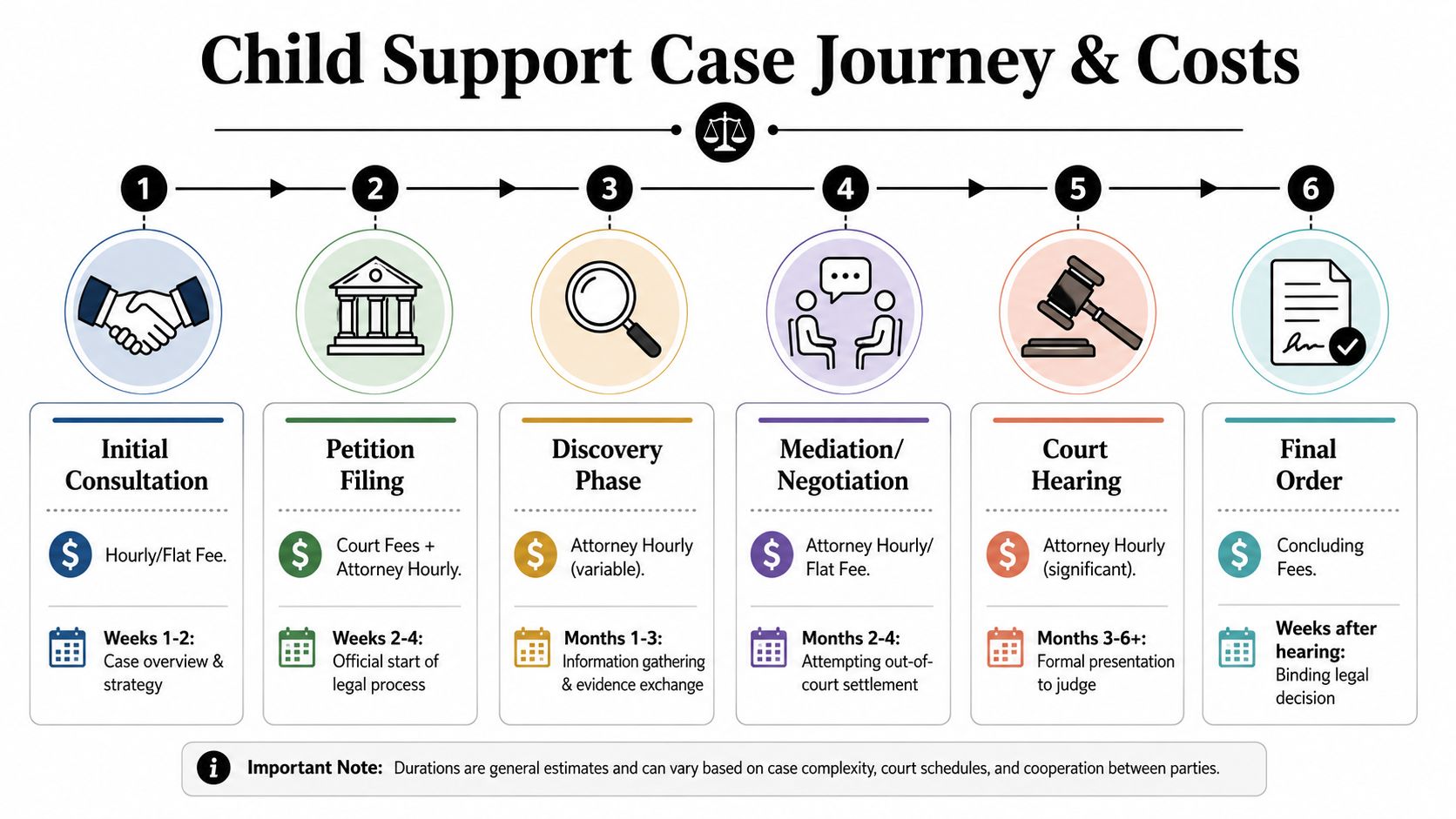
The usual case path
Most cases follow a recognizable sequence:
- Consultation and strategy review. The lawyer identifies whether the matter is establishment, modification, or enforcement.
- Filing and service. The petition or motion is filed, then formally served.
- Information exchange. The parties produce financial records voluntarily or through discovery.
- Negotiation or mediation. If settlement is possible, it often occurs at this stage.
- Hearing or final trial setting. The judge decides unresolved issues.
- Final order and enforcement setup. The signed order controls going forward.
If you want a breakdown of what drives billing in these cases, this guide to Texas child support lawyer cost factors is a useful starting point.
What slows a case down
Three things usually extend the timeline:
- Missing financial records
- Improper or delayed service
- Parents who agree in principle but fight over details
The fix is simple in theory and hard in practice. Hire counsel before the case becomes reactive. Early strategy usually costs less than correcting avoidable mistakes after a bad temporary hearing or a poorly drafted order.
Texas Child Support Frequently Asked Questions
Can parents agree to waive child support in Texas?
Parents can agree to many things. That doesn't mean the court will sign off on all of them. Texas courts look at the child's best interest, and child support is treated as a right that belongs to the child, not a bargaining chip between parents. If you're proposing no support or a non-guideline arrangement, the order still needs to withstand judicial review under the Family Code.
Does child support automatically end when a child turns 18?
Not always. In Texas, support commonly continues until the child turns 18 or graduates from high school, whichever occurs later under the applicable order and statute. Parents get into trouble when they stop paying based on assumption instead of the signed order. Read the order first. Then get legal advice if the language is unclear.
Can I get child support if we were never married?
Yes. Marriage is not the issue. Parentage is. Once paternity is established, the court can address child support, medical support, and related orders. If parentage is disputed, that issue usually needs to be resolved before support is finalized.
If we share custody equally, does that cancel support?
No. Equal time does not automatically mean no support. Texas courts still have to analyze the incomes, the requested structure, and the order being proposed. This is one of the most misunderstood parts of Texas family law, and it's where informal agreements routinely go wrong.
Should I hire a lawyer before I file or only after I'm served?
Before, if possible. Filing strategy matters. So does response strategy. If you wait until after service, you may already be reacting to allegations, deadlines, and proposed numbers that should have been challenged earlier.
If you're trying to decide whether it's time to involve counsel, talk to Texas Child Support Law Office of Bryan Fagan. The firm represents Texas parents in child support establishment, modification, enforcement, arrears, high-income disputes, and net-resource calculation cases, and can help you evaluate the right move before a support problem becomes a court order you're stuck with.