You walk out of the courthouse and feel like the hard part should be over. The judge spoke. The hearing ended. You may even have heard a monthly number stated on the record.
But this is the point where many Texas parents make expensive mistakes.
Regarding what to do after child support court hearing Texas, focus on one reality first. A courtroom ruling only matters if it becomes a correct, signed, enforceable order and the payment system behind that order gets activated. Until then, parents often rely on memory, side conversations, or assumptions. That's where arrears, missed wage withholding, insurance disputes, and bad modification records begin.
Texas child support works inside a structured framework. Chapter 154 of the Texas Family Code supplies the guideline rules, and post-hearing follow-through determines whether those rules help you or hurt you. The practical work starts the moment you leave the courtroom.
The Hearing Is Over Now the Real Work Begins
Most parents leave a child support hearing with mixed emotions. Relief is common. So is confusion.
One parent thinks, "The judge ordered support, so I guess payments start right away." Another thinks, "We agreed on the amount in court, so we can work out the rest ourselves." Both assumptions can cause trouble. In Texas, the period after the hearing is where a courtroom result turns into a real legal obligation.
A common example is the parent who remembers the judge's comments but never checks the final paperwork. Weeks later, the written order includes a different due date, a medical support term the parent missed, or wage withholding language that wasn't properly processed. By then, fixing the problem is harder.
Practical rule: Leave the courthouse assuming you still have work to do until you have the signed order, have reviewed it line by line, and know exactly how payment will be collected.
Texas courts don't calculate support by improvisation. The system is anchored in statutory guidelines under Texas Family Code Chapter 154, including §154.125 for guideline support and §154.123 when a court deviates from the guidelines. That structure helps, but it doesn't protect you from clerical mistakes, missing paperwork, or bad recordkeeping.
What matters in the first few days
Your first priority is not arguing again about what happened in court. Your first priority is locking down the result.
- Get the signed order: If the judge hasn't signed yet, find out who is preparing the order and when it will be presented.
- Check every operational term: Don't just look at the monthly amount. Review who pays medical support, who provides health insurance, where payments go, and whether income withholding is included.
- Keep your own file: Save the signed order, hearing notes, proof of income, insurance records, and any payment records from day one.
What works after a hearing is organization and speed. What doesn't work is trusting memory, relying on text messages with the other parent, or assuming the Attorney General's office or the clerk will catch every issue for you.
From Ruling to Reality Your Official Child Support Order
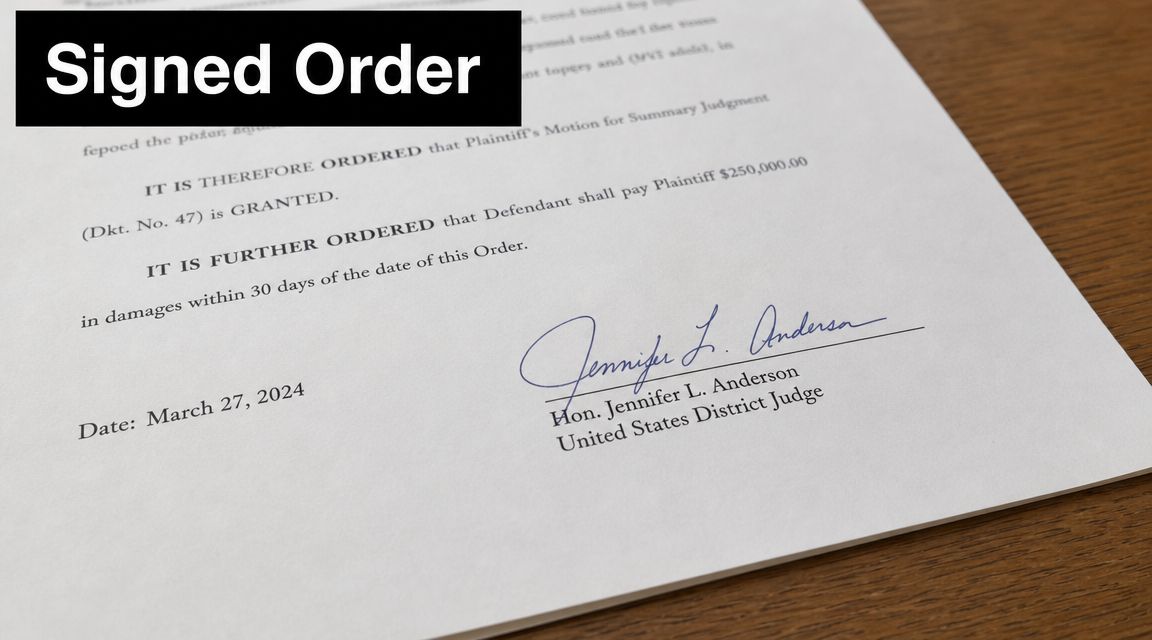
The judge's spoken ruling matters, but the signed written order controls. That's the document employers, enforcement courts, and payment processors rely on. If the written order is wrong, your problems are just beginning.
Texas guidance is clear on this point. After a Texas child-support hearing, the most important technical step is to obtain and verify the signed order immediately, because support obligations begin when the judge signs the order and the order becomes legally binding at that point (TexasLawHelp guidance on child support in Texas).
What to get from the clerk
Ask for a certified copy of the signed order once it's available. A plain copy may help for reference, but a certified copy gives you a stronger document for enforcement, employer issues, and later proceedings.
If your case involved the Office of the Attorney General, a private attorney, or a district clerk process that delays entry, don't assume someone else will notify you at the right moment. Confirm whether the order has been signed and entered.
What to review line by line
Read the signed order slowly. Don't skim it.
Check these items:
Monthly support amount
Confirm the exact amount matches what the court intended under Texas Family Code §154.125 or any stated deviation under §154.123.Date payments are due
A missed due date can create arrears quickly, even when the parent believed payroll withholding would handle everything.Medical and dental support
Texas courts often address who must carry health coverage and who receives credit for premiums. If that language is wrong or incomplete, disputes follow.Method of payment
Review whether payment is set up through income withholding, direct payment through the state system, or another ordered method.Names and identifying details
Misspelled names, wrong employer information, or incorrect child identifiers can slow withholding and create administrative problems.
The hearing transcript won't save you if the written order says something else. The signed order is the instrument everyone enforces.
Common mistakes after the hearing
Parents often hurt themselves in predictable ways:
- Relying on oral comments: If the judge said one thing in conversation but signed another, the signed order governs until corrected.
- Ignoring medical support language: Many parents focus only on the monthly support number and miss who must provide insurance.
- Failing to preserve records: Keep income documents, proof of prior payments, and health-insurance records in one file from the start.
A short post-hearing checklist helps:
| Item to verify | Why it matters |
|---|---|
| Support amount | Determines what is actually owed each month |
| Due date | Controls whether a payment is late |
| Medical support terms | Affects insurance obligations and premium credits |
| Withholding language | Determines how collection begins |
| Certified copy in your file | Gives you proof for enforcement or correction |
If the order doesn't match the ruling, act quickly. In practice, that usually means contacting counsel, the drafting attorney, or the court process that produced the order before the error becomes part of your payment history.
Setting Up the Payment Machinery Wage Withholding and Registration
Court is over, and many parents assume the hard part is done. In Texas child support cases, the next problem is usually more practical. How does the order turn into actual payments that show up on time and in a form the court can track?
A child support order becomes enforceable on paper when the judge signs it. Regular collection usually depends on what happens after that. The withholding order has to be prepared correctly, sent to the right employer, processed through payroll, and routed through the State Disbursement Unit so there is an official payment record.

How support actually gets into motion
In a standard case, the sequence looks like this:
- The judge signs the support order: The legal duty exists.
- An income withholding order is completed: This directs the employer to deduct support from wages.
- The employer implements the withholding: Payroll often needs a short setup period.
- Payments are sent through the Texas child support system: That creates the record used for enforcement, credits, and arrears calculations.
- The receiving parent gets disbursements: Assuming the case is registered and payment routing is correct.
For a practical breakdown of how funds are collected and recorded, review this guide to child support payment in Texas.
The delay that causes trouble
Parents often expect the first deduction to hit the next paycheck. Sometimes it does. Sometimes it does not.
That gap matters. If you are the paying parent, a missed payroll deduction does not erase the support obligation. If you are the receiving parent, the absence of a payment does not always mean the other parent is refusing to pay. It may mean the withholding order has not reached payroll, payroll has not processed it yet, or the case has not been fully set up in the state system.
Texas courts and the Office of the Attorney General rely heavily on wage withholding because it creates a clean payment history. Informal transfers create credit disputes, especially where retroactive support, cash payments, or a 50/50 possession schedule already make the numbers harder to sort out.
This visual shows the process parents usually deal with:
If you are the paying parent
Treat the first 30 days seriously.
- Verify the employer information in the order: A wrong company name, payroll address, or job status can delay withholding.
- Check your pay stub: Confirm the deduction starts and that the amount matches the order.
- Make temporary payments carefully if withholding has not started: Pay only in a traceable form and keep proof.
- Do not assume a 50/50 schedule means no support is due: In Texas, support can still be ordered even with equal parenting time.
I tell clients this all the time. If payroll misses the first round, fix it immediately. Waiting usually turns a clerical problem into an arrears problem.
If you are the receiving parent
Do not rely on verbal assurances from the other parent.
- Confirm that the withholding order was issued and sent
- Monitor the official payment record, not just your bank account
- Keep records of the date support was ordered to begin
- Refuse off-the-books cash arrangements unless they are fully documented and consistent with the order
Undocumented payments create ugly hearings later. The judge wants proof, not recollections.
Registration and recordkeeping matter more than parents expect
Texas enforcement runs on paperwork. If the order is not properly entered, if the withholding order never reaches the employer, or if payments are made outside the state system without reliable proof, the payment history can be wrong from the start.
That mistake is expensive to fix. It can affect claimed arrears, interest, enforcement actions, tax refund intercepts, and later modification requests. It becomes even more serious in cases involving retroactive support, high-income caps, or disputes about who paid health insurance premiums.
The practical rule is simple. Get the order into the system, get withholding started, and keep every payment traceable.
Decoding the Numbers Guideline Calculations and Texas Pitfalls
Parents often leave a hearing with one number in mind and miss the arguments hidden inside it. That is how support orders end up wrong on paper. If you cannot trace how the court got to the monthly amount, you cannot tell whether the written order matches the ruling, the evidence, or Texas law.
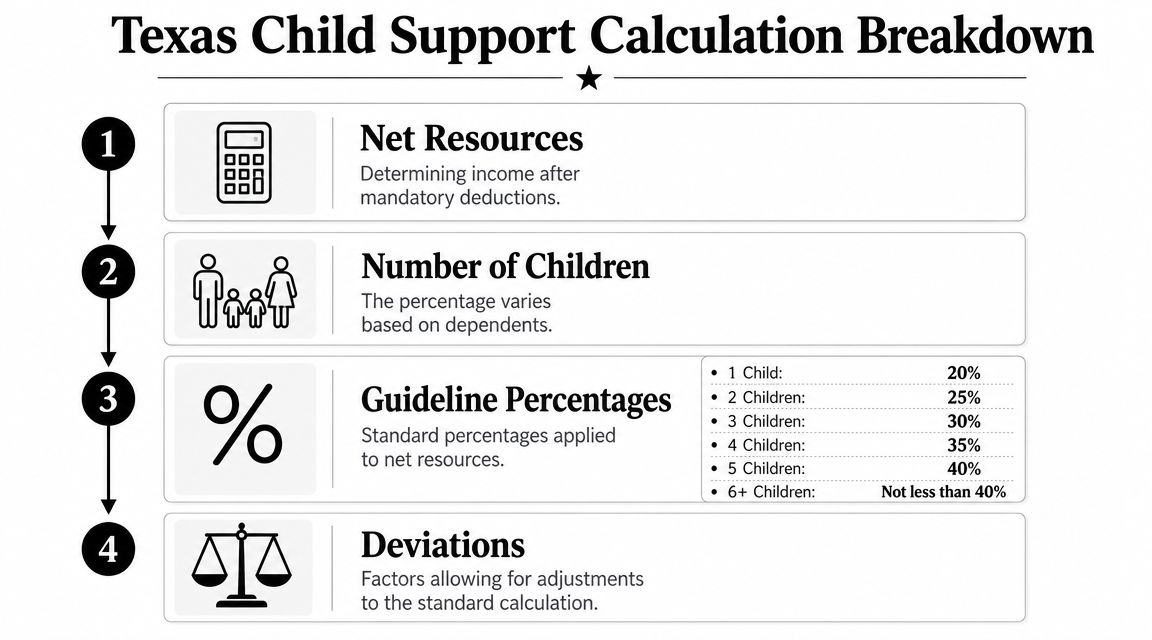
Texas child support starts with net resources and the guideline percentages in Texas Family Code §154.125. In a standard case, the court applies the statutory percentage to the obligor's net monthly resources, then decides whether any facts justify a different result under §154.123. If you want a practical breakdown of that process, review this guide on how to calculate child support in Texas.
The basic calculation
The framework is simple. The disputes usually are not.
| Step | What the court looks at |
|---|---|
| Net resources | The obligor's net monthly resources |
| Number of children | Children before the court |
| Guideline percentage | Percentage under §154.125 |
| Possible deviation | Facts under §154.123 |
That last line matters more than many parents expect. A judge may announce a monthly amount at the hearing, but unless the written order reflects the right income figure, the right cap, and any deviation findings that support the result, you may be left with an order that is harder to defend or harder to challenge later.
A high-income example
Suppose a parent has $12,000 in net monthly resources. Starting September 1, 2025, Texas applies a new $11,700 monthly net resource cap for guideline calculations in higher-income cases under the Family Code.
For one child, the guideline percentage is 20% under §154.125. In that situation, the guideline analysis applies the percentage to the first $11,700, not automatically to the full $12,000. If a party asks for more than the capped guideline amount, that usually requires a separate showing tied to the child's proven needs and a deviation analysis under §154.123.
I watch this mistake happen in both directions. One parent assumes the cap does not exist. The other assumes the cap ends the discussion. Neither position is safe unless the written order shows the math and the legal basis clearly.
Where Texas cases go sideways
Net resources are not the same as gross pay
Many post-hearing disputes start here. A parent talks about salary, overtime, bonuses, self-employment income, commissions, or contract work, but the order must be based on net resources as Texas defines them. If the wrong figure made its way from testimony into the written order, the monthly obligation may be off from day one.
This comes up often with irregular income. If the parent is paid by commission, works seasonally, or receives mixed wage and business income, the court may need to average income or sort through records carefully. Sloppy proof at hearing often becomes a very specific problem once the written amount is reduced to a final order.
Medical support changes the actual amount
Medical support is part of the child support structure, not a side note. If one parent is ordered to carry health insurance or pay cash medical support, that should line up with the financial terms in the written order and with the evidence presented in court.
I tell clients to check this paragraph line by line. Premium allocations, reimbursement language, and cash medical support provisions create avoidable fights if they are vague.
A 50/50 schedule does not cancel support
Texas does not have an automatic rule that equal possession means zero child support. In many 50/50 cases, the judge still compares incomes, considers who pays which child-related expenses, and decides whether guideline support should apply, whether one parent should pay an offset amount, or whether a deviation is justified.
That is where generic online guides fail Texas parents. They assume equal time settles the issue. It does not. The court still has to decide what arrangement fits Chapter 154 and the facts proved at the hearing.
Retroactive support needs exact language
Retroactive support can survive the hearing as a drafting problem. If the judge awarded retroactive child support, denied it, or gave credits for payments already made, the written order needs to say exactly what happened. General language is not enough.
I have seen orders that state a monthly support amount but say nothing clear about prior months, credits, lump-sum payments, or how an arrearage should be calculated. That omission can lead to an enforcement fight later, even when everyone in the courtroom thought the issue was resolved.
What to check before the order is signed
Review the proposed order against the hearing evidence, not against anyone's memory of "about what the judge said."
- Confirm the net resource figure used in the calculation
- Confirm the correct guideline percentage for the children before the court
- Check whether the post-September 1, 2025 net resource cap was applied correctly in a high-income case
- Look for written findings or language supporting any deviation from the guidelines
- Make sure medical support, dental support, and insurance obligations match the financial terms announced in court
- Read any retroactive-support or arrearage language closely, including credits for prior payments
A math error in a child support order is rarely just a math error. It can affect withholding, arrears, enforcement exposure, and any later modification request. That is why this stage deserves careful review before the order is signed and starts operating like a judgment.
Enforcement and Modification Your Long-Term Strategy
A child support order is not a one-day event. It's a long-term financial structure that can be enforced, challenged, or modified depending on what happens next.
That means your strategy after the hearing should have two tracks. One track is compliance and enforcement. The other is documentation for future modification.

Build your evidence file now
Texas guidance is practical on this point. The strongest strategy after a Texas child-support hearing is to build a documented record for any future modification or enforcement. Keep federal tax returns, recent pay stubs, proof of health-insurance premiums, and canceled checks for support paid. This documentation is essential to prove a material and substantial change in circumstances or to enforce arrears (TexasLawHelp guidance for child support IV-D court).
That advice matches what works in actual cases. The parent with a clean file usually has the stronger position.
Your file should include:
- Income records: Federal tax returns, recent pay stubs, proof of a new job, and start dates.
- Payment proof: Canceled checks, money-order receipts, and state payment histories.
- Insurance proof: Premium records and notices showing who covered the child and when.
- Communication notes: Dates of conversations, missed-payment discussions, and written follow-up.
Enforcement when support isn't paid
If a parent falls behind, the answer isn't repeated texting. The answer is using the order.
Texas enforcement tools can include wage withholding, liens, and contempt-related remedies when the facts support them. If the problem becomes chronic, talk with counsel about a formal enforcement action and organize your records before filing. For a practical look at that process, see how to enforce child support in Texas.
One useful distinction matters here:
| Situation | Better response |
|---|---|
| One short administrative delay | Verify payroll processing and payment posting |
| Repeated missed or partial payments | Build arrears proof and evaluate enforcement |
| Ongoing disagreement about the amount owed | Compare payment history to the signed order |
Modification when life changes
A child support order can be changed, but not because one parent thinks the result feels unfair. In practice, modification fights turn on whether the requesting parent can prove a legally sufficient reason, often framed as a material and substantial change in circumstances.
That might involve a job change, a meaningful shift in income, new insurance costs, or changed needs affecting the child. The mistake parents make is waiting until the problem is severe and then trying to reconstruct records from memory.
The Texas Child Support Law Office of Bryan Fagan is one example of a firm that handles post-order issues involving establishment, modification, and enforcement under Chapter 154 when parents need help evaluating whether their file supports court action.
Good post-hearing strategy is boring on purpose. Save documents. Track payments. Keep insurance records. Write down what changed and when. That's what wins later.
Frequently Asked Questions for Texas Parents
Common Post-Hearing Questions
| Question | Answer |
|---|---|
| Can we just agree on a different child support amount after court? | You can agree informally, but an informal agreement doesn't replace a signed court order. If the order says one amount and you follow a private side deal, the order still controls unless the court signs a modification. |
| What if the other parent is self-employed or paid in cash? | Documentation becomes the whole case. Gather tax returns, bank records, payment histories, invoices, and proof of lifestyle spending when available through lawful discovery. Courts need evidence, not suspicions. |
| Does 50/50 custody mean no child support in Texas? | No. A near-equal or equal possession schedule does not automatically eliminate support. Courts still look to Chapter 154, each parent's resources, and whether a deviation from guideline support is justified. |
| When should I start paying if wage withholding hasn't started yet? | Follow the signed order. If withholding is delayed, don't assume the obligation disappeared. Get advice quickly and keep proof of any payment made during the transition. |
| What if I think the written order is wrong? | Act immediately. Compare it to the ruling, your notes, and the evidence presented. Delay makes correction harder, especially once withholding or arrears records begin. |
| Can child support include health insurance issues? | Yes. Medical support is part of many Texas child support orders. Review who must carry coverage, who pays premiums, and whether the order gives proper credit. |
| What should I keep after the hearing? | Keep the signed order, certified copy, tax returns, pay stubs, insurance records, payment proof, and notes of important conversations. Good recordkeeping protects you in both enforcement and modification disputes. |
A few myths worth clearing up
Parents often ask whether the judge's oral comments matter more than the paperwork. They don't. The signed order is what governs.
Another common question is whether a parent can stop paying because possession changed informally. The answer is usually no. Until the court changes the order, the existing order remains the controlling rule.
If you're dealing with what to do after child support court hearing Texas, keep your focus narrow. Get the signed order. Verify the terms. Make sure the payment system is activated. Preserve every useful record. Those steps solve more problems than last-minute damage control ever will.
If you need help reviewing a signed child support order, correcting calculation issues, preparing an enforcement case, or evaluating whether a modification is justified under the Texas Family Code, the Texas Child Support Law Office of Bryan Fagan handles Texas child support matters involving establishment, enforcement, modification, medical support, arrears, and contested income issues.