You and the other parent may already have the schedule worked out. The kids spend equal time in both homes. Pickups are steady. Holidays are divided. It feels reasonable to assume the money issue should be settled too.
In Texas, that assumption often causes trouble.
A 50/50 possession schedule doesn't automatically erase child support. Courts don't treat support as a prize for the parent with more time. They treat it as a way to make sure the child is supported according to the parents' financial ability. That means two parents can share time equally and still have a support order.
The practical question isn't just whether support can exist. It's how Texas courts calculate it when time is equal. That's where most online explanations stop too soon. In real cases, the fight is usually over net resources, the offset approach, medical costs, childcare, and whether the judge should stick with the guideline number or depart from it.
If you're trying to understand child support for 50/50 custody in Texas, focus on the math the court starts with and the evidence the court uses to move away from that starting point. That's what drives outcomes.
The 50/50 Custody and Child Support Misconception
A common scenario looks like this. Two parents agree the child will spend equal time with each of them. One parent says, "If we're splitting time 50/50, nobody should pay support." The other parent assumes that's probably right, signs off on the schedule, and only later learns the court still expects a child support analysis.
That surprise happens because parents mix up possession with financial responsibility. They aren't the same thing under Texas law. Equal time doesn't mean each household has the same ability to pay for food, housing, school expenses, transportation, and insurance.
Practical rule: Texas courts care about whether the child is adequately supported in both homes, not just whether the calendar is split down the middle.
In many 50/50 cases, one parent earns materially more than the other. Sometimes one parent also pays most of the health insurance, school costs, or childcare. Those facts matter. A court may decide that equal time without some transfer payment would leave the child with a noticeably different level of support from one house to the other.
That doesn't mean every equal-possession case produces a large payment. Some produce a modest offset. Some justify a deviation. Some end with very little support because the evidence shows the parents' financial circumstances are close and the child-related expenses are being shared in a workable way.
What doesn't work is walking into mediation or court with only one argument: "We have 50/50, so support should be zero." That's usually too thin. A stronger position is built around income proof, expense proof, and a clear explanation of what each parent is already paying.
The Legal Foundation for Support in 50/50 Cases
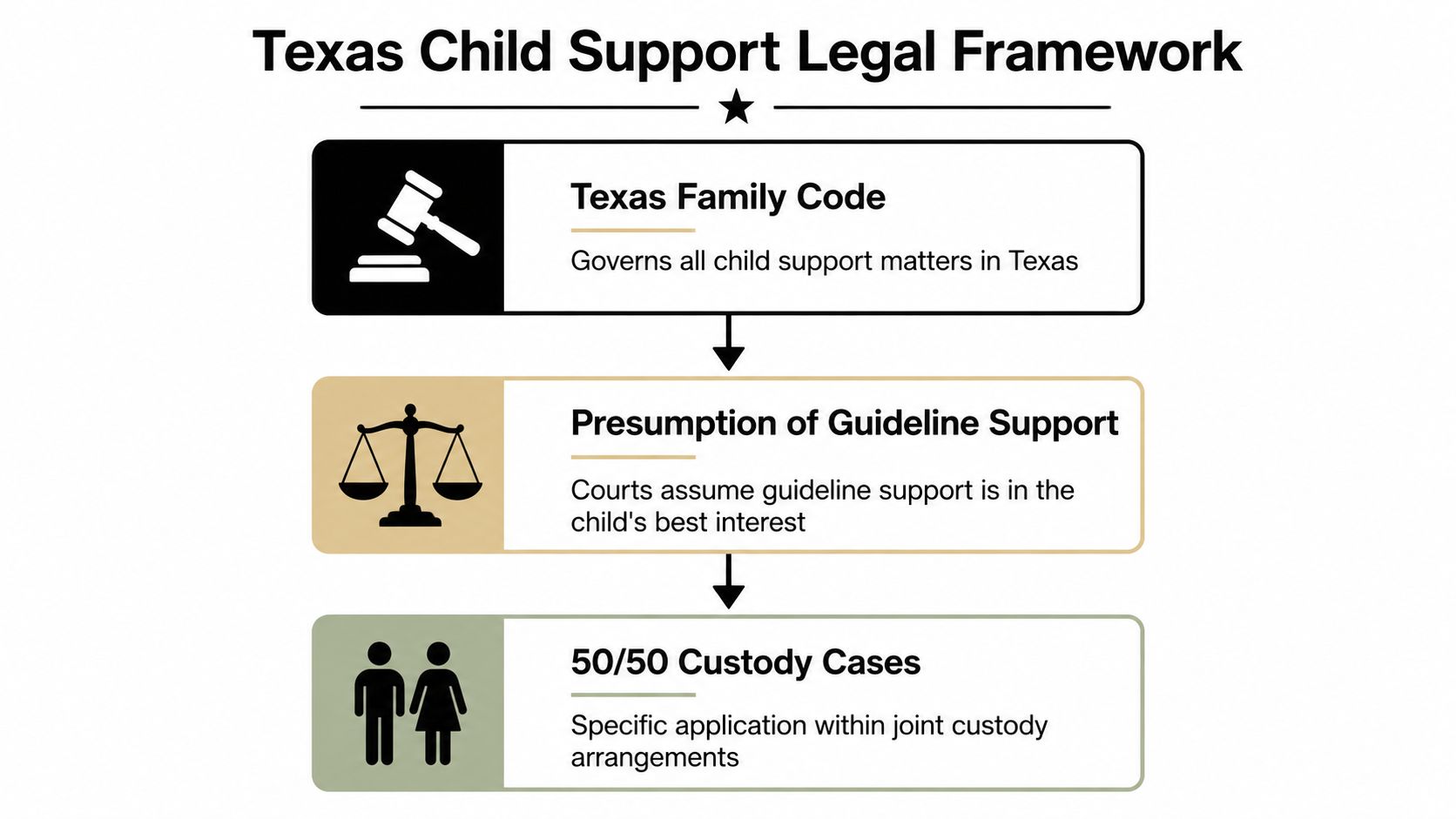
Texas child support law starts with a presumption that guideline support is the proper baseline. In the Family Code, that framework appears in Texas Family Code §154.122 and §154.125. Even in a 50/50 case, the court usually begins there.
The legal labels matter. One parent is typically treated as the obligor, meaning the parent from whom support is calculated. In a straight guideline case, that parent's net resources drive the number. In a shared-possession case, the judge may still use the same framework first and then decide whether an offset or deviation is more appropriate.
What the statute gives the court
Texas guideline percentages remain the starting point. Texas Law Help explains that the state formula starts with the obligor's net resources and applies 20% for one child, 25% for two, 30% for three, 35% for four, 40% for five, and at least 40% for six or more children, with the guidelines applying to net resources up to $11,700 per month (Texas child support guidelines at Texas Law Help).
That matters for one reason above all. Equal possession does not cancel the formula's starting point.
If you want to read the statute structure itself before a hearing or mediation, review the Texas Family Code child support framework. It helps to know where the court gets its authority before arguing over the numbers.
Joint managing conservatorship isn't the same as no support
Parents often hear "joint managing conservators" and assume that means equal time and equal financial burden. It doesn't. Joint managing conservatorship concerns rights and duties. Possession schedules concern time. Child support concerns financial responsibility under Chapter 154.
A court can approve a schedule that looks balanced on paper and still conclude that one parent should pay support. That's especially true where one parent has substantially higher net resources or where one parent is absorbing recurring child-related costs the other isn't covering.
The cleanest way to understand a 50/50 case is this. The calendar may be equal, but the court still asks whether the child's support is financially balanced.
Calculating Guideline Child Support The Starting Point
In a real 50/50 dispute, the first serious fight is rarely over the calendar. It's over net monthly resources. If that number is wrong, everything built on it is wrong.
Under Texas Family Code §154.062, net resources can include wages, salary, self-employment income, and other income streams recognized by the statute. Then the court considers the deductions allowed by law to reach the net figure used for support. In practice, lawyers usually build this from pay stubs, tax returns, employer records, profit-and-loss statements for self-employed parents, and proof of insurance costs.
What lawyers actually examine
The analysis usually turns on documents, not assumptions:
- Employment income: Regular wages, salary, commissions, and other compensation reflected in payroll records.
- Self-employment income: Business income often needs closer review because gross receipts aren't the same as usable net resources.
- Other financial sources: Cases involving investments, rental income, or irregular compensation need documentation that shows whether the income is recurring and how the court should treat it.
- Allowed deductions: The court applies the deductions recognized under the Family Code to reach the net-resources figure used in the support formula.
For a practical walkthrough of the framework courts use, see how child support is calculated in Texas.
Why 50/50 doesn't end the inquiry
In shared-possession cases, courts still focus on each parent's financial capacity. As the Albin Law Group explains, 50/50 custody does not automatically eliminate child support, and courts still look at each parent's net resources, the child's needs, and whether the parents' incomes are materially different. That same discussion notes that judges may deviate when one parent covers a disproportionate share of costs (Texas 50/50 custody and child support discussion).
That point is easy to miss in settlement talks. Parents often spend hours negotiating exchanges, vacations, and school breaks, then treat child support as an afterthought. The court won't. If one parent's net resources are significantly stronger, the court may still order support despite equal parenting time.
Bring proof, not estimates. Judges hear broad claims about income and expenses every day. Pay records, tax documents, insurance statements, and childcare invoices carry more weight than a rough spreadsheet.
Where the cap matters
The $11,700 monthly net resource cap effective September 1, 2025 matters in high-income cases because it limits the income base used for the standard guideline framework. If your case involves earnings above that level, the argument often shifts. The basic formula still gives the judge a starting point, but counsel may need to focus more heavily on the child's proven needs and on whether a guideline result is unjust or incomplete under the facts.
That is why high-income 50/50 cases are often more evidence-driven than parents expect. Once the formula reaches its limit, the quality of the financial proof and the credibility of the deviation argument become more important.
The 50/50 Offset Calculation A Practical Example
When parents ask what child support for 50/50 custody in Texas how it works looks like in court, this is the part they need. In many shared-possession cases, courts use an offset method. Instead of pretending support disappears, the court calculates what each parent would owe under the guideline approach and then subtracts the smaller obligation from the larger one.
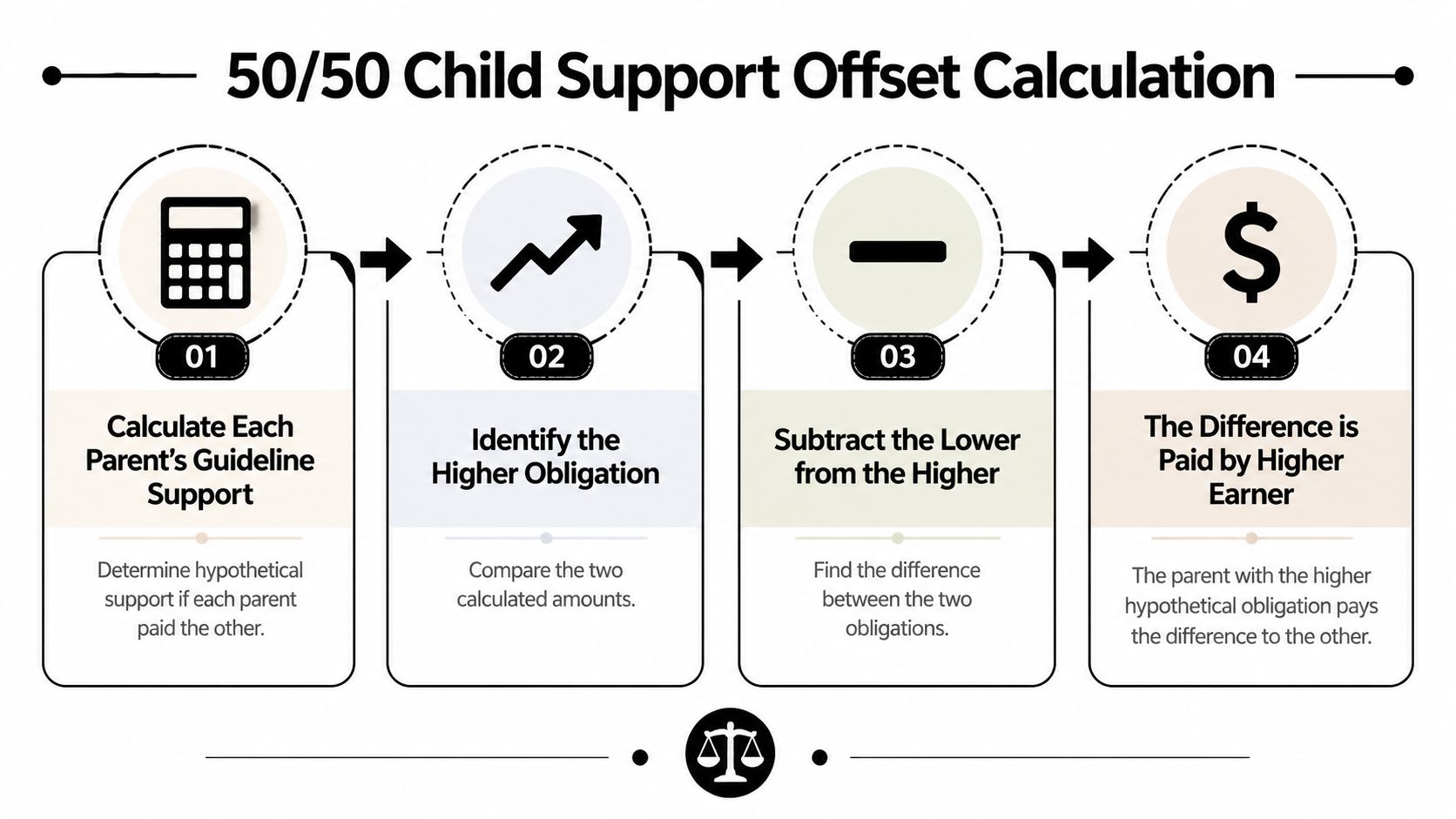
Texas practitioners see this structure often because it gives the court a workable number without ignoring the unequal earning power between households. The shared-custody discussion at Goranson Bain Ausley notes that these cases are often handled as an offset, where the court compares what each parent would owe under the guideline formula and uses the difference as the payment, while also noting the $11,700 net-resource cap effective September 1, 2025 and the importance of deviation arguments under Family Code §154.123 (shared-custody child support offset discussion).
A simple one-child example
Assume there is one child. Parent A has $6,000 in monthly net resources. Parent B has $4,000 in monthly net resources. Because the guideline percentage for one child is 20% under the Texas framework already discussed, you run the calculation for both parents.
| Parent | Net monthly resources | Guideline percentage | Hypothetical support |
|---|---|---|---|
| Parent A | $6,000 | 20% | $1,200 |
| Parent B | $4,000 | 20% | $800 |
Now subtract the smaller figure from the larger figure.
$1,200 minus $800 equals $400.
In that example, Parent A would pay $400 per month to Parent B.
That doesn't mean every court will use this exact method in every equal-time case. But it is a practical model because it reflects both parents' earnings instead of acting as if time alone answers the support question.
Here's a short video explanation before looking at strategy issues:
What changes the result
The offset result can move if the court adjusts the net-resources figures or decides the facts justify something other than a mechanical subtraction. Common pressure points include:
- Insurance costs: If one parent carries the child's coverage, that expense may affect the final analysis.
- Childcare responsibility: A parent paying most of the work-related childcare has a stronger argument that a straight offset understates the actual burden.
- Irregular income proof: Bonuses, self-employment income, or disputed business deductions can change the starting numbers.
- Deviation evidence: If guideline math doesn't fit the family reality, §154.123 gives the court room to do something different.
A lot of bad settlements happen because the parents skip the step-by-step calculation and negotiate from gut instinct. The offset method gives both sides a disciplined place to start.
Deviating from the Guideline Arguing for a Different Amount
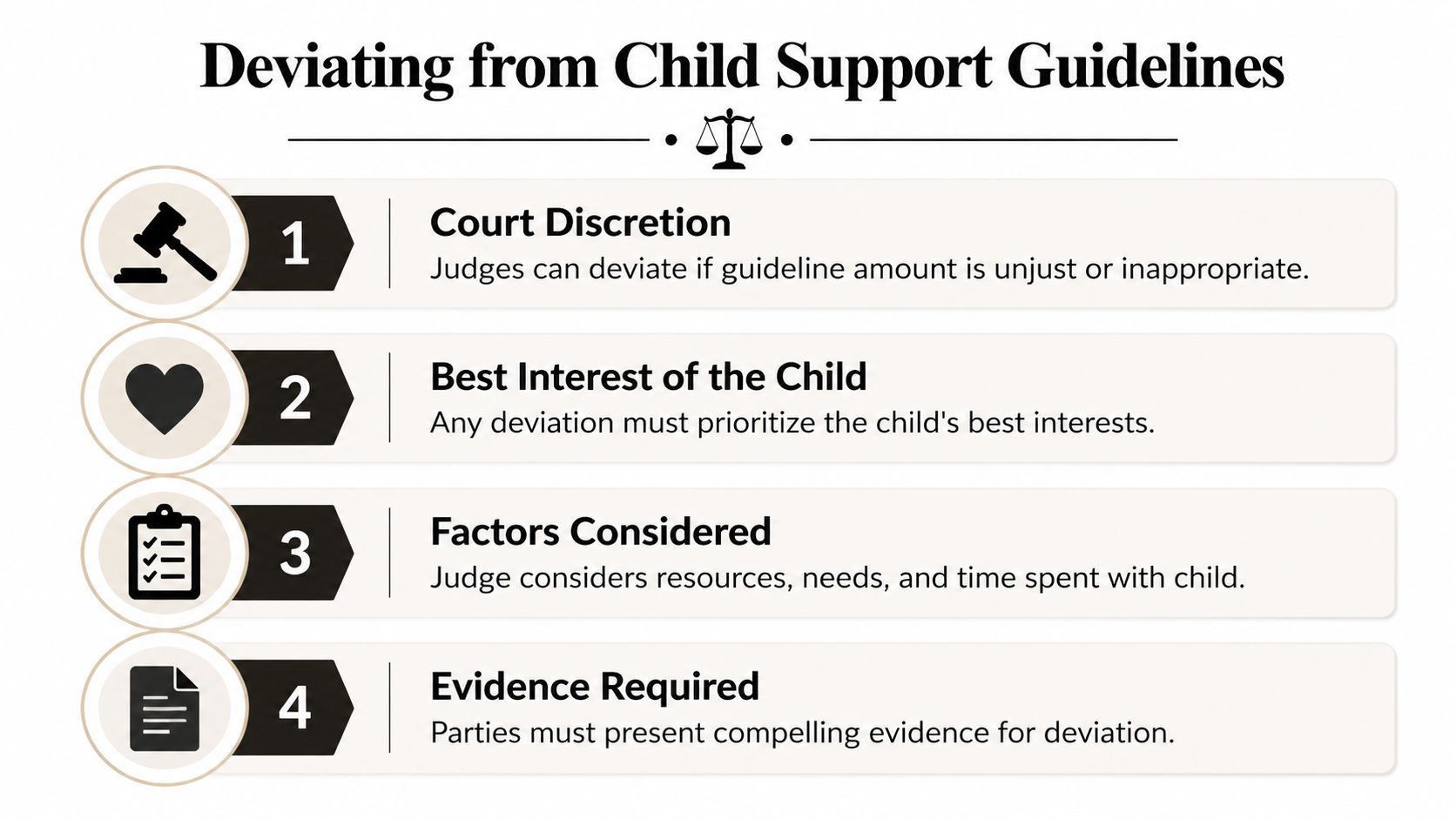
The guideline number is important, but it isn't sacred. Texas Family Code §154.123 allows the court to order an amount different from the guideline result if applying the guideline would be unjust or inappropriate under the circumstances.
That section is where strong lawyering matters in a 50/50 case. If you want the judge to move away from the offset number, you need facts the court can use. General complaints about fairness won't do much. Specific proof usually will.
Arguments that tend to matter
Some deviation arguments are more persuasive because judges can tie them directly to the child's day-to-day support:
- One parent pays most medical coverage: If one parent provides the child's health or dental insurance and absorbs related recurring costs, that can support an adjustment.
- Documented childcare imbalance: Equal possession on paper doesn't always mean equal childcare spending in practice.
- Education and recurring activity costs: Tutoring, school-required expenses, and regular extracurricular costs may justify a different figure when one parent consistently pays them.
- Special needs of the child: Ongoing therapy, treatment, or specialized support can make a straight formula unrealistic.
- Exchange and travel expenses: In some cases, transportation costs tied to possession are substantial enough to matter.
What weakens a deviation request
A weak deviation request usually has one of three problems.
First, the parent has no records. Second, the expenses are discretionary and inconsistent. Third, the parent asks the judge to reward or punish conduct unrelated to support. Courts want a child-focused financial explanation.
Don't argue that the other parent is difficult unless the conduct affects money, access to records, or the child's actual needs. Support hearings turn on evidence, not frustration.
How to present the case
In practice, a deviation request should be organized like a business file. Use summaries, but attach the backup. Group expenses by category. Show who paid what and how often. If you're claiming the offset number is too high or too low, show the court why that number fails to reflect the child's actual support structure.
This is also the point where some parents seek focused counsel on strategy. A firm such as Texas Child Support Law Office of Bryan Fagan handles Chapter 154 issues including net-resource disputes, deviations under §154.123, and 50/50 support calculations. Whether you use that office or another Texas family law attorney, the value is in turning a broad fairness complaint into admissible proof.
Procedural Next Steps From Filing to Court Order
Once the support issue is contested, procedure matters almost as much as substance. A strong position can be damaged by missed deadlines, incomplete financial disclosures, or a poorly prepared hearing.

How the case usually moves
A child support issue may be raised in a divorce, a suit affecting the parent-child relationship, or a modification case. The basic path is familiar:
Filing the pleading
One party files the petition or modification request and states the relief sought. If support is disputed in a 50/50 case, the pleading should make that clear.Service on the other parent
The other side must be formally served unless service is properly waived. Informal notice isn't enough.Financial information exchange
Both sides usually need to produce income records, tax returns, insurance information, and proof of child-related expenses. If the case involves self-employment or inconsistent income, this phase often determines the negotiating position.
For a practical filing overview, review how to file for child support in Texas.
Where cases often resolve
Most family courts expect serious settlement efforts before trial. Mediation is common. A good mediation brief in a 50/50 support case should include the proposed net-resources calculation, the offset analysis if one is being used, and the deviation grounds if either side wants to move off the guideline result.
If no agreement is reached, the court will hear evidence and sign an order. That order should address not just the monthly support amount, but also wage withholding, medical support, and related obligations.
The courtroom rarely rewards the parent who says "we'll figure it out later." Judges prefer orders that are specific, enforceable, and hard to misread.
Modification after the order
Many 50/50 disputes arise after an order already exists. A prior support order can be modified when the legal standard is met, commonly a material and substantial change in circumstances. A major income shift, a real change in the possession arrangement, or a significant change in who is paying major child expenses may all become relevant.
If you're seeking modification, don't rely on the old order to tell the whole story. Courts decide the current request based on current facts.
Texas 50/50 Child Support FAQ
Can parents agree to zero child support in a 50/50 case
Sometimes. But the judge still has to decide whether that agreement is in the child's best interest. If both parents have similar financial capacity and the expenses are being shared in a clear, workable way, a zero-support structure may have a better chance. If one parent clearly earns more or one parent is carrying major child costs alone, the court may reject it or require different terms.
Who pays health and dental insurance
The order should address medical support clearly. In many cases, one parent is ordered to provide coverage, or one parent reimburses the other for the child's premium cost. In a 50/50 case, that issue often becomes part of the deviation argument because insurance cost isn't always evenly shared.
How are braces, school trips, and other large expenses handled
The best orders don't leave those issues vague. Parents can agree to split certain expenses, assign them by category, or set a reimbursement procedure with deadlines and proof requirements. If the order is silent, those costs often become the next fight.
What if one parent loses a job
A job loss doesn't automatically change support. Until the order is modified, the existing obligation usually remains in place. The parent affected should move quickly to seek modification if the legal standard is met and should bring proof of the income change.
Does equal time always mean an offset calculation
No. Offset is common and practical, but it isn't mandatory in every case. Courts can use the guideline framework as a starting point and then decide whether the evidence supports a different structure under §154.123.
What is the biggest mistake parents make in these cases
Treating support like a side issue. In 50/50 cases, support often turns on records, detail, and presentation. The parent with the cleaner financial proof usually has the stronger position.
If you're preparing for a 50/50 support dispute, don't guess at what a judge might do with your income, your expenses, or your current schedule. The attorneys at Texas Child Support Law Office of Bryan Fagan help parents establish, modify, enforce, and challenge child support orders under the Texas Family Code, including offset calculations and deviation arguments in equal-possession cases.