Losing a job can make the next child support due date feel impossible. One day you have a paycheck, and the next day you're staring at a layoff notice, checking your bank account, and wondering whether Texas automatically lowers support because the income is gone.
It doesn't.
That answer frustrates paying parents and alarms receiving parents, but it's the starting point for almost every unemployment child support case in Texas. If you're dealing with child support if a parent is unemployed in Texas, the issue usually isn't whether the court cares about job loss. It does. The issue is whether you respond the right way, with the right proof, under the right Family Code standards.
Texas courts don't handle every unemployment case the same way. A genuine layoff is different from quitting. Temporary unemployment is different from long-term reduced earnings. A parent receiving unemployment benefits presents a different calculation issue than a parent with severance, savings, contract income, or a history of high earnings. In practice, the hardest cases turn on the interaction between net resources, earning capacity, the low-income guidelines, and the guideline cap.
Your Job Is Gone What Happens to Child Support Now
A common fact pattern looks like this. A parent gets laid off on a Friday, receives final pay and maybe severance, and the child support withholding that had been running through payroll suddenly stops. By Monday, the central question isn't abstract. It's immediate. Do I still owe the full amount? Can I pay less? What happens if I can't cover it this month?
For the parent receiving support, the fear runs the other direction. Payments slow down or stop, and now rent, groceries, school costs, and routine child expenses are at risk. Many parents assume the court will quickly “fix it” because the job loss is obvious. Texas procedure usually moves slower than family finances.
The practical answer is that unemployment changes the case, but it doesn't change the order by itself. Texas law gives you a path, and the path matters. If you're the parent paying support, your next steps should be organized and fast. If you're the parent receiving support, your next steps should be careful and documented.
Practical rule: Treat job loss as the start of a legal process, not as permission to rewrite the order on your own.
In real courtrooms, judges want to see two things early. First, what happened to the job. Second, what you've done since then. Parents who move quickly, keep records, and file the right pleadings usually stand in a much stronger position than parents who wait and hope the arrears problem will sort itself out later.
The First Rule Your Support Order Does Not Stop Automatically
A layoff changes your finances fast. It does not change the court order. In Texas, the existing child support order stays enforceable until a judge signs a new one. The legal authority for modification is in Texas Family Code Chapter 156, and the support framework the court uses sits in Chapter 154, including §154.062 on net resources and §154.125 on guideline support.

What the court order still means
If you were ordered to pay support, you still owe the ordered amount unless and until the court modifies it. That remains true even if payroll withholding stops because the job ended. The withholding mechanism may stop with the paycheck, but the support obligation does not.
That distinction matters because unpaid support turns into arrears. Arrears can be enforced later through wage withholding after reemployment, money judgments, liens, license suspensions, and other enforcement tools available under Texas law. Parents often focus on the missed paycheck. Courts focus on the unpaid order.
Informal agreements create problems here. A text saying “pay what you can” may reflect good intentions, but it does not rewrite a signed order. If the case reaches enforcement, the judge will look first at the existing order, the payment record, and whether anyone filed to modify.
Why net resources still matter after a job loss
Job loss does not automatically mean support drops to zero because Texas measures support from net resources, not just from current wages. That can include final pay, severance, unemployment benefits, contract income, commissions still being paid out, and other income streams that continue after employment ends. To understand what courts count and what they exclude, review how Texas courts calculate net resources.
This is the part many articles miss. In real cases, the question is usually not just “Are you unemployed?” The harder question is “What resources do you still have, do the low-income guidelines apply, and does your monthly amount fall under or over the guideline cap?” Those details often decide whether a modification makes sense, how far the payment may change, and whether a judge sees the request as reasonable.
A parent who lost a $6,000 per month job but is receiving severance or unemployment may still have support calculated from current net resources. A parent with very low monthly resources may fit into Texas's separate low-income framework. A parent with income above the guideline cap faces a different analysis. The order stays in place while the court sorts that out.
Payroll can stop overnight. Your legal obligation continues until the court changes it.
What helps, and what hurts
What helps
- Filing promptly: A modification request gives the court a live case to act on. Delay usually means more arrears.
- Making partial payments when possible: Partial payments do not change the order, but they can reduce the arrearage and show the court you did not ignore the obligation.
- Keeping proof from day one: Save the layoff notice, final paystub, severance documents, unemployment claim records, job search logs, and recent bank statements.
What hurts
- Stopping payments on your own: That usually creates an arrears problem under the existing order.
- Relying on side deals: Verbal agreements and text messages are poor substitutes for a signed modification order.
- Showing up without records: Judges hear job-loss stories every week. Documents carry the case.
How Texas Courts Calculate Support for Unemployed Parents
Texas courts do not treat unemployment as a single category. The court starts with current net resources, then asks a more practical question: what money is available now, and is the parent out of work for a legitimate reason or by choice? That distinction drives the math.
For a parent who is legitimately unemployed, the first calculation usually turns on whether the case fits Texas's low-income child support framework or the standard guideline percentages under Texas Family Code §154.125. The low-income schedule can apply when monthly net resources are very limited, which matters in real job-loss cases involving unemployment benefits, reduced hours, small severance payments, or temporary contract work.
The low-income guideline approach
Texas uses a reduced guideline schedule for a parent with no more than $1,000 in monthly net resources. Under that schedule, support is typically 15% for one child, 20% for two, 25% for three, 30% for four, and 35% for five or more children.
Here is the comparison courts and lawyers use:
| Number of Children | Standard Guideline (% of Net Resources) | Low-Income Guideline (<$1,000/mo Net Resources) |
|---|---|---|
| 1 | 20% | 15% |
| 2 | 25% | 20% |
| 3 | 30% | 25% |
| 4 | 35% | 30% |
| 5 or more | 40% | 35% |
Those percentages only matter after the court identifies the parent's net resources correctly. That is often where these cases are won or lost. If you need the mechanics, review this explanation of how Texas courts calculate net resources.
What courts actually count during unemployment
A parent can be unemployed and still have countable income. Unemployment benefits may count. Severance may count. Some recurring payments from other sources may count. Judges also look closely at whether the drop in income is temporary, whether the parent is receiving cash work off the books, and whether the claimed monthly shortfall matches the bank records.
That is why two unemployed parents can get very different outcomes. One parent may qualify for the low-income schedule because the only incoming funds are modest unemployment benefits. Another parent may still be treated as having meaningful resources because severance, commissions that continue after termination, or other payments are still coming in.
This is the point many articles miss. In Texas, the hard question is usually not whether the parent has a job title. The hard question is what the court will treat as current net resources under the Family Code.
Why the guideline cap still matters
The guideline cap also affects some unemployment cases, especially when the parent recently lost a high-paying position. If the old job paid far above guideline levels, the dispute often shifts to timing and proof. The obligor argues the court should use present income. The other parent argues the court should examine available resources, recent compensation patterns, and whether the income drop is likely to last.
In practice, high-income job loss cases are rarely simple. A court may see a sudden layoff as real, but still question whether a parent with a strong earning history, substantial severance, deferred compensation, or quick reemployment prospects should receive the same treatment as someone with no cushion at all.
In unemployed parent cases, the support number usually turns on three moving parts: current net resources, whether the low-income schedule applies, and whether the court believes the unemployment is genuine and temporary or strategic.
When Courts Impute Income for Intentional Unemployment
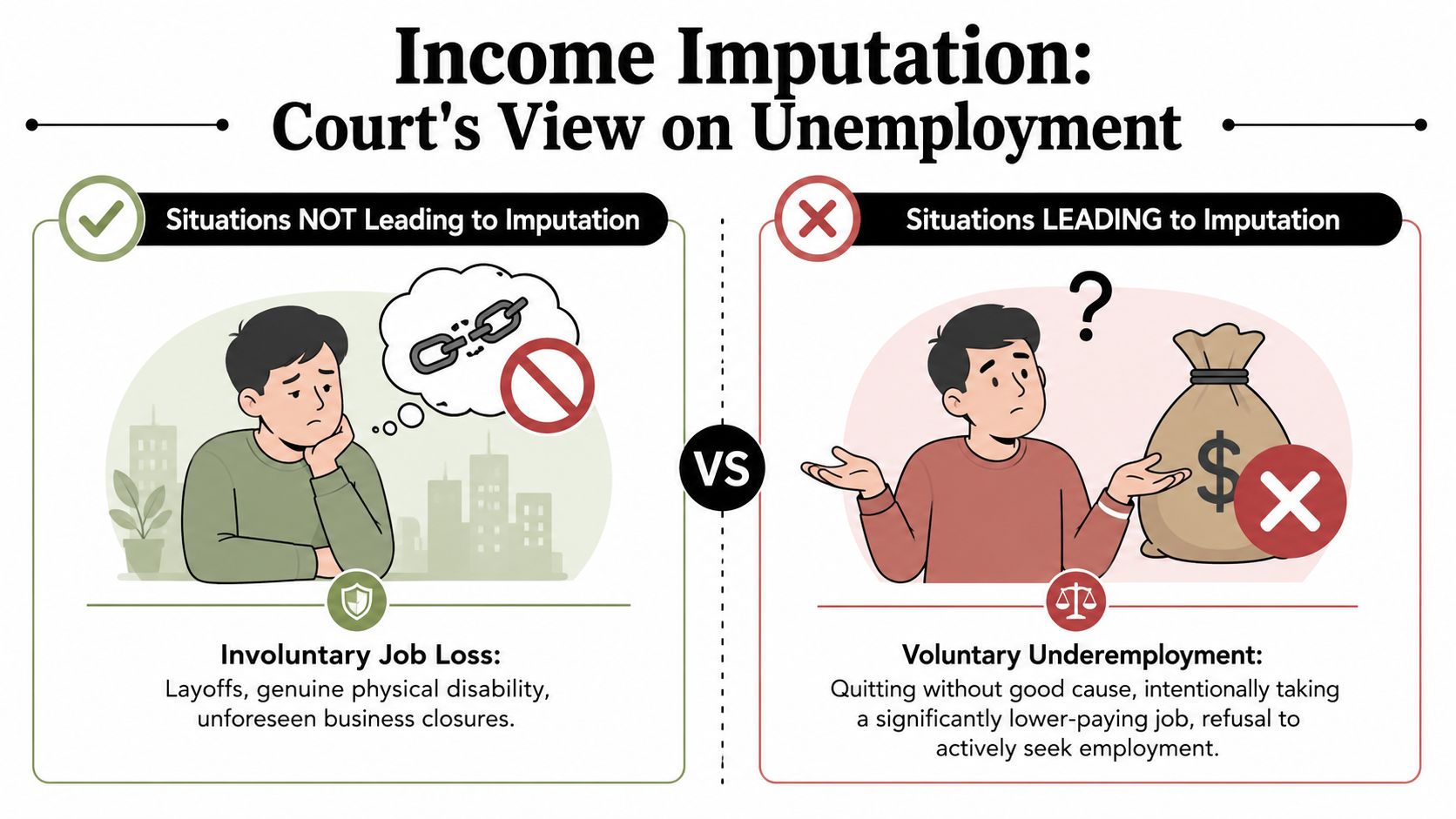
Not all unemployment is treated the same. Under Texas Family Code §154.066, a court can apply support principles based on earning potential when the evidence shows intentional unemployment or underemployment. That is one of the most important dividing lines in child support if a parent is unemployed in Texas.
What judges are looking for
A layoff, plant closure, or genuine medical limitation presents one kind of case. Quitting a stable job without good cause, refusing available work, or taking a sharply lower-paying position for the purpose of reducing support presents another.
Courts look at the surrounding facts. Work history matters. Education matters. Prior earnings matter. Efforts to find comparable employment matter. So do credibility and timing. A parent who resigns right after a support dispute begins should expect hard questions.
If you want a deeper look at this doctrine, this article on imputing income in Texas child support cases explains how Texas courts frame the issue.
The minimum wage benchmark
One common benchmark appears in Texas child support practice when a court decides to attribute income. Texas courts can impute income to an intentionally unemployed or underemployed parent using a 40-hour workweek at the current Texas minimum wage of $7.25 per hour, which equals about $290 per week or roughly $1,257 per month before adjustments, as discussed in this Texas analysis of minimum child support in Texas if unemployed.
That benchmark is not the ceiling. It's often a floor. If the evidence shows a parent has a stronger earning history, specialized training, or recent high income, the litigation may focus on a much larger earning-capacity argument.
A practical courtroom distinction
Here is the strategic difference that matters. If your unemployment is involuntary, your case is usually about proof. If your unemployment looks voluntary, your case is usually about credibility.
- Involuntary loss: Show termination records, benefit records, applications, interview activity, and a consistent search for replacement work.
- Voluntary reduction: Expect the other side to argue that the court should ignore your current earnings and calculate support from earning capacity instead.
- Mixed facts: These are the hardest cases. A parent may have left one job for reasons that sound reasonable, but the court may still ask whether the move unjustifiably reduced the child's support.
The same source also gives an example of a parent with $6,000 in monthly net income supporting two children still owing $1,500 per month, or $18,000 per year, if the court finds the reduction in earnings was intentional, which shows how seriously Texas courts treat bad-faith unemployment in support cases.
The Legal Process to Modify Support After Job Loss
A support change happens by court order, not by explanation, apology, or private agreement. If you've lost your job and need relief, the issue is whether you can prove a material and substantial change under Texas Family Code §156.401 and then present a clean evidentiary record.
The first move is procedural. You file a petition to modify in the court with continuing jurisdiction over the child support order. The request must identify the existing order, state the requested change, and put the other parent on formal notice through service or an accepted waiver when appropriate.
This process usually unfolds in stages:
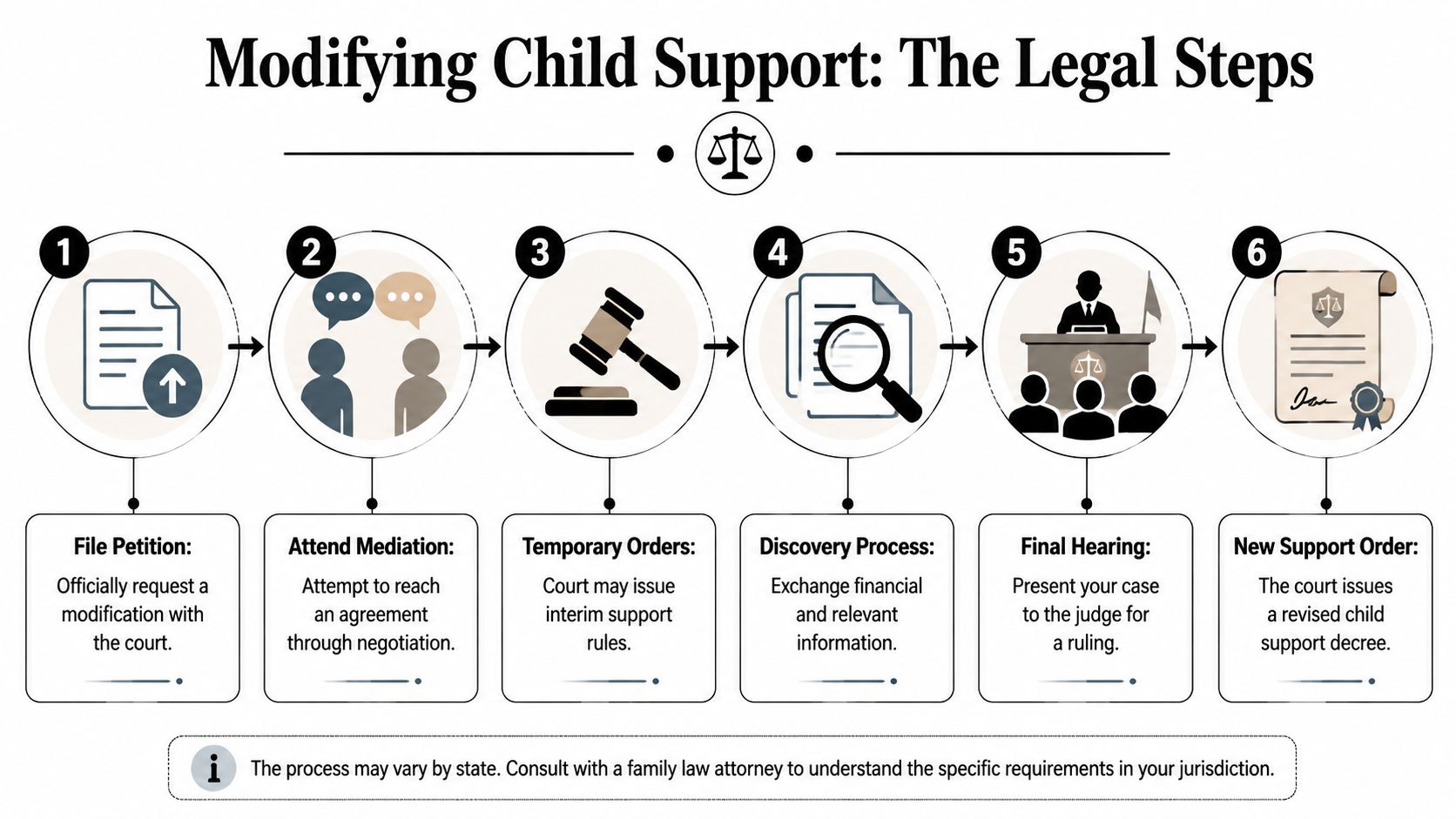
What to file and what to prove
Texas practice turns heavily on evidence. A Texas parent who loses a job should file a modification request and document a material and substantial change with layoff papers, unemployment statements, income records, and a job-search log. Courts may grant a temporary reduction, but only if the evidence proves the job loss was not intentional, as discussed in this article on child support calculations for unemployed parents in Texas.
That evidence usually includes more than a termination email. A serious presentation often contains:
- Employment records: Termination letter, reduction-in-force notice, or employer communication showing the separation wasn't voluntary.
- Income documents: Final paystub, severance records if any, benefit statements, and current account activity.
- Search evidence: Applications, interview confirmations, recruiter emails, and a dated job-search log.
- Updated financial picture: Monthly expenses, health insurance changes, and any new income source.
If you're preparing this kind of case, a practical resource is this guide on how to modify child support in Texas.
Service, negotiation, and hearing strategy
The other parent has to be brought into the case correctly. If service is mishandled, the case can stall. If the pleadings are vague, the hearing can drift into avoidable fights about issues no one properly framed.
Many courts push parents toward negotiation or mediation before a final hearing. That's often useful, but only if both sides are working from real financial records. Unsupported proposals usually fail because neither side trusts the numbers.
A short overview can help if you want to see the process discussed in plain terms:
What helps in court
The parents who do best in these hearings usually present a narrow, disciplined case.
- Tie the timeline together. Show when the job ended, what money was received after separation, and what happened next.
- Prove active effort. Judges notice whether the parent treated unemployment like a temporary setback or like an excuse to disappear from the labor market.
- Ask for practical relief. Sometimes that means a temporary reduction while the search continues. Sometimes it means a final reset based on current resources.
One option some parents use for case planning is Texas Child Support Law Office of Bryan Fagan, which handles modification and income-calculation disputes under the Texas Family Code.
A Guide for Custodial Parents When the Other Parent Is Unemployed
If you're the parent receiving support, don't assume a missed payment means the other parent is lying. Also don't assume the explanation is enough. Your child's right to support is protected by the court order, and that order remains in place unless the judge changes it.
Don't make handshake deals
The most common mistake on the receiving side is agreeing informally to a reduced amount because the other parent says work dried up. Sometimes that explanation is true. The problem is that a private deal doesn't replace the signed order, and informal arrangements tend to produce confusion about what was paid, what was forgiven, and what remains owed.
If the other parent has suffered a legitimate job loss, the proper response is a formal modification case. That protects both sides. It creates a record, forces disclosure, and gives the court a chance to decide whether the reduction is justified.
If the other parent wants the support amount changed, the safest answer is simple. Put it in front of the judge.
How to respond strategically
A careful response usually includes these steps:
- Review the filing closely: Look at what relief the other parent is asking for, not just what they said by text or phone.
- Ask for documents: Income records, benefit statements, severance information, and proof of job search often tell you whether the request is serious.
- Watch the lifestyle evidence: If a parent claims total inability to pay but continues spending in a way that suggests hidden income or undeclared support from others, that can matter.
- Use enforcement when appropriate: If there is no modification order and payments have stopped, enforcement may be the correct path.
What courts tend to care about
Judges usually focus on whether the unemployment is genuine, whether the parent is making real efforts to regain income, and whether the child is being asked to absorb the financial fallout unfairly. If the paying parent is candid and well documented, a reduction may be warranted. If the story doesn't line up, the court may keep the order in place or attribute income instead.
For custodial parents, the key is staying formal, staying organized, and resisting pressure to solve a court-order problem with an off-the-record compromise.
Frequently Asked Questions About Texas Child Support and Unemployment
Can unemployment benefits be garnished for child support
Yes. In Texas, unemployment benefits can be withheld for child support. That matters for two reasons. First, a parent who loses a job may still have income the court can count. Second, the support analysis usually does not start and end with wages.
In practice, these cases often turn on the interaction between unemployment benefits, any other available resources, and the Texas guideline framework. If the parent receiving benefits is also arguing for the low-income adjustment, the court will still look at actual available income before deciding whether a reduced amount is justified.
If I just lost a high-paying job, does the guideline cap still matter
Yes, sometimes it does. A recent job loss does not erase the larger support questions overnight, especially if the parent had substantial prior earnings, severance, bonus history, or other income sources. Courts look at current net resources, but they also examine whether the drop in income is temporary, whether other funds are available, and whether income should be attributed instead of accepted at face value.
The cap matters most in cases where the paying parent had income above the guideline ceiling before the layoff. The low-income rules matter at the other end of the spectrum. Real disputes often sit between those two points, which is why these cases are more fact-specific than many parents expect.
Can I reduce payments on my own while I wait for court
No. The order stays in effect until a judge signs a new one.
A parent who pays less without a modification order is still building arrears, even after a legitimate layoff. The better approach is to file promptly, keep proof of the job loss, document unemployment benefits and job search efforts, and pay what is realistically possible while the case is pending.
What if my unemployment was caused by my own decision
The court may decide that the parent is intentionally unemployed or underemployed and calculate support based on earning ability instead of current actual income. That issue comes up after resignations, career changes, commission drops without a clear explanation, or situations where the evidence suggests the parent could be working at a higher level.
The question is usually not whether the parent prefers a different job. The question is whether the child should bear the financial effect of that choice under the Texas Family Code.
Should I hire a lawyer for this
Sometimes yes, and the answer usually depends on the proof problems in the case. If unemployment benefits are the main income source and the numbers are straightforward, some parents can handle a simple modification on their own. If the case involves disputed intent, hidden income, severance, self-employment, prior earnings above the guideline cap, or enforcement for unpaid support, legal help can materially change the outcome.
These are evidence-driven cases. The parent with better records, clearer timelines, and a support calculation tied closely to the Family Code usually has the stronger position.
If you're dealing with a layoff, an imputed-income claim, or a contested modification, Texas Child Support Law Office of Bryan Fagan works with parents across Texas on establishing, modifying, enforcing, and defending child support orders under the Texas Family Code. A focused review of the existing order, current income sources, and documentary proof can clarify what the court is likely to do next.