If you're already paying child support in Texas and another child support case is starting with a different mother, you're probably asking the same questions I hear in consultations all the time. Does the first order go down? Does the new mother get less because there is already an order? Who gets paid first if there are two cases? Can you just tell the court you have another child and expect the math to fix itself?
Those questions matter because child support for multiple children in Texas with different mothers is not handled by common sense alone. Texas uses a structured system under the Family Code, but the part that trips people up isn't only the formula. It's the process. Courts don't automatically rebalance old cases. Each order stands on its own until someone files the right pleading and gets a new signed order.
That means the parent who acts quickly, gathers the right financial proof, and asks for the correct relief usually does better than the parent who assumes the state will sort it out on its own.
Navigating Child Support with Children in Multiple Households
A common real-world situation looks like this. A father has one existing child support order for a child from a prior relationship. Later, he has another child with a different partner, and either a new case gets filed or he wants the first case lowered because he now supports another child. He assumes the judge will just divide things evenly across both homes.
That is not how Texas courts work.
Texas courts look first at the case that is before the court. Then they apply the Family Code framework for guideline support, including the multiple-family adjustment when it fits. But an older order doesn't change by itself. If you want the earlier case adjusted, you usually need to file a separate modification in that case.
Practical rule: In multi-household child support cases, math matters, but procedure decides the outcome.
The biggest mistakes usually fall into three categories:
- Paying less without an order: Parents often assume a new baby gives them an automatic reduction. It doesn't.
- Mixing up separate cases: Each mother may have a different cause number, a different court, and a different payment history.
- Focusing only on percentages: The Family Code starts with guidelines, but courts also look at deviation issues under Texas Family Code §154.123 when the facts justify it.
What the court is really trying to balance
Texas law is trying to do two things at once. It tries to support the child in front of the court, and it also recognizes that a parent may owe a legal duty to children in other households. That balance is why these cases feel more complicated than a standard one-household support case.
When I advise clients in this situation, I tell them to stop asking only, "Will support go down?" The better questions are these:
- Which order is currently enforceable?
- Which case needs a modification filed first?
- What proof of income and other support obligations can be presented cleanly?
- Is this a straight guideline case, or is someone going to argue for a deviation under §154.123?
The parent who treats this like one big informal family arrangement usually loses ground. The court sees separate legal files, separate obligations, and separate remedies.
The Foundation Texas Standard Child Support Guidelines
Texas child support starts with the guideline model in Texas Family Code §154.125. The court calculates support as a percentage of the obligor's net resources. In plain English, that means the court doesn't begin with gross pay and stop there. It determines the obligor's monthly net resources, then applies the statutory percentage tied to the number of children before the court.
For orders finalized on or after September 1, 2025, the guideline percentages apply up to $11,700 in net monthly resources, and the baseline rates are 20% for one child, 25% for two, 30% for three, 35% for four, and 40% for five or more according to Texas child support 2025 guideline figures. That same source explains the resulting maximum guideline amounts within the cap, including $2,340 for one child, $2,925 for two children, and $3,510 for three children.

The baseline rule judges start with
The guideline framework matters because every multi-mother case starts here. Before anyone argues about credits for other children, the court needs a baseline.
A simple way to think about it:
| Children before the court | Guideline percentage |
|---|---|
| 1 child | 20% |
| 2 children | 25% |
| 3 children | 30% |
| 4 children | 35% |
| 5 or more children | 40% |
The court then compares that baseline to the facts of your case. If there are other children in other households, the standard percentage may be adjusted. If there are unusual facts, the court may consider whether the guideline amount would be unjust or inappropriate under §154.123.
Why the cap matters in real cases
The $11,700 cap matters most for higher earners, but it also changes negotiation strategy in ordinary cases. Before this update, some parties argued from outdated assumptions about where the guideline ceiling stopped. Those assumptions can now produce the wrong settlement position.
In court, outdated child support math is worse than no math. It makes the judge question the rest of your presentation.
For clients, the practical takeaway is straightforward:
- Know your actual net resources: Courts want organized proof, not estimates.
- Know how many children are before the court: The percentage depends on that number first.
- Know whether the case falls inside or above the cap: That issue affects whether the discussion is pure guideline support or whether proven needs and deviation arguments may matter more.
The Multi-Family Adjustment How Texas Accounts for Other Children
When a parent has children in more than one household, Texas doesn't stack full guideline percentages directly on top of each other. The law uses adjusted multiple-family guidelines. That is where many online explanations stop too early, and that is why parents walk into court expecting an automatic equal split.
The better way to view it is this: the court starts with the children in the case before it, then adjusts because the obligor also has a legal duty to support other children elsewhere. A published Texas family-law source explains that 1 child in the current case plus 1 child from another family adjusts to 17.50%, 1 child in the current case plus 2 children from another family adjusts to 16.00%, and 2 children in the current case plus 1 child from another family adjusts to 22.50% under the multiple-family framework discussed in this Texas multiple child support orders explanation. The same discussion ties the adjustment to Texas Family Code §154.123 and the goal of proportional support rather than double charging the same parent at full rates in separate households.
What the adjustment is trying to prevent
Without the multiple-family adjustment, one parent could be ordered to pay the full one-child percentage in one case and then another full one-child percentage in a second case, with no recognition that both orders draw from the same pool of income. Texas tries to avoid that result.
That doesn't mean every child gets the same dollar amount. Different cases may involve different incomes, different insurance costs, and different arguments about deviation. It means the court has a structured way to account for other legal support obligations.
Here is a short reference point based on the published examples above:
| Children before the court | Other children supported (1) | Other children supported (2) | Other children supported (3) |
|---|---|---|---|
| 1 | 17.50% | 16.00% | Qualitative adjustment applies under the chart |
| 2 | 22.50% | Qualitative adjustment applies under the chart | Qualitative adjustment applies under the chart |
For a broader discussion of how courts handle these situations, see child support when a father has multiple families in Texas.
What counts and what doesn't
The adjustment generally turns on children the parent is legally obligated to support. That usually means the child is part of an existing order or otherwise within a recognized legal support duty. If you walk into court saying you help someone informally, that is not the same thing as proving a legal obligation the court should use in the calculation.
Clients also miss another point. The adjustment applies in the case before the court. It doesn't retroactively rewrite every other order in the state.
A multiple-family guideline is not a global reset button. It's a calculation tool used in a live case with proper evidence.
Putting It Into Practice Sample Calculations and Scenarios
The easiest way to understand child support for multiple children in Texas with different mothers is to run the numbers in a couple of common situations.
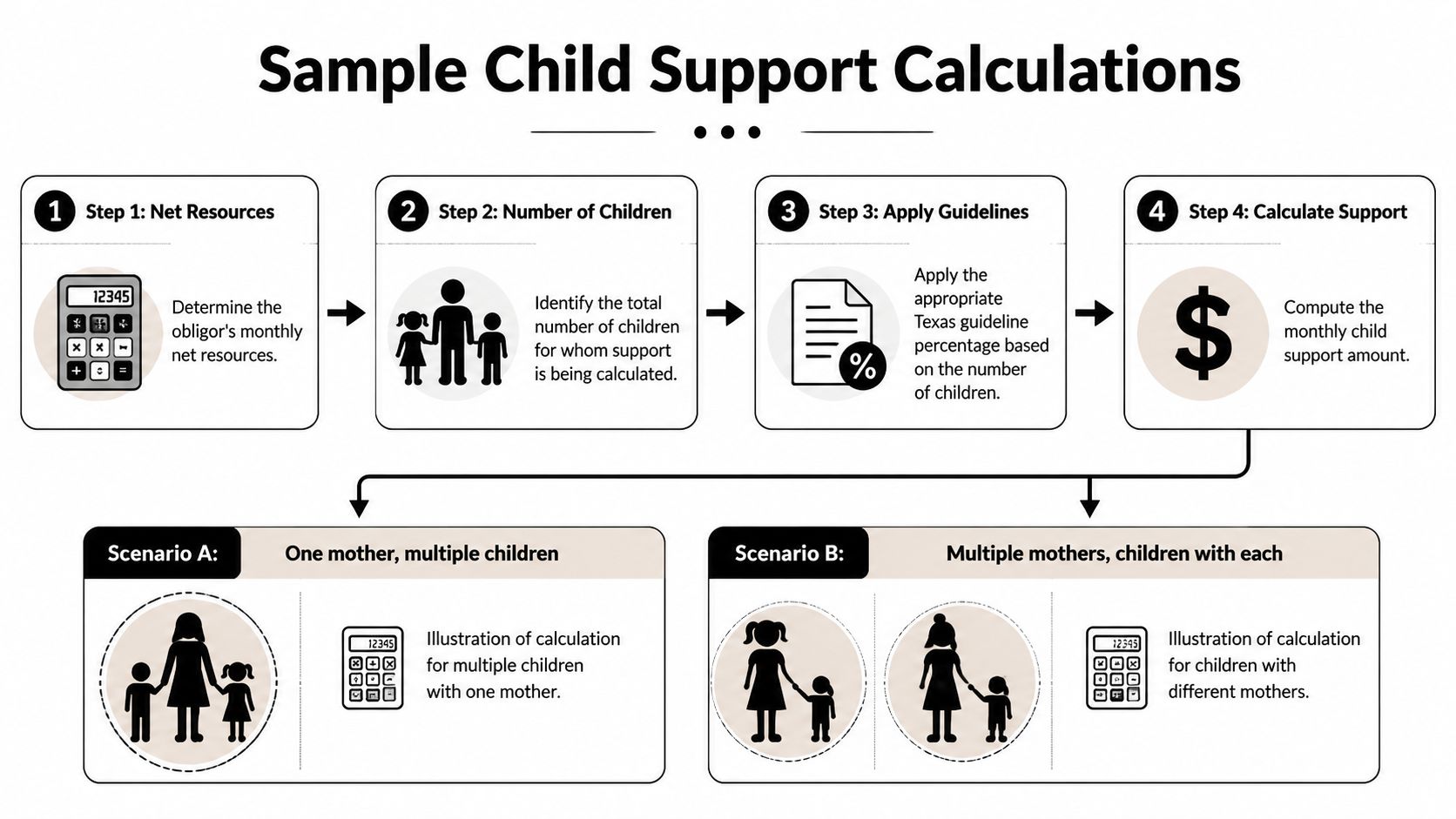
A straightforward example under the adjusted chart
Assume a parent has $6,000 in monthly net resources. There is already one child from a prior relationship, and now a court is setting support for one child in a new case with a different mother.
If this were a simple one-child case with no other children to support, the baseline guideline would be the ordinary one-child percentage. But in a multiple-family situation, the court can use the adjusted figure for 1 child before the court plus 1 other child supported, which is 17.50% under the published Texas source discussed above.
The math in that scenario is direct:
- Net monthly resources: $6,000
- Children before the court: 1
- Other child supported elsewhere: 1
- Adjusted guideline percentage: 17.50%
- Guideline support in the new case: $1,050
That does not automatically reduce the older case. If the parent wants the earlier order changed to reflect the later-born child and current circumstances, a modification must usually be filed in that older case.
A second common setup is two children in the current case and one child in another household. The published example gives 22.50% for that combination. If the obligor's net monthly resources were still $6,000, the guideline amount in the current case would be $1,350.
A higher-income example above the guideline cap
The next scenario is where many lawyers earn their fee. The obligor has $15,000 in monthly net resources and children in more than one household. The Texas Attorney General's calculator states that the guidelines are designed for net monthly resources up to $11,700, as shown in the Attorney General's monthly child support calculator.
Here is what that means in practice. The guideline calculation starts with the cap, not the full $15,000, when applying the standard percentage structure. If the case is one child before the court and the court is using the ordinary one-child baseline within the cap, the maximum guideline amount under that cap is $2,340. For two children, it is $2,925. For three children, it is $3,510.
The court may then face the harder question. Is the capped guideline amount enough, or is someone asking the judge to go above it based on the child's proven needs and the deviation framework under §154.123? In higher-income, multi-household cases, that is often where the actual dispute lives.
Before the hearing, it helps to understand the sequence:
- Determine the obligor's net monthly resources.
- Identify whether the case falls within or above the guideline cap.
- Apply the correct guideline or adjusted multiple-family percentage.
- Decide whether either side is asking the court to deviate based on case-specific evidence.
A short explainer can help visualize that process:
In higher-income cases, the fight usually isn't over whether guidelines exist. It's over whether guidelines alone are enough.
The Crucial Step Modifying an Existing Child Support Order
This is the part people get wrong most often. A later child does not automatically reduce an existing Texas child support order. The current order stays in place until a court signs a new one. Texas guidance makes that point clearly in this discussion of having another baby and Texas child support.

What you actually have to file
If you're trying to reduce or recalculate an older support obligation because you now support another child, the usual vehicle is a petition to modify the parent-child relationship. The legal standard is generally a material and substantial change in circumstances. In many cases, a new legal duty to support another child can form part of that argument.
The process usually looks like this:
- File the modification case in the court with continuing jurisdiction over the existing order.
- Serve the other parent properly unless service is waived in a way the court accepts.
- Exchange and organize financial proof, including income records and proof of existing support obligations.
- Set the matter for hearing if there is no agreement.
- Present the updated calculation and any deviation evidence under §154.123.
- Get a signed order. Without that, the old amount usually remains enforceable.
For a practical overview of the filing path, see how to modify child support in Texas.
What doesn't work
A surprising number of parents try one of these approaches:
- Self-help reduction: They lower the payment because they believe the new child automatically changes the amount.
- Informal side agreement: They rely on a text exchange or verbal promise with the other parent.
- Waiting for the new case to fix the old one: They assume one court will update every other order.
None of those approaches protects you.
Arrears can keep accruing under the old order while you wait, and courts generally enforce what is signed, not what you thought should happen. If there are separate mothers and separate orders, you may need separate legal action in more than one file.
The date that matters most is often the date you filed. Delay can be expensive.
Enforcement and Prioritization How Payments and Arrears Are Handled
Parents often ask a blunt question: Who gets paid first? The practical answer is that Texas does not consider one mother's order to be superior to another's merely because it came first. Each support order is its own enforceable obligation.
That point is badly explained in most public discussions. The better framing is this: if there are multiple valid orders, the paying parent must deal with each one. If one case goes into arrears, enforcement can move forward in that case even if another case is current. The public guidance gap on this issue is real, but the underlying practical point is clear in this discussion of multiple child support orders and who gets paid first: each order is independent, and enforcement actions can proceed on any case that is in arrears.

What that means in the real world
In practice, clients dealing with multiple orders usually face three separate issues:
- Current support obligations: What is due right now under each signed order.
- Arrears exposure: Whether one case already has unpaid support building up.
- Enforcement posture: Whether the other parent or the state is actively pursuing remedies in a particular file.
If wage withholding is involved, payment administration can become technical. But from the court's perspective, the larger point remains simple. You do not get to choose which valid order matters most.
Common misconceptions
These assumptions cause trouble fast:
- The first order has automatic priority: It doesn't work that way as a general rule.
- Changing one case changes the others: It usually doesn't. Each case needs its own review.
- Being current on one order protects you on another: It doesn't. Arrears in a separate case can still trigger enforcement.
If you're dealing with unpaid support issues in one or more files, Texas child support enforcement options are worth reviewing before the problem gets larger.
Deviations from Guidelines and When to Hire an Attorney
Guidelines matter, but judges aren't required to stop at the worksheet. Under Texas Family Code §154.123, a court may deviate from the presumptive guideline amount when applying the guideline would be unjust or inappropriate and when a different result better serves the child's best interest.
That matters in multi-household cases because the facts are rarely clean. One child may have unusual medical needs. One parent may be paying health insurance. One case may involve a much higher income level than the other. A parent may also be in a 50/50 possession arrangement where support is still disputed because incomes differ. Those are not cases to handle casually.
When legal help moves the case forward
An attorney becomes especially useful when the case includes any of the following:
- Multiple open orders: Separate cause numbers create separate risks.
- Modification strategy: One file may need to be modified immediately while another needs to be defended.
- Income disputes: Net resources are often the core battlefield.
- Cap and deviation issues: Cases above the guideline cap require disciplined proof and careful argument under §154.123.
One practical option is working with a firm that regularly handles these specific disputes, such as Texas Child Support Law Office of Bryan Fagan, which represents parents in establishment, modification, enforcement, and high-income support matters under the Texas Family Code.
Frequently asked questions
Does having another child automatically lower child support in Texas
No. The existing order usually stays in effect until a court signs a modified order.
If I have children with different mothers, does Texas split support evenly
Not necessarily. Texas uses the guideline framework and, when applicable, the multiple-family adjustment. Equal isn't the controlling rule.
Do I need to modify every case separately
Often, yes. If there are separate orders in separate files, each one usually has to be addressed in the proper court.
Can a judge order something different from the guideline amount
Yes. Under §154.123, a judge may deviate if the evidence supports it and the result is in the child's best interest.
When should I hire counsel
If your case involves multiple mothers, multiple orders, contested income, arrears, or a high-income support dispute, delaying legal advice usually costs more than getting clear direction early.
If you're dealing with child support for multiple children in Texas with different mothers, the safest next step is to get a case-specific review before filing, agreeing, or falling behind. The Texas Child Support Law Office of Bryan Fagan helps parents evaluate existing orders, calculate support under the Texas Family Code, prepare modification filings, and respond to enforcement across Texas courts.